Showing posts with label psychology. Show all posts

Climate Communications and Human Psychology (Video)

We must acknowledge that facts alone are insufficient to augur widespread climate action. The Trump administration's disdain for facts highlight the importance of a science-based understanding of climate change. However, the Trump administration is not the biggest impediment to climate action. They are merely taking advantage of human psychology.

Narratives bassed exclusively on facts make people feel both afraid and guilty. Rather than motivating us to act fear causes apathy, avoidance and passivity.  We need messaging that is both clear and concise. We also need narratives that reflect the propensities of the human psyche.

First and foremost we must acknowledge that we are social creatures. This is a defining feature of human psychology.  We can more effectively encourage climate engagement if we incorporate what we know about social-behavior. Research shows that making comparisons and encouraging competition has been found to foster action. Social competition has been shown to help people engage in environmentally friendly behaviors like saving energy.

We also need more optimistic climate narratives. Behavioral change is possible but we must do more than guilt people into action. We need to help people understand that we can manage the climate crisis no matter how daunting it may appear. We need to avoid pessimism and present positive narratives. We need to share environmental success stories including the campaigns that induce behavior changes like those that are resulting in the repair of the ozone layer.

Climate Lab is a partnership between Vox and the University of California. They created the following video which explores research conducted by the UCLA Engage Project. It offers some interesting research-based insights into the realm effective climate communications.


Related
Climate Narratives
The Science of Storytelling: Making Facts Matter in a Post-Factual World

Sustainability as Both Sexy and Spiritual
The Pearl in the Oyster - Leveraging the Climate Crisis for Human and Planetary Health
Why We Need a New Climate Change Narrative
Overcoming Obstacles in the Creation of a New Climate Narratives
Video - It's all in our heads: The psychology of sustainability
Video - Making People Care About Climate Change: The Psychology of Risk Perception
Video - Changing the Narrative to Change the World
Guide - Solutions to Sustainable Living: A New Narrative
Video - Narratives on Carbon Pollution: Are Individuals to Blame for Carbon Pollution?
Making Environmentalism Everyone's Concern
How Morality Can Win the War on Climate Change
Study Shows Americans Would Act on Global Warming if they were Urged to do so by People they Like and Respect

Marketing Sustainability and the Science of Storytelling

Marketing sustainability is about telling a good story and creating an emotional experience. While it may seem like an art there is a lot of science behind good storytelling. The advantages good sustainability focused storytelling benefit both the brand and the bottom line. The goal is to invoke drama that incites emotion. Well crafted branding can arouse the kinds of emotions that call for action and encourages customers to make buying decisions. This is what all marketers try to do but it is especially important when it comes to sustainability.  The buy in that is encouraged here goes beyond taking a product to the cash, it even goes beyond the forging of a loyal bond between a product and a consumer. Sustainability focused storytelling pushes us beyond our own experience and gives us potency to act on a global problem.

Despite this power, many companies have a hard time communicating their sustainability efforts in a fashion that people can relate to.  Why is it hard for corporations to leverage their environmental stewardship efforts when being a responsible corporate citizen should be a great marketing and public relations opportunity? Perhaps that is because there is nothing sexy about reams of data. 

Nancy Buzby published a piece on storytelling in a 2016 business blog post. Buzby does strategic marketing and communications for EDF, she asks why, "companies are often doing considerably more sustainability work than they publicize." Suzanne Shelton, President & CEO, Shelton Group answers that question this way:

“The problem isn’t that most companies don’t have strong, legitimate things to say about their sustainability efforts. It’s that they try to tell all of it in little bitty ways or they tell none of it — in either case, they don’t make a marketing impact. What works is boiling the story down to a tight, emotionally compelling narrative that aligns with what the market cares about, what the brand stands for and what a company’s internal culture can embrace.”

To bring this data to life it must be steeped in human experiences so that people can relate to it on an emotional level.  

To communicate sustainability we need to learn to tell the right stories. Science offers us some invaluable insights into how we can cultivate loyalty and passion from customers. There is a strong organic relationship between science and sustainability. Sustainability focused storytelling derives its veracity from science and we are seeing the ways in which science can help to make us better storytellers.

In an Op-Ed the EDF’s Fred Krupp said, "It’s time to go beyond the annual sustainability report and engage deeply on these stories."

For information on The Science of Storytelling see: Making Facts Matter in a Post-Factual World

Related
Sustainability as Both Sexy and Spiritual
The Pearl in the Oyster - Leveraging the Climate Crisis for Human and Planetary Health
Why We Need a New Climate Change Narrative
Overcoming Obstacles in the Creation of a New Climate Narratives
Forging a New Climate Change Narrative: Addressing 5 Psychological Realities
Video - It's all in our heads: The psychology of sustainability
Video - Making People Care About Climate Change: The Psychology of Risk Perception
Video - Changing the Narrative to Change the World
The Power of Story Telling for Sustainable Businesses
The Power of Storytelling: Lessons in Consumer Engagement

The Science of Storytelling: Making Facts Matter in a Post-Factual World

A new narrative is needed to counter prevailing ignorance and augur collective behavior change. However, we will never be able to get a handle on climate change, environmental degradation and a host of other problems with facts alone. Now more than ever we need science, but it is up to the storytellers to bring it to life.

As evidenced at the ballot box, Americans and others around the world are woefully misinformed about science. There is an unwarranted deep seated mistrust of scientists. People once revered scientists and politicians once depended on science to make policy decisions. However, those days are receding and we are facing what amounts to the darkest period in modern history.

We have been deceived by clever misinformation campaigns from corporate interests like the fossil fuel industry. We have been duped by conservative ideologies, political organizations and politicians. In the world of new media, fake news dominates and people take up residence in echo-chambers from which they rarely emerge.

Confronted with the multiple shades of grey of the modern world we have regressed to a more primitive state.  We have entered a post factual world where destructive narratives are gaining momentum, tribalism and nationalism rule the day and people are coalescing around populist bigots. If for no other reason than to combat the prevailing anti-science and anti-environmental narratives of our times, we need a new narrative

We are in desperate need of a new narrative that extols the virtues of science. The key is to make science storytelling emotionally engaging while remaining accurate. Understanding this approach is crucial for scientists and environmental journalists alike. The goal is to produce compelling stories that capture the reader's imagination and inform them at the same time.

The crafting of compelling stories is no easy feat in this highly competitive media landscape. The challenge is to engage an audience while providing accurate science-based information. Fact checking is crucial. We cannot communicate the value of science if we do not render it accurately. This is about more than sharing facts in an interesting way, it is about weaving a narrative that resonates with people and encourages them to act.

People need to have science rendered in an accessible language. It is the job of the storyteller to translate scientific jargon into the vernacular.

Science not only refutes the insanity of our post factual world, it also offers us some insights into what we can do to make stories resonate with readers. For example, we know that character-driven stories are easier to relate to and a more effective form of narrative than fact-based stories that are more abstract.

We also know that there is a danger that too much negativity will augur denial. While a pessimistic narrative may be accurate, it can also cause people to turn away. A positive narrative more readily leads to action.

We cannot escape stories and narratives as they are sewn into the fabric of human experience. We are defined by our use of symbols, we depend on stories. Joseph Campbell, Carl Jung and many others have shown how certain themes (sometimes called archetypes) emerge in the stories that we tell. These narratives endure across cultures and generations. Science contains many of the elements of the great narratives that have galvanized human civilizations dating back to prehistory. 

A narrative is alluring and enticing in a way that facts alone will never be. A good story has the ability to change people's thinking, foster empathy and transform people. To get there you need to make people feel something. it is not enough that they known, they must be made to feel.

Scientists have been unable to persuade people with numbers and statistics even though they may be irrefutable. Science does not resonate because it forces us to think analytically. This in turn primes us to be more skeptical which decreases the likelihood that we will act.

Narratives are a biological reality for our species and we are genetically predisposed to respond to a good story, it is hard-wired into our brains. The trigger for behavioral change is emotion, that complex array of electrochemical reactions that occur in the brain. As reviewed in a Berkeley University post, The Science of the Story, research suggests that the neurochemical processes set into motion by a good story are capable of inducing profound behavioral changes.

Some research suggests that a spike in both cortisol and oxytocin may play a salient role in behavior change. When we encounter a threat or when we read a good story we release cortisol, which boosts strength and speed. It also engages our attention. Oxytocin is a neurochemical that signals trust and safety to the brain it is also known to be associated with empathy and cooperative behaviors.

We are in need of stories, narratives that capture people's interest and propel them to act. Understanding the science of these stories can help us to be more effective communicators. It can also help us to create a new narrative that eschews the insanity of a post factual world and recognizes the merit, utility and necessity of science.

Related
Sustainability as Both Sexy and Spiritual
The Pearl in the Oyster - Leveraging the Climate Crisis for Human and Planetary Health
Overcoming Obstacles in the Creation of a New Climate Narratives
A New Environmental Movement Breeds Hope for the Future
Forging a New Climate Change Narrative: Addressing 5 Psychological Realities
Video - Changing the Narrative to Change the World
Guide - Solutions to Sustainable Living: A New Narrative
How Morality Can Win the War on Climate Change

Event - Let's Talk Climate: Messages to Motivate Americans (Webinar)

This webinar will take place on Friday, November 20th, 2015. It will address research on communicating climate change and a followup discussion. This webinar will review the research findings on the most effective language to use when talking about climate change. It will focus on the messages that most effectively motivate Americans and how these messages can be used for greatest success across a broad diversity of American audiences.

Hosted by ecoAmerica this webinar will address the findings in their upcoming research report Let’s Talk Climate: Messages to Motivate Americans. This report delivers the results from research that rigorously tested words, phrases, and narratives that link climate change to mainstream Americans' values. The findings include personally-relevant messages that give advocates and leaders across the country a powerful tool to propel climate as a priority in town halls, board rooms, hospitals, universities, places of worship, and in Congress. The report offers emotionally resonant messages applicable to everyone, plus thematic messages that tap into American priorities and affiliations.

Change the Conversation
  • Market-tested climate change messages designed to engage Americans across political and demographic groups on solutions.
  • Valuable for anyone communicating on climate change.
  • Includes tips for application, what to avoid, and specific language tailored for people in health, faith, higher education, communities, and business.
Click here to register.

Related
Sustainability as Both Sexy and Spiritual
The Pearl in the Oyster - Leveraging the Climate Crisis for Human and Planetary Health
Why We Need a New Climate Change Narrative
Overcoming Obstacles in the Creation of a New Climate Narratives
Crafting a Positive Environmental Narrative
Pessimism is Impeding Environmental Advocacy
A New Environmental Movement Breeds Hope for the Future
Forging a New Climate Change Narrative: Addressing 5 Psychological Realities
Video - It's all in our heads: The psychology of sustainability
Video - Making People Care About Climate Change: The Psychology of Risk Perception
Video - Changing the Narrative to Change the World
Guide - Solutions to Sustainable Living: A New Narrative
The Power of Story Telling for Sustainable Businesses
Video - Narratives on Carbon Pollution: Are Individuals to Blame for Carbon Pollution?
Making Environmentalism Everyone's Concern
Building Support for Action on Climate Change Before We Reach Tipping Points
Why We Need to Reach American Climate Change Deniers
How to Get Through to Climate Deniers
How Morality Can Win the War on Climate Change
A Thanksgiving Infused with Environmental Gratitude
The Ecological Message in the Symbolism of Easter

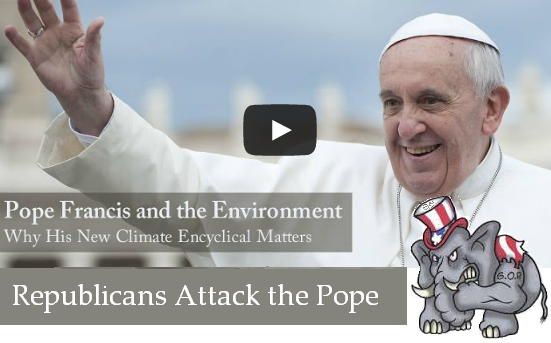
Implications of Pope Francis' Environmental Encyclical and Republican Attacks (Videos)

This first video covers a recent Yale summit which explains why the Pope's environmental encyclical matters and how it may transform the global debate. This video also provides context for the Pope's efforts from the perspectives of a multidisciplinary panel of expert. The video which follows reviews some of the conservative push-back including GOP presidential hopefuls and right wing media pundits. 


Both before and after the release of the encyclical conservative media personalities and leading Republicans including GOP presidential candidates attacked Pope Francis for his stance on the environment and climate change. The assault from conservatives is a cynical political move from the party that is synonymous with climate denial. Republicans rightly worry that their base of support will be eroded by the Pope's castigation of climate deniers and call to environmental stewardship.


Related Articles
Pope's Environmental Encyclical Supports the Poor While Demanding Change from the Rich
Leaked Papal Encyclical Lauds the Climate Movement and Derides Deniers
Spoof of Pope Francis' Environmental Encyclical (Video)
The Vatican's Climate Conference Calls for a Moral Awakening that Includes Rejecting Fossil Fuels
Pope Francis the Environmentalist
Why Christianity is Important to Action on Climate Change
How Morality Can Win the War on Climate Change
Female Faith Leaders Say Climate Change is a Priority Issue
Climate Leadership from the Head of the Episcopal Church
Video - How Religion can Energize Ecological Renewal
Video - Using the Bible as Religious Support for Climate Denial
The Religious Psychology of Green

Leaked Papal Encyclical Lauds the Climate Movement and Derides Deniers

Here is a leaked preview of Pope Francis' much awaited encyclical which is due to be officially released at noon on Thursday June 18. As expected the Pope has come out as one of the world's foremost environmental leaders. He praises the environmental movement, warns of the need for change and calls out climate deniers. The Pope wades into some of the finer points of the climate discussion even taking a stand on carbon trading.

As reported by The Guardian, the leaked version of the encyclical calls us to avoid "unprecedented destruction of our ecosystem. The 192 page document warns of "grave consequences for all of us," if we fail to make adjustments in the way we live our lives and change the way we consume energy.

Pope Francis unabashedly tackles the issue of climate change and plainly attributes it to "human activity." He also squarely refutes the position of climate deniers like Republicans in the US Congress. His draft reads

"The attitudes that stand in the way of a solution, even among believers, range from negation of the problem, to indifference, to convenient resignation or blind faith in technical solutions."

Pope Francis echoed the sentiments of his predecessor pope Benedict XVl when he called for a new global authority to tackle pollution and poverty.

The encyclical was released on Monday by an Italian magazine L'Espresso.

Although the papal encyclical comments on climate change are premised on scientific conclusions its focus is on humanities "God-given" responsibility to combat it.

The draft starts with a comment about the Earth and how humanities treatment of the Earth is wrong. He specifically mentions "the irresponsible use and abuse of the goods that God has placed on her." He goes on to say that we mistakenly believe that, "we were her owners and dominators, authorised to loot her. " Evidence of our malfeasance can be found in the "Earth, the water, the air and in living things."

The document is intended for all the people of the Earth regardless of their religious views. One of the more surprising statements in the draft disputes the value of carbon credits saying they "could give rise to a new form of speculation and would not help to reduce the overall emission of polluting gases". On the contrary, the pope wrote, it could help "support the super-consumption of certain countries and sectors".

Related Articles
Implications of Pope Francis' Environmental Encyclical and Attacks from Republicans (Videos) 
Pope's Environmental Encyclical Supports the Poor While Demanding Change from the Rich
Spoof of Pope Francis' Environmental Encyclical (Video)
Faith Based Environmental Leadership
Female Faith Leaders Say Climate Change is a Priority Issue
The Vatican's Climate Conference Calls for a Moral Awakening that Includes Rejecting Fossil Fuels
Video - How Religion can Energize Ecological Renewal
Why Christianity is Important to Action on Climate Change
The Religious Psychology of Green
The Symbolism of Easter in an Ecological Context
Pope Francis the Environmentalist
Crafting a Positive Environmental Narrative
How Morality Can Win the War on Climate Change
The Vatican's Climate Conference Calls for a Moral Awakening that Includes Rejecting Fossil Fuels

On April 28th, the Vatican held a major conference on climate change that called for a moral awakening. The summit addressed the need for urgent action including reductions in our consumption of fossil fuels. The conference was titled, Protect the Earth, Dignify Humanity: The Moral Dimensions of Climate Change and Sustainable Development. It was hosted by the Pontifical Academy of Science and included 60 scientists, religious leaders and diplomats.

The opening address was delivered by UN Secretary-General Ban Ki-moon and the conference participants included the American economist Jeffrey Sachs, the director of the UN Sustainable Solutions Network and the Earth Institute at Columbia University. As Sachs explained to reporters,
"Companies that invest in fossil fuels will lose money. Everybody needs to understand that policies are going to change to make it unprofitable if you wreck the planet," he said. "Those companies that continue exploring and developing fossil fuel resources for which there is no safe use are going to pay a very heavy cost for that."
This event included participants from each of the world's major religions. As explained by the Vatican the goal was to, "help build a global movement across all religions for sustainable development and climate change throughout 2015 and beyond...[and] elevate the importance of the moral dimensions of protecting the environment in advance of the papal encyclical and to build a global movement to deal with climate change and sustainable development."

The encyclical which has already been written is currently being translated and it is expected to be released this summer.

A statement by Cardinal Peter Turkson of Ghana, who helped the Pontiff to write his encyclical said, "the ever-accelerating burning of fossil fuels…is disrupting the earth’s delicate ecological balance on almost unfathomable scale." He said that a "full conversion" of hearts and minds is needed if we are to succeed in meeting the threat of global warming.

"In our recklessness, we are traversing some of the planet’s most fundamental natural boundaries," Turkson warned. "And the lesson from the Garden of Eden still rings true today: pride, hubris, self-centredness are always perilous, indeed destructive. The very technology that has brought great reward is now poised to bring great ruin."

The conference specifically focused on what the Vatican called, “the intrinsic connection between respect for the environment and respect for people—especially the poor, the excluded, victims of human trafficking and modern slavery, children and future generations."

The Heartland Institute, a fossil fuel funded lobby group that poses as a think tank sent a delegation to Rome to protest the idea that climate change is caused by human activity. However, the Pope has been unequivocal in his belief that man is the primarily cause of climate change. The Pope has called exploiting the Earth a sin and has also indicated that a Christian who does not protect God’s creation "is a Christian who does not care about the work of God."

The conference repeatedly referencing the scientific observation that humans are the driving force behind climate change and no space was provided for the anti-scientific views of climate skeptics (aka climate deniers).

Both Turkson and Ban made it clear that scientists and people of faith were united in their call for action. "Science and religion are not at odds on climate change. Indeed, they are fully aligned. Together, we must clearly communicate that the science of climate change is deep, sound and not in doubt."

In addition to slamming the door on climate denial, the conference urged industrialized countries to reduce their carbon footprints and invest in clean energy. Turkson also called faith leaders to be role models. "Think of the positive message it would send for churches, mosques, synagogues, and temples all over the world to become carbon neutral," he said. "At a time like this, the world is looking to faith leaders for guidance."

Acknowledging that our current trajectory invites calamity the final joint declaration was categorical in its emphasis on immediate action. "Human-induced climate change is a scientific reality, and its decisive mitigation is a moral and religious imperative for humanity."

The message from the Vatican summit was that all people of faith should embrace climate action and part of those efforts involve reducing our reliance on fossil fuels.

Related Articles
Implications of Pope Francis' Environmental Encyclical and Attacks from Republicans (Videos) 
Pope's Environmental Encyclical Supports the Poor While Demanding Change from the Rich
Leaked Papal Encyclical Lauds the Climate Movement and Derides Deniers
Spoof of Pope Francis' Environmental Encyclical (Video)
Faith Based Environmental Leadership
Female Faith Leaders Say Climate Change is a Priority Issue
Video - How Religion can Energize Ecological Renewal
Why Christianity is Important to Action on Climate Change
The Religious Psychology of Green
The Symbolism of Easter in an Ecological Context
Pope Francis the Environmentalist
Crafting a Positive Environmental Narrative
How Morality Can Win the War on Climate Change

Climate Leadership from the Head of the Episcopal Church

Katherine Jefferts Schori is the presiding bishop of the Episcopal Church, she believes that those who deny the science of climate change are both "blind" and "immoral." Jefferts Schori is not only a religious authority, she also has some serious scientific credentials. She holds a doctorate in oceanography and worked as a marine biologist before becoming a priest.

At a March 24 Episcopal event in Los Angeles called The Climate Change Crisis Forum, Jefferts Schori delivered a speech in which she said, "this planet is overheating, its climate is changing, and the residents are sick, suffering, and dying."

As reported by the Huffington Post, Jefferts Schori said, “We are making war on the integrity of this planet. We were planted in this garden to care for it, literally to have dominion over its creatures. Dominion means caring for our island home.” She went on to say that humanity must make a "life and death" decision and she added that the window of opportunity to do so, "will not last long."

As the highest ranking woman in the Anglican Communion, Jefferts Schori is the most powerful female in all of Christianity. She oversees 2.5 million members of the Episcopal church in 17 countries. She has shown moral leadership on climate change, as have other other female faith leaders.

Jefferts Schori's efforts are part of a wave of faith based environmental leadership. Many other faith communities are also involved in climate action and they are doing more than just turning out their lights for Earth Hour. As reported recently in a Global Warming is Real article, led by Pope Francis, Catholics are mobilizing for action on climate change.

The Episcopal Church is among a number of religious groups that are engaging environmental stewardship. The Episcopal Ecological Network has been building grassroots efforts and providing educational resources since 1986. In 2012, the church partnered with interfaith environmental nonprofit GreenFaith to launch a certification program to make Episcopal church facilities more environmentally friendly. The church is currently redoubling its efforts to lead the charge against climate change.

Also on March 24th, the Episcopal church broadcast a 90-minute webcast to discuss both the regional impacts of atmospheric warming and the moral implications of those impacts. The Climate Change Crisis Forum marked the start of the 30 Days of Action challenge for people to learn about and advocate for environmental change. Over the course of the initiative, which ends on Earth Day, April 22, participants will receive daily emails designed to help them reduce their carbon footprint, spread awareness about climate initiatives, as well as lobby government and international corporations to fight climate change. As explained on the church's website, “Focusing on environmental change on a personal, community and global level for 30 days can help Episcopalians proclaim a commitment to caring for God’s creation.”

A large number of faith groups are divesting from fossil fuels because they see divestment as a moral imperative. However, as explained in an interview with The Guardian, Jefferts Schori is not onboard. “If you divest you lose any direct ability to influence the course of a corporation’s behavior,” she said. “I think most pragmatists realise that we can’t close the spigot on the oil wells and close the coal mines immediately without some other energy source to shift to.”

Jefferts Schori believes that we are called to put our scientific understanding into practice. “Episcopalians understand the life of the mind is a gift of God and to deny the best of current knowledge is not using the gifts God has given you,” she said. However, she concedes that, “It’s hard work when you have a climate denier who will not see the reality of scientific truth.” She went on to say that ignoring science and denying climate change is, “a very blind position.”

As explained in another Global Warming is Real article, morality can play a salient role in marshaling the human resources necessary to win the war on climate change.

The Episcopal bishop described action on climate change as a “moral issue", particularly as it impacts on the poorest and most vulnerable people in the world. She compared climate action to the civil rights movement and she explained that the evangelical community is increasingly involved in activism due in large part to their understanding of climate impacts on the poor.

“We are meant to love God and what God has created and to love our neighbors as ourselves,” she said in her March 24th speech. “Jesus insists that those who will enjoy abundant life are those who care for all neighbors, especially the ‘least of these’ — the hungry and thirsty, the imprisoned and sick — and that must include all the species that God has nurtured on this planet.”

While she acknowledges that some are resistant to climate action for political reasons, she suggested that denial is "immoral" regardless of the motivation. “The Judeo-Christian tradition has always called these motivations sinful,” Jefferts Schori said. “It’s decidedly wrong to use resources that have been given into our collective care in ways that diminish the ability of others to share in abundant life,” she added.

“I really hope to motivate average Episcopalians to see the severity of this issue, the morality of this issue,” Jefferts Schori said. “Turning the ship in another direction requires the consolidated efforts of many people who are moving in the same direction.”

Jefferts Schori's moral leadership is timely as we herald the arrival of spring and prepare to celebrate Easter and Passover.

Source: Global Warming is Real

Related Articles
Implications of Pope Francis' Environmental Encyclical and Attacks from Republicans (Videos) 
Pope's Environmental Encyclical Supports the Poor While Demanding Change from the Rich
Leaked Papal Encyclical Lauds the Climate Movement and Derides Deniers
Faith Based Environmental Leadership
Female Faith Leaders Say Climate Change is a Priority Issue
The Vatican's Climate Conference Calls for a Moral Awakening that Includes Rejecting Fossil Fuels
Video - How Religion can Energize Ecological Renewal
Why Christianity is Important to Action on Climate Change
Pope Francis the Environmentalist
Crafting a Positive Environmental Narrative
How Morality Can Win the War on Climate Change