Showing posts with label #divest. Show all posts

The End is Near for Dirty Energy: Fossil Fuels are Being Abandoned by Investors, Insurers and Banks

“I’m done with fossil fuels. They’re done. They’re just done. We’re starting to see divestment all over the world.” - CNBC’s Jim Cramer

The fact that investors, insurance companies and banks are abandoning the fossil fuel industry is a clear sign that coal, oil and gas are in the final stage of their energy dominance. Those who refuse to come to terms with this fundamental reality will by punished financially and in the court of public opinion.

Jim Cramer is a stock market pundit and he sees the writing on the wall. "I’m done with fossil fuels. They’re done. They’re just done. We’re starting to see divestment all over the world,"  Cramer said on CNBC.  He also said the industry is in the "death knell phase" comparing them to the tobacco industry before its collapse. "You’re seeing divestiture by a lot of different funds. It’s going to be a parade."

According to the Guardian, a report at the end of last year concluded that coal-fired power stations were, "on the way to becoming uninsurable". At least 35 insurers have begun pulling out of coal investments. The number of insurers withdrawing coverage for new fossil fuel projects has more than doubled over the last year.

Fossil fuels are not only imperiling life on the planet they are also bad investments. Despite one of the most bullish stock runs in decades, the share prices of many major oil companies are falling short of expectations.  Even if they were providing stellar returns it is hard for investors to justify supporting an industry that augurs death. 

"I think we’re at the point in the global warming story where anyone with an eye to history might want to ask, 'Do I really want to be trying to profit off the wreckage of the planet?'" said environmentalist and 350.org co-founder Bill McKibben. "Also, considering how badly the fossil fuel sector is underperforming the economy, politicians might want to ask themselves, 'Do I really want my constituents to think I’m this bad at managing my money?'"

According to a 2019 study published in Nature Energy, the energy return on investment (EROI) for fossil fuels is not what many believe. While a ratio of 25:1 is a commonly sited EROI for fossil fuels, this study suggests it is closer to 6:1 putting them in line with renewable energy. As the study's co-author told Bloomberg "The transition from fossil fuels to renewables actually might not be as bad as people thought," he said.

By 2016 it was becoming clear that divestment was a serious and growing movement. This became irrefutable when in 2017 the world's largest equity investor, Norges Bank Investment Management ("NBIM"), Norway's $1 trillion sovereign wealth fund, announced that it was selling its $35 billion stake in oil and natural gas stocks. As of 2020 most investors now accept that fossil fuels are terminal.

BlackRock, the world’s largest asset management firm, has recently announced that it is launching new investment products that screen fossil fuels. BlackRock CEO Larry Fink used his most recent annual letter to warn of a "significant reallocation of capital". With more than $7 trillion in assets under management, this represents a seismic shift in the investment world. Goldman Sachs announced it wouldn’t fund drilling in the Arctic National Wildlife Refuge and they have signaled that they intend to decrease their financing of of new coal-fired power projects and diversify away from the fossil fuels.

Riksbank, Sweden's central bank has sold off bonds from parts of Canada and Australia due to concerns about fossil fuels. Reuters reported that Riksbank Deputy Governor Martin Floden said the bank would no longer invest in assets from issuers with a large climate footprint, even if the yields were high. "As a result of the new investment policy, we sold our holdings of bonds issued by Alberta in the spring. For the same reason, we have recently sold our holdings in bonds issued by the Australian states of Queensland and Western Australia," Floden said.

It looks as though 2020 will be they year that the shift away from fossil fuels goes mainstream. The European Investment Bank (EIB), the EU’s lending arm said as of the beginning of this year they will no longer finance fossil fuel projects. In 2017 The World Bank pledged to stop funding oil and gas projects beyond 2019. As reported by Reuters Matthew Green, a total of 130 banks worth $47 trillion are moving away from fossil fuels. This includes Deutsche Bank, Citigroup, and Barclays, all of which have adopted UN backed climate policies that would shift them away from fossil fuels to align them with the 2015 Paris Agreement. Other banks to join the "Principles for Responsible Banking" initiative included Danske Bank, ABN Amro, BNP Paribas, Commerzbank, Lloyds Banking Group and Societe Generale, according to a statement.

The fossil fuel industry is indeed dying, but unless they end quickly they may still take us all with them.

Related 
Ending Fossil Fuels is Necessary but it Won't be Easy
The Fossil Fuel Industry is Dying
Corruption in Washington: The Money Trail Leads to the Fossil Fuel IndustryRepublicans are the Leading Purveyors of the Fossil Fuel Industry's Climate Denial
Climate Action Must Include Efforts to End Fossil Fuels
Tackling Climate Change by Riding the Fossil Fuel Industry into the Ground
Market Forces are Killing the Fossil Fuel Industry
Oil is a Bad Investment
Curbing Fossil Fuels
The Risks Associated with Stranded Fossil Fuel Assets
The Fossil Fuel Industry has Reason to be Nervous
Fossil Fuel Divestment and Stranded Assets
Infographic - Stranded Fossil Fuel Assets

Video - Fossil Free Investing (Shelton Alpha Fund)

Video - Fossil Free Investing (Shelton Alpha Fund)


Shelton Capital Management offers sustainability focused investments in what is known as the Green Alpha Fund. They describe their The Fund is designed for those interested in exploring fossil free investing. The focus in on "innovation, people, the planet, the future." The Shelton promotional video speaks about, preparing for "a new world" and the need to invest in companies that "maximize resources [and] minimize global impact'" They invest in sustainability leaders that are helping to build the green economy.

See The Economic Case for Divestment.

Video - Massive Apple and First Solar Partnership

Video - Massive Apple and First Solar Partnership
Corporate behemoth Apple is making good on its embrace of sustainability with a new $848 million 3000 acre solar project powered by panels from First Solar. This will triple Apple's supply of solar energy. This electricity will power its offices in California, along with 52 retail stores and a data center. This is a good deal for Apple as there are no upfront investment costs and they will get electricity cheaper than they would have through the existing grid. However as Apple CEO Tim Cook explained this is about more than just ROI, renewable energy projects are consistent with Apple's values. As Cook has said repeatedly Apple's new corporate ethos is about "leaving the world a better world than we found it." Under Cook Apple is aligning the company with the values of its customers including environmental sustainability.

Related
Apple Makes Sustainability Investments in China

Apple Proves its Never too Late to Go Green
Apple's Sustainability Leadership
Companies with the Best CSR Reputation
Lisa Jackson on the Road to 100% Renewables (Video)
Is Apple's Adoption of Sustainability Too Little Too Late?
Apple's Reversal on EPEAT
Steve Jobs: Apple's Product Recycling Efforts
Under Steve Jobs Leadership Apple Removed Toxic Chemicals from its Products
Video: Steve Jobs 2005 Stanford Commencement Speech
Video: Steve Jobs on Computer Efficiency
Apple's iPhone Green Applications

Video - The Rockefeller Fund Divests from Fossil Fuels


The Rockefeller Fund may have earned its fortunes in fossil fuels, but like so many others they are taking a leadership role in their decision to divest from oil and gas last September. In this video Carl Larry, president at Oil Outlook & Opinions, talks with Olivia Sterns about the heirs of John D. Rockefeller divesting their vast oil fortune from the family’s $860 million philanthropic organization and looks at which investors are getting in as the Rockefellers and others exit big oil.

Video - Divestment is both Good and Dangerous (Tim DeChristopher)


"Its time to tell those at the top of the our power structure we know your scared of this and you should be because were coming for your power were coming for your privilege."  These are the words of Tim DeChristopher​ who spoke at the Massachusetts State House on February 13th, 2015 as part of 350 Massachusetts​' #DivestWeek & Global Divestment Day (February 13 & 14). Tim went on to say, "divestment is in some ways a dangerous idea -- and that's a good thing."

Video - Message For Global Divestment Day from Reinhard Bütikofer


Here is a February 13 message For Global Divestment Day from Reinhard Bütikofer, member of the European Parliament (Greens/EFA) and Co-Chair of the European Green Party (EGP). Bütikofer is a powerful divestment advocate who has explained why we need to divest and the link between fossil fuels and climate change in an insightful infographic.

Video - The Logic and Benefits of Divesting from Fossil Fuels


We must divest from fossil fuels because they are the primary contributor to climate change. Divesting is the necessary thing to do to address climate change. However the fossil fuel lobby is very powerful and this makes legislative changes difficult. Divesting from fossil fuels and reinvesting in clean energy is a smart financial move. Sustainable companies and renewable energy is growing while fossil fuels are declining. Divesting is also a political statement that seeks to shine light on the trend away from fossil fuels.

Why Faith Communities are Divesting from Fossil Fuels

The fossil fuel divestment movement is growing worldwide and faith communities are leading the charge. Divestment sends an important symbolic message about our commitment to preserving God's creation. Although faith-based activism will not eradicate fossil fuels, it brings moral force to the issue and the kind of leadership that can help to win the hearts and minds of people all around the world.

Faith communities have been singled out to lead the divestment movement. Last May United Nations climate head Christiana Figueres called on religious leaders to take a strong stance on climate change, calling it "one of the great humanitarian issues of our time."

Moral convictions are at the core of the decision making process of faith communities. They have a long history of ethical investing which is why faith communities are at the vanguard of the fossil fuel divestment movement.

Divestment is both a manifestation of core values and a pragmatic approach to managing the financial risks posed by fossil fuels.

Fossil fuels pose and existential risk that threatens all life on earth. Oil and gas companies are poisoning our air and water, destroying our land and bringing about a calamitous future fraught with suffering disease and death. They wreak havoc on the planet they also spend a fortune to influence governments and buy legislators. Their lobbying efforts protect fossil fuel subsidies and tax breaks for oil and gas companies while undermining support for solutions like renewable energy and carbon pricing.

The research indicates that if we are to succeed in curtailing climate change we must leave up to 80 percent of known fossil fuel reserves in the ground. Many faith leaders are listening to the warnings from climate scientists and they are acting in response to the realization that fossil fuels are sabotaging God’s creation.

In a paper titled "Is it Ethical to Invest in Fossil Fuels" Christian theologians, scientists and environmentalists argue that the Church must transition away from fossil fuels and towards clean energy as a matter of life and faith.

Divestment is also a social justice issue because it is the poor and the vulnerable that are most at risk. "With national governments reluctant to take difficult decisions, it falls to us as members of the body of Christ to show leadership in taking action to reduce damaging pollution," Uniting Church President Rev. Prof. Andrew Dutney said, "We simply must act. This is a matter of social, environmental, and intergenerational justice."

Divestment among faith communities is quite rightly presented as a moral and ethical duty. These communities see divestment as part of their responsibility to counter climate change causing emissions.

Rev. Jim Antal, responsible for the 375 United Church of Christ congregations in Massachusetts, said of fossil fuel companies, "we are letting them destroy God’s creation...When people call on their pension funds or schools to divest, they are not only pressuring the institution to change, they are forcing the leaders of the institution and the members of the board to grapple with a moral question."

As explained by Archbishop Desmond Tutu, "People of conscience need to break their ties with corporations financing the injustice of climate change."

As custodians of creation Christians along with other People of the Book (Jews and Muslims) have a biblical responsibility to steward the earth. It is a responsibility that begins with God commanding the first human inhabitants in the garden of Eden, "to till it and keep it". This is in stark contradiction to the behavior of the fossil fuel industry.

Rabbi Warren Stone, Co-chair, National Religious Coalition on Creation Care, "Climate change has become the most significant moral and spiritual issue facing humanity." The best way the we can address climate change is by reducing our reliance on fossil fuels.

Hind Al-Abadleh is an adherant of Islam and an Associate Professor of Chemistry at Wilfrid Laurier University in Waterloo, Ontario. She has argued that for Muslims who derive their value system from the Quran and the traditions of the Prophet Mohammed, combating climate change should be "a priority of high importance."

"[I]f we are to truly live up to teachings of our religion, Muslim investment firms should be among the early birds in divesting from fossil fuels, and investing instead in emerging clean energy technologies likes solar and wind."

Interest in divestment is driven by faith teachings and the desire to build support for a sustainable future. It is part of an effort to challenge the social license of fossil fuel companies and erode their political support. As 350.org founder Bill McKibben said, "morality demands thinking as much about the future as about ourselves–and that there’s no threat to the future greater than the unchecked burning of fossil fuels."

People of faith are called to create a better world for future generations. We cannot simultaneously be good stewards of the Earth while doing nothing to reduce the rate at which we burn fossil fuels. Our faith calls us to act as a function of our moral duty to be good stewards. This is living out our values and our beliefs, this is what it means to have integrity as Christians or as people of faith. Our values preclude investing in fossil fuels and call us to invest in industries that afford a sustainable future.

The United Methodist Church are among those who see divestment as a values based decision. According to Rev. Jenny Phillips, coordinator of Fossil Free UMC, "As a denomination, we can’t continue to say we’re against climate change while saying we’re for fossil fuel profits."

For Christians divestment is about repentance for our failure to properly care for God's creation. The biblical meaning of repentance entails making the decision to change directions. In the context of divestment, this implies that we must transition away from fossil fuels. This is exactly what we must do if we are to succeed in keeping temperatures from rising above the 2 degree Celsius upper threshold limit.

"Scripture tells us that all of the world is God’s precious creation, and our place within it is to care for and respect the health of the whole." Serene Jones, the President of New York City's Union Theological Seminary wrote in an op-ed for Time magazine. "We have sinned, and we see this divestment as an act of repentance for Union...Climate change poses a catastrophic threat. As stewards of God’s creation, we simply must act to stop this sin."

According to many faith leaders we must atone for the sin of our environmental neglect and divestment is an appropriate starting point. The leadership shown by faith communities around the world give us reason to hope that we can succeed in being good stewards of the Earth.

In the Old Testament, God hears Solomon’s cry and replies: "If my people who are called by my name humble themselves, pray, and seek my face and turn from their wicked ways, then I will hear from heaven and will forgive their sin and heal their land."

The road ahead is a difficult one but as explained by Fossil Free Faith, "we need to embrace the courage and hope our faith provides us, and be unafraid to confront and change our dependency on a fossil fuel based economy."

Source: Stewardship of the Environment

Related Articles
Faith Groups that have Divested from Fossil Fuels
Implications of Pope Francis' Environmental Encyclical and Attacks from Republicans (Videos)
Pope's Environmental Encyclical Supports the Poor While Demanding Change from the Rich
Leaked Papal Encyclical Lauds the Climate Movement and Derides Deniers
Faith Based Environmental Leadership
Female Faith Leaders Say Climate Change is a Priority Issue
The Vatican's Climate Conference Calls for a Moral Awakening that Includes Rejecting Fossil Fuels
Video - How Religion can Energize Ecological Renewal
Why Christianity is Important to Action on Climate Change
The Religious Psychology of Green
Pope Francis the Environmentalist
Crafting a Positive Environmental Narrative
How Morality Can Win the War on Climate Change

Time to Reduce the Subsidy Gap Between Fossil Fuels and Renewable Energy

Disproportionate subsidies for fossil fuel aid an industry that is the primary driver of climate change and hinder the growth of clean energy solutions.

Now is the time for a reduction in fossil fuels subsidies. The markets have adjusted to oil at a much higher price than they are right now, this means that removing fossil fuel subsidies could be done with less shock. Removing such subsidies would save the government money and drive up the price which would encourage efficiency and diminish demand.

Subsidies are useful to help new industries get off the ground. However, fossil fuels are a mature industry while renewable energy is still very young.

As much as two trillion dollars each year is being poured into fossil fuel subsidies. The International Energy Association (IEA) says Fossil fuels get $550 billion a year in subsidies while the World Energy Outlook says that oil, coal and gas received more than four times the $120 billion paid out in subsidies for renewables. Others say fossil-fuel subsidies outpace renewable-energy subsidies by a factor of 6 to 1.

Whatever the exact number, with the world spiraling towards runaway climate change a policy shift needed to limit global warming. Reducing the subsidy gap is one of the cheapest ways to manage climate change as this would increase fuel efficiency and speed up the switch to cleaner energy.

The IEA singled out the Middle East as a region where fossil fuel subsidies are hampering renewables. It said 2 million barrels per day of oil are burned to generate power that could otherwise come from renewables, which would be competitive with unsubsidized oil.

"In Saudi Arabia, the additional upfront cost of a car twice as fuel efficient as the current average would at present take 16 years to recover through lower spending on fuel," the IEA said. "This payback period would shrink to three years if gasoline were not subsidized."

Even without a reduction in the Subsidy gap, renewables are growing and the transition away from fossil fuels is already underway. According to the IEA the share of renewables in power generation will rise to 37 percent in countries that are members of the Organization for Economic Cooperation and Development.

Increasing support for renewable and decreasing support for fossil fuels is essential if we are to succeed in staving off the worst impacts of climate change.

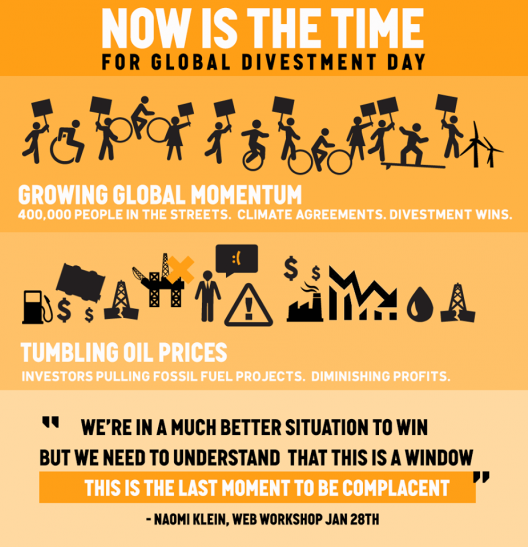
Infographic - Now is the Time to Divest from Fossil Fuels

On Global Divestment Day (February 13 and 14) people around the world are coming together to say no to fossil fuels. As the primary driver of climate change, a fast growing global movement is challenging the social license of the dirty energy industry's right to destroy our planet. Science tells us that we must leave 80 percent of fossil fuels in the ground if we are to stave off the worst impacts of climate change. However, the fossil fuel industry continues to expand while at the same time using their tremendous financial clout to buy politicians and obstruct pro-social change.  In the face of their intransigence millions of people around the world acting to divest and encourage others to do the same.  

Today is the Day to Divest from Fossil Fuels

Today is the start of the largest fossil fuel divestment movement in history. Thousands of actions on six continents will show we are moving away from dirty energy towards a cleaner future powered by renewables. People and organizations all around the world are coming together to challenge the social license of the fossil fuel industry's right to operate. The fossil fuel industry is the primary contributor to climate change while at the same time they finance powerful lobby groups and political parties that obstruct responsible climate action.

Only a few short years ago 350.org launched the fossil fuel divestment campaign. That movement has grown across America and around the globe. Now divestment is the fastest growing movement in the world today. Already more than 140 institutions representing over $50 billion in assets have committed to divest. For both moral and financial reasons now is the time for you to divest from fossil fuels.

In the absence of responsible political leadership people divesting from fossil fuels and making their voices heard. We know that Republican control of Congress in the US and Conservative governments in Canada and Australia make it impossible to secure the kind of legislative changes that could make a difference. In addition to advocating for a transition to more responsible political leaderships, grassroots organizations are taking the fight directly to the fossil fuel industry and making a powerful case for divestment.

The movement is a reflection of the fact that 80 percent of all known fossil fuel reserves must stay in the ground if we are to have a chance of staying within the internationally agreed upon 2 degree Celsius upper threshold limit.

Later this year the COP 21 climate negotiations are scheduled to convene in Paris. At this meeting world leaders are expected to sign a global climate agreement. Global Divestment Day intends to break the climate gridlock and set the stage for the meeting in Paris.

This is the year that we take a stand to begin the process of ending fossil fuels. Together we can make 2015 a turning point by embracing divestment on a mass scale. For the love of our planet lets end our relationship to fossil fuels and invest in clean renewable sources of energy.

Over the next two days (February 13 and 14) thousands of events (rallies, vigils, flash mobs, banner drops, sit-ins, or other creative action) are taking place all around the globe.

Click here to find an event near you.

The Upside to Low Oil Prices

While much has been said about the downside to low oil prices there is also an upside. Low oil prices introduce a disincentive to the financial equation to invest in fossil fuel exploration and development. This is particularly important for the environment as some of the most expensive fossil fuels come from the most ecologically sensitive areas.

Perhaps the biggest single benefit from low oil prices will be the downward pressure it exerts on tar sands expansion. This is not only the most carbon intensive source of fossil fuels it is also four times more expensive than traditional oil extraction. We are currently well below the break-even price of around $75 per barrel. With a break-even point of around $60 per barrel US shale drilling projects are also going to suffer.

Any decrease or even a delay in these carbon intensive forms of fossil fuel extraction is a boon for renewable energies. Every day that the dirtiest forms of oil are delayed represents means that much less carbon will be emitted into the atmosphere.

Natural Gas Will Not Slow Climate Change and it Will Impede the Growth of Renewables

While many people look to natural gas as a climate savior it is neither clean nor is it cheap. Much of the easily accessible gas has already been extracted, remaining gas is harder to extract and more expensive. To access this gas requires the infamous practice of hydraulic fracturing or "fracking" as it is colloquially known. This comes with a large spectrum of problems from contaminated ground water to earthquakes.

While it may have half of the carbon load of coal, it also leaks vast quantities of methane, another potent greenhouse gas. Further, the ongoing expansion of natural gas puts downward pressure on the growth of truly clean and renewable sources of energy. An October 2014 study titled Climate Change: A Crack in the Natural Gas Bridge shows that expanding natural gas would not slow the growth of global greenhouse gas emissions worldwide over the long term. Inexpensive natural gas would also accelerate economic growth and expand overall energy use.

"The effect is that abundant natural gas alone will do little to slow climate change," said lead author Haewon McJeon, an economist at the Department of Energy's Pacific Northwest National Laboratory.

Renewable's Predictable Pricing Trumps Volatile Oil

Renewable energy offers the kind of pricing predictability that is in everyone’s interest. While the price of oil has fluctuated, generally increasing over time, the price of renewable energy has shown fairly steady and consistent declines.

A new report released by the International Renewable Energy Agency (IRENA) indicates the costs of renewables will fall by almost 40 percent in the next two years, and solar energy should reach grid parity in 80 percent of its market by 2017.

Oil's price volatility is an economic nightmare while the relative stability of renewable energy makes it far easier to plan capital allocation. Wild swings in the price of oil have deleterious impacts across the entire economy. Even renewable energy continues to suffer from volatility in oil markets. Price uncertainty makes it harder to raise capital to finance a wide range of renewable energy projects.

Unlike fossil fuels, renewable sources of energy have shown themselves to be stable and predictable. They certainly have not been subject to the wild increases that we have seen in fossil fuel pricing. Predictable pricing benefits everyone from small businesses to national economies. Everyone is better able to make long range plans with an energy infrastructure that has predictable pricing.

What makes renewables predictable is the fact that they are a technology and not a commodity. Technologies tend to see declining costs over time while commodities tend to increase in price. Commodities like oil are finite and they become consistently more scarce whereas renewables are limitless and always subject to improvements in efficiency which drives down their costs.

Price volatility combined with their emissions profile make fossil fuels an unworkable source of energy. Conversely renewables offer a predictable source of abundant energy.

Related
Renewable Energy Can Replace Fossil Fuels
Renewables will Save us from the Scourge of Fossil Fuels
Time to Reduce the Subsidy Gap Between Fossil Fuels and Renewables
The Growth of US Renewables are Outpacing Fossil Fuels
Renewables Gaining on Fossil Fuels Despite Reports to the Contrary
Energy Economics: Cheap Oil Will Not Stop Renewables
Low Oil Prices will Slow Renewable Energy

Oil's Price Volatility is Bad for the Economy and the Environment

No matter how you slice it, oil's price volatility is bad for business and bad for the economy. At the start of this decade headlines were commenting about the high cost of oil now they are awash with remarks about price declines.

Unpredictable oil prices hurt everyone. The problem of oil's price volatility was made apparent during the OPEC oil embargo of 1974. Since then we have seen a number of radical fluctuations including a sudden price spike in the summer of 2008 when a barrel of crude hit more than $130 only to fall to $40 per barrel a few months later.

This radical swing contributed to the worst recession since the great depression. Further, it is hard to make capital allocation decisions in the context of such volatility.

Recently we have seen even more price volatility. In February 2011 the price of oil was again almost $130 per barrel only to fall to $90 per barrel in 2012 and then climb back up to almost $120 in 2013. Then starting at the end of July 2014 oil began to free fall to under $50 per barrel.

This volatility is being driven by uncertainty about the future of oil. There is massive speculation going on in the oil futures market and in both the up and down directions. However, the reasons that oil is so volatile goes far beyond speculators. The future of the fossil fuel industry itself is being impacted by concerns about carbon bubbles, stranded assets and carbon pricing.

The Saudi's are undeniably playing with oil markets for their own advantage. In 2011 they hyped peak oil which drove up prices. We now know that the concern is not peak oil but peak carbon (It has been said that at least half of all known oil reserves will have to be left in the ground if we are to stay within our carbon buget). We will have to bring down global emissions and this means we will have to wean ourselves off of fossil fuels. The Saudi's understand this fact so they are now flooding the market with "spare capacity." This cheap oil serves two purposes, first it kills their competition and second it is part of their plan to bring as much oil to market as they can before global markets dry up.

Volatile oil prices create economic instability which undermines efforts to invest in a low carbon economy. Further, the rush to bring as much fossil fuels to market as possible is bad for the economy and even worse for efforts to reduce emissions and combat climate change.

Cheap Oil is no Windfall

The rapid decline in the price of oil is fraught with misconceptions. A year and a half ago a barrel of crude that sold for more than $110 is now just over $50. The combination of OPEC (Saudi) oversupply, less European demand and American natural gas from fracking have driven the price of oil down.

The biggest fallacy about cheap oil is that this will be a boon for the American economy. Most Americans work in the service sector where energy constitutes small percentage of their annual budgets (less than 10 percent). So the economic benefits of cheap oil have been overstated.

Higher energy prices have the effect of increasing efficiency, while low prices tend to reverse this trend. The amount of energy used by Americans has steadily declined since energy prices spiked during the oil embargo of the 1970s. When the Organization of Petroleum Countries (OPEC) embargoed oil exports to the US in 1974, this spurred an unprecedented wave of efficiency.

So high energy prices are good for the economy because they spur efficiency while low energy prices invite wastefulness.

Low oil prices will not radically alter the economic picture in the US. While high energy costs have decreased demand and fostered efficiency, cheap oil will slow the trend towards decreased consumption and greater efficiency.

Declining oil prices increase consumption and decrease efficiency a combination that could prove disastrous for efforts to combat climate change which will cost the global economy trillions of dollars.  Oil accounts for about 42 percent of global carbon emissions so cheap oil will likely add millions of tons of carbon emissions to the atmosphere.

Cheap oil is not the economic boon it is touted as being, it undermines climate mitigation efforts, increases consumption and impedes efficiency. 

Solar is Destined to Defeat Fossil Fuels

While many are preoccupied with declining oil prices, solar power continues its steady trajectory towards grid parity. The long-term cost of utility-scale has fallen 20 percent in the past year and 78 percent in the last five years. While it was hard for solar to compete with subsidized natural gas the outlook for solar is very bright.

Unlike fossil fuels which are a commodity that cannot improve, solar is a technology that keeps on getting more efficient. Solar keeps getting cheaper while the price of extracting fossil fuels continues to increase.

As documented in the report, Photovoltaic (PV) Pricing Trends: Historical, Recent, and Near-Term Projections (2014 Edition) the price of solar keeps falling. In 2013 the price of distributed solar photovoltaic (PV) system prices dropped by 12 - 19 percent in the US and in 2014 prices were expected to fall an additional 3 - 12 percent. The trend of declining solar costs are expected to continue over the next couple of years. Modeled utility-scale PV system prices fell below $2 a watt in 2013, and have continued to decline in 2014, to roughly $1.80 a watt, which is 59 percent below what modeled pricing showed in 2010. By 2020 PV is expected to reach widespread grid parity in the U.S. without federal or state subsidies. These numbers are consistent with the SunShot initiative in which the DOE supports efforts by private companies, universities, and national laboratories to drive down the cost of solar electricity to $0.06 per kilowatt-hour.

An October 2014 Deutsche Bank report by Vishal Shah indicates that prices will keep dropping as the technology improves and financing becomes more affordable. If the current tax credit is maintained, by 2016 solar will be as cheap or cheaper than the current electricity bills in 47 US states. Even if that credit falls by one third from the current rate of 30 percent to 10 percent, solar will still be price competitive or better in 36 states.

Solar has already achieved grid parity in 10 states that are responsible for 90 percent of US solar electricity production. In those states alone, installed capacity growth will increase six times over the current levels in the next three or four years.

Michael Park, an analyst at Sanford Bernstein, refers to solar's price superiority paradigm as the Terrordome.

The declining cost of solar will not only benefit the US it will be revolutionary in poorer countries which simply cannot afford to invest the billions of dollars commonly required for a centralized fossil fuel power plant.

Solar is en route to being the world’s preeminent source of electricity. According to International Energy Agency (IEA) predictions, solar will go from being a bit player in the electricity production to being the undisputed energy juggernaut by 2050. The IEA report explicitly states that "the sun could be the world’s largest source of electricity by 2050."

The key point in this analysis is that solar is a technology, and like other technologies it is destined to keep improving. This means greater efficiency, more productivity and lower costs. Fossil fuels simply cannot compete as they are commodities which are finite. All the easily accessible oil has already been extracted what remains is harder to reach and more expensive to extract. This makes them very volatile.

As stated by said Lyndon Rive, CEO of SolarCity Corp.,"Fluctuations in oil prices have little impact on solar or many other renewable energy sources. This is partly why the economic proposition of solar is so compelling, unique and valuable…For example, up to 50% of the cost of a fossil plant is the expense of the fuel over the life of the plant, while sunlight is essentially free."

With the price declines in solar photovoltaic (PV) technology showing no signs of slowing anytime soon, fossil fuel prices are losing their sway over the solar industry.

Related
The Rapid Growth of On-Site Solar Energy in the US
Solar's Prodigious Growth in the US
Renewable Energy Can Replace Fossil Fuels
Renewable's Predictable Pricing Trumps Volatile Oil
Renewables will Save us from the Scourge of Fossil Fuels
Time to Reduce the Subsidy Gap Between Fossil Fuels and Renewables
The Growth of US Renewables are Outpacing Fossil Fuels
Renewables Gaining on Fossil Fuels Despite Reports to the Contrary
Energy Economics: Cheap Oil Will Not Stop Renewables

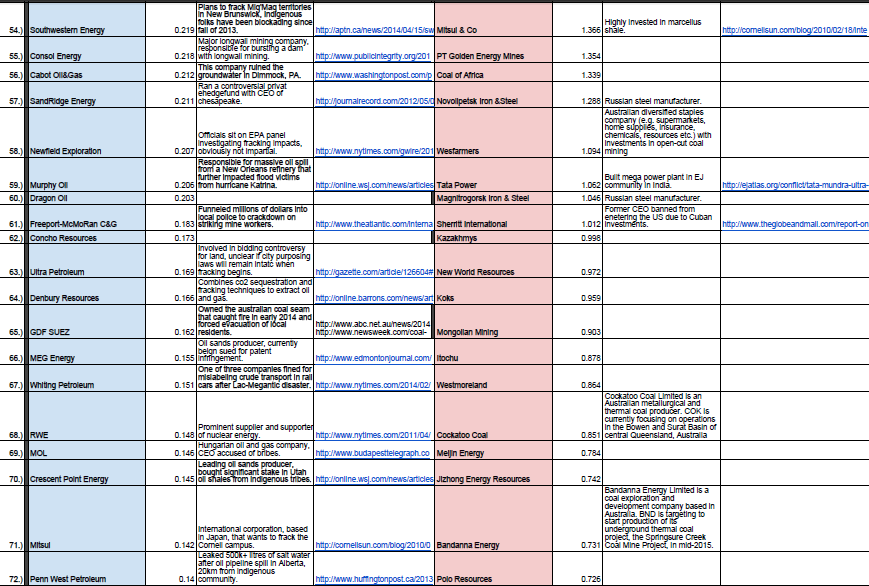
Fossil Fuel Divestment: Top 100 Companies

Here is a comprehensive list of fossil fuel companies from the Carbon Underground provided by Fossil Fuel Indexes and ranked in terms of divestment priority.

Renewable Energy Case Studies: Burlington Vermont and Argentina

The massive growth of renewable energies is hard to refute. Strong growth forecasts come from the combination of current day models of clean energy use and extraordinary opportunities that remain to be exploited.

Here are two renewable energy case studies from the municipal level (Burlington Vermont) to the national level (Argentina). The first illustrates a current example of functioning renewable energy systems and the second points to the potential for growth.

Countries like Germany and Norway are not the only ones transitioning to renewable energy. Scotland is destined to be a net exporter of renewable energies. In the US, the city of Burlington, Vermont is entirely powered by renewables. Through a combination of biomass, hydroelectric, solar and wind, Burlington is the first US city to get all of their energy from renewables. This switch to renewables will also save the city $20 million over the next decade. Cities like Burlington demonstrate what has already been shown in Germany, renewable energy contribute to a strong economy.

Burlington's sustainability leadership also involves an aggressive energy efficiency program that enables the city to use less electricity in 2015 than it did in 1989. The city also has nine electric charging stations, which is admirable for a city with less than 50,000 people.

The market for renewable energy is growing both in the US and around the world. Latin America stands out as a stellar opportunity. In this region it is expected that renewables will help to meet growing power demands. A 2011 Bloomberg New Energy Finance study showed that in 2010, over US$13 billion was invested in Latin America in clean energy generation, and is growing at a compound annual growth rate of 70% since 2004. That’s almost twice as fast as global investment in the industry, which in itself is among one of the fastest growing industries in the world.

While the growth of renewable energy has been curtailed somewhat by the economic slowdown in Brazil, there are a number of other countries that continue to see rapid investment growth. Argentina is particularly well positioned in this regard. Argentina’s power mix primarily comprises natural gas (over 50%) and hydropower (circa 40%). While energy demand is expected to increase domestic gas production is declining. This provides impetus for the transition to renewables.

In 2011 Argentina had only 553 megawatts (MW) of installed renewable energy, and three quarters of it is comprised of mini-hydro projects. This represents less than 2 percent of the country’s energy matrix. Furthermore, almost all of the investment pre-dates the 2006 Renewable Energy law, which requires that by 2016, fully 8 percent of the energy matrix be derived from clean energy. This represents a legal requirement to have more than 3.000 MW of renewable energy operating in the next five years and will require no less than US$5.5 billion in investment.

Argentina has abundant unexploited wind resources, especially in the southern Patagonia region . Current installed capacity stands at 32 MW, though the Government is targeting 1.2 GW by 2016.

Despite ongoing difficulties with project financing and low electricity prices, certain provinces have introduced local tax incentives. The province of Chubut has approved legislative incentives designed to spur the build-out of an estimated 2.2-GW pipeline.

Argentina’s eastern plains and north western regions are ideal for solar PV development. However, only 10 MW of solar has been installed in Argentina to date, making it a huge untapped resource. The Government has set a target of generating 3.3 GW of solar power by 2020.

The growth of renewables in Argentina and around the world will come at the expense of fossil fuel usage. This will have economic benefits and it will advance climate change mitigation efforts.

Related
Moving Towards 100% Renewables in the US
Renewable Energy in Africa and the Middle East
The ABCs of Latin American Renewable Energy (Argentina, Brazil and Costa Rica)
Asian Renewable Energy (China, India Japan, South Korea)
Australia Can Go 100% Renewable Due to Falling Costs
Canada Could Get All of Its Electricity from Renewables
Europe Moving Towards 100 percent Renewable Energy
Growth of Renewable Energy in 2015 and Beyond
One of the Best Years Ever for Renewable Energy in 2014
2014 Year End Review: Renewable Energy Achievements
Economic Benefits of Renewable Energy and Efficiency