Showing posts with label country. Show all posts
Showing posts with label country. Show all posts


Chart - Green Cities Ranking (GGEI)


Related
Global Green Economy Index 2014
Ranking of National Performance in the Green Economy (GGEI)
Chart - Green Investments and Markets National Rankings (GGEI)
Chart - Efficiency National Rankings (GGEI)
Chart - Sustainable Buildings National Rankings (GGEI)
The Best and the Worst Climate Performers (CDP)


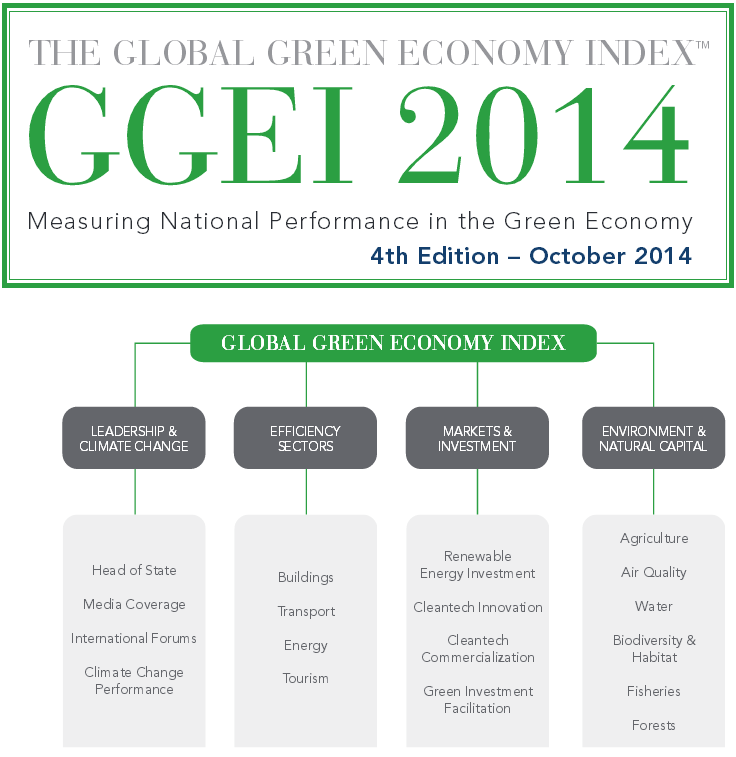
Global Green Economy Index 2014

Here is a summary of their results:
• Germany (perception) and Sweden (performance) top the 2014 GGEI, confirming a trend observed in prior editions of strong results by Germany and the Nordic states. Besides performing well on both the economic and environmental areas of the GGEI, these nations display consistent green leadership and receive global recognition for it.
• Costa Rica performs extremely well, ranking third on the GGEI performance measure behind Sweden and Norway and receiving strong recognition on the perception survey, an impressive result for such a small country. Click here for the complete list of countries.
• Like in 2012, Copenhagen is the top green city as ranked by our survey of global experts, reinforcing the continued strength of the Danish green brand. Tracked for the first time this year, Vancouver and Singapore also rank in the top 10 of green cities.
Emerging Trends
• Many of the fastest growing economies in the world rank poorly on the GGEI performance measure, highlighting an urgent need to reorient their economies to greener growth pathways. Regionally, these countries are mostly in Africa (Ghana), the Gulf (Qatar,United Arab Emirates), and Asia (Cambodia, China, Thailand, Vietnam);
• There are concerning results related to more developed countries as well – notably Australia, Japan, the Netherlands, and the United States – where perceptions of their green economic performance dramatically exceed their actual performance on the GGEI. These countries appear to receive more credit than they deserve, an information gap that requires further exploration;
• Despite its leadership founding the Global Green Growth Institute (GGGI), South Korea continues not to register as a green country brand on our survey and performs poorly, ranked 39th out of 60 on this year’s GGEI. Despite better perception results, Japan also performs poorly on the 2014 GGEI, ranked 44th out of 60;
• While the United Kingdom performs adequately in most areas of the GGEI, it doesn’t excel on any one topic, possibly due to inconsistent political rhetoric and policy related to green economy there. While gradually improving in each successive GGEI edition, the UK still lags behind its northern European and Nordic competitors;
• Five European nations - Austria, Iceland, Ireland, Portugal and Spain – reveal performance scores that exceed their perception ones significantly – signaling an urgent need for better strategic communications and information exchange of their green merits and associated investment opportunities.
• The GGEI results reveal a similar observation for a variety of non-European states - including Ethiopia, Mauritius, Rwanda and Zambia in Africa and Colombia, Chile and Peru in Latin America – again suggesting a need for these states to better position their green economies on the international stage.
The GGEI also suggests how to reorient global growth towards a low carbon, resource efficient pathways. To access the full report click here PDF.
Related
Ranking of National Performance in the Green Economy (GGEI)
Chart - Green Cities Ranking (GGEI)
Chart - Green Investments and Markets National Rankings (GGEI)
Chart - Efficiency National Rankings (GGEI)
Chart - Sustainable Buildings National Rankings (GGEI)
The Best and the Worst Climate Performers (CDP)
Video - India's Use of Solar in Rural Villages
Solar lanterns are popping up in rural villages all over northern India. This An ADB-assisted project helps communities to study, do chores and lead more productive lives at night. Solar lanterns complement solar energy which is now present in many of India's rural areas. Indian Prime Minister Narendra Modi has the ambitious goal of bringing electricity to the 400,000,000 Indians who do not currently have access to it. By 2019, says Narendra Taneja — Modi's energy spokesperson — every household will be able to run at least two light bulbs, a television and also cook with a solar cooker.
Related Articles
National Laws and a Global Climate Agreement
Denmark's Climate Change Bill
Obama's End Run Around the Senate to Secure a Climate Deal
Finland's New Legislation will Reduce Emissions by 80%
Why France is a Global Climate Leader
The Sustainability Yearbook 2013 Leading Countries
Global CO2 Emissions Data for 2011 from the CDIAC
10 Countries for Green Investments
10 Leading Wind Energy Countries
Carbon Rankings from the Environmental Investment Organization
Video: Top 10 Greenest Countries
Video - Iran's Renewable Energy Revolution
This 2012 video shows that Iran was already exploring cleaner energy two years ago. Iran may be an oil producing state that is at odds with the West over its desire to exploit its nuclear options, but the country is also investing in renewable energy and solar power in particular. In May 2014, Iran approved the allocation of €500 million from national development fund for renewable energy projects. Iran is diversifying its energy portfolio a necessity.and this includes growing amounts of investment in solar and wind. As reported in Cleantechnica earlier this year, Iranian Energy Minister Hamid Chitchian announced plans to increase Iran's solar and wind portfolio by 5,000 MW by 2018. This is an ambitious undertaking when you consider that Iran is currently producing only 200 megawatts for photovoltaic solar.
The Iranian government has allocated $60m this year to develop photovoltaic solar projects compared to just $12m last year. Large scale solar projects have been implemented under President Hassan Rouhani. One such project is located in the arid hills of rural Iran. The Taleghan Renewable Energy Site, 160 kilometres northwest of Tehran, has photovoltaic solar panels and parabolic trough collectors that concentrate the sunlight for energy conversion into electricity.
Iran is ideally suited to solar energy as it gets an average of 300 days of sunshine a year. Solar is also a great way to power rural Iran The government is offering subsidies for on-site (distributed) solar panel installation to ordinary families. Solar panels have been installed at some 1,000 locations across Iran, including the on rooftops of mosques, schools and government buildings.
Related Articles
National Laws and a Global Climate Agreement
Denmark's Climate Change Bill
Obama's End Run Around the Senate to Secure a Climate Deal
Finland's New Legislation will Reduce Emissions by 80%
Why France is a Global Climate Leader
The Sustainability Yearbook 2013 Leading Countries
Global CO2 Emissions Data for 2011 from the CDIAC
10 Countries for Green Investments
10 Leading Wind Energy Countries
Carbon Rankings from the Environmental Investment Organization
Video: Top 10 Greenest Countries
National Laws and a Global Climate Agreement

A GLOBE International and CDKN Study found that there was a correlation between strong climate change legislation and high ambition at international climate talks. The study found that a total of almost 500 national climate change laws have been passed in 66 countries, according to the 2014 GLOBE Climate Legislation Study. All developed and major economies are expected to deliver emission reduction targets to the UN by the end of March 2015.
The US Environmental Protection Agency has announced plans to cut carbon from the power sector by 30 percent. However, passing climate and energy legislation in the US is impossible for the foreseeable future. Consequently the Obama administration has come up with a clever approach for a national climate strategy that unlike a treaty does not require the approval of the Senate.
One European nation that is emerging as a climate leader is France. The county has proposed a bill that will radically reduce greenhouse gases a total of 75 percent by 2050.
No nation has shown more climate leadership than Finland. On June 6 Finland approved a proposal for a National Climate Act that would reduce greenhouse gas emissions a total of 80 percent by 2050.
The UK government was the first to pass emissions reduction legislation in 2008 and they recently reiterated their plans to cut GHGs under its climate change act. Earlier this summer Denmark ratified a plan that will reduce emissions by 40 percent by 2020.
The EU will meet in October to finalize their climate and energy framework to 2030. Part of this initiative is an EU wide Emissions Trading Scheme that focuses on European energy and industry.
Senior Chinese officials indicated that they are working on proposals to cap emissions as are Ireland, South Korea, Mexico and Vietnam
At a UN meeting in Mexico earlier this year a resolution was passed by the majority of the 400 MPs present. These representatives hailed from 80 countries and they agreed to push for tougher climate legislation in their domestic parliaments.
The UN has released a set of guidelines for governments to follow when submitting their ‘nationally determined contributions’ to a proposed UN climate deal.
Christiana Figueres, head of the UN’s climate body, said that legislation was key in carrying forward a “clean revolution”.
She said: "Domestic legislation is critical because it is the linchpin between action on the ground and the international agreement."
Related Articles
Denmark's Climate Change Bill
Obama's End Run Around the Senate to Secure a Climate Deal
Finland's New Legislation will Reduce Emissions by 80%
Why France is a Global Climate Leader
The Sustainability Yearbook 2013 Leading Countries
Denmark's Climate Change Bill

The country has a science based approach to managing climate change while at the same time focusing on the nation's economic well being. It is setting up a climate change council that will ensure the nation meets its goals both from a scientific and economic perspective.
This legislation legally binds Denmark to meet its greenhouse gas emissions reduction targets. It also give confidence to the business community which fears uncertainty and seeks to understand the regulatory environment in which they must operate.
Such broad legislation will have repercussions across various sectors. It will impact energy policy, industrial policy, economic policy, agricultural policy, land policy and forestry policy.
Related Articles
National Laws and a Global Climate Agreement
Obama's End Run Around the Senate to Secure a Climate Deal
Finland's New Legislation will Reduce Emissions by 80%
Why France is a Global Climate Leader
The Sustainability Yearbook 2013 Leading Countries
Obama's End Run Around the Senate to Secure a Climate Deal

This political agreement is being sought ahead of the December 2015 United Nations Framework Convention on Climate Change (IPCCC) meeting in Paris.
By doing an end run around the Senate, the Obama administration will be able to avoid the fate of the Kyoto protocol which was approved by then president Clinton in 1997 only to be shot down by legislators.
The end run may have been in the works for quite some time. At the 2011 United Nations climate change conference in Durban, South Africa, it was agreed that the goal for the 2015 Paris meeting was an, "outcome with legal force under the convention applicable to all parties." However the US succeeded in changing the language at the 2013 conference. At the conclusion of the IPCCC meeting last year, the negotiating document removed language calling for a legally binding treaty under international law.
The political agreement being developed by the Obama administration is actually an updated version of a preexisting climate agreement which the Senate ratified in 1992.
Even if Obama succeeds in cobbling together such an agreement there will still be stiff opposition. Particularly vociferous resistance can be expected from the Conservative fossil fuel obsessed governments in Australia and Canada. Even the UK has back peddled on a climate agreement under Conservative rule, which calls one to question the intelligence of the white English speaking world.
If we are to have any hope of signing an international climate deal the US must be on-board. Without support for some kind of climate deal from the US it is very unlikely that other nations will follow suit. In the absence of a legally binding treaty, the Obama administration intends to use a name and shame approach to securing participation from other nations which is premised on global peer pressure.
The absence of a legally binding treaty will not please the EU and developing nations, however, there are few alternatives to the political deal being proposed given the legislative obstacles in the US.
President Obama is working within the framework of the powers allotted to him by the constitution. At the end of the day, a politically binding treaty is far better than allowing the process to be killed by the small minded ignorance of a few dozen legislators.
Related Articles
National Laws and a Global Climate Agreement
Denmark's Climate Change Bill
Finland's New Legislation will Reduce Emissions by 80%
Why France is a Global Climate Leader
The Sustainability Yearbook 2013 Leading Countries
Finland's New Legislation will Reduce Emissions by 80%

The country's climate policy addresses regulatory uncertainty and provides a clear road forward for the business community. In addition to providing a predictable climate policy for business, it will also provide an impetus for low carbon research efforts.
The passage of Finland's Climate Change Act on June 6, 2014, is not the nation's first kick at the climate can. In 2005 the country was the first to create a National Climate Change Adaptation Strategy. The document outlines adaptation measures for 15 sectors of the country's economy.
As Niinistö explains, there really is no alternative to ambitious carbon reduction. "If we don’t do smart green growth there isn’t going to be any economic growth on the planet."
To see the climate change act click here (PDF).
Related Articles
National Laws and a Global Climate Agreement
Denmark's Climate Change Bill
Obama's End Run Around the Senate to Secure a Climate Deal
Why France is a Global Climate Leader
The Sustainability Yearbook 2013 Leading Countries
Why France is a Global Climate Leader

The proposed bill is worth about €10 billion ($13.41 billion) and includes tax breaks, low-cost loans, and bonuses. The bill supports renewable energy, zero emission vehicles, and efficiency. The bill would reduce the nation's dependence on fossil fuels and nuclear energy.
The legislation has already won the approval of the cabinet and it will go before the French Parliament this autumn. It is expected to be ratified in 2015.
Energy
The bill would almost triple renewable energy from 12 to 32 percent, it would also cut greenhouse gas emissions a total of 75 percent by 2050.
Vehicles
The proposed legislation would offer grants for zero emission vehicles and home charging stations.
Efficiency
Under the new bill homeowners would receive compensation for 30 percent of the cost of thermal insulation from their taxable income, up to a maximum of €16,000 per couple. A €1.5 billion fund would be established to subsidize "zero-waste" and "energy-plus" (communities or buildings producing more energy than they import).
Fossil Fuel Taxes
France already taxes fossil fuel use including transport fuels and domestic heating.
Fracking Ban
The nation has also banned fracking, a position which has survived constitutional challenges.
Rio (2012)
At the 2012 Rio+ 20 meeting, Francois Hollande reiterated French support for the creation of a UN Environment Organization.
G8 (2013)
In 2013 at the 39th G8 summit held Northern Ireland, Hollande called on the leaders in attendance to cut carbon emissions and set an example for the world. G8 nations generate half
"There can be no growth or development that is not sustainable," Hollande said. "The G8 must do its part and give a strong political impetus to curb carbon emissions."
G8 countries represent around 50 percent of the global economy, and account for approximately 46 percent of carbon emissions released on an annual basis.
UN Climate Conference (2015)
Hollande has called for an 'ambitious' agreement at COP 21, the 2015 UN Climate Summit which will be hosted in Paris. As Hollande said at the G8 conference in 2013, "It is the responsibility of the international community as a whole to ensure the success of the negotiations."
Under Hollande's leadership, the French government has set an ambitious course which the wider world would be wise to follow.
Related Articles
National Laws and a Global Climate Agreement
Denmark's Climate Change Bill
Obama's End Run Around the Senate to Secure a Climate Deal
Finland's New Legislation will Reduce Emissions by 80%
The Sustainability Yearbook 2013 Leading Countries
The Leading Clean Energy Nation in Terms of Both Investment and Installed Capacity

The most recent data gives China the distinction of being the world's clean energy leader. According to the Pew Charitable Trusts’ latest report titled "Who’s Winning the Clean Energy Race?," China made more investments and deployed more clean energy than any other country in the world in 2013. They invested a whopping total of $54.2 billion and installed 191 gigawatts (GW) of renewable energy capacity. Despite a strong year the US came in second with 138 GW of installed capacity.
According to Bloomberg China installed between 12 and 14 GW of photovoltaic (PV) projects in 2013. This is a global record beat out its nearest competitor by one third and more than tripled US totals. China's installed PV capacity for 2013 beat out Germany's record of 7.6 GW which was set in 2012. The US installed about 4.2 GW of PV capacity in 2013.
Chinese firms now dominate the global solar market. Three firms in particular are leading the world, they are China Power Investment Corp., China Three Gorges and China Huadian Corp.
This prodigious solar growth shows no signs of letting up in 2014. The Chinese government plans to add an additional 14 GW of PV capacity this year more than half of which will come from rooftop installations connected to the distribution grid.
When it comes to wind power China is also a dominant player. China has been the world’s biggest wind power market for years. In 2012, the nation increased its wind production by 41 percent. In 2013, China led the world by installing more than 16 GW of wind power last year. This is exponentially more than the number two and three spots for installed wind capacity in 2013. Germany installed 3.2 GW in 2013 and the UK installed 1.8 GW last year. In fact China's totals for 2013 are considerably more than the combined totals for the rest of the top ten nations in the world (16 GW vs. 12. GW)
China's total installed wind capacity is now at 91.4 GW. The next closest competitors are the US with a total installed capacity of 61 GW, followed by Germany with 34 GW.
Due to the government's ongoing commitment to wind, China will remain a world leader. They have raised the official wind target for 2020 to 200GW.
Related
Global Green Economy Index 2014
Ranking of National Performance in the Green Economy (GGEI)
The Best and the Worst Climate Performers (CDP)
National Laws and a Global Climate Agreement
Denmark's Climate Change Bill
Obama's End Run Around the Senate to Secure a Climate Deal
Finland's New Legislation will Reduce Emissions by 80%
Why France is a Global Climate Leader
Video - Iran's Solar Power Revolution
The Sustainability Yearbook 2013 Leading Countries
Global CO2 Emissions Data for 2011 from the CDIAC
Carbon Rankings from the Environmental Investment Organization
Video: Top 10 Greenest Countries
10 Countries for Green Investments
10 Leading Wind Energy Countries
US China Japan and Others Agree to Fight Climate Change

The world's two biggest economies and worst polluters have signed a groundbreaking agreement to reduce climate change causing greenhouse gases (GHGs). On April 14, 2013, the United States and China announced that they would accelerate action by advancing cooperation on technology, research, conservation, and alternative and renewable energy. In a joint statement the US and China said they “consider that the overwhelming scientific consensus regarding climate change constitutes a compelling call to action crucial to having a global impact on climate change.”
The joint statement acknowledges the urgent need for action to reduce GHG emissions and says, “Such action is crucial both to contain climate change and to set the kind of powerful example that can inspire the world.”
The two sides recognize the sharp rise in average global temperature, ocean acidification, loss of sea ice, and extreme weather events.
A similar deal has also been signed between the US and Japan. The deals with China and Japan reflect an action plan by US climate negotiator Todd Stern, which he outlined in a paper published in 2007. Stern’s plan was to work with the world's worst polluters and avoid the unwieldy geopolitics of the UN Framework Convention on Climate Change. This group would essentially impose a global deal on the rest of the world.
In addition to Japan, the US and China, the deal will include the EU, Brazil, India and South Africa. Bilateral deals with these countries are already in place, but the question is whether they will be brought to the level of the Chinese and Japanese deals.
The details of the deal between the US and China will be worked out at a Strategic and Economic Dialogue between the two countries in July.
© 2013, Richard Matthews. All rights reserved.
Related Articles
The Dangerous Trajectory of CO2 Growth Since the 1880's
C02 Concentrations are the Highest in 3 Million Years
The EIA's Emissions Analysis by US States
We are on Track for a 6 Degree Rise in Temperature
The Dramatic Implications of Melting Arctic Sea Ice
The Safe Upper Limit of Atmospheric Carbon is 350 PPM
Arctic Monitoring Stations Report High Levels of CO2
Primer on CO2 and Other GHGs
Debunking CO2 Myths and The Science of Climate Change
The joint statement acknowledges the urgent need for action to reduce GHG emissions and says, “Such action is crucial both to contain climate change and to set the kind of powerful example that can inspire the world.”
The two sides recognize the sharp rise in average global temperature, ocean acidification, loss of sea ice, and extreme weather events.
A similar deal has also been signed between the US and Japan. The deals with China and Japan reflect an action plan by US climate negotiator Todd Stern, which he outlined in a paper published in 2007. Stern’s plan was to work with the world's worst polluters and avoid the unwieldy geopolitics of the UN Framework Convention on Climate Change. This group would essentially impose a global deal on the rest of the world.
In addition to Japan, the US and China, the deal will include the EU, Brazil, India and South Africa. Bilateral deals with these countries are already in place, but the question is whether they will be brought to the level of the Chinese and Japanese deals.
The details of the deal between the US and China will be worked out at a Strategic and Economic Dialogue between the two countries in July.
© 2013, Richard Matthews. All rights reserved.
Related Articles
The Dangerous Trajectory of CO2 Growth Since the 1880's
C02 Concentrations are the Highest in 3 Million Years
The EIA's Emissions Analysis by US States
We are on Track for a 6 Degree Rise in Temperature
The Dramatic Implications of Melting Arctic Sea Ice
The Safe Upper Limit of Atmospheric Carbon is 350 PPM
Arctic Monitoring Stations Report High Levels of CO2
Primer on CO2 and Other GHGs
Debunking CO2 Myths and The Science of Climate Change
The Sustainability Yearbook 2013 Leading Countries

Nine US-based companies, more than any other country, have been awarded gold medals for sustainability practices in RobecoSAM and KPMG’s Sustainability Yearbook 2013. The US gold medal winners include Molson Coors, Alcoa, Sonoco Products, Herman Miller, UnitedHealth Group, Baxter International, Waste Management, MeadWestvaco and PepsiCo.
Germany and South Korea were tied for second place with six medals each. German gold medalists are Siemens, SAP, BMW, Henkel, Adidas and travel firm TUI.
In South Korea, GS Engineering & Construction Co., personal products firm Amorepacific Corp., SK Telecom, communications company KT Corp and retailer Lotte Shopping set the standard as industry leaders. In addition, Hyundai Engineering & Construction Co. were also awarded a gold medal.
Australia, Taiwan and Canada were represented in the top 10 list of gold medal-winning countries. While the US won the competition, the Asia Pacific was the best-represented region, followed by North America, Europe, Latin America and Africa.
For this annual competition RobecoSAM reviews the sustainability performance of more than 2,000 companies across 58 sectors. Each company is assessed on up to 120 financially material economic, environmental, social and governance criteria specific to its own industry, with a focus on long-term value creation.
© 2013, Richard Matthews. All rights reserved.
Related Articles
Global CO2 Emissions Data for 2011 from the CDIAC
10 Countries for Green Investments
10 Leading Wind Energy Countries
Carbon Rankings from the Environmental Investment Organization
North America 300 Carbon Ranking 2011
Global 800 Carbon Ranking 2011
Top Ten Companies in the 2012 Carbon Disclosure Project Report
Video: Top 10 Greenest Countries
Germany and South Korea were tied for second place with six medals each. German gold medalists are Siemens, SAP, BMW, Henkel, Adidas and travel firm TUI.
In South Korea, GS Engineering & Construction Co., personal products firm Amorepacific Corp., SK Telecom, communications company KT Corp and retailer Lotte Shopping set the standard as industry leaders. In addition, Hyundai Engineering & Construction Co. were also awarded a gold medal.
Australia, Taiwan and Canada were represented in the top 10 list of gold medal-winning countries. While the US won the competition, the Asia Pacific was the best-represented region, followed by North America, Europe, Latin America and Africa.
For this annual competition RobecoSAM reviews the sustainability performance of more than 2,000 companies across 58 sectors. Each company is assessed on up to 120 financially material economic, environmental, social and governance criteria specific to its own industry, with a focus on long-term value creation.
© 2013, Richard Matthews. All rights reserved.
Related Articles
Global CO2 Emissions Data for 2011 from the CDIAC
10 Countries for Green Investments
10 Leading Wind Energy Countries
Carbon Rankings from the Environmental Investment Organization
North America 300 Carbon Ranking 2011
Global 800 Carbon Ranking 2011
Top Ten Companies in the 2012 Carbon Disclosure Project Report
Video: Top 10 Greenest Countries
The State of Government Sustainability Efforts

Despite progress, most government leaders have been woefully inadequate in their efforts to manage climate change. This is particularly true of conservatives. World leaders will only respond when there is sufficient popular support and right now they are lacking in political will and leadership.
One poll showed that more than three quarters of sustainability experts surveyed said they think it will take an apocalyptic event to move governments forward. Hurricane Sandy may prove to be a catalyst for change in the US. The disaster provides a tangible reminder of the need for governments to aggresively manage climate change.
Related Articles
Governments and the Ongoing Growth of Sustainability
Governments Engaging Sustainability
Governments Environmental Collaborations
National Governments Seen to be Lacking Political Will on Sustainable Development
Confusion of Conservative Governments on Sustainability
Scientists Urge Government Action on Climate Change
Government Energy Policy the Environment and the Economy
The Environmental and Economic Implications of a Government
The Green Economy is the Right Solution for our Troubled Times
Government Investment Green Jobs and Economic Recovery
Green Government Investments and Job Creation
CEIL: Standard Compliance Knowledge Center for Green Government
Conservative Confusion about the Role of Government in Support of the Green Economy
Republican Cuts Target Green Jobs
The Fate of the Democrats is Tied to Green Jobs
State Green Jobs Initiatives Need Federal Legislation
Electric Vehicles Create Jobs
Excerpts of President Obama's American Jobs Act Speech
Obama's Jobs Plan Emphasizes Education and Greener Schools
Video: President Obama's American Jobs Act
US Wants Government Action on Clean Energy
The US Government is Investing in Greener Vehicles
US Government Incentives for EVs
The Federal Government's Green Ribbon Schools
British Government to Lead the Green Energy Economy
UK Government Investments in Efficiency and Renewable Energy
The Indian Government is Supporting the Sustainable Development
The Chinese Government is Investing in Clean Energy
Chinese Government Investment in Electric Vehicles
Canada's Conservative Government at Odds with the Public
World Urges Canada's Conservative Government to Do More to do More
Government Investment Fuels Greener Vehicles
Government Incentives are Growing Renewable Energy
Canada's Conservative Government Opposes Kyoto and Hampers
Canadian Conservative Government Rejects Kyoto
Report: Canadian Government is Environmentally Deficient
GRI and the Canadian Government
Canadian Government Spending on Dirty Oil
Former Environment Canada Employee on Harper's Assault on the Environment
Subscribe to:
Posts
(
Atom
)