Here are some of the brave souls who gave their lives in 2019 in defense of the environment. There have been an increasing number of environmental activists murdered in recent years. Many of the murders in 2019 took place in Brazil which is currently being ruled by far-right Brazilian President Jair Bolsonaro. In Brazil a total of 56 defenders were assassinated in 2017 alone. At least eight land defenders were killed in 2018 in the Brazilian state of Para alone. Since becoming president Bolsonaro has all but declared war on the Amazon and the indigenous people of Brazil.Tashka Yawanawa, a chief of the indigenous Yawanawa people in the Brazilian Amazon says his community is facing "genocide". Some have suggested that the fires in Brazil are a form of genocide.
There are also concerns that Guatamalan Mayans could be facing genocide. By January 2019 reports surfaced that indicated Guatemala's community leaders were being killed for defending their land from from transnational companies. This comes after four decades of civil war that left more than 200,000 causalities, most of them indigenous Guatemalans. This has been described by some Guatemalan courts as genocide. In 2018 there were hundreds of attacks and dozens of murders in Guatemala. One such murder was that of 25 year old Ixil Maya nurse, Juana Raymundo, near the city of Nebaj. Raymundo was one of 20 similar murders that took place in Guatemala in the summer of 2018. Many of those that end up on U.S. borders are Guatemalans fleeing violence.
The killings continued in Guatemala in 2019. In July, Jorge Juc a 77-year-old indigenous Maya Q'eqchi' community leader was hacked to death with machetes while he tended his cornfield in eastern Guatemala. Isidro Pérez and Melecio Ramírez were two more Guatemalan activists who were killed in July. These two indigenous rights activists and land protectors were murdered in Eastern Guatemala while attending a peaceful action.
Also in July, dozens of armed gold miners murdered Emyra Wajãpia Waiapi, he was the leader of Yvytotõ an indigenous village in northern Brazil. In September Maxciel Pereira dos Santos, a defender of Brazil’s indigenous tribes was executed in the Amazon town of Tabatinga.
In October five indigenous leaders were massacred in the southwestern region of Cauca in Colombia. Cristina Bautista, chief of the Nasa Tacueyó reservation and four of the community’s unarmed guards were killed, 6 others were wounded. In the last four years at least 700 social leaders, mostly Afro-Colombian and indigenous activists, have been murdered in Colombia.
In November, illegal loggers murdered Paulo Paulino Guajajara an Amazon Forest Guardian inside the Araribóia reservation in the northeastern state of Maranhão, Brazil. His partner was also injured but managed to escape. Not all of these murders occurred in central and south America many also took place in Asia, most notably in the Philippines and India. Poachers have also taken a toll on rangers in Africa. In November Ranger Kambale Kasuki Jean Aimé was ambushed and killed by armed assailants near Ngwenda village (Rutshuru Territory). One of the truck drivers was also murdered and a second ranger sustained non-life-threatening injuries.
Each year environmental activists are killed for trying to defend the natural world. It is fitting that we start the year by remembering the brave souls who are on the front lines of efforts to protect their land, water or local wildlife. For every environmental activist killed hundreds more were assaulted. This includes the indigenous activists in Brazil who had their hands cut off with machetes by ranchers. To add insult to injury the perpetrators of these villainous acts are almost never caught. The murderers are linked to agribusiness, mining, poaching and wildlife trafficking. These killings commonly take place in corrupt tropical and subtropical countries, particularly in Central and South America. Some of the most deadly countries are Brazil, the Philippines, Colombia, Mexico and the Democratic Republic of the Congo.
Indigenous people make up a disproportionately large proportion of the victims. This is but the most recent manifestation of a long history of indigenous murders. In recent years these murders have reached their highest point since colonial times.
In 2010 at least 96 environmental activists were killed.
In 2011 at least 106 environmental activists were murdered.
In 2012 at least 147 environmental activists were slain.
In 2014 at least 116 environmental activists were assassinated.
In 2015 at least 185 environmental activists were killed.
In 2017 a total of 207 environmental activists were murdered.
As reported by the Guardian a recent report indicates that at least 1,558 environmental activists in 50 states were killed between 2002 and 2017. Even by these conservative estimates, this represents a doubling of such murders in the last 15 years. These murders now occur at an average rate of four per week.
People in the north are complicit in the murder of these environmentalists. Nathalie Butt, a researcher at the University of Queensland and the author of the study on murdered environmental activists said companies and consumers in wealthy countries in the northern hemisphere should take responsibility for products sourced in the south. "We need to make ethics and transparency an important part of the supply chain. We need to ensure that there is no blood on our hands," she said.
The trend of warmer Arctic temperatures and melting Arctic ice appears to be worsening. Less ice means more global warming. Last year was the warmest year on record replacing 2015. We saw a number of extreme weather events in 2016 and ongoing evidence of the global warming trend, particularly in the Arctic.
A WMO report presented at COP22 at the end of 2016 indicates that in recent years parts of Arctic Russia, temperatures were 6°C to 7°C above the long-term average. Many other Arctic and sub-Arctic regions in Russia, Alaska and northwest Canada were at least 3°C above average. The global average temperature increase is around 1.5°C above average.
The report also revealed a cascade of related phenomena including sea level rise associated with rapidly melting polar ice. Over the past five years, Arctic sea ice is 28 percent below the average of the previous 29 years. The impact from this melting trend is not only rising sea levels it is also decreasing global cooling from the ice associated with the albedo effect (light or radiation that is reflected by a surface). Simply put, less ice means more warming. Arctic ice reached its equal second-lowest extent in the satellite record in September 2016 and in the fall of 2016 the Arctic was very hot and the extent of sea ice covering the polar ocean was at a record low. The ice was also slower to freeze in the fall of 2016 and it is much thinner than normal.
While the winter, spring, and summer were abnormally warm in the Arctic, the departure from the mean increased in October, November, and December.
In November, Arctic ice normally increases, however, over a period of five days it saw 19,000 square miles of ice cover melt away. NOAA said this was very unusual and almost without precedent. In November Arctic temperatures were 18 degrees warmer than normal. The abnormally warm Arctic was partly responsible for second-warmest November global temperatures on record.
Richard James, a meteorologist who is also the author of a blog on Alaska weather, analyzed 19 weather stations surrounding the Arctic Ocean and found that the average temperature was about 2 C (4F) above the record set in 1998. Since November, temperatures have risen even higher. "It is amazing to see that the warmth has become even more pronounced since the end of October," James wrote on his blog. Towards the end of last year, Arctic temperatures were about 20°C (36 F) higher than normal above 80 degrees North Latitude despite the onset of the polar night.
"Despite onset of #PolarNight, temperatures near #NorthPole increasing. Extraordinary situation right now in #Arctic, w/record low #seaice," Daniel Swain, a climate scientist at UCLA posted to Twitter.
As reported by NASA, a large hot cyclone that crossed the Arctic in December 2015 thinned and shrunk the sea ice cover during a time of the year when the ice should have been growing thicker and stronger.
This phenomenon repeated in December 2016. As reported by the Washington Post, Arctic expert, James Overland with the National Oceanic and Atmospheric Administration {NOAA), said that the jet stream transported warmth northward into the Arctic. This is highly abnormal in terms of both persistence and magnitude.
As reported in Slate, much warmer than usual temperatures have dominated the Arctic at the end of 2015 and into 2016. "[T]he northernmost permanent settlement, Norway’s Svalbard archipelago, has averaged 10 degrees C (18 degrees F) above normal this winter, with temperatures rising above the freezing mark on nearly two dozen days since Dec. 1. That kind of extremely unusual weather has prompted a record-setting low maximum in Arctic sea ice, especially in the Barents Sea area north of Europe."
Writing on his blog, former NASA scientist Roy Spencer said that February 2016 featured “whopping” temperature anomalies especially in the Arctic.
In a Huffington Postarticle, Michael Mann said that February stands out for its record-setting heat particularly in the NortherHemispherere.
"For the first time on record, we crossed the 2 degrees C ‘dangerous’ level of warming (for the Northern Hemisphere, the best-measured part of the globe)...It is unlikely we will see this anomalous warmth sustained for the remainder of the year, but it is a reminder of how perilously close we are now to permanent dangerous levels of warmth. It is yet another warning of the urgency of reducing global carbon emissions."
According to Mashable , February’s warmth was especially pronounced in the north. The Arctic saw record low sea ice and temperatures that were about 6 degrees C (almost 11 degrees F) above normal.
Mark Serreze, who heads the National Snow and Ice Data Center in Boulder, Colo., agreed that something odd is going on. Both air and water temperatures unusually warm. "There are some areas in the Arctic Ocean that are as much as 25 degrees Fahrenheit above average now," Serreze said in December. "It’s pretty crazy...The sea ice is at a record low right now, for this time of year, that’s one thing," Serreze said. "And why it’s so low — again, there’s so much heat in the upper ocean in these ice-free areas, the ice just can’t form right now. The ocean’s just got to get rid of this heat somehow, and it’s having a hard time doing so."
Another Washington Post article said, "it’s premature to say if these events are becoming more frequent, the intensity of the warm air reaching the Arctic is almost certainly increasing. "
“[T]he warmest midwinter temperatures at the North Pole have been increasing at a rate that is twice as large as that for mean midwinter temperatures at the pole,” a Nature study published in mid-December 2016 said. “It is argued that this enhanced trend is consistent with the loss of winter sea ice from the Nordic Seas that moves the reservoir of warm air over this region northwards".
The trend is unmistakable. A study by National Snow and Ice Data Center (NSIDC) and NASA researchers revealed that the length of the melt season for Arctic sea ice is growing by several days each decade, and an earlier start to the melt season is allowing the Arctic Ocean to absorb enough additional solar radiation in some places to melt as much as four feet of the Arctic ice cap's thickness.
A Yale 360 article by Peter Wadhams indicates that melting sea ice is "triggering a cascade of effects that will amplify global warming and could destabilize the global climate system." Wadhams continued, "The planet is swiftly heading toward a largely ice-free Arctic in the warmer months, possibly as early as 2020."
Wadhams is a scientist who specializes in Arctic sea ice, he is professor emeritus of ocean physics at Cambridge University. Wadhams says that over his 46-year career as a scientist he has observed the thickness and extent of Arctic sea ice shrink by 50 percent since the early 1970s. Even steeper declines (75 percent) in volume have been observed. Wadhams explains that there are global feedback effects associated with the arctic ice "death spiral":
"The great white cap that once covered the top of the world is now turning blue [changing the region's albedo causing only 10 percent of solar radiation to be reflected back into space compared to 50 percent when the surface is covered with ice.]— a change that represents humanity’s most dramatic step in reshaping the face of our planet. And with the steady disappearance of the polar ice cover, we are losing a vast air conditioning system that has helped regulate and stabilize earth’s climate system for thousands of years."
Arctic waters have been generally below zero for tens of thousands of years in the summer. With much less ice in the warmest months, Arctic ocean temperatures have risen as much as 7 F in some places. Now rather than cooling the Earth the Arctic is contributing to global heating.
According to one recent study, a warm Arctic is responsible for 25 percent of global warming. Together these impacts are driving global warming. As explained by Wadhams, "overall ice/snow albedo effect in the Arctic could add as much as 50 percent to the direct global heating effect of CO2."
There are a number of complex feedback loops at play. Lower levels of sea ice increase ocean temperatures and warmer sea melt even more ice. declining sea ice creates another feedback loop. Less sea ice cover east of the Nordic Sea helps create a passageway for warm air. Other feedback loops affecting the Arctic include more waves that further dismantles ice, warmer terrestrial temperatures that increase the albedo effect on land and water runoff from the warming land or melting ice. Other feedback loops include water vapor, the slowing of the global ocean conveyor belt and major shifts in the northern hemisphere’s jet stream.
Wadhams says the most dangerous feedback loop is methane trapped in ice on the floor of the Arctic Ocean. Methane traps heat in the atmosphere 23 times more efficiently per molecule than carbon dioxide. More than five years ago Russian scientists had already documented methane seeping from Arctic ice.
"These changes represent a spiritual impoverishment of the earth, as well as a catastrophe for humanity" Wadhams said. This is a wake-up call Wadhams concluded, "the time for action has long since passed."
Maybe part of the problem is that people just don't relate to the Arctic on a personal level. With that in mind here is a historic performance in the middle of the Arctic Ocean by acclaimed Italian composer and pianist Ludovico Einaudi. Described by Paul Hawkins as, "without question, the best video ever made on climate change."
"I've been about to see the purity and fragileness of this area with my own eyes and perform a song that I composed on the best stage in the world," Einaudi said. "It is important that we understand the importance of the Arctic, [and] stop its process and protect it." Einaudi is one of eight million people from across the world demanding protection for the Arctic.
On May 11th the Honduran government arrested four men and charged them with the murder of indigenous environmental activist Berta Cáceres. She was killed because of her opposition to the Agua Zarca hydropower project in the Gulacarque river basin. Men affiliated with Desarrollos Energéticos S.A. (DESA), the Honduran company building the dam, are implicated in her murder.
The shots that killed Berta echoed around the globe. The world was outraged that the winner of the 2015 Goldman Environmental Prize, was savagely gunned down for what can only be described as her noble efforts to defend the rights of her people and protect the land on which they live. After she was killed there was an unremitting cry for an independent international investigation. Berta's daughter even called for the suspension of aid to Honduras. As the pressure mounted, the Honduran government capitulated and arrested Berta's killers two months after she was murdered.
Sierra Club Executive Director Michael Brune commented on the apprehension of Berta's assassins in the following statement:
"Berta Cáceres was a remarkable and inspiring leader who fought tirelessly for indigenous rights and environmental justice for her community and the world. It is clear that the Honduran government heeded the massive international call for justice, and these arrests represent a small victory for Berta’s family, friends, and the entire environmental justice and human rights community. Now we join with those demanding to know the truth about who orchestrated the assassination. Tragically, this kind of justice is increasingly rare, and the murder of activists is frighteningly common. The fight for a safe, clean, and equitable future for all is far from over, but we stand with activists across the world who continue to work toward this shared vision, and we will strive to honor Berta’s unparalleled passion. Berta’s life may have been tragically cut short, but her legacy will live on for generations to come."
In a world that can seem awash with ignorance and apathy, Berta stands out for being a dedicated soul who fought the good fight, to the bitter end. She called us all to, "undertake the struggle in all parts of the world."
Berta Cáceres, remember that name and be inspired by her legacy.
We may have signed a global climate agreement at COP21 in Paris but global levels of atmospheric emissions keep climbing along with temperature records.
The NOAA reports that we have passed 405 ppm of CO2 in the atmosphere this year. According to NASA Goddard Institute for Space Studies, the global average temperature was 1.13 degrees C, or slightly more than 2 degrees F, warmer in January 2016 than the long-term average (1951-1980) for this month. This beats the previous record for the warmest recorded January that was set in 2007.
While the so called super El Niño played a role the temperatures are also being driven upward by growing levels of CO2. Month after month the overall trend continues and this cannot be explained by El Niño.
While we must always make the distinction between climate and weather, January 2016 contributes to an ongoing decades long warming trend. One of the more troubling aspects of January's weather is the particularly warm temperatures in the north (above 60 degrees latitude). This includes the Canadian Arctic, Greenland and Siberia. This is part of what is called the Arctic Oscillation or differences in air pressure over the Arctic and lower latitudes. The phenomenon allows Arctic air to flow south while warmer air is pumped north. The Arctic is warming two or three times faster than the rest of the globe.
As reported by Discover, the president of the Sami Parliament of Norway said:
"Indigenous peoples are running out of time and are having fewer opportunities to adapt to changes."
There are many impacts associated with a warming Arctic that extend beyond the catastrophic impacts being felt by the regions indigenous populations. This includes changes in global weather patterns due to the disruption of the the jet stream which will also cause more extreme weather events like the polar vortex. Melting sea ice can also disrupt ocean circulation and currents. Greenhouse gases have caused the earth to warm and Arctic ice to retreat, this in turn is the cause of what is known as the albeido effect where more of the sun's energy is absorbed by the earth and less is reflected back into space. Simply put, less ice means more warming.
Sea ice coverage has declined by 40 percent since the late 70s and as of 2007 that trend appears to be accelerating. According to a report titled "Arctic Matters: The Global Connection to Changes in the Arctic" by the National Research Council of the National Academies, Arctic sea ice extent is the lowest it has been in over three decades. The expectation is that we will soon see ice free summers in the Arctic. This means that in the coming decades the Arctic will be navigable by ship traffic.
Melting arctic ice will also increase erosion and the rate at which methane seeps from the permafrost. Together the impacts of Arctic warming are directly related to everything from accelerated warming to the resultant food scarcity.
Warming temperatures are directly related to increasing levels of atmospheric carbon and other greenhouse gases. We have never seen such a rapid buildup of greenhouse gases than the one augured by the industrial revolution and our wanton burning of fossil fuels.
During the Pliocene 2.6 – 5.3 million years ago, there was between 350 and 400 ppm of atmospheric CO2. At that time global average temperatures were 2-3 degrees Celsius hotter than 1880s levels and sea levels were about 80 feet higher than current levels.
Arctic monitoring stations first reported atmospheric levels of CO2 at 400 ppm in June 2012 and other monitoring stations recorded this level of atmospheric carbon in April 2013.
The Mauna Loa Observatory has recently reported that CO2 levels have hit a new record global high of 405.66 ppm. Last year we saw the fastest growth of CO2 ever recorded. We can expect that by the time atmospheric carbon levels reach their annual maximum in May we will see levels of around 407 ppm. We have not seen these levels of atmospheric carbon since the Middle Miocene climate epoch, 15 to 17 million years ago. During this period temperatures were between 3 to 5 degrees Celsius hotter than they were in 1880 and sea levels were about 120 to 190 feet higher.
The trend is troubling as we may be on the cusp of tipping points. From the release of methane stored in the Arctic permafrost to the failure of traditional carbon sinks there are a host of concerns associated with these levels of emissions. For example it is known that the oceans which have long been a sink for carbon can no longer absorb as much CO2 as they used to.
The inter-relatedness of all these climate phenomenon (global average temperature, the Arctic, sea ice and global emissions) weave a troubling tale of a climate that is rapidly spiraling out of control.
Although the Obama administration has effectively shut down Arctic drilling the region is far from being protected from the dangers of fossil fuel extraction. The President has imposed stringent lease conditions on Arctic oil extraction but other Northern nations do not have such restrictive national laws. Countries including Russia and Norway continue to set their sights on Arctic oil.
Arctic drilling is a source of concern for many reasons including the risks of a spill. According to Greenpeace there is a 75 percent chance of a serious spill. This would prove catastrophic in this fragile and remote ecosystem. There is also the overarching issue of emissions contributions at a time when we already have more known oil reserves that can be safely burned. According to the US Geological Society the Arctic holds up to 13 percent of the world’s undiscovered oil reserves. Ironically, global warming caused largely by fossil fuels makes Arctic drilling even more attractive as there is now less ice to contend with.
Shell withdrew from the Arctic because the project became non-viable due to low oil prices. Citing "current market conditions" the Department of Interior has canceled two future auctions of Arctic offshore oil leases in the Chukchi and Beaufort seas. They have also denied requests from Shell and other oil companies to secure more time on their existing leases. They have also indicated that existing leases will not be renewed after their expiration in 2020.
The Obama administration appears to have brought Arctic drilling to an end for the remainder of the President's term. Further, all the leading Democratic contenders for president have indicated that they are against Arctic drilling. However, this does not preclude a return of oil companies to the American Arctic at some future date. If a Republican were to take control of the white house we would almost certainly see such a return. Republicans in Congress, including Alaska's Lisa Murkowski have already made it clear that they want to extend the life of drilling leases.
While US companies may lead the race to extract Arctic oil, other countries are also looking to exploit the regions fossil fuel reserves. Russia's Arctic drilling operations have been delayed by sanctions over the Ukraine, however early in 2015 cooperation between Russian and Norwegian oil companies suggested that Arctic drilling would proceed despite the sanctions.
For example, the Norwegian company Statoil has increasingly close relations with the Russian oil company Rosneft and together they are planning to drill four wells in Russia. Rosneft has a stake in a license in the Barents Sea operated by Statoil. Russia's second biggest oil producer Lukoil is also working with Norwegian and Swedish firms.
It is only due to tensions over the ownership of the remote Arctic Svalbard islands that we are not seeing even more Arctic drilling cooperation between Norway and Russia.
In the largest single entity settlement in the Department of Justice's history, BP will have to pay $20.8 for its role in the infamous Gulf of Mexico oil spill in April, 2010. Since the disastrous explosion of the Deepwater Horizon drilling platform BP has been engaged in protracted negotiations with the federal government. Now the Department of Justice have finalized the settlement with BP. The settlement comes after years of legal wrangling. In July, the Supreme Court denied the company’s appeal to block benefits for those not directly affected by the spill. As reported by The Hill, the fine breaks down as follows
$5.5 billion to settle civil claims under the Clean Water Act
$7.1 billion for environmental restoration work
$700 million to compensate for still-unknown damages to natural resources in the region
$4.9 million to Gulf Coast states affected by the spill
$1 billion to local communities. Florida, Alabama, Mississippi, Louisiana and Texas will split that portion of the settlement.
BP has also already spent more than $1 billion on environmental restoration work in the area
Almost $9 billion of the settlement money will be used by for a Gulf restoration fund. This money will be invested in coastal and habitat repair, water quality improvement in wetlands and recreational projects in the region.
Biologists have observed that the 3.19 million gallons of oil that pored into the Gulf is having long term effects that continue to this day.
"This is still the largest environmental penalty under the Clean Water Act and Oil Pollution Act, ever," Attorney General Loretta Lynch said. "BP is receiving the punishment it deserves while also providing critical compensation to the damage to the Gulf region."
The punishment will serve as a deterrent that will hopefully prevent similar disasters in the future.
"The steep penalty should inspire BP and its peers to take every measure necessary to ensure that nothing like this can ever happen again," Lynch said.
The $20.8 billion fine is separate from the class-action settlement with businesses and individuals affected by the spill.
Environmental Protection Agency Administrator Gina McCarthy noted that the settlement includes $700 million to address any potential environmental damages that officials have yet to discover.
"Justice is not about dumping a pile of money and walking away," McCarthy said. "It is about investing in sustainable ways that empower and strengthen the Gulf communities over the long term."
The settlement still needs to be approved by a federal court.
Shell may be drilling the Chukchi Sea off the coast of Alaska this summer but they will only be able to do half of the drilling they had planned. On Tuesday June 30, the Obama administration announced that it has limited shell's drilling plans in the Arctic citing wildlife protections. The federal government has effectively prevented them from simultaneously boring two wells.
The US Fish and Wildlife Service indicated that they want to reduce the noise from the drilling and they are using a 2013 regulation that prohibits drilling less than 15 miles between wells. Shell's plan was to bore two holes 9 miles apart. Federal regulations demand that Shell have two rigs in the region in case an emergency forces the company to bore a relief well. However, they had planned to put the second rig to work simultaneously drilling a second exploratory well nearby.
This means that while Shell has moved two drilling rigs into the Burger prospect, only one exploratory well can be drilled at a time. Shell will spend $1 billion on the exploratory drilling in the Burger prospect this year bringing their total spend on drilling in the Arctic Ocean to more than $7 billion.
While this will reduce the amount of drilling that will take place in Chukchi Sea this summer, it will likely lengthen the amount of time Shell will be in the Arctic by a number of years. Shell's two rigs Transocean Polar Pioneer and the Noble Discoverer have a very limited drilling window that runs during the ice-out period between July 15th and September 28th.
Before it can begin drilling in the Arctic Shell still needs one more drilling permit from the Interior Department's Bureau of Safety and Environmental Enforcement.
The last time Shell tried to drill in the Arctic it did not go well. They lost control of their rig and it ran aground. It was later revealed that they had inadequate safety equipment.
BP has a lengthy criminal rap sheet that culminated in the Deepwater Horizon explosion in the Gulf of Mexico. Despite BP's long criminal history they are anything but repentant. Rather than accept the penalties levied against them for the 2010 spill they are doing everything in their power to minimize their legal and financial responsibilities.
US District Court judge Carl Barbier found that BP was guilty of "gross negligence" and "willful misconduct." Although the trial concluded earlier this year, the final settlement has yet to be announced. All throughout the legal proceedings BP has waged a massive and misleading advertising campaign which gives the impression that all is well in the Gulf. However this contention is squarely refuted by the science.
The statutory penalty in the Clean Water Act for BP's actions its actions is $4,300 per gallon, or over $18 billion. Thus far BP has agreed to pay $4.5 billion in related criminal and civil penalties and faces additional fines, as well as to thousands of claims by individuals and companies. It’s also agreed to resolve most private-party lawsuits as part of an uncapped settlement BP values at about $9.2 billion
Whatever the fines, they will be a fraction of the actual costs to the economy, wildlife and the Gulf ecosystem.
After months of negotiations the EPA gave BP the right to bid for US contracts and oil leases on March 2014. However, BPs misinformation and refusal to take full responsibility for the Gulf oil spill casts aspersions on the EPA decision.
As reported by Bloomberg, the EPA imposed the contract suspension in 2012 after determining that BP hadn’t fully corrected deficiencies that led to the Gulf oil spill. BP sued the EPA in federal court in Houston seeking to lift the suspension and then dropped the lawsuit after a deal was reached.
As explained by Tyson Slocum, director of the Public Citizen’s Energy Program in Washington, the EPA decision was premature. This "lets a corporate felon and repeat offender off the hook for its crimes against people and the environment," Slocum said in a statement. BP "was on criminal probation at the time of the 2010 Deepwater Horizon disaster, and it has failed to prove that it is a responsible contractor."
The government suspended BP’s rights to seek federal contracts after the company pleaded guilty to 11 counts of felony seaman’s manslaughter, two pollution violations and one count of lying to Congress in connection with the spill.
In addition to the spill, the EPA cited the 2005 explosion at a BP-owned Texas City, Texas, refinery and two oil spills in Prudhoe Bay, Alaska, as grounds for the 2012 debarment. At the time of the April 2010 spill, BP was on probation after pleading guilty in 2007 to a felony air-pollution charge and paying a $50 million fine for the explosion in Texas City that killed 15 workers.
A number of wildlife species have been devastated by the 2010 BP oil spill in the Gulf of Mexico. This includes seabirds, turtles, fish, and vegetation.
Between 800,000 and one million sea birds have died from oil exposure in the Gulf of Mexico since 2010. Entire seabird populations have suffered from major die-offs. Oil related deaths include 12 percent of brown pelicans (over 200,000 have been exposed to oil), almost one third (32 percent) of northern gulf laughing birds and 13 percent of royal turns. A total of 20,000 Kemp's turtles and 60,000 Ridley turtles died in 2010.
Five times the normal rate of lung disease have been observed in bottlenose dolphins and a total of 1000 dolphins have been found stranded between 2010 and 2015. Under the water a number of species were impacted including oysters and sea grass which provide food and habitat for a wide range of aquatic life. There has been an 85 percent reduction in the diversity of northern gulf seaweed habitats. Species that depend on this seaweed include shrimps, lobsters and crabs.
In the two years following the disaster there was a 50 percent drop in oysters and 10 square miles of sea grass were adversely impacted.
The importance of the gulf oil spill on fish species is important because two thirds of fish species that live in the area of the spill are found only in the gulf. As few as 50 Brydes whales are thought to be left in the gulf and the calves of this species are particularly vulnerable to the dispersant used to break-up the spill. Dispersants are also thought to have adverse health impacts on Sperm Whales and other species
To this day fish species continue to suffer from disruptions to their growth, development and reproduction. Some fish species were found to be covered in lesions due to the spill.
Heart defects and other morphological abnormalities have been found Atlantic bluefin, yellowfin tunas and an amberjack species. Swordfish, marlin, mackerel and other Gulf species may also suffer from similar impacts.
It will take years if not decades to understand the full scope on the impacts.
A number of studies indicate that the environmental impacts of the BP's 2010 oil spill in the gulf is anything but over. Huge amounts of oil are still on the ocean floor and this is finding its way into the food chain. Other studies show fish that spawn in these oil contaminated waters in the Gulf are suffering from a wide range of lethal deformities.
A study published earlier this year suggested that the oil that lingers in the Gulf of Mexico continues to pose a threat to local ecosystems. The study by Florida researchers indicates that About 3,243 sq miles (8,400 square km) of the sea floor is still covered with oil from the disaster. "This is going to affect the Gulf for years to come," Jeff Chanton, the study's lead researcher and a professor of chemical oceanography at Florida State University, said in a statement.
This study corroborates an October study which found that as much as 30 percent of the spilled oil remains on the ocean floor.
"Fish will likely ingest contaminants because worms ingest the sediment, and fish eat the worms. It's a conduit for contamination into the food web."
CBS news quoted the study’s lead researcher, Jeff Chanton, as saying: ‘This is going to affect the Gulf for years to come.
‘Fish will likely ingest contaminants because worms ingest the sediment, and fish eat the worms. It's a conduit for contamination into the food web.’
Dolphins and turtles in the Gulf are dying in record numbers. Bottlenose dolphins have been dying at more than twice the normal rate over the past five years and the nesting habits of the endangered Kemp's Ridley sea turtle changed dramatically around the time of the spill. Commercial fisheries have also seen a reduced yield.
The BP oil spill was an unprecedented disaster and after five years 2 percent of samples of water and seafloor sediment continue to exceed federal toxicity levels. According to research from the Associated Press the overall health of the Gulf of Mexico has declined 11 percent since April 2010.
The research suggests that lingering impacts of the BP oil spill in the Gulf are being felt by tuna and other species that spawned in oiled offshore habitats in the northern Gulf of Mexico. A Stanford NOAA study revealed that the spill is causing severe defects in the developing hearts of Atlantic bluefin, yellowfin tunas and an amberjack species. The study shows that crude oil exposures is slowing the heartbeat or causing an uncoordinated rhythm in these fish, which can ultimately lead to heart failure.
"We know from the 1989 Exxon Valdez spill in Prince William Sound that recently spawned fish are especially vulnerable to crude oil toxicity," said Nat Scholz, Ph.D., leader of the ecotoxicology program at NOAA’s Northwest Fisheries Science Center in Seattle. “"That spill taught us to pay close attention to the formation and function of the heart."
"This fits the pattern," said Dr. John Incardona, NOAA research toxicologist and the study’s lead author. "The tunas and the amberjack exposed to Deepwater Horizon crude oil were impacted in much the same way that herring were deformed by the Alaska North Slope crude oil spilled in Prince William Sound during the Exxon Valdez accident."
"The timing and location of the spill raised immediate concerns for bluefin tuna," said Barbara Block, Ph.D., a study coauthor and professor of biology at Stanford University. "This spill occurred in prime bluefin spawning habitats, and the new evidence indicates a compromising effect of oil on the physiology and morphology of bluefin embryos and larvae."
The culprit in the heart defect appears to be oil-derived polycyclic aromatic hydrocarbons (PAHs). PAHs can persist for many years in marine habitats and cause a variety of adverse environmental effects. Other observed morphological abnormalities on oil-exposed larva were also revealed in the study. This includes poor growth of fins and eyes.
"We now have a better understanding why crude oil is toxic, and it doesn’t bode well for bluefin or yellowfin embryos floating in oiled habitats.” said Block. “At the level of a single heart muscle cell, we’ve found that petroleum acts like a pharmacological drug by blocking key processes that are critical for cardiac cell excitability."
The authors further suggest that other species like cardiac-related impacts on swordfish, marlin, mackerel and other Gulf species may also be impacted cardiac abnormalities if they spawned in proximity to oil.
Experts say it could take "decades" for the ecosystem to recover.
Exactly five years ago (April 20, 2010), BP's Deepwater Horizon oil well exploded in the Gulf of Mexico killing 11 people and injuring 17 more. The explosion unleashed one of the worst environmental disasters in human history. For 87 days (April 20 and July 15, 2010) the oil spewed from the well and by the time it was finally contained at least 3.2 million barrels (134 million gallons) of crude oil had contaminated the Gulf of Mexico and 1,100 miles of coastline.
The worst marine disaster ever damaged bird sanctuaries, marine and wildlife habitats. It also soiled beaches, killed wildlife and devastated local economies. The ecologically vital marsh lands of the gulf coast have not recovered and wildlife is still suffering.
The Gulf may look clean but it is not. Even after a five year $28 billion clean-up operation the repercussions from the spill continue to this day. While much of the oil has evaporated or dissolved, up to 10 million gallons of oil remain on the sea floor. About 3,243 sq miles of the sea floor is still covered with oil from the disaster. Oil can also be found in marshes along the coast and deposits still wash up on shore. The unprecedented spill took place 5000 feet below the surface of the ocean, 40 miles off the Louisiana coast. It had immediate economic impacts on the fishing industry and tourism. It also took a devastating toll on wildlife. Untold thousands of birds, turtles fish and shrimp were killed in the aftermath and a range of species are being impacted to this day. Dolphins and turtles are dying in record numbers and fisheries are still being affected.
The head of the NOAA during the spill Jane Lubchenco aptly summarized events when she said, "The spill was — and continues to be — a disaster. The bottom line is that oil is nasty stuff. Yes, the Gulf is resilient, but it was hit pretty darn hard."
One of the world's largest oil companies has stated that we have to price carbon to curtail carbon emissions.
The science is clear and there have been a vast number of warnings coming from a wide variety of sources including, AGU, IEA, IPCC, PwC, World Bank, and the World Meteorological Organization stating that our current trajectory is catastrophic. Now even those responsible for the problem are coming forward with warnings of their own.
In a February 2015 report titled, "Energy Outlook 2035," BP says that to keep carbon dioxide emissions within upper threshold limits the world must take coordinated action. BP's warning foreshadows demands that will be made for global emissions reductions at the forthcoming COP 21 climate talks at the end of the year in Paris. The UN and many other scientific bodies have repeatedly said that we must keep global temperatures from rising more than 2 degrees Celsius above preindustrial times to avert the worst impacts of climate change.
Many people think that the only way we can curtail climate change is through some forms of carbon pricing scheme and it would appear that BP agrees. BP has warned that atmospheric levels of CO2 from burning fossil fuels are unsustainable in the absence of global pollution regulations. The BP report predicts that CO2 emissions will increase by 1pc per year, or 25pc in total, through to 2035.
"The most likely path for carbon emissions, despite current government policies and intentions, does not appear sustainable. The projections highlight the scale of the challenge facing policy makers at this year’s UN-led discussions in Paris. No single change or policy is likely to be sufficient on its own," said BP chief executive, Bob Dudley. "This underpins the importance of policy-makers taking steps that lead to a global price for carbon, which provides the right incentives for everyone to play their part."
The author of the report, BP’s new chief economist Spencer Dale also acknowledged the volatile nature of oil prices from here on in.
"After three years of high and deceptively steady oil prices, the fall of recent months is a stark reminder that the norm in energy markets is one of continuous change," said Mr Dale.
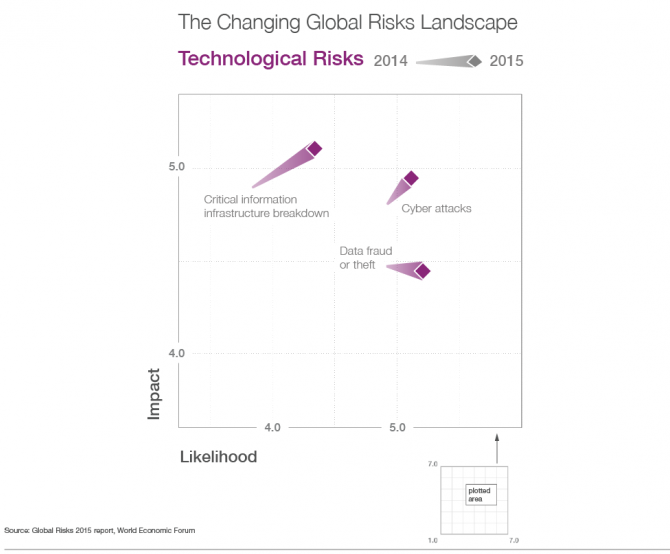
The 2015 edition of the Global Risks report completes a decade of highlighting the most significant long-term risks worldwide, drawing on the perspectives of experts and global decision-makers.
The report is broken down into the following areas:
People often think that global warming is a slow and gradual process that will take generations. However, this film from the American Association for the Advancement of Science (AAAS) (the world's largest scientific society), warns that we are at risk of pushing the earth’s climate system toward, "abrupt, unpredictable, and potentially irreversible changes."
In the 2015 edition of the Global Risks report environmental risks are viewed as more prominent than economic risks. At the very top of the list are international conflicts although water crises rank highest in terms of impact. Overall, geopolitical and societal risks dominate as the biggest threat to global stability.
The 10th edition of the Global Risks report, was published on January 15, 2015 by the WEF. The annual report features an assessment by nearly 900 experts on the top 28 global risks in terms of likelihood and potential impact over the coming 10 years. Despite a preponderance of economic concerns, the report ranks more environmental issues among the top risks than economic ones. This is a consequence of the negative assessment attributed to existing preparations to cope with challenges such as extreme weather and climate change.
In terms of likelihood of a given risk, extreme weather events are exceeded only by interstate conflict followed by failure of national governance systems, state collapse or crisis, and high structural unemployment or underemployment.
In terms of impact, the water crises was deemed to be the greatest risk facing the world followed by the spread of infectious diseases, weapons of mass destruction and failure of climate change adaptation.
The report expresses concern over the world’s ability to solve its most pressing societal issues, including economic, environmental and geopolitical risks.
In addition to ranking risks, the report features three examples of risk management and resilience practices related to extreme weather events.
Margareta Drzeniek-Hanouz, Lead Economist, World Economic Forum said, "seeking to return the world to a path of partnership, rather than competition, should be a priority for leaders as we enter 2015."