Showing posts with label national. Show all posts

Ranking National Climate Action - 2020 Performance Index

The United States and Canada are some of the worst climate performers in the world. None of the countries reviewed in the 2020 Performance Index have demonstrated that they are on a path that is compatible with the goals laid out in the Paris Climate agreement. Sweden leads the group of high-performing countries, as it did in the 2018 and 2019 Indices. The other four top performing countries in the top five are Denmark, Morocco, the UK and Lithuania. The US is in last place. The 2020 Climate Change Performance Index tracks the performance of 57 countries and the EU on greenhouse gas (GHG) emissions, renewable energy, energy use and climate policy. The 2020 Index finds that “no country performs well enough in all index categories to achieve an overall very high rating,” meaning that no country is yet “on a path compatible with the Paris climate targets.” Countries are assessed based on their compatibility with ambitions to keep temperatures from warming beyond 2 degrees Celsius above preindustrial norms.

On GHG emissions, 31 out of 57 high-emitting countries recorded decreasing emissions. Sweden received a very high rating and Egypt received a high rating for its comparatively low level of current GHG per capita emissions, additional emission reductions over recent years and an ambitious 2030 target. The UK is classified as medium for current per capita emissions, but achieved high ratings for the other three GHG emissions indicators, including a high rating for its 2030 GHG emission target. The bottom performers in this category include the Republic of Korea and Saudi Arabia.

Overall, no country received a very high rating for all the renewable energy indicators, which indicates that there is significant room for improvement in mitigating emissions by accelerating deployment of renewable energy. However, the Index states that, “additions of renewable power generation outpaced net installations of fossil fuel and nuclear power”. Sweden, Latvia and Denmark were the top performers in renewable energy. The bottom performers on renewable energy are Malaysia, Iran and the Russian Federation. The report emphasizes that Malaysia has failed to make any improvements in renewable energy, and the Russian Federation has a very low rating for its ambition in the 2030 target. On energy use, Malta, Morocco and Mexico are the top performers. Saudi Arabia, Canada and the Republic of Korea are the bottom three performers.

On climate policy, no country received a very high rating for the category, although Portugal, Finland, Sweden and Norway achieved a very high rating for their international climate policy performance. Portugal ranked first, followed by Finland, recognized for its target to become carbon neutral by 2035 and its ban on burning coal by 2029. Morocco ranked high based on its ambitious 2030 targets. The bottom three performers are Turkey, the US, and Australia.

The Index is prepared by a group of thinktanks comprising the NewClimate Institute, the Climate Action Network and Germanwatch. To read the complete report click here (PDF).

Related
We are Falling Further Behind on Emissions Reduction
Heat Records Tell Us What We Need to Know
You Can't Say You Haven't Been Warned

One Planet Summit Highlights the EU's Climate Leadership

As evidenced by the recent One Planet Summit, the EU and its member states are leading climate action. In the EU, governments, businesses and investors are all engaged in hopeful efforts and initiatives designed to combat climate change.

On the anniversary of the signing of the Paris Climate agreement on December 12, French President Macron convened a summit to encourage private and public financing for the implementation of the Paris agreement. The One Planet Summit was attended by governments, corporations and other organizations. At this event the European Union announced that it would invest at least €9 billion (US$10 billion) on clean energy, sustainable cities and agriculture. Even Theresa May, the less than green-minded prime minister of the UK, acknowledged the need for wealthy nations to help the developing world. She pledged to contribute £140 million to help poorer countries manage climate change.

European nations are also working towards the goal of eradicating emissions. Germany is already a climate leader and that nation has announced that it will slash its greenhouse gas emissions by as much as 95 percent by 2050. France has emerged as the global climate leader. The country in engaged in serious emission reduction efforts through the adoption of a host of forward looking initiatives.

The EU and its member states are leading producers of renewable energy. engaged in consorted efforts to reduce emissions, ratchet-up climate finance, move away from fossil fuels, grow the green economy, and invest in agricultural adaptation.

The EU's efforts are all the more important in the face of the fiasco that is the Trump administration. Trump has eviscerated the US government's climate action plan. Trump announced that he is withdrawing from the 2015 Paris Climate agreement.

The US is now the only nation on Earth that has will not honor to their emissions reduction pledges. In the face of an historically irresponsible US government the EU is leading nations, organizations and individuals who are committed to the goals of the Paris Accord.

France Shows Trump What Climate Leadership Looks Like

France is leading climate action. The host nation for the signing of the historic Paris Agreement has repeatedly refuted Trump's climate denial while adopting a raft of measures as part of an ambitious national climate plan.  It is fair to say that with its support of science, climate focused political agenda, and progressive climate plan France is one of the most sustainable countries in the world.  French efforts have been ongoing for years and include everything from mandatory sustainability reporting to the problem of food waste. In May France announced that it was moving forward with 17 GW of clean energy investments. These are just some of the reason France has emerged as a global climate leader.


Science

The US under Donald Trump is the only nation in the world that is not signed on to the Paris Climate Agreement. In reponse to Trump's contempt for climate science, France awarded "Make Our Planet Great Again" grants to 18 researchers including 13 US climate scientists. The research grants will extend throughout the remainder of Trump's term (assuming he is able to avoid impeachment). The laureates include professors and researchers from Cornell University, Columbia University, and Stanford University.

Following Trump's withdrawal from the Paris Accord in June French President Emmanuel Macron said that France would cover the US share of funding for a U.N. climate change panel. When Macron and former California governor Arnold Schwarzenegger met in July they made fun of Trump's climate denial. "Now we will deliver together to make the planet great again," Macron said.

He also sent out an invitation to US climate scientists saying:

"To all scientists, engineers, entrepreneurs who were disappointed by the decision of the President of the United States I want to say that they will find in France a second homeland. I call them to come and work here, with us on concrete solutions for our climate and our environment. I can assure you that France will not give up the fight".

Macron awarded 3-5 year long climate research grants worth between €1 - €1.5 million. The grants cover research for climate modeling as well as well as the technological and social challenges associated with transitioning away from fossil fuels. At the beginning of 2018, France is teaming up with Germany to provide €60 million worth of grants to 50 projects.

Macron said during the ceremony: “We will be there to replace US financing of climate research. If we want to prepare for the changes of tomorrow, we need science”.

As reported by the Star one of the awardees lamented the "devaluing of science by this administration" These remarks came from Louis Derry, a leading professor of Earth and atmospheric sciences at Cornell, who also said that he is happy to be free of the "crazy stuff that goes on in Congress and with the current administration".

Another grant recipient is Núria Teixidó Ullod, a visiting scientist at Hopkins Marine Station of Stanford University. Her research revealed the relationship between fossil fuels and drought. Another recipient of the French grant is Alessandra Giannini. Giannini is a Research Scientist at Columbia University. Giannini is well known for having conducted research that makes a causal connection between global warming and drought.

Trump is pleased to see these people go because their research flatly contradicts his climate denying narrative.

Politics

Macron has made it clear that climate action will continue regardless of what the ruling US administration does. After it has become clear that the US president has no interest in listening to reason, The French president seems to have decided that Trump is not relevant. Macron is part of a growing chorus that sees Trump as irrelevant. To make the point Trump was not invited to the climate-focused UN and World Bank's "One Planet Summit," that took place one day after the Macron's grant award ceremony.

France must also be acknowledged for having stemmed the tide of right-wing populism. In the wake of Trump's electoral victory, some were concerned that similar dystopia creating governments would pop up all across Europe.

Many are saying that France's rejection of the far right in recent elections killed the momentum that threatened all of Europe. Germans followed the French lead reelected Angela Merkle. Europeans seem to be rejecting the politics of Trump (and UK Prime Minister Theresa May), instead they are embracing progressive centrist forms of government. The importance of France in this respect cannot be overstated. France is a bulwark against the cancerous nationalism that is presently dividing Americans.

The fossil fuel industry pays the Repubublicans handsomely to deny climate science and the recent tax bill is an homage to that relationship. It would appear that Trump and the GOP are using nationalism to mask a plutocracy.

Although Macron's government is decidedly pro-capitalism, they are also anti-corruption. The Trump administration by contrast is the most corrupt administration in Amercian history. 

Economy

France is a model for Republicans who purport to be concerned about the economy and claim to be pro-business. Since 2015 the French economy has been steadily growing. Entrepreneurs seem to be thriving in the country and this has pushed France ahead of the rest of Europe in startup fundraising.Macron acknowledges the importance of climate consideration as both a health concern and an economic issue. This is evident in their appraisal of the Comprehensive Economic and Trade Agreement (CETA) with Canada. In October France announced that they would only ratify the trade deal it will not affect the nation's climate policies and regulations.

France has seen tremendous economic returns from their investments in clean energy.  First with nuclear and increasingly with renewables France is a clean energy titan. France is currently a low carbon energy leader getting more than 75 percent of its electricity from nuclear power. It produces so much energy, in fact, that it exports much of it to nearby nations to the annual tune of $3.2 billion.

"France wants to become the No. 1 green economy." This is part of France's ambitious climate plan. After the announcement Shares of French automaker, PSA Group rose 2.4 percent and Renault SA gained 1.9 percent, making them the day’s best performers on the Bloomberg 500 Autos Index.

Climate plan

In July French Ecological Transition Minister Nicolas Hulot unveiled details of a national climate plan to help France eliminate net carbon emissions by 2050.  Macron's predecessor President Francois Hollande, strongly supported renewable energy and he made bold strides towards ramping up capacity.  Holland announced that France will close all of the nation's coal-fired power plants by 2022.

Macron is continuing Holland's agenda by ramping up renewables and encouraging homeowners to produce their own energy. Last summer Macron announced that he is planning a massive home renovation retrofit program that will reduce energy consumption and cut CO2 emissions.

France is embracing renewables are abandoning fossil fuels. This includes an initiative to end the sale of fossil fuel powered cars by 2040. Hulot said that the government will stop issuing licenses for oil and gas exploration on French territory. "There will be no new exploration licenses for hydrocarbons," Hulot told BFMTV. Hulot has previously indicated that France will offer tax incentives to help get fossil fuel powered vehicles--especially older vehicles--off of the road. Hulot has also expressed an interest in raising diesel taxes.

On the issue of climate change Trump is like Macron's polar opposite just as Scott Pruitt is Huot's evil antithesis. Trump and Pruitt are eroding support for renewables and smoothing the path for more fossil fuel development.  The contrast between the climate focus of Macron's government and the rampant denial in the Trump administration could not be starker. The two governments have diametrically opposed climate narratives. While Macron is charting a course into the future, Trump is reaching back to the darkness that got us here.

Related Posts
Vive La France! French Electorate Rejects Climate Denial and Commits to Progressive Action
France: One of the Most Sustainable Countries in the World
France Curbs Vehicles and Decrees Green or Solar Roofs
Why France is a Global Climate Leader
France Restricts Both GMOs and Cars
Obama and Hollande Call for Climate Action

Germany Continues its Green Dominance in 2015 (Video)

Europe has the highest concentration of national sustainability efforts in the world. In 2015 Nordic countries once again assumed a leadership role along with France. In addition to being an economic giant Germany is also an environmental titan. Germany is ranked fourth in the Global Green Economy Index.and seventh in a RobecoSAM study. Germany has distinguished itself as an early adopter of clean power and it has a secure place in history as a renewable energy pioneer.

The country has passed legislation in support of renewable energy and it is producing results. In 2015 Germany set solar power records and surpassed some major renewable energy milestones that are the envy of governments around the world.

German efforts extend beyond renewable energy and encompass green building. Germany was ranked number 6 in the world by the U.S. Green Building Council (USGBC) in 2014.

The German government led by Angela Merkel has joined other major powers in endorsing ambitious climate objectives. This includes a statement calls for, "deep cuts in global greenhouse gas emissions," and "decarbonisation of the global economy over the course of this century."

Germany is not a newcomer to climate action and Merkel has been at the forefront of this movement for two decades. In 1996 Merkel was a German representative in the European Council of environment ministers that were the first political body to declare the goal of keeping temperatures below 2C was the goal.

Germany is a world leading renewable energy power getting as much of three quarters of its daily demand from clean sources. On July 25, 2015, Germany obtained 78 percent of its electricity from renewable sources.

Year after year German production of renewable energy has increased. In 2015 Germany generated 193 billion kilowatt hours (billion kWh), or one third of its energy from renewable sources up one fifth from the year before.

Cleantech not only reduces the countries emissions it is providing jobs. Nearly 800,000 jobs people work in the cleantech sector and 214,000 people work in renewables in Germany.

The German government has supported the growth of renewable energy and managed to radically reduce its dependence on fossil fuels. As part of a policy called "energiewende" (energy transition) policies Germany is embarking on complete de-fossilization. Germany is already on the cusp of getting 34 percent of its energy from renewables a target it had set to achieve by 2020. The country expects to get 100 percent of its electricity requirements from renewables by 2050.

Cities across Germany are ramping up their renewable energy capacity. The small German town of Feldheim gets all of its electricity from renewables and Munich, Germany's third largest city is working to get all of its electricity from renewable sources by 2025. The city of Frankfurt has pledged to have zero carbon emissions by 2050.

Frankfurt 's comprehensive energy management scheme has decoupled growth from emissions. The city has reduced its emissions by 15 percent since 1990 and grew its economy by 50 percent. The nation as a whole has also succeeded in decoupling economic growth and emissions. Germany's GDP has grown while their GHGs have fallen. 

German cities also support for car free zones and green spaces. There German city of Hamburg has what may be the most climate friendly motto's in the world: “Understanding climate change — reducing climate change — master the effects of climate change.”

In 2015, Hamburg announced plans to eliminate fossil fuel powered cars in the next couple of decades and cover a two-mile section of the Autobahn with greenspaces. These "roof-parks" will cover 60 acres and have forests, gardens, and trails.

Germany's support for renewable energy also extends to other countries. In 2015 the nation gave India a 125 billion Euro loan for green energy projects. The Indo-German partnership is designed to fund transmission infrastructure of renewable energy projects. The German loans will fund green energy projects in Himachal Pradesh and Andhra Pradesh.

Germany is a model for the world that is a real world refutation of some of the criticism leveled against renewables. The fossil fuel lobby frequently point to the problem of intermittancy of renewables (eg the sun is not always shining and the wind is not always blowing). However, as pointed out in a Bloomberg article, Germany proves that intermittancy can be overcome.

In this short film, Germany Trade & Invest focus on Germany’s Renewable Energy Revolution. Scientists, industry leaders, and politicians review the country's achievements, next steps, and the opportunities the energy transition offers.


Related
Germany is an Economic and Environmental Leader
Germany Surpasses Renewable Energy Milestones
German Law Supports Renewable Energy
Renewables Supply 60 Percent of Germany's Energy
Merkel's Reelection and German Green Energy Issues
The Growth of Global Solar Energy including Germany
Global Clean Energy Investment including Germany
CDP Identifies Germany as the Global Sustainability Leader
The 10 Leading Wind Energy Countries
Germany and the Global Competition for EV Supremacy
Germany Abandons Nuclear for Coal
Merkel and Harper: Two Opposing Energy Visions of Energy

France: One of the Most Sustainable Countries in 2015

In 2015 France stood out as one of the most sustainable countries in the world due to the scope of their national efforts and the wider economic implications of their actions. While Nordic countries and their neighbor Germany have ranked very highly on a number of national sustainability assessments, France must be including on any list of the greenest European countries in 2015. France is listed among the top ten countries in the Environmental Performance Index (EPI) ranking of 180 nations. 

As hosts of the COP21 climate talks last December French leadership was essential. This is particularly true in light of the Paris terror attacks that took place just prior to the start of the final round of negotiations. Under the leadership of Francois Hollande France has been a global climate leader. In addition to being the host of the most important climate conference in human history, France introduced a number of sustainability measures in 2015. From managing food waste to supporting renewable energy France showed that it is walking the talk last year.

In 2015 France passed important green energy legislation that will quadruple the country's carbon tax by 2020. They also installed a 300 megawatt solar PV plant that is now the largest such facility in Europe. France is striving to get almost a quarter of its energy from renewables by 2020 and 40 percent by 2030.

France has also made green and solar roofs mandatory on all new constructions and they have restricted the number of fossil fuel powered vehicles that can travel on city roads. France has also made sustainability reporting mandatory.

Alongside government efforts French companies are assuming a leadership role. For example Air France and a hundred or so other corporate leaders endorsed a statement that included calls for "prompt and decisive action on climate change." The statement sought to lay out a framework to combat climate change and stimulate economic growth. It explicitly called for more clean energy.

French power stations are pushing for an energy roadmap. Électricité de France and other companies that comprise the Global Sustainable Electricity Partnership (GSEP) sent a letter to governments urging them to provide a clear pathway outlining the move away from fossil fuels and towards low-carbon energy.

France is also investing in clean power in the developing world. The French and Jordanian Prime Ministers signed an agreement for a $44 million loan to build a transmission corridor for renewable energy.

Related Posts
France Makes Sustainability Reporting Mandatory
The Problem of Food Waste is Being Addressed in France
France Curbs Vehicles and Decrees Green or Solar Roofs
Why France is a Global Climate Leader
Moving Towards 100% Renewable Energy in Europe (France)
French Support for Renewable Energy
French Energy Leadership: Nuclear, Fossil Fuels and GHGs
France Restricts Both GMOs and Cars
Obama and Hollande Call for Climate Action

France Makes Sustainability Reporting Mandatory

There is a growing trend towards mandatory sustainability reporting and France is leading the way by introducing obligatory carbon reporting for financial institutions. This means that pension funds, insurance companies and other institutional investors in France will have to disclose environmental, social and governance (ESG) issues.

These ESG issues, including risks associated with climate change, are of increasing interest to investors as the world transitions to a low carbon economy. Under the new rules investors will need to set targets and measure progress. They will also be held accountable if these targets are not met.

The announcement was made by finance minister Michel Spapin on May 22nd at the Climate Finance Day conference in Paris. The rule is contained in draft legislation known as Article 48 of the French Energy Transition Law which was recently passed by the French parliament.

France is establishing itself as a climate leader with a host of initiatives from national emissions reductions pledges, to reducing food waste. The UK already requires companies to disclose the risks of climate change and mitigation efforts. Sweden may very well be next. The mandatory sustainability reporting will put pressure on other nations to follow suit.

Related Posts
Stock Exchanges Increasingly Requesting Reporting from Listed Companies
Mandatory Emissions Reporting on the UK Stock Exchange
Why France is a Global Climate Leader
The Problem of Food Waste is Being Addressed in France
France Curbs Vehicles and Decrees Green or Solar Roofs

Moving Towards 100% Renewable Energy in Europe (France)
French Support for Renewable Energy
French Energy Leadership: Nuclear, Fossil Fuels and GHGs
France Restricts Both GMOs and Cars
Obama and Hollande Call for Climate Action

France Curbs Vehicles and Decrees Green or Solar Roofs

In France we are seeing efforts to both curb vehicular emissions and increase renewable energy. City officials in Paris have instituted a system that is designed to curb the number of cars that can drive in Paris. This follows new legislation mandating either solar panels or plants on the roofs of all new buildings.

Last March France restricted both GMOs and cars, this March their vehicular restrictions continue alongside the new rooftop initiative.

Air quality is problem in Paris, so city officials are using partial bans on cars to reduce pollution from car exhaust. On Monday March 23, Paris banned cars vehicles with even-numbered license plates. To enforce the ban there were more than one thousand police. The policy was enacted into law last year and it gives government the authority to limit vehicles dependent on air quality readings.

In another move that benefits air quality France has issued a decree that demands that a part of all new rooftops to be covered in either plants or solar panels. The new law was passed on Thursday March 19 and it applies to all new buildings in commercial zones across the country.

Green roofs sequester carbon, provide oxygen and offer an additional layer of insulation. Additional benefits include the promotion of biodiversity, providing a nesting place for birds and retaining rainwater which reduces runoff.

Related Posts
France Makes Sustainability Reporting Mandatory
The Problem of Food Waste is Being Addressed in France
Why France is a Global Climate Leader
Moving Towards 100% Renewable Energy in Europe (France)
French Support for Renewable Energy
French Energy Leadership: Nuclear, Fossil Fuels and GHGs
France Restricts Both GMOs and Cars
Obama and Hollande Call for Climate Action

Chart - Efficiency National Rankings (GGEI)

Chart - Green Investments and Markets National Rankings (GGEI)

Chart - Sustainable Buildings National Rankings (GGEI)

Chart - Green Cities Ranking (GGEI)

Ranking of National Performance in the Green Economy (GGEI)

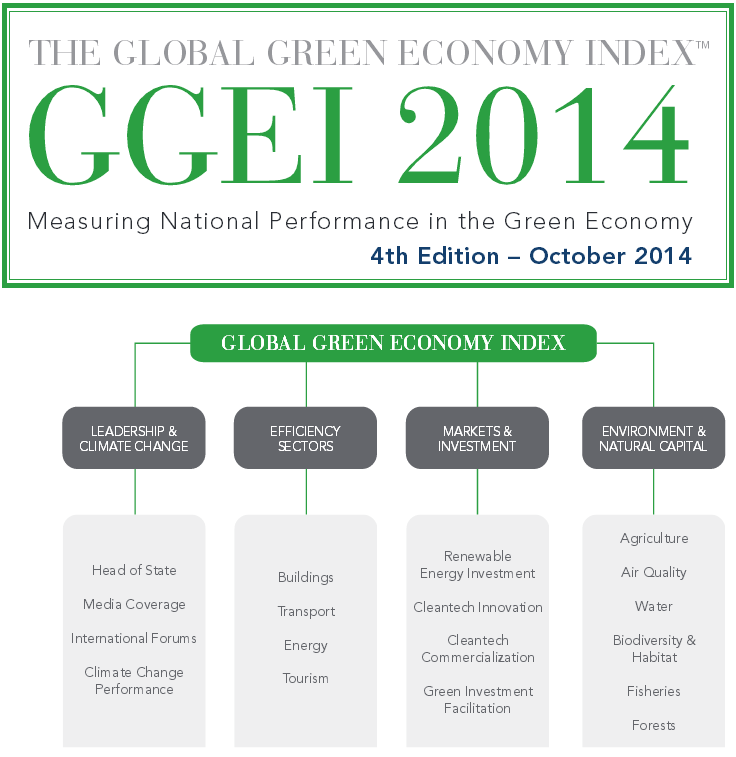
Global Green Economy Index 2014

The 4th edition of the Global Green Economy Index (GGEI) uses data and indicators to rank 60 countries and 70 cities. The report's publisher Dual Citizen LLC measured four dimensions in defining a green economy - political leadership & climate change, efficiency sectors, markets & investment, and environment & natural capital. Their performance and perception calculations reference both public and internally-generated datasets to calculate the rankings.

Here is a summary of their results:

• Germany (perception) and Sweden (performance) top the 2014 GGEI, confirming a trend observed in prior editions of strong results by Germany and the Nordic states. Besides performing well on both the economic and environmental areas of the GGEI, these nations display consistent green leadership and receive global recognition for it.

• Costa Rica performs extremely well, ranking third on the GGEI performance measure behind Sweden and Norway and receiving strong recognition on the perception survey, an impressive result for such a small country. Click here for the complete list of countries.

• Like in 2012, Copenhagen is the top green city as ranked by our survey of global experts, reinforcing the continued strength of the Danish green brand. Tracked for the first time this year, Vancouver and Singapore also rank in the top 10 of green cities.

Emerging Trends

• Many of the fastest growing economies in the world rank poorly on the GGEI performance measure, highlighting an urgent need to reorient their economies to greener growth pathways. Regionally, these countries are mostly in Africa (Ghana), the Gulf (Qatar,United Arab Emirates), and Asia (Cambodia, China, Thailand, Vietnam);

• There are concerning results related to more developed countries as well – notably Australia, Japan, the Netherlands, and the United States – where perceptions of their green economic performance dramatically exceed their actual performance on the GGEI. These countries appear to receive more credit than they deserve, an information gap that requires further exploration;

• Despite its leadership founding the Global Green Growth Institute (GGGI), South Korea continues not to register as a green country brand on our survey and performs poorly, ranked 39th out of 60 on this year’s GGEI. Despite better perception results, Japan also performs poorly on the 2014 GGEI, ranked 44th out of 60;

• While the United Kingdom performs adequately in most areas of the GGEI, it doesn’t excel on any one topic, possibly due to inconsistent political rhetoric and policy related to green economy there. While gradually improving in each successive GGEI edition, the UK still lags behind its northern European and Nordic competitors;

• Five European nations - Austria, Iceland, Ireland, Portugal and Spain – reveal performance scores that exceed their perception ones significantly – signaling an urgent need for better strategic communications and information exchange of their green merits and associated investment opportunities.

• The GGEI results reveal a similar observation for a variety of non-European states - including Ethiopia, Mauritius, Rwanda and Zambia in Africa and Colombia, Chile and Peru in Latin America – again suggesting a need for these states to better position their green economies on the international stage.

The GGEI also suggests how to reorient global growth towards a low carbon, resource efficient pathways. To access the full report click here PDF.

Related
Ranking of National Performance in the Green Economy (GGEI)
Chart - Green Cities Ranking (GGEI)
Chart - Green Investments and Markets National Rankings (GGEI)
Chart - Efficiency National Rankings (GGEI)
Chart - Sustainable Buildings National Rankings (GGEI)
The Best and the Worst Climate Performers (CDP)

French Energy Leadership: Nuclear, Fossil Fuels and GHGs

France will reduce its dependence on nuclear energy while decreasing its use of fossil fuels and slashing its greenhouse gas (GHG) emissions. This is in stark contrast to nation's like Japan, Germany and Italy which are increasing fossil fuel use to to make up for the decommissioning of nuclear plants.  France plans to ramp up wind and other renewable sources of energy to replace nuclear.

When he was elected in 2012, French President François Hollande promised to reduce the country’s use of nuclear energy from 75 percent to 50 percent by 2025. This vision was reiterated in April, by the new French Prime Minister Manuel Valls who said the details of the French energy mix will be revealed in an energy law that will be unveiled by the end of June.

As many as 20 French reactors may have to be closed by 2025 to meet Hollande’s pledge to reduce dependence on nuclear power.

According to the World Bank, in 2012, fossil fuels accounted for half (49 percent) of the France's energy consumption.

What makes France a clean energy leader is the fact that by 2030 the country will virtually eliminate nuclear power while reducing its use of fossil fuels by 30 percent and slashing carbon emissions by 40 percent.

Related
France Restricts Both GMOs and Cars: Vivre La France!
Obama and Hollande Call for Climate Action
French Leadership: Nuclear, Fossil Fuels and GHGs 
French Support for Renewable Energy

The Leading Clean Energy Nation in Terms of Both Investment and Installed Capacity

Many nations are moving boldly forward with clean energy investments and installations, but there is one nation that has shown unparalleled leadership for the last several years. The clean energy global investment total for 2013 is about $254 billion and one nation is responsible for more than one fifth of this amount. This nation is leading renewable energy investments and dominating solar and wind installations. They installed more solar and wind capacity in 2013 than any other nation on Earth.

The most recent data gives China the distinction of being the world's clean energy leader. According to the Pew Charitable Trusts’ latest report titled "Who’s Winning the Clean Energy Race?," China made more investments and deployed more clean energy than any other country in the world in 2013. They invested a whopping total of $54.2 billion and installed 191 gigawatts (GW) of renewable energy capacity. Despite a strong year the US came in second with 138 GW of installed capacity.

According to Bloomberg China installed between 12 and 14 GW of photovoltaic (PV) projects in 2013. This is a global record beat out its nearest competitor by one third and more than tripled US totals. China's installed PV capacity for 2013 beat out Germany's record of 7.6 GW which was set in 2012. The US installed about 4.2 GW of PV capacity in 2013.

Chinese firms now dominate the global solar market. Three firms in particular are leading the world, they are China Power Investment Corp., China Three Gorges and China Huadian Corp.

This prodigious solar growth shows no signs of letting up in 2014. The Chinese government plans to add an additional 14 GW of PV capacity this year more than half of which will come from rooftop installations connected to the distribution grid.

When it comes to wind power China is also a dominant player. China has been the world’s biggest wind power market for years. In 2012, the nation increased its wind production by 41 percent. In 2013, China led the world by installing more than 16 GW of wind power last year. This is exponentially more than the number two and three spots for installed wind capacity in 2013. Germany installed 3.2 GW in 2013 and the UK installed 1.8 GW last year.  In fact China's totals for 2013 are considerably more than the combined totals for the rest of the top ten nations in the world (16 GW vs. 12. GW)

China's total installed wind capacity is now at 91.4 GW. The next closest competitors are the US with a total installed capacity of 61 GW, followed by Germany with 34 GW.

Due to the government's ongoing commitment to wind, China will remain a world leader. They have raised the official wind target for 2020 to 200GW.

Related
Global Green Economy Index 2014
Ranking of National Performance in the Green Economy (GGEI)
The Best and the Worst Climate Performers (CDP)
National Laws and a Global Climate Agreement
Denmark's Climate Change Bill
Obama's End Run Around the Senate to Secure a Climate Deal
Finland's New Legislation will Reduce Emissions by 80%
Why France is a Global Climate Leader
Video - Iran's Solar Power Revolution
The Sustainability Yearbook 2013 Leading Countries
Global CO2 Emissions Data for 2011 from the CDIAC
Carbon Rankings from the Environmental Investment Organization
Video: Top 10 Greenest Countries
10 Countries for Green Investments
10 Leading Wind Energy Countries

France Restricts Both GMOs and Cars: Vivre La France!

In an ecological one two combination France has dealt punishing blows to both genetically modified foods and fossil fuel powered cars. France is making an environmental stand by challenging genetically modified foods (GMOs) and auto emissions. In a brazen move the country has issued a decree that bars Monsanto's genetically modified maize known as MON 810. They are also restricting cars from entering Paris.

The French government's position is that GMOs present environmental risks, however this is not close to being a done deal. What makes the banning of Monsanto so bold is the fact that similar efforts have been struck down by French courts twice. To make matters worse, MON 810 is currently the only variety of maize authorized for use in the EU.

Longstanding differences between EU countries resurfaced in February when they failed to agree on whether or not to approve another GM maize variety, Pioneer 1507, developed by DuPont and Dow Chemical. France would like to see the EU change its stance on GMOs including restricting MON 810 and Pioneer 1507.

To help combat the smog problem in Paris, France has introduced driving restrictions that will prevent cars from entering the city on alternate days. These new rules are important because the country's diesel fuel subsidies have helped to put a lot of diesel burning engines on French roads. According to research from UC Berkeley, diesel fuel is responsible for the lions share of smog pollution. Specifically secondary organic aerosol (SOA) which contributes to respiratory problems and poor air quality.

Drivers are only permitted to use their cars on alternate days, which in theory should reduce the number of vehicles on Paris streets by one half. The move comes in concert with free public transport, including cycle and electric car-sharing schemes.

The tandem of less cars and fewer GMOs is a combination that is being heralded by environmentalists all around the world.

Related
Obama and Hollande Call for Climate Action 
French Leadership: Nuclear, Fossil Fuels and GHGs 
French Support for Renewable Energy

A World Bank Action Plan to Combat Climate Change

The World Bank has been an advocate of environmental action for many years now. Recently the Bank's president Jim Yong Kim called for a plan to address climate change. Rachel Kyte, vice-president for sustainable development, explained that fighting climate change has become a guiding principle for the bank.

The World Bank has introduced a wide array of projects to mitigate and adapt to climate change: from promoting partnerships for climate action in urban areas across the globe to funding clean technology in developing countries.

With historic commitments of more than $12 billion, India has been the main beneficiary of World Bank funding for climate-related projects. The vast majority of projects are directed at renewable energy, while a much smaller number concern forestry, water, sanitation and flood protection.

Underscoring the Bank's efforts to assist developing countries, Ms Kyte said that “climate change is absolutely central to our understanding of how we can help...countries grow and prosper.”

© 2013, Richard Matthews. All rights reserved.

Related Articles
The World Bank: Declining Climate Change Funding
World Bank President Advocates Putting a Price on Carbon
World Bank Climate Change Warning
World Bank Report Predicts 4°C Temperature Increase
World Banks Warning: We Need to Act Now on Climate Change
European Commissioner for Climate Action Urges Development Banks to Divest from Fossil Fuels
A Large and Growing Chorus is Calling for an End to Fossil Fuel Subsidies

The World Bank: Declining Climate Change Funding

The World Bank is a strong supporter of efforts to counter climate change. However, funding for climate-related projects has been declining sharply since peaking in 2010. The World Bank acknowledges that climate change represents a fundamental threat to economic development and the fight against poverty. The Turn Down the Heat reports explained the consequences of 4°C warming by 2100. The costs of a 4°C temperature increase will have adverse global impacts including reduced crop yields and flooding.

In its latest research the World Bank cites the example of Thailand, where flooding in 2011 resulted in losses of $45 billion or about 13 percent of GDP. Previous studies have estimated the cost of a 2°C warming in the region of 1-3 percent of global GDP.

The bank’s climate funding almost doubled between 2009 and 2010, but commitments for 2013 are likely to be the lowest since 2007. At the Copenhagen summit donor countries pledged fast-start finance of $30 billion between 2010 and 2012. This may explain a sudden decline in commitments from $5 billion in 2012 to $1.6 billion in 2013.

© 2013, Richard Matthews. All rights reserved.

Related Articles
A World Bank Action Plan to Combat Climate Change
World Bank President Advocates Putting a Price on Carbon
World Bank Climate Change Warning
World Bank Report Predicts 4°C Temperature Increase
World Banks Warning: We Need to Act Now on Climate Change
European Commissioner for Climate Action Urges Development Banks to Divest from Fossil Fuels
A Large and Growing Chorus is Calling for an End to Fossil Fuel Subsidies

Chinese Solar to Lead the World

According to a July 15 statement from the State Council, China will increase its installed solar capacity to 35 gigawatts (GWs) by 2015. The country plans to add 10 GWs of solar-power capacity annually over the next three years.

China is already the world’s biggest maker of solar panels, but it is suffering from oversupply. The expansion of domestic solar is designed to reduce the problem of oversupply that is plaguing the Chinese solar industry.

To achieve its ambitious goal China will help supply credit to profitable photovoltaic (PV) manufacturers, encourage overseas investment and offer tax breaks to solar companies that acquire others, merge or reorganize their operations. The government will also encourage partnerships between the makers of polysilicon (used to make solar panels) with chemical companies.

China's installed solar capacity is growing faster than any other country and it is expected that it will soon surpass Germany which is the current global leader.

© 2013, Richard Matthews. All rights reserved.

Related Articles
America Surpasses a Solar PV Milestone and Keeps Going
The Solar Industry at a Glance: Past Present and Future
Breakdown of Solar Demand in Q1 & Q2 2013
Deutsche Bank Revises its PV Forecasts for 2013
Ambitious Growth Predicted for Solar in 2013 and 2014
Solar Increasingly Sustainable Even Without Subsidies
Jinko Solar: Silicone Procurement at the Heart of its Success
Outlook for the Chinese Solar Industry in 2012
US Solar Energy Review and 2012 Forecasts
Renewable Energy Is Our Only Hope