Showing posts with label Best. Show all posts

2016 Corporate Sustainability Leaders

A bevy of iconic brands have been singled out as the world's leading sustainability companies. The results of the 2016 GlobeScan/SustainAbility survey of corporate sustainability leaders were released on June 7th 2016. The list is formally known as the The 2016 Sustainability Leaders and his year it was produced in partnership with Sustainable Brands,

The Sustainability Leaders Survey tracks expert opinions on the evolution of sustainability. These experts are now saying that values and purpose are "top drivers" of change. Leaders in sustainability excel at integrating social and environmental purpose into their core business. Leading companies also model innovation and set ambitious goals.

Mark Lee, Executive Director at SustainAbility commented: “Sustainability experts now believe that national governments and the private sector must take equal responsibility for advancing sustainable development over the next two decades, with 34% of experts rating each as vital to progress. Expectations for governments to lead have gradually decreased in recent years, while those for the private sector have been rising. Multi-sectoral partnerships are also seen as playing a central role.”

This year Unilever, Patagonia, Interface, IKEA, Tesla, Nestlé and Natura are among the top-rated global leaders on sustainability. Tesla is the only new addition in the top 13 this year.

The survey sampled 900 experts in 84 countries were asked to identify three companies that are leaders in integrating sustainability into their business strategy. Four in ten experts singled out Unilever as a global leader on sustainability. This is the sixth year in a row that Unilever has made the list. A feat not accomplished by any other company in the survey's almost two decade long history.

North America is the most competitive when it comes to sustainability: Patagonia leads with 16 percent followed by Nike at 10 percent, Interface at 8 percent and at Walmart 7 percent.

To see the full results of the survey click here.

Related
2016 Green Business Award Winners
Green Business Award Winners in 2016 (Guardian and Environmental Leader)
2015-2016 Awards for Reporting on the Environment (SEJ)
The Best and the Worst Sustainability and Climate Stories in 2015 
2015 Global Corporate Sustainability Leaders 
The Best of Green in 2015: Products, Projects, Leaders, Corporations, CEOs and Chemistry
The Top Sustainability Focused Innovations of 2015

Glaxo­SmithKline Doing Well by Doing Good

Glaxo­SmithKline (GSK) is at the top of Fortune's 2016 Change the World list. They are being recognized for their exemplary corporate citizenship. In an age of rampant profiteering in the pharmaceutical industry, Glaxo­SmithKline (GSK) has stood out by making it their business to give back.

The practices of GSK stand in stark contrast to other recent pharmaceutical news. Martin Shkreli bought the rights to a life saving HIV drug called Daraprim,then he hiked up the price by 5,000 percent. CEO of Mylan Pharmaceuticals Heather Bresch raised the price of an EpiPen pack to more than $600.

As reviewed in Fortune, Glaxo­SmithKline is a 300 year old company that built its name with products like baby formula and penicillin. The company made almost $16 billion in 2015 and they use their wealth to do good. They are working on vaccines for malaria and the Zika virus and they support HIV treatment programs in places like Botswana. The prices they charge are a function of people's means and the company reinvests 20 percent of the profits to local health care infrastructure and worker training.

Sustainability is part of Glaxo. As they say on the website GSK is focused on, "improving the quality of human life." They are committed to reducing the environmental impacts of their products and they have set ambitious goals to reduce carbon, water and waste. They are leaders in green chemistry.

In 2014 Glaxo was recognised for outstanding sustainable business practices at the Singapore Environmental Achievement Awards 2014 and in 2010 they recieved the Environmental Stewardship Award from Nalco.

Glaxo is number one on Fortune's annual Change the World list. This list of 50 companies are leading efforts to address major societal problems, reducing damage to the environment, strengthening communities, serving the underserved, and significantly improving lives. They are also generating a profit. The average return on publicly traded stocks in last year’s list was 16.6 percent which was even better than the S&P 500.

For the complete Change the World 2016 list of companies click here.

Related
2016 Green Business Award Winners
2016 Corporate Sustainability Leaders
Green Business Award Winners in 2016 (Guardian and Environmental Leader)
2015-2016 Awards for Reporting on the Environment (SEJ)
The Best and the Worst Sustainability and Climate Stories in 2015 
2015 Global Corporate Sustainability Leaders 
The Best of Green in 2015: Products, Projects, Leaders, Corporations, CEOs and Chemistry
The Top Sustainability Focused Innovations of 2015

Green Business Award Winners in 2016 (Guardian and Environmental Leader)

Here is a summary of sustainable businesses, projects and individuals that are leading the way forward. As we teeter on the brink of tipping points, sustainability leadership is more important than ever. Awards that recognize the best companies, projects and individuals lead by example and serve as valuable models. In addition to well deserved recognition these efforts put sustainability on display, showcasing achievements that other businesses can follow. Here is a summary of green awards that have been handed out to businesses and individuals in the first half of 2016. This list includes Guardian's Sustainable Business Awards as well as Environmental Leaders Product and Project of the year awards.


Guardian 2016 Sustainable Business Awards

The sixth annual Guardian Sustainable Business Awards celebrate those organizations and individuals going above and beyond to tackle the global challenges we face. As explained by Environmental Leader:

"In the wake of the Paris climate talks and the launch of the global goals, 2016 is the year that businesses are ramping up their engagement with sustainability."

Bold move
Winner - Páramo
Runner up - Southern Water

Waste
Winner - Winnow
Runner up - Interface

Water
Winner - Innocent drinks

Finance for good
Winner - Social Stock Exchange
Runner up - Carbon Tracker Initiative

Supply chain
Winner - SABMiller
Runner up - Pennine Pack Ltd

Social impact
Winner - The University of Manchester
Runners up - Shared Interest Society and Neighbourly

Diversity and inclusion
Winner - Marcatus QED
Runner up - Microlink PC (UK) Ltd

Net positive
Winner - IKEA UK and Ireland
Runner up - Good Energy

Communicating sustainability
Winner - Climate-KIC
Runner up - CTC and Diva Creative Ltd

Collaboration
Winner - Edinburgh Centre for Carbon Innovation
Runner up - Falcon Coffees Limited

Carbon and energy management
Winner - Wyke Farms
Runner up - ENWORKS

Built environment
Winner - The Enterprise Centre, University of East Anglia
Runner up - XCO2 Energy

Startup of the year 
Winner - Winnow
Runner up - Guru Systems

Sustainable business leader of the year 
Paul Corcoran

Unsung sustainability hero of the year
Rachel Bradley

Click here for the full list.

Environmental Leader's 2016 Product & Project Awards

The fourth annual Environmental Leader Product & Project Awards, recognizes excellence in the fields of environmental sustainability and energy management. As explained by Environmental Leader:

"Each year since the inception of the Environmental Leader Product and Project Awards program, the range and quality of the entries has risen... The community of providers continues to address the rising demand for cost-effective solutions to address complex environmental, sustainability, and energy management challenges. And end-user organizations are becoming more creative in applying the available solutions to get real results."

Product of the Year Award winners:

3M: 3M Petrifilm Plates
AkzoNobel's Marine Coatings Business, International: Carbon Credits
Big Ass Solutions: Essence
Big Ass Solutions: Haiku Light
Bloomberg LP, The Water Risk Valuation Tool: Lee Ballin
DePuy Synthes, Companies of Johnson & Johnson: ATTUNE Knee System LOGICLOCK tibial Base
DePuy Synthes, Companies of Johnson & Johnson: Attune Knee INTUITION
Ecometrica: the Ecometrica Platform
Enablon: The Enablon Enterprise-Class Platform
FoundationFootprint: FoundationFootprint
GridPoint: GridPoint Energy Management System
Hilton Worldwide: LightStay
IHS: Repsol EMISphere
Lakeshore Recycling Systems: Lakeshore Recycling Systems Sustainable Business Model
Leidos: AMPLIFY Application Management Platform for Energy Efficiency Programs
Panasonic Industrial Devices Sales Co. of America: Panasonic Vacuum Insulation Panel
Petro-Canada Lubricants Inc: HYDREX XV
Quantis: Life Cycle Perceptions Game
Rapport: Rapport
Source Intelligence: Supply Chain Compliance Tool
SunPower Corporation: Cradle to Cradle Certified SunPower E and X Series DC Panels
Thermo King, a brand of Ingersoll Rand: Thermo King Truck and Trailer Refrigeration Units in Europe
Thinkstep Compliance Limited: EC4P
Thinkstep Compliance Limited: BOMcheck Substances Declarations Web Database
Trane, a brand of Ingersoll Rand: CenTraVac Water Chiller Models CVHH and CDHH
Trane, a brand of Ingersoll Rand: Sintesis
UL EHS Sustainability: cr360
Urjanet: Urjanet Utility Data Service
Waste to Energy Partners: Bolder Black
WeNow: WeNowBox

Top Project of the Year Award winners:

ALDI Inc: ALDI Energy Management Systems, Siemens Rollout
AMD: 25 x 20 Energy Efficiency Initiative
Ameresco: Minneapolis-St. Paul International Airport
Arby's, Ecova, Powerhouse Dynamics and Weathermatic: How Arby's Leveraged Ecova and a Partnered Water Meter Solution to Save over 7M Gallons of Water
Caesars Entertainment: Enterprise Waste Diversion Project
Consumer Technology Association and National Cable & Telecommunications Association: Voluntary Agreement for Ongoing Improvement to the Energy Efficiency of Set-Top Boxes
Domtar: Plymouth K-Lime
Dow Water & Process Solutions: Camp de Tarragona DEMOWARE Municipal Wastewater Reuse Project
General Motors: Chevrolet Volt Battery Secondary Reuse Project
Hartsfield-Jackson Atlanta International Airport: Energy Management Program
IHS: Repsol EMISphere
Jackson Family Wines: Tesla Stationary Energy Storage System
Leidos: Hawaii Energy Conservation and Efficiency Program
MillerCoors: MillerCoors Irwindale Brewery Solar Array
Timberland: Empowering Haitian Farmers through Tree Planting
United States Business Council for Sustainable Development: United States Materials Marketplace

Click here to download the full Awards Report.

Related
2016 Green Business Award Winners
2016 Corporate Sustainability Leaders
2015-2016 Awards for Reporting on the Environment (SEJ)
The Best and the Worst Sustainability and Climate Stories in 2015 
2015 Global Corporate Sustainability Leaders 
The Best of Green in 2015: Products, Projects, Leaders, Corporations, CEOs and Chemistry
The Top Sustainability Focused Innovations of 2015

Hilary Clinton is our Last Best Hope of Tackling Climate Change

Anyone interested in climate action needs to appreciate that Hilary Clinton is our last best hope. Clinton has emerged as the presumptive Democratic presidential nominee and she is a far better choice than the Republican candidate Donald Trump. To get a handle on what is at stake, voters need to understand that without US involvement, efforts to reign-in climate change are doomed to fail. Clinton has recently received endorsements from the greenest candidate in this election cycle Tom O'Malley and Potus himself, President Barack Obama.

Clinton is now in a position to be the first women ever to be president of the United States. This is even more significant following on the heels of the successful presidency of Barack Obama. The first African American president and the greenest president in US history. Regardless of who becomes president Clinton is the first female presidential nominee of the two major US parties.

Arguably even more import than this historic achievement, Clinton is now the only one who can stop the presumptive Republican presidential nominee Donald Trump. Make no mistake about it, a Trump presidency at this juncture would kill any hope we have of reigning in climate change. We are rapidly running out of time before we trigger unstoppable tipping points from which we could not recover. So in this sense, Clinton is the best hope we have to tackle climate change.

As revealed by Clinton's recent evisceration of Trump, she has the toughness that it takes to do what the field of Republican presidential contenders could not. 

Clinton has made her views on climate change known in the first Democratic primary debate and through her published policy positions. Here is a brief summary of her climate and energy policies:

Paris Climate Agreement

Clinton accepts the veracity of climate change and the 1.5 - 2.0 degree Celsius upper threshold temperature limits included in the Paris Climate Agreement. She will increase US emissions reductions to 30 percent below 2005 levels by 2025. This is a slight improvement on the Obama administration's goals of cutting emissions 26 to 28 percent. She will also work to preserve Obama's climate actions including the Clean Power Plan, which faces stiff opposition from Republicans. Clinton will also continue Obama's national fuel efficiency standards and the new methane rules.

Social and Environmental Justice

She has also indicated that she will try to make the transition to cleaner sources of energy more palatable to the majority of Americans. To illustrate she has indicated that she will work on economic development in coal mining communities that are out of work. Clinton recently released a comprehensive plan on environmental injustice that includes efforts to address lead.

Renewables and Efficiency

On her website she pledges that all American homes will be powered by renewables within a decade and she will oversee the installation of half a billion solar panels by the end of her first term. She will also work to make America more energy efficient saving $8 billion a year in energy and health care costs.

Clinton has also proposed a National Infrastructure Bank that would support grid investments for distributed energy, and investments in clean energy R&D. She would also ease permitting on new electricity transmission, increase the amount of renewable energy used in federal buildings and on public land. raise the bar on efficiency standards for all federal procurement and federally funded infrastructure.

Through a program called the Clean Energy Challenge, she has promised $60 billion in grants provided to states who show climate leadership.

Fossil Fuels

One of her biggest climate fails may be her support for natural gas as a bridge fuel. However, Clinton wants natural gas to be cleaner. She has proposed a National Infrastructure Bank that would reduce the number of leaks in natural gas pipelines, Through clean energy and efficiency measures she has also promised to reduce US oil consumption by a third. She does not support oil and gas production in the Arctic and the Atlantic coast, and she supports Obama's moratorium on new coal leasing. She does not support a blanket ban on new oil and gas leases on public land.

Nuclear

Clinton wants to keep existing nuclear plants operational. While Bernie Sanders has indicated that he would like to phase them out over time. Nuclear power provides 20 percent of all electricity generation in the US and 60 percent of all zero-carbon energy. Clinton also wants to increase investment in new forms of nuclear power.

Comparison

There are a number of differences that have emerged between Clinton and Sanders. A side by side comparison reveals that Clinton is not be as green as Sanders and certainly not as green as O'Malley, but she is the last person standing capable of taking on Trump.

Anyone but Trump

Trump's policy positions, if you can call them that, are largely unintelligible. His populism appears to be cobbled together on the spot so it is hard to weave a coherent narrative out of his rants. Although he may not have a proper platform, many of his stated actions would cause great harm. This is not only about climate change and the environment. A Trump presidency would hobble the economy and derail America's energy agenda. When compared to the horror-show that a Trump Presidency would augur, Clinton is the best choice by a country mile. Those who support climate action may not have an ideal candidate, but unless they want to abet disaster by abstaining to vote, they must support Clinton.

Related
Climate Focus at the April 14th Democratic Debate
Climate Related Excerpts from the March 9th Democratic Presidential Debate
Hilary Maintains her Climate Silence as O'Malley Pushes his Green Agenda (Iowa Democratic Town Hall)
Climate Change May Give Democrats the Edge in the 2016 Federal Election

The Top Sustainability Focused Innovations of 2015

Innovation is more than a buzzword, it is an absolutely essential component of the required efforts needed to address the environmental and climate crisis we are facing. Here is a summary of some of the best sustainability focused innovations of 2015 from Sustainia.

On December 6th, 2015 the fourth Sustainia awards celebrated a number of groundbreaking sustainability solutions, technologies and projects from around the world. In honor of COP21 the awards took place in Paris, home to the COP21 climate talks.

The Sustania Award Committee is composed of Arnold Schwarzenegger, Honorary Chair of Sustainia, Chair of Regions20 and Former Governor of California; Christiana Figueres, Executive Secretary of the UN Framework Convention on Climate Change, UNFCCC; Connie Hedegaard, Chair, KR Foundation, Former European Commissioner for Climate Action and Dr. Rajendra Pachauri Former Chair of the Intergovernmental Panel on Climate Change, IPCC.

Sustania's top ten finalists for the most sustainable innovations of 2015 are:

Buildings: Archiblox (Australia) - energy-positive prefabricated houses.
Food: SunCulture (US) - solar-powered drip irrigation for smallholders.
Fashion: Vigga.us (Denmark) - leasing organic kids-wear.
IT: Mapdwell, Massachusetts Institute of Technology (US) - 3D solar potential mapping tool.
Education: Seoul Metropolitan Government (South Korea) - citizen engagement for voluntary behaviour change.
Energy: Mobisol (Germany) - micro-financed off-grid solar power.
Health: Solar Ear (Brazil) - solar-powered hearing aids with open source design.
Cities: City of Johannesburg (South Africa) - green bonds finance city climate action.

The winner of the 2015 Sustania Award

In 2015 the Sustania Award went to a transportation redesign for the Indian city Chennai. This innovation was created by the Corporation of Chennai, Institute for Transportation & Development Policy and Chennai City Connect Foundation (India). The redesign is focused on creating streets for walking and biking as a solution to the city’s air pollution and traffic casualties.

The solution requires at least 60 per cent of the city’s transport budget to be allocated to a full-scale redesign including expanded footpaths, safe pedestrian crossings, protected cycle tracks, properly scaled carriageways, conveniently placed bus stops and clearly designated on-street parking.

Smart transport adaptations will reduce air pollution which is Chennai’s (and many other cities) top health risk. Given that motorized transport in cities are a leading source of greenhouse gas emissions, this is a solution with far-reaching health and environmental benefits. It is also designed to reduce the 10,000 traffic accidents and resulting deaths and injuries in Chennai.

Sustainia Community Award

The people's choice award known as the Sustainia Community Award went to resources finalist for a project called Social Plastic. It was designed by the: Plastic Bank (Canada) and it turns plastic waste into currency. This innovative solution to resource management offers communities a way to collect waste plastic and repurpose it as a form of currency. While removing plastic waste from the environment, it also gives individuals the chance to improve their livelihoods and encourages companies to purchase and use this recycled material. With as much as 12.7 tons of plastic washes into the ocean every year, this innovation is a way to save all the animals that are killed by plastic each year, it will also help protect human health from the toxins that leach from the plastic into the food chain.

The Plastic Bank (TPB) offers a concrete solution encouraging the behaviour change needed to meet this systemic challenge. Operating as a social enterprise , TPB removes plastic litter from beaches and oceans by offering local communities the opportunity to bring collected waste to a plastic bank facility, where it can be repurposed. In exchange, they receive basic goods and tools, in addition to access to 3D printers enabling them to create items for themselves and to sell within the community. Furthermore, TPB also encourages businesses to take part in the initiative by buying social plastic.

Over 400 people representing more than 70 different countries have already applied to operate a Social Plastic Recycling Market in their region. In 2015, meetings were held at the home offices of Unilever, Seventh Generation, Method Home and various other global brands to discuss the process for the ongoing purchase and promotion of Social Plastic®.. TPB was awarded the Recycling Council of British Columbia’s Innovation Award in May 2014 for developing 3D printing technology. Their open source 3D printing filament extruder can create the source stock for 3D printers using recycled Social Plastic®.

TPB’s Vancouver Lab is successfully producing recycled 3D printable filament for 30 cents per pound. This same filament can be used to create products that are worth $ 5, $ 10 or even $ 100 per pound, according to the organization. Repurposing at scale: Marine plastic waste can wash up on any shore, in any part of the world, as freely as the wind blows and the tides turn.

Click here for the complete list of Sutainia's 100 sustainable innovations for 2015.

Related
2016 Green Business Award Winners
2016 Corporate Sustainability Leaders
Green Business Award Winners in 2016 (Guardian and Environmental Leader)
2015-2016 Awards for Reporting on the Environment (SEJ)
The Best and the Worst Sustainability and Climate Stories in 2015 
2015 Global Corporate Sustainability Leaders 
The Best of Green in 2015: Products, Projects, Leaders, Corporations, CEOs and Chemistry

The Best of Green in 2015: Products, Projects, Leaders, Corporations, CEOs and Chemistry

Here are some of the best of the best in the green economy from 2015. This includes the best products and projects of the year, the top sustainability leaders and corporate citizens, leading innovative bioeconomy CEOs and the best green chemistry companies. These lists are derived from Energy Manager Today, edie, Corporate Responsiblity (CR) Magazine, Il Bioeconomista and the EPA.

Products

In alphabetical order here are the inaugural Energy Manager Today Product and Project Award winners for 2015:

Adobe - Stem Energy Storage
Big Ass Solutions, Haiku with SenseME
Blue Pillar, Aurora
EnergyCAP, Inc., EnergyCAP
Green Charge Networks, Energy Storage Platform
GridPoint, GridPoint Energy Manager
Hyster Company, PSI Industrial Lift Truck Engines Featuring Hyster Variable Power Technology
JLL, IntelliCommand Smart Building Solutions
Lennox International, Energence Ultra Rooftop Units
Lucid BuildingOS
Meazon SA, Zi-Clamp
NexRev Inc., DrivePak HVAC Efficiency Retrofit
Panoramic Power, Device Level Energy Management
Schneider Electric, Altivar Process
Schneider Electric, EcoBreeze AirEconomizer
Schneider Electric, Resource Advisor’s, Performance Analytics and Energy Performance Services
Urjanet, Urjanet Utility Data

Projects
 
ABM, Wright State University Building and Energy Solutions
ABM Government  ServicesGSA LA ESPC GS-09P- 12-KS-C-0023
Big Ass Solutions, Cassidy Elementary School, Lexington, KY
Bueno Crown Casino - Energy and Operational Savings across a multi-use entertainment complex
Cascades, Heat Recovery Steam Generator
Caterpillar, Thinking Outside AND Inside the Box to Reduce CO2 Emissions
Daintree Networks, Universal Music Group Energy Efficiency Project
Digital Lumens, Atlas Box Deploys
Digital Lumens to Achieve Energy Intelligence
Ensight Pty. Ltd., Energy Leadership, Program, Richards Bay Minerals
FirstFuel Software E.ON UK Energy Toolkit for SME (Small and Medium Enterprise) Customers
Powerhouse Dynamics, Saving the Bottom Line at Bertucci’s
Saint-Gobain Corporation
Vancouver Impact Mill, Heat Recovery
STV, Mother Clara Hale Bus Depot

UK Sustainability Leaders

The ninth edie Sustainability Leaders Awards celebrated a number of individuals and organizations in 2015. These people and companies setting the standard for more responsible business. 

Opening the awards, edie editor Luke Nicholls said: "The Sustainability Leaders Awards have become a shining example of how the green industrial revolution is entering the corporate mainstream. All of this year's finalists have shifted from talking about ambitious sustainability initiatives to delivering them at scale and at pace. And in many cases, they’re already seeing a huge return on investment."

Sustainable Business of the Year - Willmott Dixon
Sustainability Leader - Estelle Brachlianoff, Veolia
Carbon Management - National Grid
Energy Management - Heathrow Airport
Employee Engagement & Behaviour Change - Tesco with Global Action Plan
Sustainability Product Innovation - Genesis Biosciences
Sustainability Product Innovation: Energy Efficiency - Lontra
Sustainability Professional - Anthony Kingsley, Vacherin
Sustainable Business Models - Mud Jeans
Sustainability Reporting - Marks & Spencer
Sustainable Packaging - LINPAC Packaging
Sustainable Supply Chains - KPMG
Waste & Resource Management - DS Smith
Water Management - Southern Water

Best Corporate Citizens

The fifth annual ranking of Corporate Responsiblity Magazine's best corporate citizens including the top performers in the following sectors: business services, consumer items, consumer staples, energy, financial, healthcare, information technology, materials, media and entertainment, and utilities.

By industry, the best corporate citizens for 2015 are:

Business Services — Ecolab
Consumer Items — Hasbro
Consumer Staples — Campbell Soup Co.
Energy — Hess
Financials/Insurance/Real Estate — Jones Lang LaSalle
Healthcare — Johnson & Johnson
Information Technology — Microsoft
Materials — Sigma-Aldrich
Media & Entertainment — Walt Disney Co.
Utilities — Entergy

Innovative Bioeconomy CEOs

Here is Il Bioeconomista's inaugural list of the most innovative bioeconomy CEOs for 2015:

Vincent Chornet, Ceo of Enerkem (Canada)
Carlos Fadigas, Ceo of Braskem (Brazil)
Benjamin Gonzalez, Ceo of Metabolix Explorer (France)
Ilkka Hämälä, Ceo of Metsä Fibre (Finland)
Jennifer Holmgren, Ceo of Lanzatech (New Zealand/USA)
Maxim Katinov, Ceo of GFBiochemicals (Italy)
Hariolf Kottmann, Ceo of Clariant (Switzerland)
Jussi Pesonen, Ceo of UPM (Finland)
Marc Simmers, Ceo of Celtic Renewables (Scotland)
Tom van Aken, Ceo of Avantium (The Netherlands)

Green Chemistry

Here are the EPA's winning companies in the 2015 Presidential Green Chemistry Challenge:

Algenol in Fort Myers, Florida, was recognized for developing a blue-green algae to produce ethanol and other fuels. The algae uses CO2 from air or industrial emitters with sunlight and saltwater to create fuel while reducing the carbon footprint, costs and water usage, with no reliance on food crops as feedstocks.

Hybrid Coating Technologies/Nanotech Industries of Daly City, California, was recognized for developing a safer, plant-based polyurethane for use on floors, furniture and in foam insulation. The technology eliminates the use of isocyanates, the top cause of workplace asthma.

LanzaTech in Skokie, Illinois, was recognized for the development of a process that uses waste gas to produce fuels and chemicals, reducing companies’ carbon footprint. LanzaTech has partnered with Global Fortune 500 Companies and others to use this technology, including facilities that can each produce 100,000 gallons per year of ethanol, and a number of chemical ingredients for the manufacture of plastics.

SOLTEX (Synthetic Oils and Lubricants of Texas) in Houston, Texas, was recognized for developing a new chemical reaction process that eliminates the use of water and reduces hazardous chemicals in the production of additives for lubricants and gasoline. If widely used, this technology has the potential to eliminate millions of gallons of wastewater per year and reduce the use of a hazardous chemical by 50 percent.

Renmatix in King of Prussia, Pennsylvania, was recognized for developing a process using supercritical water to more cost effectively break down plant material into sugars used as building blocks for renewable chemicals and fuels. This low-cost process could result in a sizeable increase in the production of plant-based chemicals and fuels, and reduce the dependence on petroleum fuels.

Professor Eugene Chen of Colorado State University was recognized for developing a process that uses plant-based materials in the production of renewable chemicals and liquid fuels. This new technology is waste-free and metal-free.

Related
2016 Green Business Award Winners
2016 Corporate Sustainability Leaders
Green Business Award Winners in 2016 (Guardian and Environmental Leader)
2015-2016 Awards for Reporting on the Environment (SEJ)
The Best and the Worst Sustainability and Climate Stories in 2015
2015 Global Corporate Sustainability Leaders 
The Top Sustainability Focused Innovations of 2015

IPCC Synthesis Report: Background and Summary

In November the Intergovernmental Panel on Climate Change released its final world Synthesis Report. This is the world's most comprehensive assessment of scientific knowledge on climate change. The conclusions in the report are the starkest warnings yet. Urgent action is required as we are rapidly running out of time.

The final Synthesis Report summarizes three massive climate investigations:

1. The report on the physical science of climate change was released in September 2013. It reiterated the finding that humans are the leading cause of climate change. They further demonstrated that as measured by a number of indicators (ice sheet melt, glacial melt and sea level rise), climate change is occurred faster than predicted. It further stated that this is impacting meteorological conditions by increasing the frequency and intensity of extreme weather events.

2. The report on impacts, adaptations, and vulnerability was released in March 2014. It found that people everywhere are vulnerable to climate change and we have done little to adapt to them. It further concluded that climate change is already harming agricultural yields and affecting food availability and prices. In the absence of immediate action temperatures increases will exceed the internationally agreed upon upper threshold limit of 2ºC.

3. The report on mitigation measures was released in April 2014 it concluded that we must see massive reductions in carbon emissions from the energy sector. It further indicated that our use of renewable forms of energy must quadruple by 2050. It stated that with the cost of renewables declines, deforestation slowing we still have a chance to stay within the 2ºC upper temperature limit, if we act soon. It further stated that we cannot afford to keep investing in fossil fuel infrastructure without surpassing the upper temperature limits.

Brief Review of the Synthesis Report

The final report restates the fact that the scientific case is irrefutable and immediate action is needed. Humans are the cause of climate change and we are already seeing its impacts on every continent. If we do not reign-in greenhouse gases we will see profound impacts that will fundamentally alter the natural world and human society.

Policy Action Required

What we need in terms of action is serious policy shifts. Youba Sokona, co-chair of IPCC Working Group III (Mitigation), finds it technically feasible to transition to a low-carbon economy. However, he notes, "what is lacking are appropriate policies and institutions. The longer we wait to take action, the more it will cost to adapt and mitigate climate change."

© 2014, Richard Matthews. All rights reserved.

Related
Latest IPCC Report Indicates the World is Headed Towards Unacceptable Temperature Increases
Republican Ignorance and the Latest IPCC Report
Graphs - IPCC Report: CO2, Temperatures and Emissions
Economic Costs of Combating Climate Change (IPCC)
Latest IPCC Report on the Viability of Fast Actions to Limit Climate Change Including SLCP
The Three Most Revealing IPCC Charts
Video - IPCC Report: Fossil Fuels Must be Eliminated by 2100
Failure to Reduce Emissions will Result in an Ecological and Economic Catastrophe (IPCC's Leaked "Synthesis" Report)
Video - Review of the Salient Findings in the IPCC AR5 WGll
IPCC AR5 WGll Report: An Impending Climate Catastrophe
The Sole Scientist who Disagrees with the Conclusions of the AR5 WGll
Hope for Climate Finance and Why We Can't Give Up on UN Climate Talks
Figueres on the Need for a Binding Global Climate Treaty by 2015

Chart - Efficiency National Rankings (GGEI)

Chart - Green Investments and Markets National Rankings (GGEI)

Chart - Sustainable Buildings National Rankings (GGEI)

Chart - Green Cities Ranking (GGEI)

Ranking of National Performance in the Green Economy (GGEI)

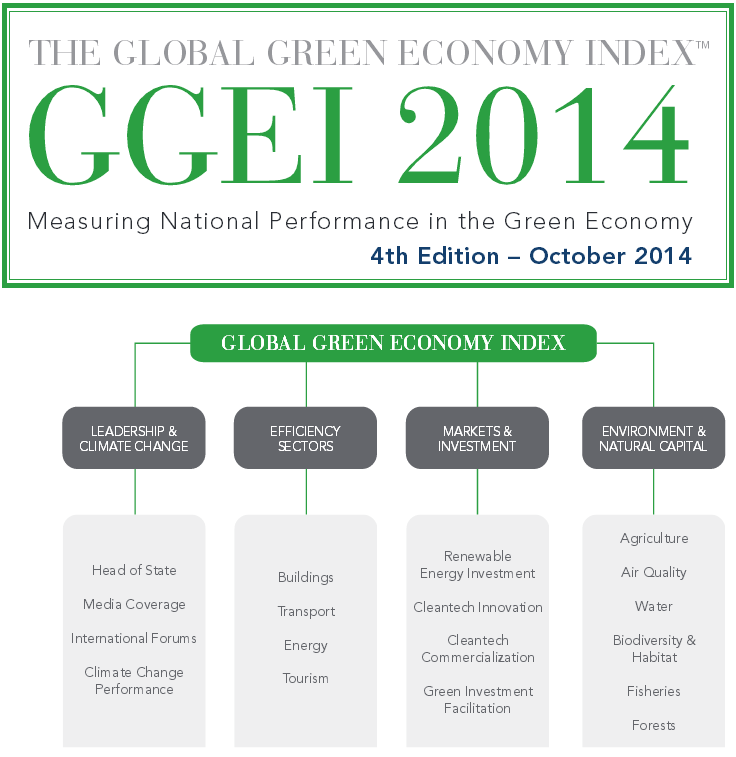
Global Green Economy Index 2014

The 4th edition of the Global Green Economy Index (GGEI) uses data and indicators to rank 60 countries and 70 cities. The report's publisher Dual Citizen LLC measured four dimensions in defining a green economy - political leadership & climate change, efficiency sectors, markets & investment, and environment & natural capital. Their performance and perception calculations reference both public and internally-generated datasets to calculate the rankings.

Here is a summary of their results:

• Germany (perception) and Sweden (performance) top the 2014 GGEI, confirming a trend observed in prior editions of strong results by Germany and the Nordic states. Besides performing well on both the economic and environmental areas of the GGEI, these nations display consistent green leadership and receive global recognition for it.

• Costa Rica performs extremely well, ranking third on the GGEI performance measure behind Sweden and Norway and receiving strong recognition on the perception survey, an impressive result for such a small country. Click here for the complete list of countries.

• Like in 2012, Copenhagen is the top green city as ranked by our survey of global experts, reinforcing the continued strength of the Danish green brand. Tracked for the first time this year, Vancouver and Singapore also rank in the top 10 of green cities.

Emerging Trends

• Many of the fastest growing economies in the world rank poorly on the GGEI performance measure, highlighting an urgent need to reorient their economies to greener growth pathways. Regionally, these countries are mostly in Africa (Ghana), the Gulf (Qatar,United Arab Emirates), and Asia (Cambodia, China, Thailand, Vietnam);

• There are concerning results related to more developed countries as well – notably Australia, Japan, the Netherlands, and the United States – where perceptions of their green economic performance dramatically exceed their actual performance on the GGEI. These countries appear to receive more credit than they deserve, an information gap that requires further exploration;

• Despite its leadership founding the Global Green Growth Institute (GGGI), South Korea continues not to register as a green country brand on our survey and performs poorly, ranked 39th out of 60 on this year’s GGEI. Despite better perception results, Japan also performs poorly on the 2014 GGEI, ranked 44th out of 60;

• While the United Kingdom performs adequately in most areas of the GGEI, it doesn’t excel on any one topic, possibly due to inconsistent political rhetoric and policy related to green economy there. While gradually improving in each successive GGEI edition, the UK still lags behind its northern European and Nordic competitors;

• Five European nations - Austria, Iceland, Ireland, Portugal and Spain – reveal performance scores that exceed their perception ones significantly – signaling an urgent need for better strategic communications and information exchange of their green merits and associated investment opportunities.

• The GGEI results reveal a similar observation for a variety of non-European states - including Ethiopia, Mauritius, Rwanda and Zambia in Africa and Colombia, Chile and Peru in Latin America – again suggesting a need for these states to better position their green economies on the international stage.

The GGEI also suggests how to reorient global growth towards a low carbon, resource efficient pathways. To access the full report click here PDF.

Related
Ranking of National Performance in the Green Economy (GGEI)
Chart - Green Cities Ranking (GGEI)
Chart - Green Investments and Markets National Rankings (GGEI)
Chart - Efficiency National Rankings (GGEI)
Chart - Sustainable Buildings National Rankings (GGEI)
The Best and the Worst Climate Performers (CDP)

Failure to Reduce Emissions will Result in an Ecological and Economic Catastrophe (IPCC's Leaked "Synthesis" Report)

The latest leaked Intergovernmental Panel on Climate Change (IPCC) report reiterates three points that we already know and warns us of dire consequences if we fail to act. Climate change is here, it is caused by humans and it has a number of dangerous impacts. It is noted that extreme weather like heat waves, drought, flooding and rising seas are already serious problems today.

The document specifically states that as greenhouse gas emissions continue to rise we can expect the situation to worsen. This means more "severe, pervasive and irreversible impacts for people and ecosystems."

The report spells out the high level of risk associated with failing to significantly reduce emissions. These risks include sea-level rise causing widespread coastal flooding (effecting 70 percent of the world’s coastlines by the end of the century), more severe and enduring heat waves and droughts, torrential downpours, diminished agricultural yields resulting in widespread food shortages, species extinction and pest outbreaks. Ocean acidification is another major concern that could have serious implications for the entire interrelated web of marine life.

These climate impacts will have major economic and social consequences described in the report as "catastrophic," this includes massive material costs, violent conflicts, environmental refugees and significant increases in global poverty.

The 127 page climate draft of the Synthesis Report (SYN) was leaked at the end of August, it essentially summarizes the findings in the three preceding IPCC reports:

WGI: The Physical Science Basis - September 2013

WG II: Impacts, Adaptation and Vulnerability – March 2014

WG III: Mitigation of Climate Change – April 2014

We have already documented a temperature increase of .85 Celsius since 1880. This is the fastest temperature rise since well before the dawn of human civilization more than 10,000 years ago. It is expected to get much hotter as we go forward.

The report sets the stage for climate talks scheduled for LIma, Peru this coming December and the all important global climate agreement hoped for at the meeting in Paris planned for the end of 2015. In 2009 countries committed themselves to finding solutions that would keep global temperature increases below the internationally agreed upon 2 C (3.6 F) upper threshold limit. Without major reductions in carbon emissions we are on track to substantially exceed this limit. Conservatives estimates suggest that we will see a temperature increases of 3.7 C by the end of the century, which is almost twice the prescribed upper threshold limit.

The leaked report clearly indicates that we are not doing nearly enough to stave off catastrophe, even if we get serious about climate action it will be very difficult to stay within the prescribed upper threshold limits. Perhaps the most sobering fact is that even if we act now, there’s a real risk of “abrupt and irreversible” changes.

The Synthesis Report (SYR) is expected to be finalized and released for review at a Copenhagen meeting scheduled for October.

© 2014, Richard Matthews. All rights reserved.

Related Articles
Video - Review of the Salient Findings in the IPCC AR5 WGll
IPCC AR5 WGll Report: An Impending Climate Catastrophe
Second Quarter of the Fifth IPCC Report Leaked
The Sole Scientist who Disagrees with the Conclusions of the AR5 WGll
Most Recent IPCC Report Omits Green Climate Fund
Hope for Climate Finance and Why We Can't Give Up on UN Climate Talks
Figueres on the Need for a Binding Global Climate Treaty by 2015
Sustainable Development Goals to Follow Millennium Development Goals
Debunking Efforts to Undermine the Latest IPCC Report
IPCC AR5 WGl Summary: Headline Statements from the Summary for Policymakers
Background of the IPCC's Latest Climate Report
The Science in the 2013 IPCC Report: Unequivocal Evidence of Anthropogenic Climate Change
Non-Profit Groups and Scientists React to the Fifth IPCC Report
The Business Community Responds to the 2013 IPCC Report
UN and US Political Reactions to the 2013 IPCC Report
IPCC Charts: Surface Temperatures, Sea Levels and CO2

Latest IPCC Report on the Viability of Fast Actions to Limit Climate Change Including SLCP

The latest Intergovernmental Panel on Climate Change (IPCC) report indicates that many fast actions for addressing climate change are proving to be more affordable than previously imagined. The report is entitled Climate Change 2014: Mitigation of Climate Change, it is the third of three Working Group Reports, which make up the IPCC's fifth Assessment Report.

The report addresses the viability of restricting short lived climate pollutants (SLCP) and also indicates that there are a number of other fast actions that can be taken that will have a dramatic impact on global warming without adversely impacting people's quality of life. They include efforts to improve energy efficiency through new building codes, vehicle efficiency standards and increases in renewable energy. The economic viability of clean energy sources like wind and solar are becoming increasingly obvious as they are becoming cheaper to produce and deploy.

The report highlighted the importance of reducing SLCP to quickly reduce climate change causing emissions. In addition to reducing temperature increases, such measures would protect human health and ecosystems.

Numerous recent studies have shown that addressing short-lived climate pollutants (SLCPs), including black carbon soot, methane, tropospheric ozone, and hydrofluorocarbons can produce significant near-term climate benefits while also improving human health, food security and energy security.

“Cutting short-lived climate pollutants could cut the current rate of climate change in half by 2050, while preventing more than 2.4 million air-pollution related deaths a year, and avoiding around 35 million tonnes of crop losses annually.” stated Durwood Zaelke, President of the Institute for Governance & Sustainable Development. “Cutting SLCPs is one of the best ways to reduce impacts over the next 50 years and beyond.”

The report noted that fast mitigation and co-benefits ‘are particularly high where currently legislated and planned air pollution controls are weak.’

“We have the technologies to cut the short-lived pollutants today,” Zaelke added. “This includes phasing down HFCs under the Montreal Protocol and using other complementary initiatives such as the Climate and Clean Air Coalition to Reduce Short-Lived Climate Pollutants, the only global effort focusing on these pollutants.”

Related Articles
CCAC Celebrates its One Year Anniversary
New Soot Rule Approved by the White House
The Importance of Urgently Addressing SLCP and GHGs
Study Quantifies the Costs of Climate Change Advocates Action on SLCP
Clinton Working to Cut Short-Lived Climate Pollutants
US Secretary of State at the Green Partnership for Growth
EPA's Carbon Pollution Standard
The Climate and Clean Air Coalition to Reduce Short-Term Climate
New Partners of the Climate and Clean Air Coalition
Six Initiatives from the Climate and Clean Air Coalition
Melting Arctic Ice is Releasing Massive Amounts of Methane
Natural Gas is Not Clean Energy

Latest IPCC Report Indicates the World is Headed Towards Unacceptable Temperature Increases

If we continue with business as usual we will see a temperature increase of more than 4ºC above preindustrial temperatures by the end of the century. This is more than double the internationally agreed upon upper temperature limit increase of 2ºC.

According to a report by the Intergovernmental Panel on Climate Change (IPCC) Global greenhouse gas (GHG) emissions increased by the equivalent of ten billion tonnes of carbon dioxide (CO2) between 2000 and 2010. The report entitled Climate Change 2014: Mitigation of Climate Change, is the third of three Working Group Reports, which make up the IPCC’s fifth Assessment Report on climate change.

The report states that we are on track to see temperatures increase of 4.8C above preindustrial times by the end of the century. With half of all human CO2 emissions between 1750 and 2010 having occurred in the last forty years, we are rushing headlong into a climate disaster.

To stay within the 2ºC upper threshold limit we must lower GHG emissions by as much as 70 percent compared to 2010 numbers by mid-century and reaching near-zero emissions by 2100.

© 2014, Richard Matthews. All rights reserved.

Related Articles
Republican Ignorance and the Latest IPCC Report
IPCC Synthesis Report: Background and Summary
Graphs - IPCC Report: CO2, Temperatures and Emissions
Economic Costs of Combating Climate Change (IPCC)
Latest IPCC Report on the Viability of Fast Actions to Limit Climate Change Including SLCP
The Three Most Revealing IPCC Charts
Video - IPCC Report: Fossil Fuels Must be Eliminated by 2100
Failure to Reduce Emissions will Result in an Ecological and Economic Catastrophe
Video - Review of the Salient Findings in the IPCC AR5 WGll
IPCC AR5 WGll Report: An Impending Climate Catastrophe
The Sole Scientist who Disagrees with the Conclusions of the AR5 WGll
Hope for Climate Finance and Why We Can't Give Up on UN Climate Talks
Figueres on the Need for a Binding Global Climate Treaty by 2015

The Leading Clean Energy Nation in Terms of Both Investment and Installed Capacity

Many nations are moving boldly forward with clean energy investments and installations, but there is one nation that has shown unparalleled leadership for the last several years. The clean energy global investment total for 2013 is about $254 billion and one nation is responsible for more than one fifth of this amount. This nation is leading renewable energy investments and dominating solar and wind installations. They installed more solar and wind capacity in 2013 than any other nation on Earth.

The most recent data gives China the distinction of being the world's clean energy leader. According to the Pew Charitable Trusts’ latest report titled "Who’s Winning the Clean Energy Race?," China made more investments and deployed more clean energy than any other country in the world in 2013. They invested a whopping total of $54.2 billion and installed 191 gigawatts (GW) of renewable energy capacity. Despite a strong year the US came in second with 138 GW of installed capacity.

According to Bloomberg China installed between 12 and 14 GW of photovoltaic (PV) projects in 2013. This is a global record beat out its nearest competitor by one third and more than tripled US totals. China's installed PV capacity for 2013 beat out Germany's record of 7.6 GW which was set in 2012. The US installed about 4.2 GW of PV capacity in 2013.

Chinese firms now dominate the global solar market. Three firms in particular are leading the world, they are China Power Investment Corp., China Three Gorges and China Huadian Corp.

This prodigious solar growth shows no signs of letting up in 2014. The Chinese government plans to add an additional 14 GW of PV capacity this year more than half of which will come from rooftop installations connected to the distribution grid.

When it comes to wind power China is also a dominant player. China has been the world’s biggest wind power market for years. In 2012, the nation increased its wind production by 41 percent. In 2013, China led the world by installing more than 16 GW of wind power last year. This is exponentially more than the number two and three spots for installed wind capacity in 2013. Germany installed 3.2 GW in 2013 and the UK installed 1.8 GW last year.  In fact China's totals for 2013 are considerably more than the combined totals for the rest of the top ten nations in the world (16 GW vs. 12. GW)

China's total installed wind capacity is now at 91.4 GW. The next closest competitors are the US with a total installed capacity of 61 GW, followed by Germany with 34 GW.

Due to the government's ongoing commitment to wind, China will remain a world leader. They have raised the official wind target for 2020 to 200GW.

Related
Global Green Economy Index 2014
Ranking of National Performance in the Green Economy (GGEI)
The Best and the Worst Climate Performers (CDP)
National Laws and a Global Climate Agreement
Denmark's Climate Change Bill
Obama's End Run Around the Senate to Secure a Climate Deal
Finland's New Legislation will Reduce Emissions by 80%
Why France is a Global Climate Leader
Video - Iran's Solar Power Revolution
The Sustainability Yearbook 2013 Leading Countries
Global CO2 Emissions Data for 2011 from the CDIAC
Carbon Rankings from the Environmental Investment Organization
Video: Top 10 Greenest Countries
10 Countries for Green Investments
10 Leading Wind Energy Countries