Showing posts with label media. Show all posts

Trump's America: State of Lies

Donald Trump deflects, distracts and exaggerates, but he is best known for his straight out lies. He has proven to be a master of the double-down. When he is caught lying he just lies some more. Even before he took office the New York Times wrote a piece titled, "Trump, Trapped in His Lies, Keeps Lying. Sad!". It is indeed sad, but the understandable outrage at his repeated deceptions misses the point.

Dishonest Don's malfeasance will live in infamy, however, his mendacity serves a darker end-game then most people realize. The unreality king lies to muddy the waters making it hard for casual observers to understand the issues, and that is the point.

The liar-in-chief has repeatedly deceived the American people and his own staff. The spin king lies about his business, he lies about his policy positions and now we know beyond a shadow of a doubt that he lies about his philandering.

Trump's lying quite likely started shortly after his birth.  Since then he has lied about his education and his achievements as a private citizen. He continued to lie as a candidate for president, he lied as president-elect and kept on lying after inauguration day and throughout his first year and a half in office. There is every reason to believe that he will keep on lying until the very end.

Forrest Trump may not be the sharpest tool in the shed but he has shown a commitment to subterfuge never before seen in the Oval Office. He may be a snake oil salesman but he is also the most accomplished charlatan the world has ever known. In his book the 70 year old sociopath-toddler dubbed his deceit with the equally deceptive moniker "truthful hyperbole".

Many expected that Trump's presidency would be defined by subterfuge. Washington Post Media Columnist Margaret Sullivan, correctly predicted that Trump’s presidency would be a "hellscape of lies and distorted reality." Just days after the fraud of fifth avenue declared victory Politico warned that democracy was in the cross-hairs.

Trump told dozens of lies on the campaign trail and according to the Washington Post he lied more than 300 times in his first hundred days in office.  In his first six months Trump is reported to have lied 414 times. By August the Washington Post claimed that Trump lied more than 1000 times and by May 2018 Trump is reported to have made 3,251 false or misleading claims. Even members of his own party, including Bob Corker, have called Trump a liar. Corker said Trump is an, "utterly untruthful president".

Given his propensity for dishonesty it should come as no surprise that Trump has not kept his campaign pledges. A Huffpost article lists at least a dozen broken promises and Robert Reich reviewed 20.

To support his alternate reality the golden wrecking ball is waging war against those who could expose his lies, namely science and the free press. Shortly after declaring victory Trump floated the idea of not having a White House press office, doing no press briefings, closing down the White House press room, and only having a single pool reporter covering the president. In March 2017 Trump barred media outlets that did not give them favorable coverage and then in May Trump said he was going to end White House press briefings altogether, because "it is not possible" for his staff to speak with "perfect accuracy" to the American public. On July 25th CNN reporter Kaitlan Collins was barred from attending an Open Press event in the Rose Garden because the Trump administration did not like the questions she asked.

The only way we can face this well honed turpitude is by judiciously confronting their lies in all their forms.  Fact based reporting is our best weapon against corrupt, self serving politicians. The press is key and journalists know what they have to do. They have learned how to fight fake news and how to cover Trump

Despite this administration's efforts there is reason to believe that mainstream media is winning the war.  As of April 2017 Trump saw a 17 percent decline in the number of voters that believed him. Although his lies have accelerated, a June Public Policy Poll (PPP) reveals that more than half of Americans believe mainstream media while only a bit more than a third believe Trump. According to another recent poll, 61 percent of Americans think Trump regularly has trouble telling the truth. Americans do not appear to be as gullible as the commander and chief would like them to be.

Nonetheless, the sheer volume of deceit is hard to keep up with and that is a central component of Trump's strategy. As explained in a Politico article, Trump's lies are meant to confuse: "When we are overwhelmed with false, or potentially false, statements, our brains pretty quickly become so overworked that we stop trying to sift through everything." This is sometimes called cognitive load and it is how the nation's chief deceiver short circuits the truth. To posit a message he wants to impart he simply repeats the lie endlessly to create something called illusory truth.

Trump obfuscates in many ways. He commonly says one thing than does another. This allows him to portray himself as somewhat moderate while ultimately reverting to a far more partisan position. Gun safety and DACA are but two examples. He often says two diametrically opposed things in close succession or all at once. His comments about Charlottesville illustrate this point, "there are fine people on both sides" the new furor infamously said after neo-Nazis clashed with demonstrators. However, there is no better example than his relationship with Russian strongman Vladimir Putin.

Multiple branches of US intelligence have repeatedly made it clear that under Putin's direction, Russia meddled in the election in 2016 to help elect Trump.  Putin's pet initially dismissed this assessment then under pressure he seemed to change his mind. Since then Benedict Donald has flip-flopped on this issue many times.

Trump recently ignited a firestorm of controversy when he stood next to Putin in Helsinki and said, "he sees no reason why Russia would meddle". When faced with bipartisan criticism he offered yet more double speak. Reading from a script he claimed that instead of using the word "would" he misspoke and used the word "wouldn't". However, the boychurian candidate immediately went off script and added, "could have been other people also".

Although his staff tried to re-frame his comments the meeting with the press ended with Trump saying "no" in response to a question about Russia's ongoing meddling. However, this is at odds with the bipartisan consensus that the Russians continue to meddle as we head into the midterm elections of 2018. 

Captain Chaos also likes to control the narrative by co-opting the criticisms leveled against him. He accuses others of the very thing he is guilty of.  He rails against "fake news" when he is its leading purveyor.  While on the campaign trail Don the Con accused the Democrats of collusion with the Russians and he was also fond of calling Hilary a "crook". Most recently he has suggested that Russia may be trying to hack the midterm elections to favor the Democrats.

When Hilary called Trump "Putin's puppet" during a debate Trump responded with the rapier wit of a 9 year old saying, "your the puppet". Trump acts like a disturbed child and a bully, unless he is in the presence of Putin, then he cowers like a chastened school-boy. Most Americans are troubled by his subservience and they object to his overt pandering. According to a recent poll 64 percent of Americans think Trump is not tough enough on Russia.

It may be months before we learn what Putin has on Trump. Whether it is money from Russian oligarchs or a pee-pee tape, the world is reeling from his supplication. Whatever form of coercion is at play undermining the truth is a vital component of this strategy. Putin's control over the leader of the free world is ultimately meant to sew discord and breed chaos.

As President Obama explained in a speech commemorating the 100th birthday of Nelson Mandala, authoritarian populist leaders reject objective reality and put self serving false narratives in their place. Obama sounded the alarm about the dangers of disconnecting policy from the facts.

Trump's Environmental Protection Agency (EPA) offers the best example of policy un-tethered to the truth. Under Trump's leadership, former EPA administrator Scott Pruitt declared war on science and he obfuscated to justify policy positions like opposing the Paris Climate Accord and the Clean Power Plan. Although the science proving anthropogenic climate change is clear, Pruitt referenced pseudo-science to cast aspersions on the overwhelming body of evidence. Pruitt's contempt for science was part of his strategy to execute a politically motivated policy agenda that panders to polluters.  

Trump shares Pruitt's aversion to science. He is the only president in modern history who has opted to do without a science advisor and his disdain for science precludes informed policy.

Disparaging science makes it easier for politicians to line their pockets by making policy decisions that serve industry. This is particularly true of the fossil fuel industry. Elected leaders have been complicit with big polluters through campaigns of disinformation that have caused people to question the veracity of climate change. This deceptive message gets amplified by conservative spin masters and after time the lie assumes the air of a legitimate point of view.

Dictators have long understood the power of using contradictory information to muddy the waters of reality. Successful despots undermine the prevailing narrative and replace it with a countervailing narrative that suits their political ends. Nazi propaganda minister Joseph Goebbels said, "If you repeat a lie often enough, it becomes the truth."  In Mein Kampf, Adolf Hitler described a propaganda technique known as "the big lie". These deceptive techniques bear a striking resemblance to Trump's application of truthful hyperbole.

Trump's immigration policy and his remarks in the wake of the Charlottesville tragedy have led many to conclude that Trump is a fascist carnival barker.  However, his thinly veiled racism is about more than just contempt for certain ethnic groups. Trump along with his White Power advisor Stephen Miller have crafted an immigration policy that recapitulates an age old formula of social control. Vulnerable minorities have been singled out and vilified by countless regimes throughout history. Stoking fears causes people to coalesce around hatreds that unify a political movement.

The Trump administration does not deserve all the credit, Republicans have been playing this game for years, albeit with more subtlety. Long before Hair Trump was the Republican nominee, the GOP was working to marginalize voting blocs that represent a threat to their hold on power. We see evidence of this in both voter suppression and gerrymandering (aka redistricting).

Trump may be the predictable endpoint of Republicanism but not so long ago the GOP was doing everything in its power to keep the gossamer-skinned bully from being the nominee. Now they are working with the rabble-rousing demagogue to achieve their own destructive agenda. They have already succeed in killing climate action and passing a tax-scam. Their next big agenda item will see legislation that will include massive cuts to social security, medicare and medicaid.

There is no doubt that much of what the riptide of regression says is driven by pathological narcissism, however he is also advancing a sinister agenda.  Trump's former chief advisor Steve Bannon is a leading advocate of this dystopia and although he no longer works for the president, the influence of his ideology remains.

Trump lies first and foremost to serve his ego, but this two-bit Caesar's obfuscation is also tied to a devious plot to sabotage democracy. The goal is to kill the basic idea of truth so that false self-serving narratives can flourish. He has already succeeded in undermining domestic and global institutions that have served peace and prosperity since the end of the second world war. If his lies prevail they will replace western liberal democracy with an authoritarian rule that will kill the basic freedoms we take for granted.

Related
The Importance of Fact Based News to Combat Trump's Lies
Trump's Litany of Lies Captured on Video
Why Trump Hates Traditional Journalism and Loves Digital Media (Videos)
Trump Battles with CNN over the Existence of Reality
How Conservatives Use Fake News to Control the Narrative
Trump and the Darkness of Post-Factual Media
Fake News is Serious but so are Efforts to Combat it
The Science of Storytelling: Making Facts Matter in a Post-Factual World
The Media Prevents Trump from Escaping His Lies
How to Fight the Trump Administration and Fake News
Trump's Denial of Reality Makes Him Putin's Puppet
Trump's Trade Wars and Love for Despots: Why Environmentalists are Not the Only Ones Who Should Fear the Rise of Populism

Anti-Science Journalism Helped to End Progressive Climate Governance in Australia

The popular media's campaign of climate change subterfuge helped to bring down Julia Gillard's government in Australia. Anti-science propaganda has been rampant in the Australian press. A number of extreme weather events (droughts and floods) succeeded in drowning out the voices of those that oppose action on climate change and helped Gillard to get elected in 2010.  Subsequently a determined anti-science media campaign eroded Gillard's popularity and ultimately led to her downfall.

Popular media has flouted their journalistic responsibilities on climate change. A widespread campaign against Australia's carbon policy was adopted by the company that controls most Australian metropolitan newspapers. According to a 2013 study of climate science in newspapers,  the coverage of the Gillard government’s carbon policy was mostly negative (73 per cent to 27 per cent). Negative coverage (82 per cent) across News Ltd newspapers far outweighed positive (18 per cent) articles. The Daily Telegraph was the most negative (89 per cent). The Daily Telegraph has since continued its campaign against Sydney Lord Mayor Clover Moore and bike riders.

Rupert Murdoch's media empire pushes an editorial slant with an anti-environment agenda. Nowhere was this more evident than in Australia where Murdoch's tabloids regularly derided Gillard and her government's climate policy.

According to a 2011 report, Australia's climate change coverage is rife with anti-science skepticism.  This report indicates that there was considerable hostility to the Gillard government climate-change policy particularly in Murdoch's tabloids.

The impact of these media attacks adversely impacted the public's perception of carbon pricing and helped cause the ruling government's popularlity to plummit to historic lows. Ultimately the Gillard government fell.

The net result of this biased news coverage was that Australia's progressive climate policies were replaced by a climate denying government led by Tony Abbott.  

Anti-science media coverage contributes to climate change misinformation and prevent progressive governments from getting elected. As the fall of the Gillard government illustrates, they can also help unseat standing governments.

© 2013, Richard Matthews. All rights reserved.

Related Articles
New Australian PM Vows to Kill the Nation's Green Dream
Why Greens are Seeing Red in the 2013 Australian Elections
New Report on Extreme Weather in Australia
Sustainable Australia Report 2013
Australia's National Solar Schools
Clean Energy Week in Sydney Australia
Video: Putting a Price on Carbon in Australia
Popular Media is Distorting the Facts about Climate
Popular Media is to Blame for Inaction on Climate Change
The Persecution of EnvironmentalistsCambodian Environmentalist Murdered
Environmental Problems and Activists Struggling Against Abuse (Video)Environmental Advocacy Through Citizen Journalism

Greenpeace Toxics Campaigner John Deans Talks Campaign Strategy

In an interview with Brandchannel, Greenpeace Toxics Campaigner John Deans made it abundantly clear that there is a new highly effective approach that is taking businesses to task for their irresponsible practices. These Greenpeace campaigns are putting the extraordinary power of social media to work for the environment.

“We’re not your grandfather’s Greenpeace anymore," Deans told Brandchannel. "We’re part of a new, building movement with a new set of people who are social media denizens. Brands see it’s not going away and that Greenpeace is communicating directly with their customers."

Deans remarked about how quickly social media messages can be disseminated, “Social media tools have let Greenpeace latch on to the viral nature of online society – and find where people are in order to spark their interest.”

Greenpeace is writing the proverbial book on how to use digital technologies for issues of environmental and social justice. As explained by Brandchannel, "the organization is now a master class in how social media activism can bridge real world physical protests, with a digital call-to-action and sophisticated, cross-channel campaigns giving people to persuade brands to step up and walk their talk."

One of the more powerful aspects of Greenpeace's social media strategy involved they way they co-opt the logos and catch phrases of popular brands.

“Companies and brands are major icons for people, prevalent and ingrained through the media. We use their logos and messaging to show the other side of the coin, ‘here’s the dirty secret’ associated with that branding,” Deans said.

Related Articles
Greenpeace's Consumer Powered Pressure Campaigns
Why a Dozen Clothing Giants Have Bowed to Greenpeace
Levi's Bows to Greenpeace Pressure
Greenpeace Succeeds in Forcing Zara to Detox
Greenpeace's Consumer Powered Pressure Campaign Targets Levi's (Video)
ZARA Mannequins Revolt! (Video)
Waitrose Bows to Greenpeace Pressure
Greenpeace Turns 40
Lego and Mattel Bow to Greenpeace Pressure and Eliminate Unsustainable Packaging
Nike and H&M Bow to Greenpeace's Detox Challenge
Social Action Driving Businesses to Adopt Sustainable Practices
Cooperation Between Environmental Organizations and Businesses
Greenpeace and the Revolutionary Power of Social Media Driving Corporate Changes
Social Action Driving Businesses to Adopt Sustainable Practices
Surveys of America's Greenest Brands Suggest that Redemption
Greenpeace Exposes the Koch Brothers
Greenpeace Campaign is Asking Facebook to Defriend Coal
Greenpeace's Ranking of Electronic Companies
Greenpeace's Best Green Electronics
Greenpeace's G20 Checklist
Video: Greenpeace Spoofs Volkswagen's Dark Side

Greenpeace's Consumer Powered Pressure Campaigns

Greenpeace is waging very effective pressure campaigns that reach out directly to customers. Greenpeace encourages their supporters to take direct action and voice their concerns. Greenpeace has come a long way from their beginnings in the early 70s; in addition to protests and demonstrations, they are now using digital technologies to widely disseminate their message. Social media figures prominently in the Greenpeace strategy. These Greenpeace campaigns co-opt the brand message of the companies they are targeting.

These efforts are clearly working as a wide assortment of companies have capitulated to Greenpeace's savvy digital campaigns. Through these campaigns a number of companies have been forced to adopt more responsible business practices. Brands monitor social media as closely as they monitor traditional media, and they cannot ignore the hundreds of thousands of people that like, share, comment on, or promote Greenpeace efforts. By amplifying the voices of ordinary people around the world Greenpeace is sending a powerful message.

This is truly a grassroots initiative as Greenpeace staff and activists all around the world are driving media production all without help from an outside marketing firm. This work is done by ardent foot soldiers who care passionately about the Greenpeace's environmental mission.

In addition to a wide assortment of clothing brands, Greenpeace has succeeded in pressuring a number of other companies including Trader Joe'sLego and Mattel.

Fashion Detox Campaign

On December 5th, Greenpeace launched its “Toxic Threads: Under Wraps” report. They have also posted a video about their Detox campaign and released a Detox Fashion Manifesto. Greenpeace's "Fashion Detox" pressure campaigns are changing the fashion industry one major brand at a time. Thus far a dozen clothing brands have bowed to Greenpeace pressure.

More than 400,000 people have joined the Detox campaign since they re-launched in November, demanding toxic-free fashion and clean water. Fashionistas, activists, designers and bloggers took action on Twitter and Weibo, spreading news about the industry’s toxic addiction and reaching many millions of friends and followers.

These efforts have resulted in changes at some of the biggest brands in the fashion industry. Through Greenpeace efforts these major fashion labels have agreed to reduce their environmental impacts.

Since the campaign started in 2011, the organization has convinced 11 clothing brands to commit to stop releasing toxic chemicals into the environment.

This campaign has succeeded in "detoxing" a dozen of the world's biggest clothing brands including Nike, H&M, Adidas, Puma, M&S, C&A, Li-Ning, Zara, Mango and Esprit and now Levi's.

Familiar brands like Calvin Klein, GAP and Victoria’s Secret are still being targeted by Greenpeace as part of their goal of exposing brands that use hazardous substances.

Levi's Campaign

The Levi’s campaing produced results after just eight days by creating a digital groundswell with more than 210,000 people calling on the company to Detox, and tens of thousands taking action on Facebook and Twitter.

Activists and volunteers also took to the street in over 20 countries to take the message directly to the brand’s customers and to speak with the staff working in their stores, who sent the message back to Levi’s HQ. Over 700 people protested outside Levi’s shop fronts in 80 cities around the world. One of the Greenpeace actions involved a demonstration at Levi headquarters in Mexico. Protestors created a foam river to symbolize the foam created in Mexico's rivers by Levi's toxic effluents.

Greenpeace also hosted a screening of a documentary about a family struggling to hold factories in the region to account for the pollution they are causing, including suppliers of brands like Levi’s.

Greenpeace co-opted Levi's own marketing language with the Twitter hashtags "#GoForth and #Detox!".

Waitrose Campaign

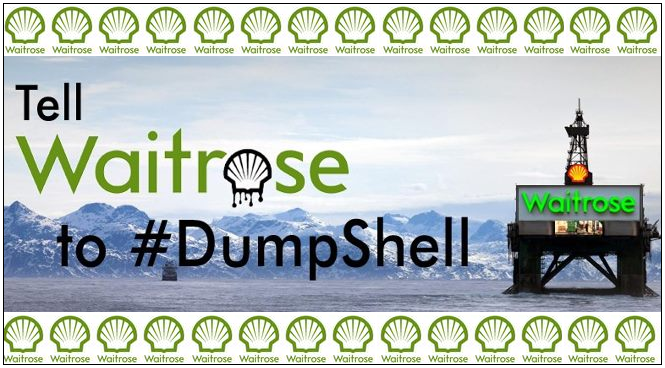
As the campaign against Waitrose demonstrated, company's are being held accountable not only for their own business practices but they are also being taken to task for who they do business with. Waitrose opened two pilot store in shell stations but after only 12 days of Greenpeace protests they were forced to abandon expansion plans.

The Greenpeace campaign targeting Waitrose campaign featured a “social media meltdown,” they garnered 40,000 emails, posted a video spoof on YouTube, and collected hundreds of angry Facebook posts. Over the summer Greenpeace created a social media response team that co-opted Shell's logo and branding. This initiative included a hoax Shell web site, ArcticReady.com, which criticized the company’s plans to drill in the Arctic.

At the London store in Islington they featured a life-size polar bear representing the threat posed to local fauna by Shell's Arctic drilling.

Companies that fail to take responsibility for the pollution created along their entire supply chain are increasingly exposed. The rising tide of people power is changing the face of business and companies are being forced to recognize and act upon these popular consumer driven campaigns.

© 2012, Richard Matthews. All rights reserved.

Related Articles
Why a Dozen Clothing Giants Have Bowed to Greenpeace
Greenpeace Toxics Campaigner John Deans Talks Campaign Strategy
Levi's Bows to Greenpeace Pressure
Greenpeace Succeeds in Forcing Zara to Detox
Greenpeace's Consumer Powered Pressure Campaign Targets Levi's (Video)
ZARA Mannequins Revolt! (Video)
Waitrose Bows to Greenpeace Pressure
Greenpeace Turns 40
Lego and Mattel Bow to Greenpeace Pressure and Eliminate Unsustainable Packaging
Nike and H&M Bow to Greenpeace's Detox Challenge
Social Action Driving Businesses to Adopt Sustainable Practices
Cooperation Between Environmental Organizations and Businesses
Greenpeace and the Revolutionary Power of Social Media Driving Corporate Changes
Social Action Driving Businesses to Adopt Sustainable Practices
Surveys of America's Greenest Brands Suggest that Redemption
Greenpeace Exposes the Koch Brothers
Greenpeace Campaign is Asking Facebook to Defriend Coal
Greenpeace's Ranking of Electronic Companies
Greenpeace's Best Green Electronics
Greenpeace's G20 Checklist
Video: Greenpeace Spoofs Volkswagen's Dark Side

Waitrose Bows to Greenpeace Pressure

In less than 2 weeks Greenpeace succeeded in getting UK supermarket Waitrose to rethink its partnership with Shell. The Greenpeace campaign targeted Waitros' stores in Shell gas stations because of the oil company’s plans to drill in the Arctic. This decision means Waitrose has shelved plans to expand on the number of  stores in Shell gas stations. Waitrose currently has two pilot stores and had planned on adding more in 2013. Yet again this underscores the power of consumer driven campaigns to influence the business practices of major brands.

The partnership between Waitrose and Shell is hypocritical when you consider that Waitrose is a company that had previously worked with Greenpeace to develop its sustainable fishing policies.

Waitrose illustrates just how dangerous it can be for companies who try to show concern for the environment on the one hand while irresponsibly pursuing profits on the other. Greenpeace originally lauded Waitrose for establishing an Arctic Sanctuary and then was forced to criticize the company after it forged a partnership with the dirty energy giant.

© 2012, Richard Matthews. All rights reserved.

Related Articles
Greenpeace's Consumer Powered Pressure Campaigns
Why a Dozen Clothing Giants Have Bowed to Greenpeace
Greenpeace Toxics Campaigner John Deans Talks Campaign Strategy
Levi's Bows to Greenpeace Pressure
Greenpeace Succeeds in Forcing Zara to Detox
Greenpeace's Consumer Powered Pressure Campaign Targets Levi's (Video)
ZARA Mannequins Revolt! (Video)
Greenpeace Turns 40
Lego and Mattel Bow to Greenpeace Pressure and Eliminate Unsustainable Packaging
Nike and H&M Bow to Greenpeace's Detox Challenge
Social Action Driving Businesses to Adopt Sustainable Practices
Cooperation Between Environmental Organizations and Businesses
Greenpeace and the Revolutionary Power of Social Media Driving Corporate Changes
Social Action Driving Businesses to Adopt Sustainable Practices
Surveys of America's Greenest Brands Suggest that Redemption
Greenpeace Exposes the Koch Brothers
Greenpeace Campaign is Asking Facebook to Defriend Coal
Greenpeace's Ranking of Electronic Companies
Greenpeace's Best Green Electronics
Greenpeace's G20 Checklist
Video: Greenpeace Spoofs Volkswagen's Dark Side

Greenpeace's Consumer Powered Pressure Campaign Targets Levi's (Video)

ZARA Mannequins Revolt! (Video)


As part of Greenpeace's global "Detox" campaign, more than 700 people, in over 80 cities, in 20 countries around the world protested, staged street theatre and conducted "mannequin" walk-outs to demand ZARA commit to eliminating the use of all hazardous chemicals throughout its supply chain. The participants, from Bangkok to Buenas Aires, also called on ZARA store managers to forward Greenpeace's Detox demands to their headquarters, after new research found traces of hazardous chemicals in ZARA clothing items, some of which can break down in the environment to become hormone-disrupting or even cancer-causing substances.

To find out more, and to join the campaign demanding fashion without pollution, click here.

Related Articles
Greenpeace's Consumer Powered Pressure Campaigns
Why a Dozen Clothing Giants Have Bowed to Greenpeace
Greenpeace Toxics Campaigner John Deans Talks Campaign Strategy
Levi's Bows to Greenpeace Pressure
Greenpeace Succeeds in Forcing Zara to Detox
Greenpeace's Consumer Powered Pressure Campaign Targets Levi's (Video)
Waitrose Bows to Greenpeace Pressure
Greenpeace Turns 40
Lego and Mattel Bow to Greenpeace Pressure and Eliminate Unsustainable Packaging
Nike and H&M Bow to Greenpeace's Detox Challenge
Social Action Driving Businesses to Adopt Sustainable Practices
Cooperation Between Environmental Organizations and Businesses
Greenpeace and the Revolutionary Power of Social Media Driving Corporate Changes
Social Action Driving Businesses to Adopt Sustainable Practices
Surveys of America's Greenest Brands Suggest that Redemption
Greenpeace Exposes the Koch Brothers
Greenpeace Campaign is Asking Facebook to Defriend Coal
Greenpeace's Ranking of Electronic Companies
Greenpeace's Best Green Electronics
Greenpeace's G20 Checklist
Video: Greenpeace Spoofs Volkswagen's Dark Side

Why a Dozen Clothing Giants Have Bowed to Greenpeace

There are powerful financial incentives that drive corporations to agree to the demands of organizations like Greenpeace. The customers moral concerns can undermine sales and thus it is very directly impacts the bottom line. A dozen clothing brands have now accepted Greenpeace demands to detox and before this there were campaigns directed against KFC, Shell, Mattel and Lego. Through its “Toxic Threads: Under Wraps” report, Greenpeace spurred a global movement that is succeeding in detoxing some of the major players in the clothing industry.

At least twelve clothing companies have decided to heed Greenpeace demands and reduce their environmental impacts including Mango, Esprit, Nike, H&M, Adidas, Puma, M&S, C&A, Li-Ning, Zara and now Levi’s.

This is not only a victory for Greenpeace and the environment it is also a victory for the companies that agree to be detox leaders. This can be a win-win scenario because these campaigns yield real environmental benefit and they help a companies to adopt more sustainable and solvent business practices.  By adopting more responsible business practices they position themselves in a way that improves their competitiveness, enhances their reputation and mitigates against the risks posed by disgruntled consumers and investors.

Why have a dozen major brands acquiesced to Greenpeace demands? The answer is simple, because the benefits of saying "yes" outweighs the costs of saying "no."

However, there is more to this picture than customer loyalty and investor confidence. These actions also have implications beyond the companies being targeted; the repercussions are felt in the wider business community.

In its simplest essence corporations are coming to understand that while there are costs there are also merits to complying with Greenpeace demands. The price of ignoring Greenpeace can prove prohibitive

Resistance to Greenpeace demands poses a very real risk to a corporations bottom line. Companies like Calvin Klein, Gap, and Victoria’s Secret, that continue to resist Greenpeace demands are vulnerable to a consumer backlash.

Greenpeace pressure can be a public relations fiasco for the company being targeted, but by complying with demands to be more environmentally responsible, a company can transform itself into an environmental leader.

Make no mistake about it Greenpeace does use a big stick, but there is a carrot here as well.

© 2012, Richard Matthews. All rights reserved.

Related Articles
Greenpeace's Consumer Powered Pressure Campaigns
Greenpeace Toxics Campaigner John Deans Talks Campaign Strategy
Levi's Bows to Greenpeace Pressure
Greenpeace Succeeds in Forcing Zara to Detox
Greenpeace's Consumer Powered Pressure Campaign Targets Levi's (Video)
ZARA Mannequins Revolt! (Video)
Waitrose Bows to Greenpeace Pressure
Greenpeace Turns 40
Lego and Mattel Bow to Greenpeace Pressure and Eliminate Unsustainable Packaging
Nike and H&M Bow to Greenpeace's Detox Challenge
Social Action Driving Businesses to Adopt Sustainable Practices
Cooperation Between Environmental Organizations and Businesses
Greenpeace and the Revolutionary Power of Social Media Driving Corporate Changes
Social Action Driving Businesses to Adopt Sustainable Practices
Surveys of America's Greenest Brands Suggest that Redemption
Greenpeace Exposes the Koch Brothers
Greenpeace Campaign is Asking Facebook to Defriend Coal
Greenpeace's Ranking of Electronic Companies
Greenpeace's Best Green Electronics
Greenpeace's G20 Checklist
Video: Greenpeace Spoofs Volkswagen's Dark Side

Levi's Bows to Greenpeace Pressure

After a mere 8 days of pressure from Greenpeace, Levi's has agreed to become more environmentally responsible. Greenpeace alleged that Levi’s suppliers are some of the worst water polluters in the Mexican textile industry. The denim behemoth has said it will stop polluting Mexico's rivers and the company further agreed to eliminate the release of all hazardous chemicals in its manufacturing process by 2020.

There have been a number of Greenpeace actions that have encouraged Levi's change of heart. Hundreds protested outside Levi’s shop fronts in 80 cities around the world and in one demonstration at Levi's headquarters in Mexico, Protesters covered the area in foam to symbolize the toxic effluents that Levi's released into the country's rivers.

In a December 12, 2012 document Levi's agreed to eliminate all releases of hazardous chemicals throughout its entire supply chain by 2020. The company has further agree to replace all hazardous chemicals with non-hazardous alternatives.

The company announced that it will begin requiring 15 of its largest suppliers in China, Mexico and elsewhere to disclose pollution data by June 2013, followed by disclosure from 25 more suppliers by the end of 2013. By 2020, it vows to have zero discharge of toxic chemicals from any Levi’s manufacturing facilities.

Although there will be a price to these commitments, there will also be benefits to the company's brand.  The  rapid capitulation of the world’s largest denim brand demonstrates just how fast a company can journey from environmental pariah to eco-leader.

To see Levi's Greenpeace Solution Document (pdf) click here.

© 2012, Richard Matthews. All rights reserved.

Related Articles
Greenpeace's Consumer Powered Pressure Campaigns
Why a Dozen Clothing Giants Have Bowed to Greenpeace
Greenpeace Toxics Campaigner John Deans Talks Campaign Strategy
Greenpeace Succeeds in Forcing Zara to Detox
Greenpeace's Consumer Powered Pressure Campaign Targets Levi's (Video)
ZARA Mannequins Revolt! (Video)
Waitrose Bows to Greenpeace Pressure
Greenpeace Turns 40
Lego and Mattel Bow to Greenpeace Pressure and Eliminate Unsustainable Packaging
Nike and H&M Bow to Greenpeace's Detox Challenge
Social Action Driving Businesses to Adopt Sustainable Practices
Cooperation Between Environmental Organizations and Businesses
Greenpeace and the Revolutionary Power of Social Media Driving Corporate Changes
Social Action Driving Businesses to Adopt Sustainable Practices
Surveys of America's Greenest Brands Suggest that Redemption
Greenpeace Exposes the Koch Brothers
Greenpeace Campaign is Asking Facebook to Defriend Coal
Greenpeace's Ranking of Electronic Companies
Greenpeace's Best Green Electronics
Greenpeace's G20 Checklist
Video: Greenpeace Spoofs Volkswagen's Dark Side

Calendar of Environmental Events 2012

FEBRUARY

February 2 : World Wetlands Day
February 20 : World Day of Social Justice

MARCH

March 14 : International Day of Action Against Dams and For Rivers, Water and Life
March 21 : World Forestry Day
March 22 : World Water Day
March 23 : World Meteorological Day
March 26 : Earth Hour

APRIL

April 7 : World Health Day
April 22 : Earth Day
April 29 : Arbor Day (Different nations have different tree planting days)

MAY
May 5: Climate Impact Day (Connect the Dots)
May 12 : World Fair Trade Day (2nd Saturday of May)
May 14-15 : International Migratory Bird Day (Second Weekend each May)
May 22 : International Day for Biological Diversity (Theme for 2012: Marine Biodiversity)

JUNE

June 5 : World Environment Day (Theme for 2012: Green Economy)
June 8 : World Oceans Day
June 15 : Global Wind Day
June 17 : World Day to Combat Desertification
June 20 : World Refugee Day
June 15-18 : Rio+20 Corporate Sustainability Forum

JULY

July 10 : International Happiness Day
July 11 : World Population Day

AUGUST

August 9 : International Day of the World’s Indigenous People
August 12 : World Youth Day
August 19 : World Humanitarian Day
August 26 : World Kitchen Garden Day
August 29 : International Day Against Nuclear Tests

SEPTEMBER

September 15: International Coastal Cleanup Day (3rd Saturday of September)
September 2 : World Car-Free Day

OCTOBER

October : TBA International Day of Climate Action by 350.org
First Week of October: Junk Mail Awareness Week
October : Non GMO Month
October 1 : World Vegetarian Day
October 3 : World Habitat Day
October 4 : World Animal Day
October 16 : World Food Day
October 27 : World Paper Free Day

NOVEMBER

November 1 : World Vegan Day
November 19 : World Toilet Day
November 21 : World Fisheries Day

November 23/24 : Buy Nothing Day (Friday after Thanksgiving Day in US and the day after internationally)

NOVEMBER & DECEMBER

November 26 to December 7 : UNFCCC COP 18 Climate Change Conference to be held at Qatar

DECEMBER

December 9 : International Day against Corruption
December 10 : Human Rights Day and International Animal Rights Day
December 11 : International Mountain Day (for Indigenous peoples)

© 2012, Richard Matthews. All rights reserved.

Related Posts
Calendar of Global Environmental Events - Spring
Calendar of Global Environmental Events - Summer
Calendar of Global Environmental Events - Fall

Cyber Monday 2010

Cyber Monday 2010
Green Gift Monday

In 2010, Cyber Monday takes place on November 29, and it is the biggest online shopping day of the year. On this day buyers are shopping online to take advantage of the deals offered on the web. This year a record breaking one billion dollars was spent online.

Online shopping is generally a greener way to shop, this is due to the fact that trucks can deliver goods efficiently and it takes a lot less energy to run a warehouse for boxes of goods than a mall.

According to a 2007 survey done by Conservation International, more than one-third of consumers indicated they will shop more online and in catalogs to save on gas.

The National Retail Federation (NRF) said that 70.1 million people plan to take advantage of 2010 Cyber Monday deals. The NRF also estimated that 88% of retailers will have special deals. Web retailers offer big discounts, free gift cards, and free shipping in order to entice buyers.

Even prior to Cyber Monday, online shopping was on the increase. On Thanksgiving Day, Paypal showed a 25% increase in 2010 over 2009, and this may be an indication of increases for 2010 Cyber Monday sales.

In the UK, online retailers are bullish about the run up to Christmas with sales estimated to rise to £6.4bn in December, according to IMRG, the e-commerce trade association. Last December, consumers spent £5.5bn online – itself a 17 per cent rise on the year before. The IMRG Capgemini e-Retail Sales Index for October revealed the highest October growth since pre-recession levels.

Chris Webster, head of retail consulting and technology at Capgemini said: “The market continues to grow ahead of our expectations and this is a crucial time for e-retailers to beat the competition by using innovative strategies and tactical promotions in the run up to Christmas. The web is consistently seen as the place to go for bargains and retailers with an online presence should use this to their advantage.”

Bjorn Kvarby, European Managing director of Shopping.com, said: “2010 is proving to be an incredible year for online shopping, as consumers begin to realize just how easy, time-efficient, and cost effective it is to find what they are looking for online.

"We’re already predicting overall growth for Shopping.com at 23 per cent for December 2010, year-on-year, and believe it’s going to be a bumper Christmas for the online retail market.”

To shop for products made by companies that manufacture greener products, seeThe Nature Conservancy's Green Gift Monday site, which is part of a campaign to turn Cyber Monday in a sustainable direction.


Related Posts
Cyber Monday 2010
Eco Cyber Monday (2009)
Online Consumers and E-Commerce: Holiday Season 2009 and Implications for 2010
Green Shopping on Black Friday
Social Capitalism
Creative Capitalism: Market-Based Social Change
Consumer Demand for Green
The Greening of Cyberspace
New Year's Resolutions for a More Sustainable World in 2010
Hope for the Holidays
The New Normal
The New Normal and Sustainability
The New Normal and Implications for Business
Carrotmobs: Adding Incentives to the Consumer Arsenal
The Future is Green
Green's Coming of Age
People Remain Loyal to Green Even in an Economic Downturn
Green Drivers
Green's Bottom Line: Staying Competitive in Volatile Economic Times
Green Stimulus and Free Markets
Creating a Sustainable Future
An Open Model of Innovation
Silencing Earth Day Critics