Showing posts with label expense. Show all posts

The End of Fossil Fuel Subsidies

Providing handouts to the wealthiest corporations on earth does not make much sense, particularly when their activities are the leading driver of climate change. Ending fossil fuel subsidies is the most obvious next step in our efforts to tackle the climate crisis. In the wake of the Paris Climate Agreement forged at COP21, continuing fossil fuel subsidies is an oxymoron.

These subsidies take many forms including, tax breaks, cheap loans, price controls, purchase requirements, purchasing equipment, royalty breaks and direct spending. According to some reports there are over 800 ways that taxpayers support the fossil fuel industry.

According to the IMF, global energy subsidies amount to 5.3 trillion dollars, or $10 million a minute. This translates to 6.5 percent of global GDP, in 2015 alone. This is more than the entire health spending of all the world’s governments. The IMF suggests that removing fossil fuel subsidies could reduce greenhouse gas emission by 20 percent. Everybody from Prince Charles to the IMF have called for an end to fossil fuel subsidies.

Nicholas Stern, climate economist at the London School of Economics, said: “There is no justification for these enormous subsidies for fossil fuels, which distort markets and damages economies, particularly in poorer countries.”

Christiana Figueres, the UN’s climate change chief commented: “The IMF provides five trillion reasons for acting on fossil fuel subsidies. Protecting the poor and the vulnerable is crucial to the phasing down of these subsidies, but the multiple economic, social and environmental benefits are long and legion.”

The president of the World Bank, Jim Yong Kim, succinctly stated: “We need to get rid of fossil fuel subsidies now.”

Shelagh Whitley, a subsidies expert at the Overseas Development Institute, said: “governments around the world are propping up a century-old energy model. Compounding the issue, our research shows that many of the energy subsidies highlighted by the IMF go toward finding new reserves of oil, gas and coal, which we know must be left in the ground if we are to avoid catastrophic, irreversible climate change.”

The world's biggest providers of fossil fuel subsidies are China, ($2.3tn) US ($700bn), Russia ($335bn), India ($277bn) and Japan ($157bn), and the European Union ($330bn).

By making fossil fuels cheaper, subsidies increase the use of dirty energy resulting in more emissions. A new report shows how subsidies are increasing our emissions. According to the report's author Radek Stefansk from The School of Public Policy at the University of Calgary:
“The resultant 170-country, 30-year database finds that the financial and the environmental costs of such subsidies are enormous- and steadily increasing. The overwhelming majority of the world’s fossil fuel subsidies stem from China, the US, and the ex-USSR; as of 2010, this figure was $712 billion or nearly 80% of the total world value of subsidies. For its part, Canada has been subsidizing rather than taxing fossil fuels since 1998. By 2010, Canadian subsidies sat at $13 billion, or 1.4% of GDP. In that same year, the total direct and indirect financial costs of all such subsidies amounted to $1.82 trillion, or 3.8% of global GDP.”
Perhaps the most noteworthy statistic contained in the report show that in the absence of subsidies emissions would have been cut in half in 2010.

IMF

Numerous other studies including IMF research have come to similar conclusion as the Policy School study. The IMF called these subsidies "unsustainable"." The IMF described these subsidies as "perverse" saying "they are using public funds to create a problem the world has agreed to fix in Paris. And they leave us all to pay the societal costs that fossil-fuel pollution causes."

Ending the subsidies would also reduce the number of premature deaths from air pollution by half translating to about 1.6 million lives a year.

In 2014, IMF leader Christine Lagarde said reducing subsidies for fossil fuels and pricing carbon pollution should be priorities for governments around the world.

“We are subsidizing the very behaviour that is destroying our planet, and on an enormous scale. Both direct subsidies and the loss of tax revenue from fossil fuels ate up almost $2 trillion in 2011—this is about the same as the total GDP of countries like Italy or Russia,” Lagarde said.

G7

In 2009 the G7 (composed of UK, US, Canada, France, Germany, Italy, Japan and the European Union) announced that it would end fossil fuel subsidies but no timelines were given. At a recent meeting of the G7 in Japan, the world's wealthiest economies have agreed to end fossil fuel subsidies in the next decade.

“Given the fact that energy production and use account for around two-thirds of global greenhouse gas emissions, we recognise the crucial role that the energy sector has to play in combating climate change,” said the leaders’ declaration, issued at the end their summit in Japan.

G20

In 2009, G20 countries promised to phase out "inefficient" fossil fuel subsidies. According to a report titled "Empty Promises: G20 subsidies to oil, gas and coal production," G20 countries are spending $452 billion US a year in direct subsidies to their respective fossil fuel industries. The study's co-author Alex Doukas, who is senior campaigner with Oil Change International, said,

"We're subsidizing companies to search for new fossil fuel reserves at time when we know that three-quarters of the proven reserves have to stay in the ground if we hope to avoid the worst impacts of climate change...So paying companies to find more fossil fuels is folly."

The report was produced jointly by Oil Change International, an advocacy group focused on moving the world away from fossil fuels, and the Overseas Development Institute, the U.K.'s leading independent think-tank on international development and humanitarian issues.

US

Despite numerous attempts to remove these subsidies in the US Congress (primarily the Republicans) have thwarted these efforts. The fossil fuel industry owns the Republican party who have consistently shown their loyalty to an industry that is rife with corruption and subterfuge. Internationally, the leaders from over 50 countries have made public commitments to phase out fossil fuel subsidies in the “medium term.” However there has not been much concrete action to date.

Canada

Canada's total federal and provincial support for the petroleum industry was close to $2.7 billion US ($3.6 billion Cdn at current exchange rates) in the 2013-14 fiscal year, with federal subsidies accounting for roughly $1.6 billion. In his election platform, Prime Minister Justin Trudeau pledged his government would end fossil fuel subsidies.

COP21

During the COP21 conference at the end of 2015, the UNFCCC released a statement which read: “An unprecedented coalition of close to 40 governments, hundreds of businesses and influential international organisations has called today for accelerated action to phase out fossil fuel subsidies, a move that would help bridge the gap to keep global temperature rise below 2°C.”

John Key, the New Zealand Prime Minister, presented the Fossil Fuel Subsidy Reform Communiqué to Christiana Figueres, executive secretary of the UN Framework Convention on Climate Change (UNFCCC). Key said:
“Fossil fuel subsidy reform is the missing piece of the climate change puzzle. It’s estimated that more than a third of global carbon emissions, between 1980 and 2010, were driven by fossil fuel subsidies.
Figueres said in accepting the Communiqué: “These subsidies contribute to the inefficient use of fossil fuels, undermine the development of energy efficient technologies, act as a drag on clean, green energy deployment and in many developing countries do little to assist the poorest of the poor in the first place...low oil prices are a good opportunity to really get going on this issue.”

Stefan Löfven, Prime Minister of Sweden, said: “History will prove fossil fuel to be a dead end. Sweden will be amongst the first fossil free welfare nations of the world. And eliminating fossil fuel subsidies is an important step on this path.”

Hakima El Haite, Environment Minister of Morocco, candidate for the presidency of COP22, said: “Not only do fossil fuel subsidies put a strain on government coffers but they also don’t help the poorest of society.”

Solutions

The end of fossil fuel subsidies is coming and there are ways that we can expedite this transition. As reviewed by Price of Oil here are four major ways we can address the problem of subsidies:
  • Increased transparency – governments must stop hiding the handouts they give to fossil fuel companies!
  • Support for the poor and vulnerable – we need to be sure that poor countries and communities are supported to ensure access to energy while removing these subsidies.
  • Global coordination – without a way for the world to coordinate on this effort, countries will continue to drag their heels.
  • Phase-out Deadline – we all know that unless you have a deadline, you’re apt to procrastinate. It’s time to set one for fossil fuel subsidy elimination!

Related
Curbing Fossil Fuels - Carbon Pricing and an End to Subsidies (WEF Summaries)
Problems and Solutions to the Climate Crisis from the World Economic Forum in Davos
A Large and Growing Chorus is Calling for an End to Fossil Fuel Subsidies
Scientists Urge Government Action on Climate Including Removing Oil Subsidies
End Fossil Fuel Subsidies Totaling One Trillion Per Year
Success of the #EndFossilFuelSubsidies Campaign
Rio+20: 350.org Campaign to End Fossil Fuel Subsidies
Obama Striving to Put an End to Oil Subsidies
End Fossil Fuel Subsidies
Obama's Call for an End to Oil Subsidies
Infographic - Fossil Fuel Subsidies
Infographic - Climate Finance vs Fossil Fuel Subsidies: National Comparisons
Infographic - Fossil Fuel Subsidies and the US Congress

Diminishing Profits Signal the Beginning of the End of Oil

Oil is dying. Low oil prices are erasing profits and setting into motion a death spiral from which fossil fuels will not recover. Big Oil is cutting costs, and scaling back production, this results in smaller returns and diminished investor confidence. The addition of carbon pricing schemes and the elimination of subsidies will ultimately inflate prices and reduce demand.
____________________________

The profits of the big oil companies keep falling along with the price of a barrel of crude. In 2015, the profits of oil behemoths like Shell, Chevron, Exxon Mobil and BP tumbled. Together, these big four saw profits decline by an average of 65 percent last year. These falling margins have a cascade of impacts that are hastening the demise of dirty energy.

Shell

At the beginning of 2014, Royal Dutch Shell’s quarterly earnings for the end of 2013 fell by almost half (48%). This was the third consecutive quarter of disappointing earnings. This was in part due to Shell’s failed multibillion dollar Alaskan drilling program. The situation has continued to deteriorate for the oil giant as Shell’s profits fell by 56 percent in the fourth quarter of 2015. Over the course of the entire year, Shell’s earnings fell by 80 percent compared to 2014. To make matters worse, Standard & Poor's downgraded Shell’s long term credit rating in February and further downgrades have been intimated.

Chevron

In 2015, Chevron saw its profits decline by 40 percent compared to 2014 and the company reported losses in the fourth quarter of last year. Chevron lost $588 million in the last quarter of 2015; during the same period in 2014 the company made a profit of $3.5 billion. This is the first time the company has reported quarterly losses since 2002.

Exxon Mobil

Exxon Mobil saw its quarterly profits decline by 58 percent at the end of 2015 and the company’s profits are down by half compared to the year before. Its exploration and production business lost $538 million in the U.S.

BP

British Petroleum said that its profits fell by 91 percent last year. They recorded a $3.3 billion loss in the fourth quarter of last year and $6.48 billion in losses for the year. Like Shell, the company also kicked off the new year with a long term credit downgrade from Standard & Poor’s.

Macro realities

There is no end in sight to low oil prices and falling share prices. We have not seen a commodity collapse of this magnitude in decades. However, unlike preceding oil crashes, environmental pressures and economic trends make the longer term financial forecast look bleak for fossil fuels.

Oil production continues to outpace demand and more supply is on the way now that the sanctions against Iran have been lifted. The situation is about to get even worse as storage space is nearing capacity.

While many are waiting for oil prices to rebound they may be disappointed. Driven by climate concerns and the declining price of both renewables and energy storage, we are seeing unprecedented interest in non-fossil fuel based energy production from all quarters.

In the longer term, the outcome at COP21 lends credence to the belief that fossil fuels will be subject to a host of headwinds. The fossil fuel industry is also having to deal with a rapidly expanding number of legal challenges, negative public perceptions and disruptions due to protests.

Death spiral

In addition to market pressure associated with low oil prices, producers realize that to bring oil prices up you have to decrease supply (i.e. reduce production). However, decreased production will further diminish returns and this will scare off investors.

Low oil prices have already shut down hundreds of extraction operations. Oil prices are currently about half of what they need to be to make the tar sands and shale oil viable. The exodus had begun even before oil prices fell to their current lows. At the beginning of last year, Shell announced that it was among a number of oil companies that are shelving their tar sands operations. Many are predicting that at least half of all shale oil producers will perish this year. It is not only energy intensive forms of fossil fuels that are at risk, as explained by Jesse Thompson, an economist at the Federal Reserve Bank in Dallas, “at this price range, nothing is safe.”

Big oil is responding to low oil prices and declining profits by slashing capital spending and operating expenses. For example, Exxon has said that it will cut spending by one quarter this year compared to last and BP is expected to cut spending by almost $3.6 billion this year. This translates to less production and exploration. Less exploration means lower reserves and lower reserves sends a powerful message about the future of the industry.

The linkage between lower oil prices and decreased production have set in motion a causal chain of events that does not bode well for the fossil fuel industry. As explained in a New York Times article:

"To assure their futures, oil companies need to add to their reserves to replace production, but with plunging prices, companies are delaying or canceling projects and struggling to add to their reserves."

Reduced earnings are translating to cuts in production. For Shell that means delaying a liquefied natural gas facility in Canada and a deep water oil and gas development in Nigeria.

The combination of less production and low oil prices translates to lower profits which puts downward pressure on the dividends that they can pay out to investors. This in turn, curtails investor interest. While big oil is trying to reassure investors by saying that they will continue to pay big dividends, the situation is untenable.

Maintaining investor interest will be challenging for BP and others, as explained by Biraj Borkhataria, an analyst at RBC Capital Markets in London. He is quoted as saying:

"2016 is likely to be a year of transition for BP with limited ability" to cover its dividend unless oil prices rose substantially.

Michael Hewson, an analyst at CMC Markets puts it this way:

"But with average oil prices still trading at multi-year lows so far this year the question now needs to be asked in how long can BP sustain the dividend at current levels, without an imminent pick up in oil prices."

When investor confidence evaporates, the fate of the fossil fuel industry is sealed.

The position of big oil goes from bad to worse when we factor carbon pricing and an end to subsidies. This will raise the cost of fossil fuels and reduce demand.

Although it will take decades it is clear that we can kill what Bill McKibben has called the immortal zombie of fossil fuels.

Source: Global Warming is Real

Related Articles
Falling oil Prices Make Fossil Fuels a High Risk Investment
Oil is a Bad Investment
Financial Losses Associated with Fossil Fuels
Low Oil Prices Offer an Opportunity to Combat Climate Change
The Upside to Low Oil Prices
Climate Pros and Cons of Low Oil Prices
Falling Oil Prices and a Global Climate Agreement
Cheap Oil Will Not Stop Renewables
Why Oil Prices Matter for Renewable Energy
An Upside to Low Oil Prices?
Video - Why Oil Prices Will Keep Falling

Oil is a Bad Investment

Iinvestors can no longer avoid the realization that their fossil fuel holdings are fraught with risks. While there are many factors at play, the 18 month slide and low price forecasts combine to make the point that investing in oil makes no economic sense.

In the short term China's slowing growth and the glut of oil are driving down the price. The situation will be exacerbated by the lifting of sanctions allowing Iran to sell its oil. High production and lower than expected demand mean that oil prices will continue to fall well into 2016.

Oil has fallen a long way, it has lost 80 percent of its value compared to its high in January 2014 when it was more than $110 a barrel (bbl). When oil slipped below $60/bbl a number of intensive drilling operations from the Arctic to the Canadian tar sands and American shale oil ceased to be profitable. These price declines reduced production but not enough to stop oil's plummeting trajectory.

At the end of 2015 the price oil plunged below $40/bbl. As the new year dawned oil prices continued to slide, they even briefly slipped below $30/bbl. US oil prices fell to $26.55/bbl on January 20th. We have not seen oil prices this low in 14 years and we have not seen an 18th month long slide in more than 60 years. 

According to the Financial Forecast Center the outlook for the next six months suggest that oil will continue to decline, falling to around $25/bbl by the start of the summer.

Although the market will eventually balance out supply and demand, the longer term outlook is still challenging for oil prices. The eia predicts that oil prices could fall to as low as $20/bbl in 2017. The Telegraph reports that some are predicting that oil could go as low as $10/bbl.

Looking even further out the situation for oil may become even more difficult. The COP21 deal sent a powerful message to the markets. The era of oil is coming to an end and as we gear up for the implementation date of the deal in 2020 there will be unprecedented downward pressure on oil prices.

Related Articles
Diminishing Profits Signal the Beginning of the End of Oil
Falling oil Prices Make Fossil Fuels a High Risk Investment
Financial Losses Associated with Fossil Fuels
Low Oil Prices Offer an Opportunity to Combat Climate Change
The Upside to Low Oil Prices
Climate Pros and Cons of Low Oil Prices

Fossil Fuel Subsidies and Renewable Energy Post COP21 (Infographic)

One of the most important things we can do to curb climate change is to end fossil fuel subsidies.  This would reduce the amount of fossil fuels burned and it would level the playing field for clean renewable sources of energy. Event thought 60 percent of all new investment is going into renewable energy fossil fuels still get the lions share of subsidies. The International Energy Agency (IEA) say that government subsidies for fossil fuels are 12 times greater than those for renewable energy.

It is estimated that removing fossil fuel subsidies would reduce greenhouse gas emission by 10 per cent by 2050.

As reported in the New Yorker, the International Monetary Fund (IMF) said that there are $5.3 trillion worth of fossil fuel subsidies in 2015 or six and a half percent of global G.D.P.. This breaks down to $10 million a minute or more than the entire health spending of all the world’s governments.

According to Reuters fossil fuel subsidies exceed climate aid by a ratio of 40 to 1.

Jake Schmidt, of the Natural Resources Defense Council, said: "Given tight budget times and the need to address global warming, subsidising activities that are heating the planet just doesn't make sense. The only beneficiaries of fossil fuel subsidies are oil, gas and coal companies that are raking in record profits at the expense of the rest of us."

Prince Charles said the governments must end fossil fuel subsidies. Realizing the dream of ending fossil fuel subsidies was brought one step closer at the recent COP21 climate meetings in Paris.

Almost 40 countries have endorsed the Fossil Fuel Subsidy Reform Communiqué, including: Canada, Chile, France, Germany, Italy, Malaysia, Mexico, Morocco, Peru, the Netherlands, the Philippines, Samoa, the U.S., Uganda and Uruguay.

According to the UNFCCC statement: “An unprecedented coalition of close to 40 governments, hundreds of businesses and influential international organisations has called today for accelerated action to phase out fossil fuel subsidies, a move that would help bridge the gap to keep global temperature rise below 2°C.”

John Key, the New Zealand Prime Minister, presented the Fossil Fuel Subsidy Reform Communiqué at the Paris Conference said: “Fossil fuel subsidy reform is the missing piece of the climate change puzzle. It’s estimated that more than a third of global carbon emissions, between 1980 and 2010, were driven by fossil fuel subsidies...Their elimination would represent one seventh of the effort needed to achieve our target of ensuring global temperatures do not rise by more than 2°C. As with any subsidy reform, change will take courage and strong political will, but with oil prices at record lows and the global focus on a low carbon future—the timing for this reform has never been better.”

Christiana Figueres, executive secretary of the UN Framework Convention on Climate Change (UNFCCC) said in accepting the Communiqué: “These subsidies contribute to the inefficient use of fossil fuels, undermine the development of energy efficient technologies, act as a drag on clean, green energy deployment and in many developing countries do little to assist the poorest of the poor in the first place.

Some wrongly argue that fossil fuel subsidies help the poorest members of society. According to the IEA said. Just 8 percent of aid reached the poorest 20 percent of each country’s population last year. Most of the benefits—85% to 90%—typically accrue to those on middle incomes and the wealthy

Hakima El Haite, Environment Minister of Morocco, candidate for the presidency of COP22, said: “Not only do fossil fuel subsidies put a strain on government coffers but they also don’t help the poorest of society.”

In 2011 President Obama's attempts to eliminate $4 billion in oil and gas subsidies from the U.S. budget was denied by Congress. However in the US and around the world pressure is growing to definitively end subsidies that are wrecking the climate and imperiling life on earth.

Here is an infographic that does a good job of visually illustrating the issue of fossil fuel subsidies:


Related
Fossil Fuel Subsidies and Renewable Energy Post COP21
Time to Reduce the Subsidy Gap Between Fossil Fuels and Renewable Energy
Infographic - Fossil Fuel Subsidies
Curbing Fossil Fuels - Carbon Pricing and an End to Subsidies (WEF Summaries)
Infographic - Climate Finance vs Fossil Fuel Subsidies: National Comparisons
Infographic - Fossil Fuel Subsidies and the US Congress
Problems and Solutions to the Climate Crisis from the World Economic Forum in Davos
A Large and Growing Chorus is Calling for an End to Fossil Fuel Subsidies
Scientists Urge Government Action on Climate Including Removing Oil Subsidies
Fossil Fuels are the Most Hated Industry in the US
End Fossil Fuel Subsidies Totaling One Trillion Per Year
Rio+20: 350.org Campaign to End Fossil Fuel Subsidies
Obama Striving to Put an End to Oil Subsidies
GOP Fights Removal of Oil Subsidies
End Fossil Fuel Subsidies
Obama's Call for an End to Oil Subsidies

Financial Losses Associated with Fossil Fuels

The losses associated with fossil fuels are staggering and it is not just oil producing states and companies that are feeling the heat. Pension funds going long on oil are getting killed as they hope that prices will rebound.

With oil prices around $50 per barrel, the IEA estimates that OPEC states have lost half a trillion dollars a year in revenues since the oil price fell from over $100 a barrel in 2011-2014 to current levels. The declining price of oil is also creating volatility in the stock market and significantly impacting the petro-economies of both Russia and Canada.

As reported by the Star, a new study from the Canadian Centre for Policy Alternatives indicates that fossil fuel holdings in Ontario's five largest pension funds lost a total of $2.4 billion. Here is their review of the amount of money lost due to falling oil and coal prices from June to December 2014:
  • Ontario Teachers’ Pension Plan: $1.77 billion
  • Ontario Municipal Employees Retirement System: $192 million
  • Healthcare of Ontario Pension Plan: $53 million
  • Ontario Pension Plan: $154 million
  • Ontario Public Service Employees Union Pension Trust: $188 million
California pension funds have been decimated by the declining price of fossil fuels. This has caused the state to pass legislation forbidding big pension funds from investing in coal. Others institutions are getting out of fossil fuels altogether. A recent report from consultancy Arabella Advisors found that 430 institutions, including the Canadian Medical Association, have committed to phasing out their fossil-fuel investments.

A Corporate Knights Capital report estimated that the CPPIB has lost $7 billion (US) in value since 2012 due to the decline in the values of carbon intensive industries. Bill & Melinda Gates Foundation Trust Endowment have lost $1.9 billion, and the University of Toronto pension and endowment fund lost $419 million.

More than 100 institutional investors representing $8 trillion in assets have signed the one-year-old Montreal Carbon Pledge. Those that took the pledge have committed to “measure, disclose and reduce portfolio carbon footprints.” Signatories include Addenda Capital, The Co-operators and the United Church.

“If they’re putting money into fossil-fuel stocks, it should be incumbent on managers and trustees to justify why they’re doing that,” said Marc Lee, a senior economist with Policy Alternatives.  

Related
Diminishing Profits Signal the Beginning of the End of Oil
Falling oil Prices Make Fossil Fuels a High Risk Investment
Oil is a Bad Investment
Low Oil Prices Offer an Opportunity to Combat Climate Change
The Upside to Low Oil Prices
Climate Pros and Cons of Low Oil Prices
Falling Oil Prices and a Global Climate Agreement
Cheap Oil Will Not Stop Renewables
Why Oil Prices Matter for Renewable Energy
An Upside to Low Oil Prices?
Video - Why Oil Prices Will Keep Falling

Summary of Recent Reports on the Costs of Climate Action/Inaction

Reports are coming in that make it hard to ignore the economic benefits of action on climate change. This includes recent reports from Citi the world's third largest bank and the London School of Economics, one of the most prestigious and respected schools in the world.

In April 2015 the World Health Organization (WHO) and the US Department of Energy published reports that demonstrate just how high the costs of inaction could be.

According to a study by the WHO, the financial costs of air pollution in Europe alone amounts to $1. trillion each year from death and disease. This is one tenth of Europe's gross national product. The economic costs of deaths alone represent $1.4 trillion.

As reported by Bloomberg, a US Energy Department report indicates that in the US, extreme weather costs about $33 billion each year.

According to a Tufts University report commissioned by the NRDC, the costs of climate inaction to the US economy is equivalent to more than $3.8 trillion annually or 3.6 percent of the nation's GDP by 2100.  Hurricane damage, real estate losses, increased energy costs and water costs add up to a price tag of 1.8 percent of U.S. GDP, or almost $1.9 trillion annually (in today’s dollars) by 2100.  Hurricane damages: $422 billion Real estate losses: $360 billion Increased energy costs: $141 billion Water costs: $950 billion.

The NRDC report indicates that if left unchecked global warming will cause drastic changes to the planet’s climate, with average temperature increases of 13 degrees Fahrenheit in most of the United States and 18 degrees Fahrenheit in Alaska over the next 100 years.

As reported in skeptical science, peer-reviewed projections indicate that the costs of inaction on climate change outweigh the costs of addressing the problem by trillions of dollars. 

"The benefits of reducing greenhouse gas emissions outweigh the costs by trillions of dollars. Combining the results of the report by the German Institute of Economic Research and Watkiss et al. (2005) studies, we find that the total cost of climate action (cost plus damages) by 2100 is approximately $12 trillion, while the cost of inaction (just damages) is approximately $20 trillion."

Image Credit: Skeptical Science

Related
Acting on Climate Change Makes Good Economic Sense According to Citibank
An LSE Cost Benefit Analysis Supports Climate Action
Action on Climate Change a Cost Benefit Analysis
The Cost of Delaying Action to Stem Climate Change
Climate Change: Frequency, Costs and Mortality (World Meteorological Organisation)
Graphics - Cost of Delaying Action to Stem Climate Change
Businesses Feel the Heat from Declining Labor Productivity
Economic Benefits of Combating Climate Change (IIED)
Economic Costs of Combating Climate Change (IPCC)
Reducing Fossil Fuel Use: The Longer We Wait the More it will Cost
Infographic - How Much Would it Cost to Go Green Globally?
Graphic - The Cost of Mitigating Climate Change
The Financial Costs of Biodiversity Loss
Extreme Weather and the Costs of Climate Change
The Costs of Global Warming
The Costs of Climate Change Related Flooding

An LSE Cost Benefit Analysis Supports Climate Action

Research from the London School of Economics (LSE) makes the economic case for acting on climate change. This study along with many others (see related posts below) make the point that the costs of inaction on global warming are far greater than the costs of acting. This is in addition to the costs directly related to the damage caused by climate change.

Much has been said about the costs of combating global warming but a slew of independent research indicates that the benefits of climate action far outweigh the costs. This was also the conclusion of Citibank study published in August.

Two research institutes at the London School of Economics found that there are significant economic gains from limiting emissions. The LSE study published in July says that improved air quality, energy efficiency and energy security combine with falling renewable energy prices to make climate action the more economically compelling option.

The employment and health benefits alone outweigh the costs of climate mitigation even if we do not factor the liabilities associated with the damaging impacts of climate change. In the simplest terms climate action has massive economic benefits while inaction will augur massive costs.

Related
Acting on Climate Change Makes Good Economic Sense According to Citibank
Action on Climate Change a Cost Benefit Analysis
The Cost of Delaying Action to Stem Climate Change
Climate Change: Frequency, Costs and Mortality (World Meteorological Organization)
Graphics - Cost of Delaying Action to Stem Climate Change
Businesses Feel the Heat from Declining Labor Productivity
Economic Benefits of Combating Climate Change (IIED)
Economic Costs of Combating Climate Change (IPCC)
Reducing Fossil Fuel Use: The Longer We Wait the More it will Cost
Infographic - How Much Would it Cost to Go Green Globally?
Graphic - The Cost of Mitigating Climate Change
The Financial Costs of Biodiversity Loss
Extreme Weather and the Costs of Climate Change
The Costs of Global Warming
The Costs of Climate Change Related Flooding

Acting on Climate Change Makes Good Economic Sense According to Citibank

A recent Citibank report showed that if we act to slow climate change we could save as much as $50 trillion. This finding is significant because cost is one of the most common reasons put forth to avoid acting on climate change. The Citi report is but the most recent study to soundly refute the contention that acting on climate change is too expensive. Research shows that climate action offers excellent ROI not to mention saving trillions of dollars of additional costs associated with the damaging affects of a warmer world.

In a report entitled, "Energy Darwinism II: Why a Low Carbon Future Doesn’t Have to Cost the Earth," Citi Global Perspectives & Solutions (GPS), conducted a cost benefit analysis of a low carbon energy economy. The research explored the costs of inaction (business as usual) versus the costs of acting (transitioning to a low-carbon energy economy).

The research shows that the action scenario actually costs less than inaction. Over the next 25 years the cost of a low carbon energy economy would be about $190 trillion while doing nothing would cost around $192 trillion. These figures do not include the $30 - $50 trillion in costs associated with the damage caused by climate change.

Using these numbers Citi concluded that acting on climate change offers excellent ROI (estimated to be around 10 percent by 2035). The Citi report also reiterates the findings of other research which suggest that a carbon tax would be beneficial for the economy.

In addition to avoiding a string of liabilities, acting on climate change also affords massive improvements in people's health and quality of life. Even if we attempt to divorce ourselves from the human toll of climate change, a purely financial assessment reveals that acting on climate change makes good economic sense.

Related
Action on Climate Change a Cost Benefit Analysis
The Cost of Delaying Action to Stem Climate Change
Climate Change: Frequency, Costs and Mortality (World Meteorological Organisation)
Graphics - Cost of Delaying Action to Stem Climate Change
Businesses Feel the Heat from Declining Labor Productivity
Economic Benefits of Combating Climate Change (IIED)
Economic Costs of Combating Climate Change (IPCC)
Reducing Fossil Fuel Use: The Longer We Wait the More it will Cost
Infographic - How Much Would it Cost to Go Green Globally?
Graphic - The Cost of Mitigating Climate Change
The Financial Costs of Biodiversity Loss
Extreme Weather and the Costs of Climate Change
The Costs of Global Warming
The Costs of Climate Change Related Flooding

Low Oil Prices Offer an Opportunity to Combat Climate Change

The plunge in the price of oil makes this an ideal time to deploy market disincentives that can cut emissions and combat climate change. We know that if we are to stave off the worst impacts of climate change we must substantially reduce our emissions. As the leading cause of climate change fossil fuels are the most obvious focal point.

All but the willfully ignorant understand that the economic costs of inaction far outweigh the costs of engagement. We have seen a number of studies which suggest the longer we wait the more it will cost.

Scientists tell us that we are running out of time and we must address climate change as soon as possible. That is part of the reason why we must deploy market levers. They can quickly and efficiently augur the changes we need. A two tiered approach involving a carbon pricing scheme and the removal of subsidies would pull back the curtain and expose some of the hidden costs associated with fossil fuels. Together these two initiatives would correct the false impression that fossil fuels are cheap.

President Obama has said that carbon pricing allows the market to do the "heavy lifting." In 2013, Rajendra Pachauri, chairman of the UN Intergovernmental Panel on Climate Change spoke about the utility of carbon pricing calling it , "an extremely effective instrument." He went on to say, "it’s only through the market that we might be able to get a large enough and a rapid enough response."

A number of studiesincluding one from UCL conclusively demonstrate that if we are to have a shot of curtailing climate change we must keep most of the known fossil fuel reserves in the ground. The UCL study's co-author Paul Ekins explained that falling oil prices present an ideal time to remove subsidies and implement a carbon tax. 

While further innovation should be rewarded, we already possess the technological wherewithal to wean ourselves away from fossil fuels. The application of the two market levers outlined would generate billions of dollars that could be used to provide greater support for energy efficiency and renewables. This would would not only combat climate change it would improve people's health in the process. It will also create a host of economic spin-offs including jobs and reduced healthcare costs.

Now is the time to impose carbon pricing schemes and eliminate fossil fuel subsidies. The plunging price of oil coupled with advances in clean energy provide a golden opportunity for politicians to rationalize their energy policies.

Related
Diminishing Profits Signal the Beginning of the End of Oil
Falling oil Prices Make Fossil Fuels a High Risk Investment
Oil is a Bad Investment
Financial Losses Associated with Fossil Fuels
The Upside to Low Oil Prices
Climate Pros and Cons of Low Oil Prices
Falling Oil Prices and a Global Climate Agreement
Cheap Oil Will Not Stop Renewables
Why Oil Prices Matter for Renewable Energy
An Upside to Low Oil Prices?
Video - Why Oil Prices Will Keep Falling

Video - WEF Global Risks Report

Video - Climate Risks: Abrupt Unpredictable Irreversible Changes

Video - Climate Risks: Abrupt Unpredictable Irreversible Changes

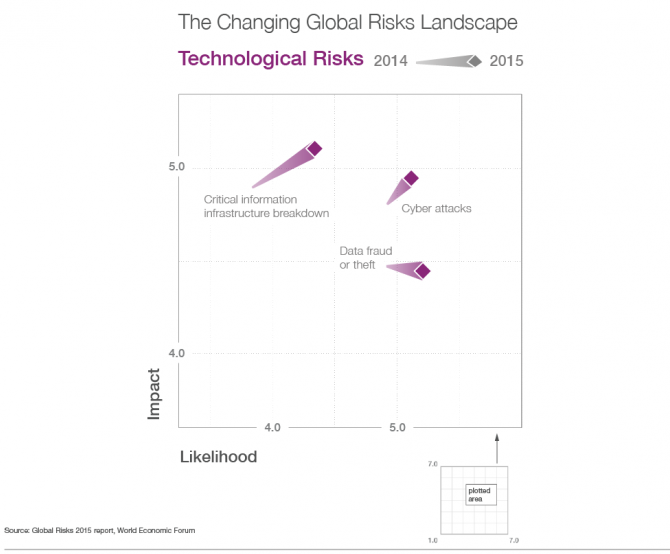
Infographic - Global Risks Report

Risks Associated with Environment, Climate, Water Crisis and Extreme Weather in the WEF Report

In the 2015 edition of the Global Risks report environmental risks are viewed as more prominent than economic risks. At the very top of the list are international conflicts although water crises rank highest in terms of impact. Overall, geopolitical and societal risks dominate as the biggest threat to global stability.

The 10th edition of the Global Risks report, was published on January 15, 2015 by the WEF. The annual report features an assessment by nearly 900 experts on the top 28 global risks in terms of likelihood and potential impact over the coming 10 years.

Despite a preponderance of economic concerns, the report ranks more environmental issues among the top risks than economic ones. This is a consequence of the negative assessment attributed to existing preparations to cope with challenges such as extreme weather and climate change.

In terms of likelihood of a given risk, extreme weather events are exceeded only by interstate conflict followed by failure of national governance systems, state collapse or crisis, and high structural unemployment or underemployment.

In terms of impact, the water crises was deemed to be the greatest risk facing the world followed by the spread of infectious diseases, weapons of mass destruction and failure of climate change adaptation.

The report expresses concern over the world’s ability to solve its most pressing societal issues, including economic, environmental and geopolitical risks.

In addition to ranking risks, the report features three examples of risk management and resilience practices related to extreme weather events.

Margareta Drzeniek-Hanouz, Lead Economist, World Economic Forum said, "seeking to return the world to a path of partnership, rather than competition, should be a priority for leaders as we enter 2015."

Click here to read the Global Risks 2015 Report.

Related

Infographic - Global Risks Report
Video - 2015 Global Risks Report
Video - Climate Risks: Abrupt Unpredictable Irreversible Changes
Video - UN Report on the Business Risks from Climate Change
Managing Materiality, Risk and Stakeholder Engagement in Sustainability Reporting
Infographic - Sustainable Business Risk Management
Rise Initiative: Helping Businesses and Investors Manage the Risks Associated with Climate Change
Factoring Climate Risks for Business
Sectors Most at Risk from Climate Change
World Economic Forum Risk Report Singles Out Climate Change
World Economic Forum Report: '"Global Risks 2014"
Guide - Physical Risks from Climate Change (Ceres)
Global Risks Report 2013: Interconnectedness of the Economy

Course - Ecological Risk Assessment: Practice and Protocols

This course will take place on March 17-18, 2015 from 9 a.m. - 4:30 p.m. at Trayes Hall - Douglass Campus Center, 100 George St, New Brunswick, NJ. Help your client understand how the ecological risk assessment process aids in developing realistic approaches to remediating sites.

For LSRP's,understand the role that ecological risk assessment plays in developing clean-up goals for your site. This two-day program will provide you with a comprehensive overview of regulatory expectations of ecological risk assessments from both federal and state perspectives.

On Day One, learn about methodologies and innovative approaches being employed to conduct ecological risk evaluations and assessments of aquatic and terrestrial ecosystems under CERCLA, RCRA, and various state mandates.

On Day Two, NJDEP representatives will take you through the new NJ guidance document for the completion of ecological risk assessments under the Licensed Site Remediation Professionals Program.

Help your client understand how the ecological risk assessment process aids in developing realistic approaches to remediating sites. For LSRP's, understand the role that ecological risk assessment plays in developing clean-up goals for your site.

This two-day program will provide you with a comprehensive overview of regulatory expectations of ecological risk assessments from both federal and state perspectives.

On Day One, learn about methodologies and innovative approaches being employed to conduct ecological risk evaluations and assessments of aquatic and terrestrial ecosystems under CERCLA, RCRA, and various state mandates.

On Day Two, NJDEP representatives will take you through the new NJ guidance document for the completion of ecological risk assessments under the Licensed Site Remediation Professionals Program.

Featured Topics

Applicability of Ecological Risk Assessments
Federal, State (NJ, NY and PA) and Regional Approaches
Regulatory Drivers
Development of Clean-up Goals
Hazard Assessment: How and Why
The US EPA's 8-Step Process
And much more!

Instructors

Charles Harman, AMEC Earth and Environmental
Nancy Hamill, NJ Department of Environmental Protection (NJDEP)
Allan Motter, NJ Department of Environmental Protection (NJDEP)

Click here to register.

Related
Risks Associated with Environment, Climate, Water Crisis and Extreme Weather in the WEF 2015 Report
Infographic - 2015 Global Risks Report
Video - WEF 2015 Global Risks Report
Video - Climate Risks: Abrupt Unpredictable Irreversible Changes
Video - UN Report on the Business Risks from Climate Change
Managing Materiality, Risk and Stakeholder Engagement in Sustainability Reporting
Infographic - Sustainable Business Risk Management
Rise Initiative: Helping Businesses and Investors Manage the Risks Associated with Climate Change
Factoring Climate Risks for Business
Sectors Most at Risk from Climate Change
World Economic Forum Risk Report Singles Out Climate Change
World Economic Forum Report: '"Global Risks 2014"
Guide - Physical Risks from Climate Change (Ceres)
Global Risks Report 2013: Interconnectedness of the Economy

Event - Risk Assessment & Remediation Conference, plus Awards Ceremony

This conference and awards ceremony will take place on October 23-24, 2014 at the Grange Tower Bridge Hotel, 45 Prescot St., London, UK. Brownfield Briefing is the host for these two seminal events. The first of these, Risk Assessment and Remediation 2014, takes place in London on 23-24 October, with the first day focusing on remediation and the second on risk assessment (both days bookable separately).

The two-day conference offers delegates the very latest information, advice and guidance concerning advances, development and innovative technologies showcasing best practice, cost-effectiveness and sustainability in risk assessment and remediation.

During the two-day event, an expert panel comprising of more than twenty speakers - representing contractors, consultants, developers and government - will address topics including:
  • Government policy on contaminated land (including State of Contaminated Land report); Building effective monitoring and verification measures;
  • Sustainable Remediation: balancing cost, resources and environmental benefit;
  • Asbestos: remediation or re-use?;
  • Developer’s perspective – current market, planning changes, brownfield challenges and solutions;
  • Financier’s perspective – attitudes to risk and brownfield sites;
  • Emerging in-situ assessment and remediation technology;
  • Remedial options;
  • Stabilisation and solidification – a durable long term solution?;
  • In-situ thermal and accelerated bioremediation;
  • Site specific risk assessment;
  • Practicalities of applying new risk assessment guidance;
  • Expert Panel case studies;
  • The role of S4ULs in effective risk assessment;
  • What is the impact of climate change on risk assessment and remediation of land and groundwater;
  • Testing and verification of hazardous ground gas protection measures;
  • Remediation through real time VOC air boundary air monitoring.

The second event, Brownfield Briefing Awards 2014 - the flagship event for the brownfield community, and one of the highest industry accolades that a company can receive - takes place at the same venue on Thursday 23rd October, giving recognition to technical and conceptual excellence in projects that have been underway over the past 12 months.

For more information or to register click here.

Related
Video - UN Report on the Business Risks from Climate Change
Managing Materiality, Risk and Stakeholder Engagement in Sustainability Reporting
Infographic - Sustainable Business Risk Management
Rise Initiative: Helping Businesses and Investors Manage the Risks Associated with Climate Change
Factoring Climate Risks for Business
Sectors Most at Risk from Climate Change
World Economic Forum Risk Report Singles Out Climate Change
World Economic Forum Report: '"Global Risks 2014"
Guide - Physical Risks from Climate Change (Ceres)
Global Risks Report 2013: Interconnectedness of the Economy
A Growing Number of Companies See the Risks Posed by Climate Change (CDP)
Climate Change as an Investment Risk or Opportunity
Alternative Energy Stocks and Risk Mitigation
Risk Posed by Climate is an Investment Risk or Opportunity
CDP Report Shows Companies See the Risks Posed by Climate Change
Investors Prompt SEC To Push for Climate Risk Disclosure
Going Beyond Compliance and Mitigating Risk
Growing US Corporate Investment is Reducing Climate Risk
Corporate America is Benefiting from Mitigating Reputational Risk
Report: Canadian Businesses are Mitigating Risk
Risk Based Approach to Responsible Procurement
CSR Standards Reduce Risk
New Types of Insurance Reduce Risk
New Tool Helps Companies with Water Risks
Top Climate Innovators Reduce Risk