Showing posts with label psychology. Show all posts

Climate Communications and Human Psychology (Video)

We must acknowledge that facts alone are insufficient to augur widespread climate action. The Trump administration's disdain for facts highlight the importance of a science-based understanding of climate change. However, the Trump administration is not the biggest impediment to climate action. They are merely taking advantage of human psychology.

Narratives bassed exclusively on facts make people feel both afraid and guilty. Rather than motivating us to act fear causes apathy, avoidance and passivity.  We need messaging that is both clear and concise. We also need narratives that reflect the propensities of the human psyche.

First and foremost we must acknowledge that we are social creatures. This is a defining feature of human psychology.  We can more effectively encourage climate engagement if we incorporate what we know about social-behavior. Research shows that making comparisons and encouraging competition has been found to foster action. Social competition has been shown to help people engage in environmentally friendly behaviors like saving energy.

We also need more optimistic climate narratives. Behavioral change is possible but we must do more than guilt people into action. We need to help people understand that we can manage the climate crisis no matter how daunting it may appear. We need to avoid pessimism and present positive narratives. We need to share environmental success stories including the campaigns that induce behavior changes like those that are resulting in the repair of the ozone layer.

Climate Lab is a partnership between Vox and the University of California. They created the following video which explores research conducted by the UCLA Engage Project. It offers some interesting research-based insights into the realm effective climate communications.


Related
Climate Narratives
The Science of Storytelling: Making Facts Matter in a Post-Factual World

Sustainability as Both Sexy and Spiritual
The Pearl in the Oyster - Leveraging the Climate Crisis for Human and Planetary Health
Why We Need a New Climate Change Narrative
Overcoming Obstacles in the Creation of a New Climate Narratives
Video - It's all in our heads: The psychology of sustainability
Video - Making People Care About Climate Change: The Psychology of Risk Perception
Video - Changing the Narrative to Change the World
Guide - Solutions to Sustainable Living: A New Narrative
Video - Narratives on Carbon Pollution: Are Individuals to Blame for Carbon Pollution?
Making Environmentalism Everyone's Concern
How Morality Can Win the War on Climate Change
Study Shows Americans Would Act on Global Warming if they were Urged to do so by People they Like and Respect

Marketing Sustainability and the Science of Storytelling

Marketing sustainability is about telling a good story and creating an emotional experience. While it may seem like an art there is a lot of science behind good storytelling. The advantages good sustainability focused storytelling benefit both the brand and the bottom line. The goal is to invoke drama that incites emotion. Well crafted branding can arouse the kinds of emotions that call for action and encourages customers to make buying decisions. This is what all marketers try to do but it is especially important when it comes to sustainability.  The buy in that is encouraged here goes beyond taking a product to the cash, it even goes beyond the forging of a loyal bond between a product and a consumer. Sustainability focused storytelling pushes us beyond our own experience and gives us potency to act on a global problem.

Despite this power, many companies have a hard time communicating their sustainability efforts in a fashion that people can relate to.  Why is it hard for corporations to leverage their environmental stewardship efforts when being a responsible corporate citizen should be a great marketing and public relations opportunity? Perhaps that is because there is nothing sexy about reams of data. 

Nancy Buzby published a piece on storytelling in a 2016 business blog post. Buzby does strategic marketing and communications for EDF, she asks why, "companies are often doing considerably more sustainability work than they publicize." Suzanne Shelton, President & CEO, Shelton Group answers that question this way:

“The problem isn’t that most companies don’t have strong, legitimate things to say about their sustainability efforts. It’s that they try to tell all of it in little bitty ways or they tell none of it — in either case, they don’t make a marketing impact. What works is boiling the story down to a tight, emotionally compelling narrative that aligns with what the market cares about, what the brand stands for and what a company’s internal culture can embrace.”

To bring this data to life it must be steeped in human experiences so that people can relate to it on an emotional level.  

To communicate sustainability we need to learn to tell the right stories. Science offers us some invaluable insights into how we can cultivate loyalty and passion from customers. There is a strong organic relationship between science and sustainability. Sustainability focused storytelling derives its veracity from science and we are seeing the ways in which science can help to make us better storytellers.

In an Op-Ed the EDF’s Fred Krupp said, "It’s time to go beyond the annual sustainability report and engage deeply on these stories."

For information on The Science of Storytelling see: Making Facts Matter in a Post-Factual World

Related
Sustainability as Both Sexy and Spiritual
The Pearl in the Oyster - Leveraging the Climate Crisis for Human and Planetary Health
Why We Need a New Climate Change Narrative
Overcoming Obstacles in the Creation of a New Climate Narratives
Forging a New Climate Change Narrative: Addressing 5 Psychological Realities
Video - It's all in our heads: The psychology of sustainability
Video - Making People Care About Climate Change: The Psychology of Risk Perception
Video - Changing the Narrative to Change the World
The Power of Story Telling for Sustainable Businesses
The Power of Storytelling: Lessons in Consumer Engagement

The Science of Storytelling: Making Facts Matter in a Post-Factual World

A new narrative is needed to counter prevailing ignorance and augur collective behavior change. However, we will never be able to get a handle on climate change, environmental degradation and a host of other problems with facts alone. Now more than ever we need science, but it is up to the storytellers to bring it to life.

As evidenced at the ballot box, Americans and others around the world are woefully misinformed about science. There is an unwarranted deep seated mistrust of scientists. People once revered scientists and politicians once depended on science to make policy decisions. However, those days are receding and we are facing what amounts to the darkest period in modern history.

We have been deceived by clever misinformation campaigns from corporate interests like the fossil fuel industry. We have been duped by conservative ideologies, political organizations and politicians. In the world of new media, fake news dominates and people take up residence in echo-chambers from which they rarely emerge.

Confronted with the multiple shades of grey of the modern world we have regressed to a more primitive state.  We have entered a post factual world where destructive narratives are gaining momentum, tribalism and nationalism rule the day and people are coalescing around populist bigots. If for no other reason than to combat the prevailing anti-science and anti-environmental narratives of our times, we need a new narrative. 

We are in desperate need of a new narrative that extols the virtues of science. The key is to make science storytelling emotionally engaging while remaining accurate. Understanding this approach is crucial for scientists and environmental journalists alike. The goal is to produce compelling stories that capture the reader's imagination and inform them at the same time.

The crafting of compelling stories is no easy feat in this highly competitive media landscape. The challenge is to engage an audience while providing accurate science-based information. Fact checking is crucial. We cannot communicate the value of science if we do not render it accurately. This is about more than sharing facts in an interesting way, it is about weaving a narrative that resonates with people and encourages them to act.

People need to have science rendered in an accessible language. It is the job of the storyteller to translate scientific jargon into the vernacular.

Science not only refutes the insanity of our post factual world, it also offers us some insights into what we can do to make stories resonate with readers. For example, we know that character-driven stories are easier to relate to and a more effective form of narrative than fact-based stories that are more abstract.

We also know that there is a danger that too much negativity will augur denial. While a pessimistic narrative may be accurate, it can also cause people to turn away. A positive narrative more readily leads to action.

We cannot escape stories and narratives as they are sewn into the fabric of human experience. We are defined by our use of symbols, we depend on stories. Joseph Campbell, Carl Jung and many others have shown how certain themes (sometimes called archetypes) emerge in the stories that we tell. These narratives endure across cultures and generations. Science contains many of the elements of the great narratives that have galvanized human civilizations dating back to prehistory. 

A narrative is alluring and enticing in a way that facts alone will never be. A good story has the ability to change people's thinking, foster empathy and transform people. To get there you need to make people feel something. it is not enough that they known, they must be made to feel.

Scientists have been unable to persuade people with numbers and statistics even though they may be irrefutable. Science does not resonate because it forces us to think analytically. This in turn primes us to be more skeptical which decreases the likelihood that we will act.

Narratives are a biological reality for our species and we are genetically predisposed to respond to a good story, it is hard-wired into our brains. The trigger for behavioral change is emotion, that complex array of electrochemical reactions that occur in the brain. As reviewed in a Berkeley University post, The Science of the Story, research suggests that the neurochemical processes set into motion by a good story are capable of inducing profound behavioral changes.

Some research suggests that a spike in both cortisol and oxytocin may play a salient role in behavior change. When we encounter a threat or when we read a good story we release cortisol, which boosts strength and speed. It also engages our attention. Oxytocin is a neurochemical that signals trust and safety to the brain it is also known to be associated with empathy and cooperative behaviors.

We are in need of stories, narratives that capture people's interest and propel them to act. Understanding the science of these stories can help us to be more effective communicators. It can also help us to create a new narrative that eschews the insanity of a post factual world and recognizes the merit, utility and necessity of science.

Related
Sustainability as Both Sexy and Spiritual
The Pearl in the Oyster - Leveraging the Climate Crisis for Human and Planetary Health
Overcoming Obstacles in the Creation of a New Climate Narratives
A New Environmental Movement Breeds Hope for the Future
Forging a New Climate Change Narrative: Addressing 5 Psychological Realities
Video - Changing the Narrative to Change the World
Guide - Solutions to Sustainable Living: A New Narrative
How Morality Can Win the War on Climate Change

Event - Let's Talk Climate: Messages to Motivate Americans (Webinar)

This webinar will take place on Friday, November 20th, 2015. It will address research on communicating climate change and a followup discussion. This webinar will review the research findings on the most effective language to use when talking about climate change. It will focus on the messages that most effectively motivate Americans and how these messages can be used for greatest success across a broad diversity of American audiences.

Hosted by ecoAmerica this webinar will address the findings in their upcoming research report Let’s Talk Climate: Messages to Motivate Americans. This report delivers the results from research that rigorously tested words, phrases, and narratives that link climate change to mainstream Americans' values. The findings include personally-relevant messages that give advocates and leaders across the country a powerful tool to propel climate as a priority in town halls, board rooms, hospitals, universities, places of worship, and in Congress. The report offers emotionally resonant messages applicable to everyone, plus thematic messages that tap into American priorities and affiliations.

Change the Conversation
  • Market-tested climate change messages designed to engage Americans across political and demographic groups on solutions.
  • Valuable for anyone communicating on climate change.
  • Includes tips for application, what to avoid, and specific language tailored for people in health, faith, higher education, communities, and business.
Click here to register.

Related
Sustainability as Both Sexy and Spiritual
The Pearl in the Oyster - Leveraging the Climate Crisis for Human and Planetary Health
Why We Need a New Climate Change Narrative
Overcoming Obstacles in the Creation of a New Climate Narratives
Crafting a Positive Environmental Narrative
Pessimism is Impeding Environmental Advocacy
A New Environmental Movement Breeds Hope for the Future
Forging a New Climate Change Narrative: Addressing 5 Psychological Realities
Video - It's all in our heads: The psychology of sustainability
Video - Making People Care About Climate Change: The Psychology of Risk Perception
Video - Changing the Narrative to Change the World
Guide - Solutions to Sustainable Living: A New Narrative
The Power of Story Telling for Sustainable Businesses
Video - Narratives on Carbon Pollution: Are Individuals to Blame for Carbon Pollution?
Making Environmentalism Everyone's Concern
Building Support for Action on Climate Change Before We Reach Tipping Points
Why We Need to Reach American Climate Change Deniers
How to Get Through to Climate Deniers
How Morality Can Win the War on Climate Change
A Thanksgiving Infused with Environmental Gratitude
The Ecological Message in the Symbolism of Easter

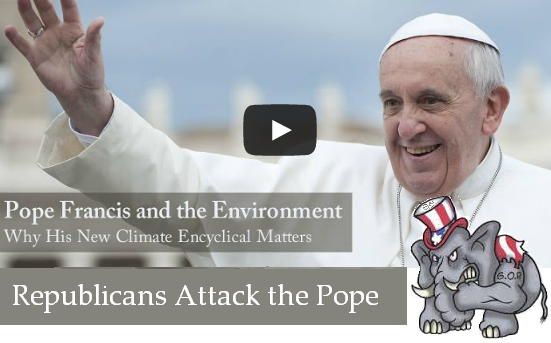
Implications of Pope Francis' Environmental Encyclical and Republican Attacks (Videos)

This first video covers a recent Yale summit which explains why the Pope's environmental encyclical matters and how it may transform the global debate. This video also provides context for the Pope's efforts from the perspectives of a multidisciplinary panel of expert. The video which follows reviews some of the conservative push-back including GOP presidential hopefuls and right wing media pundits. 


Both before and after the release of the encyclical conservative media personalities and leading Republicans including GOP presidential candidates attacked Pope Francis for his stance on the environment and climate change. The assault from conservatives is a cynical political move from the party that is synonymous with climate denial. Republicans rightly worry that their base of support will be eroded by the Pope's castigation of climate deniers and call to environmental stewardship.


Related Articles
Pope's Environmental Encyclical Supports the Poor While Demanding Change from the Rich
Leaked Papal Encyclical Lauds the Climate Movement and Derides Deniers
Spoof of Pope Francis' Environmental Encyclical (Video)
The Vatican's Climate Conference Calls for a Moral Awakening that Includes Rejecting Fossil Fuels
Pope Francis the Environmentalist
Why Christianity is Important to Action on Climate Change
How Morality Can Win the War on Climate Change
Female Faith Leaders Say Climate Change is a Priority Issue
Climate Leadership from the Head of the Episcopal Church
Video - How Religion can Energize Ecological Renewal
Video - Using the Bible as Religious Support for Climate Denial
The Religious Psychology of Green

Leaked Papal Encyclical Lauds the Climate Movement and Derides Deniers

Here is a leaked preview of Pope Francis' much awaited encyclical which is due to be officially released at noon on Thursday June 18. As expected the Pope has come out as one of the world's foremost environmental leaders. He praises the environmental movement, warns of the need for change and calls out climate deniers. The Pope wades into some of the finer points of the climate discussion even taking a stand on carbon trading.

As reported by The Guardian, the leaked version of the encyclical calls us to avoid "unprecedented destruction of our ecosystem. The 192 page document warns of "grave consequences for all of us," if we fail to make adjustments in the way we live our lives and change the way we consume energy.

Pope Francis unabashedly tackles the issue of climate change and plainly attributes it to "human activity." He also squarely refutes the position of climate deniers like Republicans in the US Congress. His draft reads

"The attitudes that stand in the way of a solution, even among believers, range from negation of the problem, to indifference, to convenient resignation or blind faith in technical solutions."

Pope Francis echoed the sentiments of his predecessor pope Benedict XVl when he called for a new global authority to tackle pollution and poverty.

The encyclical was released on Monday by an Italian magazine L'Espresso.

Although the papal encyclical comments on climate change are premised on scientific conclusions its focus is on humanities "God-given" responsibility to combat it.

The draft starts with a comment about the Earth and how humanities treatment of the Earth is wrong. He specifically mentions "the irresponsible use and abuse of the goods that God has placed on her." He goes on to say that we mistakenly believe that, "we were her owners and dominators, authorised to loot her. " Evidence of our malfeasance can be found in the "Earth, the water, the air and in living things."

The document is intended for all the people of the Earth regardless of their religious views. One of the more surprising statements in the draft disputes the value of carbon credits saying they "could give rise to a new form of speculation and would not help to reduce the overall emission of polluting gases". On the contrary, the pope wrote, it could help "support the super-consumption of certain countries and sectors".

Related Articles
Implications of Pope Francis' Environmental Encyclical and Attacks from Republicans (Videos) 
Pope's Environmental Encyclical Supports the Poor While Demanding Change from the Rich
Spoof of Pope Francis' Environmental Encyclical (Video)
Faith Based Environmental Leadership
Female Faith Leaders Say Climate Change is a Priority Issue
The Vatican's Climate Conference Calls for a Moral Awakening that Includes Rejecting Fossil Fuels
Video - How Religion can Energize Ecological Renewal
Why Christianity is Important to Action on Climate Change
The Religious Psychology of Green
The Symbolism of Easter in an Ecological Context
Pope Francis the Environmentalist
Crafting a Positive Environmental Narrative
How Morality Can Win the War on Climate Change
The Vatican's Climate Conference Calls for a Moral Awakening that Includes Rejecting Fossil Fuels

On April 28th, the Vatican held a major conference on climate change that called for a moral awakening. The summit addressed the need for urgent action including reductions in our consumption of fossil fuels. The conference was titled, Protect the Earth, Dignify Humanity: The Moral Dimensions of Climate Change and Sustainable Development. It was hosted by the Pontifical Academy of Science and included 60 scientists, religious leaders and diplomats.

The opening address was delivered by UN Secretary-General Ban Ki-moon and the conference participants included the American economist Jeffrey Sachs, the director of the UN Sustainable Solutions Network and the Earth Institute at Columbia University. As Sachs explained to reporters,
"Companies that invest in fossil fuels will lose money. Everybody needs to understand that policies are going to change to make it unprofitable if you wreck the planet," he said. "Those companies that continue exploring and developing fossil fuel resources for which there is no safe use are going to pay a very heavy cost for that."
This event included participants from each of the world's major religions. As explained by the Vatican the goal was to, "help build a global movement across all religions for sustainable development and climate change throughout 2015 and beyond...[and] elevate the importance of the moral dimensions of protecting the environment in advance of the papal encyclical and to build a global movement to deal with climate change and sustainable development."

The encyclical which has already been written is currently being translated and it is expected to be released this summer.

A statement by Cardinal Peter Turkson of Ghana, who helped the Pontiff to write his encyclical said, "the ever-accelerating burning of fossil fuels…is disrupting the earth’s delicate ecological balance on almost unfathomable scale." He said that a "full conversion" of hearts and minds is needed if we are to succeed in meeting the threat of global warming.

"In our recklessness, we are traversing some of the planet’s most fundamental natural boundaries," Turkson warned. "And the lesson from the Garden of Eden still rings true today: pride, hubris, self-centredness are always perilous, indeed destructive. The very technology that has brought great reward is now poised to bring great ruin."

The conference specifically focused on what the Vatican called, “the intrinsic connection between respect for the environment and respect for people—especially the poor, the excluded, victims of human trafficking and modern slavery, children and future generations."

The Heartland Institute, a fossil fuel funded lobby group that poses as a think tank sent a delegation to Rome to protest the idea that climate change is caused by human activity. However, the Pope has been unequivocal in his belief that man is the primarily cause of climate change. The Pope has called exploiting the Earth a sin and has also indicated that a Christian who does not protect God’s creation "is a Christian who does not care about the work of God."

The conference repeatedly referencing the scientific observation that humans are the driving force behind climate change and no space was provided for the anti-scientific views of climate skeptics (aka climate deniers).

Both Turkson and Ban made it clear that scientists and people of faith were united in their call for action. "Science and religion are not at odds on climate change. Indeed, they are fully aligned. Together, we must clearly communicate that the science of climate change is deep, sound and not in doubt."

In addition to slamming the door on climate denial, the conference urged industrialized countries to reduce their carbon footprints and invest in clean energy. Turkson also called faith leaders to be role models. "Think of the positive message it would send for churches, mosques, synagogues, and temples all over the world to become carbon neutral," he said. "At a time like this, the world is looking to faith leaders for guidance."

Acknowledging that our current trajectory invites calamity the final joint declaration was categorical in its emphasis on immediate action. "Human-induced climate change is a scientific reality, and its decisive mitigation is a moral and religious imperative for humanity."

The message from the Vatican summit was that all people of faith should embrace climate action and part of those efforts involve reducing our reliance on fossil fuels.

Related Articles
Implications of Pope Francis' Environmental Encyclical and Attacks from Republicans (Videos) 
Pope's Environmental Encyclical Supports the Poor While Demanding Change from the Rich
Leaked Papal Encyclical Lauds the Climate Movement and Derides Deniers
Spoof of Pope Francis' Environmental Encyclical (Video)
Faith Based Environmental Leadership
Female Faith Leaders Say Climate Change is a Priority Issue
Video - How Religion can Energize Ecological Renewal
Why Christianity is Important to Action on Climate Change
The Religious Psychology of Green
The Symbolism of Easter in an Ecological Context
Pope Francis the Environmentalist
Crafting a Positive Environmental Narrative
How Morality Can Win the War on Climate Change

Climate Leadership from the Head of the Episcopal Church

Katherine Jefferts Schori is the presiding bishop of the Episcopal Church, she believes that those who deny the science of climate change are both "blind" and "immoral." Jefferts Schori is not only a religious authority, she also has some serious scientific credentials. She holds a doctorate in oceanography and worked as a marine biologist before becoming a priest.

At a March 24 Episcopal event in Los Angeles called The Climate Change Crisis Forum, Jefferts Schori delivered a speech in which she said, "this planet is overheating, its climate is changing, and the residents are sick, suffering, and dying."

As reported by the Huffington Post, Jefferts Schori said, “We are making war on the integrity of this planet. We were planted in this garden to care for it, literally to have dominion over its creatures. Dominion means caring for our island home.” She went on to say that humanity must make a "life and death" decision and she added that the window of opportunity to do so, "will not last long."

As the highest ranking woman in the Anglican Communion, Jefferts Schori is the most powerful female in all of Christianity. She oversees 2.5 million members of the Episcopal church in 17 countries. She has shown moral leadership on climate change, as have other other female faith leaders.

Jefferts Schori's efforts are part of a wave of faith based environmental leadership. Many other faith communities are also involved in climate action and they are doing more than just turning out their lights for Earth Hour. As reported recently in a Global Warming is Real article, led by Pope Francis, Catholics are mobilizing for action on climate change.

The Episcopal Church is among a number of religious groups that are engaging environmental stewardship. The Episcopal Ecological Network has been building grassroots efforts and providing educational resources since 1986. In 2012, the church partnered with interfaith environmental nonprofit GreenFaith to launch a certification program to make Episcopal church facilities more environmentally friendly. The church is currently redoubling its efforts to lead the charge against climate change.

Also on March 24th, the Episcopal church broadcast a 90-minute webcast to discuss both the regional impacts of atmospheric warming and the moral implications of those impacts. The Climate Change Crisis Forum marked the start of the 30 Days of Action challenge for people to learn about and advocate for environmental change. Over the course of the initiative, which ends on Earth Day, April 22, participants will receive daily emails designed to help them reduce their carbon footprint, spread awareness about climate initiatives, as well as lobby government and international corporations to fight climate change. As explained on the church's website, “Focusing on environmental change on a personal, community and global level for 30 days can help Episcopalians proclaim a commitment to caring for God’s creation.”

A large number of faith groups are divesting from fossil fuels because they see divestment as a moral imperative. However, as explained in an interview with The Guardian, Jefferts Schori is not onboard. “If you divest you lose any direct ability to influence the course of a corporation’s behavior,” she said. “I think most pragmatists realise that we can’t close the spigot on the oil wells and close the coal mines immediately without some other energy source to shift to.”

Jefferts Schori believes that we are called to put our scientific understanding into practice. “Episcopalians understand the life of the mind is a gift of God and to deny the best of current knowledge is not using the gifts God has given you,” she said. However, she concedes that, “It’s hard work when you have a climate denier who will not see the reality of scientific truth.” She went on to say that ignoring science and denying climate change is, “a very blind position.”

As explained in another Global Warming is Real article, morality can play a salient role in marshaling the human resources necessary to win the war on climate change.

The Episcopal bishop described action on climate change as a “moral issue", particularly as it impacts on the poorest and most vulnerable people in the world. She compared climate action to the civil rights movement and she explained that the evangelical community is increasingly involved in activism due in large part to their understanding of climate impacts on the poor.

“We are meant to love God and what God has created and to love our neighbors as ourselves,” she said in her March 24th speech. “Jesus insists that those who will enjoy abundant life are those who care for all neighbors, especially the ‘least of these’ — the hungry and thirsty, the imprisoned and sick — and that must include all the species that God has nurtured on this planet.”

While she acknowledges that some are resistant to climate action for political reasons, she suggested that denial is "immoral" regardless of the motivation. “The Judeo-Christian tradition has always called these motivations sinful,” Jefferts Schori said. “It’s decidedly wrong to use resources that have been given into our collective care in ways that diminish the ability of others to share in abundant life,” she added.

“I really hope to motivate average Episcopalians to see the severity of this issue, the morality of this issue,” Jefferts Schori said. “Turning the ship in another direction requires the consolidated efforts of many people who are moving in the same direction.”

Jefferts Schori's moral leadership is timely as we herald the arrival of spring and prepare to celebrate Easter and Passover.

Source: Global Warming is Real

Related Articles
Implications of Pope Francis' Environmental Encyclical and Attacks from Republicans (Videos) 
Pope's Environmental Encyclical Supports the Poor While Demanding Change from the Rich
Leaked Papal Encyclical Lauds the Climate Movement and Derides Deniers
Faith Based Environmental Leadership
Female Faith Leaders Say Climate Change is a Priority Issue
The Vatican's Climate Conference Calls for a Moral Awakening that Includes Rejecting Fossil Fuels
Video - How Religion can Energize Ecological Renewal
Why Christianity is Important to Action on Climate Change
Pope Francis the Environmentalist
Crafting a Positive Environmental Narrative
How Morality Can Win the War on Climate Change

Faith Groups that have Divested from Fossil Fuels

Faith groups are among the 180 institutions that have divested from fossil fuels so far. A total of 50 billion has already been divested from fossil fuels and investors representing assets of $1.2 trillion have made the divestment pledge. In 2014 alone the number of institutions that have divested has more than doubled and the number keeps growing in 2015.

Last September, faith communities were among the 800 fossil fuel divestment commitments referenced by Vice President Al Gore in a speech at the UN Climate Summit in New York. Faith groups are joining the divestment movement alongside universities, local governments, banks, medical groups, and foundations.

Here is a chronological review of some of the faith communities that are leading the global divestment movement.

April 2013

The Uniting Church of Australia - New South Wales, an amalgamation of the Methodist and Presbyterian Churches, became one of the first institutions worldwide to divest from fossil fuels.

June 2013

The Council of the First Universalist Church of Pittsfield, Maine voted to sell its more than 1600 shares of Exxon Mobil stock and pledged to make its entire portfolio fossil fuel free within five years. This move is based on one of the church's Seven Principles, "respect for the interdependent web of all existence."

July 2013

The United Church of Christ became the first major denomination to vote to begin divesting from fossil fuel companies.

February 2014

The Uniting Church investment body, UCA Funds Management, announced it would pull out of thermal coal and unconventional oil investments, and in the summer of 2014 the church’s national body, the Uniting Church in Australia, agreed to divest.

June 2014

The Unitarian Universalist Association (UUA) a faith-based organization of more than 1,000 congregations with an investment fund of $175 million, voted overwhelmingly to divest from fossil fuel companies.

The University of Dayton withdrew all of their petrochemical investments to become the first US Catholic college to divest from fossil fuels.

The flagship of American progressive Protestant theology, New York City’s Union Theological Seminary announced its plans to pull all investments in fossil fuels from its $108.4 million endowment. The unanimous vote of their board made them the first seminary in the country to take such a step.

July 2014

At their yearly meeting, the Quakers Eco-Justice Working Group of Philadelphia announced that more than $2 million of assets have been divested from fossil fuels and reinvested in a new Quaker Green Fund.

The World Council of Churches (WCC), decided to divest from fossil fuels. WCC is an umbrella organization made up of 345 member churches which represents over 500 million Christians in more than 110 countries.

September 2014

GreenFaith released a statement signed by over 80 prominent theologians and religious leaders in support of fossil fuel divestment and reinvestment in a clean energy future. 

The New Zealand Quakers also endorsed the divestment movement. The Anglican Diocese of Canberra and Goulburn and the Perth Diocese of the Anglican Church passed divestment motions at their annual Synods.

The Church of Sweden completed full divestment from fossil fuels. The Church of Sweden is a divestment pioneer whose assets totaling $691,292,490 are now completely fossil free.

October 2014

The Presbyterian Church of Aotearoa New Zealand voted to divest its funds from fossil fuel companies at its biennial General Assembly in Auckland. It also encouraged its church members to do the same with their personal investments.

January 2015

The United Methodist Church's General Board of Pension and Health Benefits announced it would no longer invest its $21 billion of assets in thermal coal companies, or utilities that derive 75 percent or more of their electricity from coal-fired power plants.

February 2015

On February 11th, 2015 a group from Christian Climate Action (CAA) protested against the Church of England's investments in fossil fuels at Church House, London during the General Synod. This follows the General Synod's vote in March 2014 to review its investment policy in respect of fossil fuel companies. At this Synod one bishop referring to climate change as "the great demon of our day".

There are now almost 700 campaigns focused on divestment around the world and that includes strong representation from faith based organizations.

Source: Stewardship of the Environment

Related Articles
Why Faith Communities are Divesting from Fossil Fuels
Implications of Pope Francis' Environmental Encyclical and Attacks from Republicans (Videos) 
Pope's Environmental Encyclical Supports the Poor While Demanding Change from the Rich
Leaked Papal Encyclical Lauds the Climate Movement and Derides Deniers
Faith Based Environmental Leadership
The Vatican's Climate Conference Calls for a Moral Awakening that Includes Rejecting Fossil Fuels
Video - How Religion can Energize Ecological Renewal
Why Christianity is Important to Action on Climate Change
Pope Francis the Environmentalist
Crafting a Positive Environmental Narrative
How Morality Can Win the War on Climate Change

Why Faith Communities are Divesting from Fossil Fuels

The fossil fuel divestment movement is growing worldwide and faith communities are leading the charge. Divestment sends an important symbolic message about our commitment to preserving God's creation. Although faith-based activism will not eradicate fossil fuels, it brings moral force to the issue and the kind of leadership that can help to win the hearts and minds of people all around the world.

Faith communities have been singled out to lead the divestment movement. Last May United Nations climate head Christiana Figueres called on religious leaders to take a strong stance on climate change, calling it "one of the great humanitarian issues of our time."

Moral convictions are at the core of the decision making process of faith communities. They have a long history of ethical investing which is why faith communities are at the vanguard of the fossil fuel divestment movement.

Divestment is both a manifestation of core values and a pragmatic approach to managing the financial risks posed by fossil fuels.

Fossil fuels pose and existential risk that threatens all life on earth. Oil and gas companies are poisoning our air and water, destroying our land and bringing about a calamitous future fraught with suffering disease and death. They wreak havoc on the planet they also spend a fortune to influence governments and buy legislators. Their lobbying efforts protect fossil fuel subsidies and tax breaks for oil and gas companies while undermining support for solutions like renewable energy and carbon pricing.

The research indicates that if we are to succeed in curtailing climate change we must leave up to 80 percent of known fossil fuel reserves in the ground. Many faith leaders are listening to the warnings from climate scientists and they are acting in response to the realization that fossil fuels are sabotaging God’s creation.

In a paper titled "Is it Ethical to Invest in Fossil Fuels" Christian theologians, scientists and environmentalists argue that the Church must transition away from fossil fuels and towards clean energy as a matter of life and faith.

Divestment is also a social justice issue because it is the poor and the vulnerable that are most at risk. "With national governments reluctant to take difficult decisions, it falls to us as members of the body of Christ to show leadership in taking action to reduce damaging pollution," Uniting Church President Rev. Prof. Andrew Dutney said, "We simply must act. This is a matter of social, environmental, and intergenerational justice."

Divestment among faith communities is quite rightly presented as a moral and ethical duty. These communities see divestment as part of their responsibility to counter climate change causing emissions.

Rev. Jim Antal, responsible for the 375 United Church of Christ congregations in Massachusetts, said of fossil fuel companies, "we are letting them destroy God’s creation...When people call on their pension funds or schools to divest, they are not only pressuring the institution to change, they are forcing the leaders of the institution and the members of the board to grapple with a moral question."

As explained by Archbishop Desmond Tutu, "People of conscience need to break their ties with corporations financing the injustice of climate change."

As custodians of creation Christians along with other People of the Book (Jews and Muslims) have a biblical responsibility to steward the earth. It is a responsibility that begins with God commanding the first human inhabitants in the garden of Eden, "to till it and keep it". This is in stark contradiction to the behavior of the fossil fuel industry.

Rabbi Warren Stone, Co-chair, National Religious Coalition on Creation Care, "Climate change has become the most significant moral and spiritual issue facing humanity." The best way the we can address climate change is by reducing our reliance on fossil fuels.

Hind Al-Abadleh is an adherant of Islam and an Associate Professor of Chemistry at Wilfrid Laurier University in Waterloo, Ontario. She has argued that for Muslims who derive their value system from the Quran and the traditions of the Prophet Mohammed, combating climate change should be "a priority of high importance."

"[I]f we are to truly live up to teachings of our religion, Muslim investment firms should be among the early birds in divesting from fossil fuels, and investing instead in emerging clean energy technologies likes solar and wind."

Interest in divestment is driven by faith teachings and the desire to build support for a sustainable future. It is part of an effort to challenge the social license of fossil fuel companies and erode their political support. As 350.org founder Bill McKibben said, "morality demands thinking as much about the future as about ourselves–and that there’s no threat to the future greater than the unchecked burning of fossil fuels."

People of faith are called to create a better world for future generations. We cannot simultaneously be good stewards of the Earth while doing nothing to reduce the rate at which we burn fossil fuels. Our faith calls us to act as a function of our moral duty to be good stewards. This is living out our values and our beliefs, this is what it means to have integrity as Christians or as people of faith. Our values preclude investing in fossil fuels and call us to invest in industries that afford a sustainable future.

The United Methodist Church are among those who see divestment as a values based decision. According to Rev. Jenny Phillips, coordinator of Fossil Free UMC, "As a denomination, we can’t continue to say we’re against climate change while saying we’re for fossil fuel profits."

For Christians divestment is about repentance for our failure to properly care for God's creation. The biblical meaning of repentance entails making the decision to change directions. In the context of divestment, this implies that we must transition away from fossil fuels. This is exactly what we must do if we are to succeed in keeping temperatures from rising above the 2 degree Celsius upper threshold limit.

"Scripture tells us that all of the world is God’s precious creation, and our place within it is to care for and respect the health of the whole." Serene Jones, the President of New York City's Union Theological Seminary wrote in an op-ed for Time magazine. "We have sinned, and we see this divestment as an act of repentance for Union...Climate change poses a catastrophic threat. As stewards of God’s creation, we simply must act to stop this sin."

According to many faith leaders we must atone for the sin of our environmental neglect and divestment is an appropriate starting point. The leadership shown by faith communities around the world give us reason to hope that we can succeed in being good stewards of the Earth.

In the Old Testament, God hears Solomon’s cry and replies: "If my people who are called by my name humble themselves, pray, and seek my face and turn from their wicked ways, then I will hear from heaven and will forgive their sin and heal their land."

The road ahead is a difficult one but as explained by Fossil Free Faith, "we need to embrace the courage and hope our faith provides us, and be unafraid to confront and change our dependency on a fossil fuel based economy."

Source: Stewardship of the Environment

Related Articles
Faith Groups that have Divested from Fossil Fuels
Implications of Pope Francis' Environmental Encyclical and Attacks from Republicans (Videos)
Pope's Environmental Encyclical Supports the Poor While Demanding Change from the Rich
Leaked Papal Encyclical Lauds the Climate Movement and Derides Deniers
Faith Based Environmental Leadership
Female Faith Leaders Say Climate Change is a Priority Issue
The Vatican's Climate Conference Calls for a Moral Awakening that Includes Rejecting Fossil Fuels
Video - How Religion can Energize Ecological Renewal
Why Christianity is Important to Action on Climate Change
The Religious Psychology of Green
Pope Francis the Environmentalist
Crafting a Positive Environmental Narrative
How Morality Can Win the War on Climate Change

Faith Based Environmental Leadership

Faith based communities are coming together around the shared understanding that protecting our planet is one of the most important issues of our times. In recent years, there has been unprecedented ecological action from a diverse array of faith groups.

This past summer, in an online campaign titled "Our Voices: Bringing faith to the climate," faith groups were urged to join the global conversation on climate change.

This is an invitation to "people of all faiths around the world to raise their voices and add their perspectives in political discussions about climate change,” said the
Canon Ken Gray, who is rector of the Church of the Advent in Colwood, B.C., and the ecclesiastical province of Canada's representative in the ACEN.

As a central part of their ecological advocacy efforts, faith groups are supporting a positive outcome at the COP 21 climate talks in Paris this year. The Our Voices campaign urges people of religious faith and moral conviction, “to sign and pray in their own tradition for the Paris 2015 UN Climate Summit to succeed where all past talks have failed.”

The UN acknowledges the important role of the world's faith based communities to add a much-needed moral dimension to ecological discussions. This point was made by the FCCC's executive director, Christiana Figueres, when she spoke at St. Paul's Cathedral in London, this past May.

"[We] have the responsibility to set the ethical foundation of our global society. We have done this with slavery and with apartheid. It is time to do it with climate change," Figueres said.

As explained in the Our Voices website, “the UN believes there is hope of global agreement in Paris 2015 if the moral call for action is so loud that politicians can't ignore it.”

The power of faith based communities was evident at the historic People's Climate March last September in New York City. At this march dozens of different religious faiths and denominations came together and were united in their call for action on climate change.

In conjunction with the People's Climate March an Interfaith Summit organized by the World Council of Churches (WCC) and Religions for Peace, invited Christians, Jews, Muslims, Hindus, Buddhists, Indigenous Peoples and others to share their support for UN climate negotiations. The diverse range of religious leaders that attended the Interfaith Summit hailed from all around the world. Despite their differences these men and women came together are were united by the cause of environmental stewardship.

The Declaration from the Interfaith Summit read as follows:

"As faith leaders, we believe that unchecked climate change is one of the greatest threats to peace and prosperity for our world."

The Interfaith Summit statement of 2014 addresses the threat posed by climate change and the importance of a "fair and ambitious outcome" of the international climate negotiations. They appeal for specific action including adaptation, low carbon development, climate change education, curbing consumption and reducing our use of fossil fuels. They also indicate their readiness to engage in, "dialogue with those who remain skeptical."

This declaration follows in the footsteps of similar statements that preceded it. This includes the Uppsala Interfaith Climate Manifesto (2008), the Interfaith Declaration on Climate Change (2009), and the Declaration on Climate Justice and Sustainable Peace in Africa (2011).

As with preceding declarations, it was signed by the participants and sent to heads of states, international negotiators and faith communities, as well as the UN Secretary General.

This summit was held in conjunction with Religions for the Earth where more than 200 religious and spiritual leaders from across the world gathered at the Union Theological Seminary in New York City. Leaders assembled to appeal for action on climate justice and encourage dialogue.

Speaking about these events, Reverend Fletcher Harper, the Executive Director of GreenFaith, said,

"... there has never been such a large amount of religious-environmental activity in one location in the history of the world. This week will mark a watershed in the history of religion. It will be the time that people remember as the time when the world's faiths declared themselves, irrevocably, as green faiths."

As explored in a Huffington Post article by Grace Ji-Sun Kim, the WCC have played a critical leadership role in faith based ecological advocacy. They have been stalwart supporters of sustainable communities, including lifestyle issues, overconsumption of natural resources and waste disposal. The WCC's emphasis on sustainability began in the 1970s and then seamlessly incorporated efforts to combat climate change as that issue came into focus.

"Religious leaders who feel called to protect Creation are feeling the urgency of this crisis and looking for ways to be effective," said Rev. Dr. Serene Jones, president of Union Theological Seminary. "Now is the time for us to come together across divisive issues and divergent traditions and use our reach and influence for the good of the earth we share."

Other recent interfaith summits include the Inter-Religious Eco-Justice Network which held its second interfaith Climate Stewardship Conference from October 12-13, 2014 in West Hartford, Connecticut. The summit included speakers, panels, breakout sessions and workshops on climate change.

The first such conference was held on November 7, 2013, it was a call to action, an opportunity to learn, and a chance to network with other faith-based climate activists. The second Climate Stewardship Conference focused on our shared moral responsibility to act in the face of a changing climate. It also emphasized strategies for empowering faith communities to communicate effectively and act decisively at the local, regional and national level.

One of the goals of the summit was to train attendees in the art of faith-based storytelling, so that all participants could speak about climate change in a way that is informative, effective, and compelling. The second goal was to inform attendees about direct actions and advocacy options.

As explained on the Inter-religious website, "In an age of growing cynicism about the role of religion in our society, the credibility of our faith communities as moral agents may increasingly rest on our collective response to the unfolding climate crisis. As its ethical and spiritual implications become more obvious, climate change is increasingly taking its place as a central concern of communities of faith. The interfaith community’s role as moral leaders gives us a real opportunity — and obligation — to move the call for climate justice forward in a powerful way."

Faith leaders are well positioned to leverage the ethical dimension of the discussion, amplify the call to action and press political leaders to act on climate change.

Increasingly, faith groups are coalescing around the realization that eco-advocacy makes them powerfully relevant. Even more importantly they are acknowledging that that they have a moral responsibility to assume a leadership role.

Source: The Stewardship of the Environment Committee of the Anglican Diocese of Montreal

Related Articles
Implications of Pope Francis' Environmental Encyclical and Attacks from Republicans (Videos)
Female Faith Leaders Say Climate Change is a Priority Issue
The Vatican's Climate Conference Calls for a Moral Awakening that Includes Rejecting Fossil Fuels
Video - How Religion can Energize Ecological Renewal
The Religious Psychology of Green
Crafting a Positive Environmental Narrative
How Morality Can Win the War on Climate Change

Sustainability as Both Sexy and Spiritual

There are powerfully compelling elements to sustainability which have been largely ignored. Part of making the transition to a greener way of life involves embedding a more responsible world view into our individual psyches and collective cultures. To get there we need to foster interest in ecology so that it is seen as both desirable and sacred.
_______________________________________

Sustainability needs a new language that is more accessible and more compelling to the average person. Business, government, and other organizations are making strides advancing sustainability but we need wider involvement and faster growth. Although we are seeing increasing levels of environmental activism, we need to expand the message to reach a larger circle of people.

We must do more than preach solely to the converted.  The number of committed environmentalists is insufficient to induce the required changes.  At present, environmental communications are geared toward an elite group not the general population and for those that do get the message, it often fails to resonate. For those on the outside, the language of sustainability is a confusing jumble of fear-inducing figures that ultimately prove to be both polarizing and paralyzing.

We need government legislation and regulation, but if we are to bring about lasting results, we must augur change by speaking to the hearts and minds of average people. Fact based approaches have not worked and fear based approaches may make matters worse by breeding avoidance and apathy.

Making green advocacy more compelling to larger numbers of people demands new strategies that are based on more than fear, facts and figures. While the logic of sustainability is overwhelming, reason alone has proven insufficient to  change consciousness on a global scale.

Finding ways of communicating the value of sustainability to the masses is one of the most prescient issues of our time. To disseminate the message on a truly global scale, we need to tap into the positive emotional and spiritual elements of the human psyche.

The use of such positive emotional and spiritual communication is far more likely to induce people to act.

What we can learn from branding and marketing


We can learn a lot from branding and marketing experts. Whether or not we agree with the products and services they promote, we cannot disagree with the fact that many big brands have succeeded in changing both attitudes and behaviors. We need to harness this power and put it to work for the planet.
We must do a better job of communicating and marketing sustainability. We need to benefit from an understanding of the effective marketing and communications strategies employed by the big brands. As explained in a May 15 Marketing Magazine article:
“It is officially time to pass on, or at the least share with marketing, the baton of sustainability. It is also time to re-brand that baton. Reducing complex science to simple science in attempts to mobilise mainstream behaviour change has failed to deliver…”
We need to communicate in a language that is accessible to all.  To successfully communicate sustainability to the average person we need to employ language that resonates. As any marketer will tell you, consumers are more interested in what is sexy then what is reasonable.
“[A] sustainable society can be one where people enjoy high well-being and a rich culture, where we can all reach our potential and have an incredible time along the way. We need new and compelling consumer aspirations – ones that can be achieved within environmental limits, of course…The opportunity to frame a future that is sexy (and yes, of course, sustainable) is right here.”
We need to show that sustainability can be fun in addition to saving lives and radically enhancing our quality of life. To do this, we must understand that people are much more likely to respond to communications that speak to universal aspects of the human experience. namely love and desire.

Love and the desire to act

Cultivating love in ourselves and in others may seem like a tall order, but we are all born into the world hardwired with a capacity to love. We already have proof that love works to augur change. Love for the planet and each other is mobilizing environmental activists in unprecedented numbers all around the world. Eco-communities are popping up everywhere as more and more people are looking for ways to express their positive regard and make a difference. These passionate environmentally minded people are motivated by love, they care deeply about the planet and are prepared to act to lessen their impacts on the earth. Love for the earth makes us good stewards and tireless activists. Love endlessly motivates us to take the message out into our communities and into our workplaces.

Love is the most powerful motivation and it can help us to overcome both apathy and materialism. It is easy to feel helpless in the face of the threats posed by climate change. However the best way to combat paralysis is to care. Caring is neither difficult nor complex and it is within all of our grasps. If we really want to forge a better world, even more than the tactics we employ, we need to cultivate the love to make the effort.

Love is an antidote to rampant materialism. Although material concerns rule the day, love ties us into a value system that runs far deeper than money. Being part of a cause greater than ourselves offers a purpose and a sense of meaning to life that material pursuits do not. Acting with an awareness of the planet connects us to our world in a deeply fulfilling fashion.

Although the benefits both personally and collectively far outweigh the sacrifice, making a more sustainable world may entail a decrement in money, power, or position. These types of sacrifices are far more readily made out of love.

Love is a primary motivator that causes people to think beyond themselves and consider the needs of future generations. Without the impetus of love it will be difficult to move beyond self interest.

Accountability through spirituality


Spirituality is a powerful tool to help people be more accountable and this will increase environmental engagement. While organized religion is dying, belief in a higher power remains strong with more than 9 in 10 Americans calling themselves believers. What is even more interesting is the fact that belief is strongest amongst those who are most likely to deny climate change (conservatives and Republicans). The inference here is that spirituality may offer an inroad through the impermeable dogmatism of climate deniers.

It is important to understand that we are talking about spirituality and not religion. Religion promulgates certain fixed beliefs while spirituality in the context of this discussion is about soul-searching and the pursuit of truth. Spirituality commonly transcends the practice of religion. The distinction is important because we need to get beyond the polarization we have witnessed with environmental evangelists on one side and climate deniers on the other.

As explained by Mark C. Coleman, author of “The Sustainability Generation: The Politics of Change and Why Accountability is Essential NOW!,” one of the keys to getting people environmentally involved is fostering a greater spirit of accountability.
“Being accountable by being present and in the right frame of mind for sound decision-making is essential for (1) recognizing our behavior; (2) understanding the impact of our behavior on economy, environment, and society; and, (3) being able to take action through personal accountability to modify behavior to effect change.”
Spirituality is is an ego transcending journey that cultivates a sense of purpose beyond ourselves.
“Being able to think beyond ourselves requires patience, humility, a strong capacity for listening and learning, and an ability to separate ego from our true ‘self’,” Coleman explains. “Understanding that spirituality goes beyond the practice of religion, and that we all are part of a generation living within a context of time and fate which is requiring more accountability from each of us, is a perspective toward how people can begin to embrace sustainability from personal point of view.”
People are suffering from widespread disillusionment. Add to this the anxiety inducing reality of climate change and people are more likely to avoid rather than engage.  People are detached from themselves, from each other and from nature.
“The underlying power of humanity is that we are resilient and can adapt to change. But in the act of being resilient we rely on spirituality, being caring, and finding connections among one another and the world that foster sense of self, resourcefulness, and community.”
According to Coleman the answers to spirituality and sustainability are within us.
“The sustainability of our generation, and the earth, are intrinsically tied to our capacity to delve individually and collectively into spirituality. Individuals have the power within themselves to be the stewards of their behaviors, to set the standard for accountability within society, and represent a generation of enlightened individuals that can not only be resilient, but be a force for creating a better world. The generation living here and now is the Sustainability Generation. This generation will be measured not on its ability to wage war, land on the moon, or build financial wealth…From here on out the Sustainability Generation will seek out harmonizing its relationships with nature, among one another, and with God.”
The convergence of sustainability and spirituality can foster accountability and increase the will to act. Spirituality can also enable us to avoid falling victim to hopelessness and selfishness.

Deep Ecology


A direct offshoot of sustainability, deep ecology includes a spiritual element, and as such, may be a better vehicle to communicate the value of green. Deep Ecology brings together cutting-edge science, philosophy, action and spirituality. It is arguably the most holistic school of environmental thought as it is largely concerned with ecosystems and as such, it is a study of interrelationships.

This environmental philosophy is characterized by its advocacy of the inherent worth of all living beings regardless of their instrumental utility to human needs. It further advocates that societies need to be restructured in accordance with such ideas. It holds that human destruction of the natural world poses a threat to all organisms in the natural order.

Deep ecology’s core principle is the belief that the living environment as a whole should be respected and regarded as having the right to live and flourish. Deep ecology is providing a foundation for the environmental, ecology and green movements and has fostered a new system of environmental ethics.

A new approach to communicating sustainability must engage people on a spiritual and psycho-emotional level. Ecological awareness must be communicated as a heart-felt mind-set that people embrace and practice everyday. If the sustainability revolution is to expand and achieve critical mass, it must be embedded into our core values.

Source: Global Warming is Real

© 2014, Richard Matthews. All rights reserved.

Related Articles
The Pearl in the Oyster - Leveraging the Climate Crisis for Human and Planetary Health
Why We Need a New Climate Change Narrative
Overcoming Obstacles in the Creation of a New Climate Narratives
Crafting a Positive Environmental Narrative
Pessimism is Impeding Environmental Advocacy
A New Environmental Movement Breeds Hope for the Future
Environmental Success Stories: Mercury, SLCPs and Many More
Forging a New Climate Change Narrative: Addressing 5 Psychological Realities
Video - It's all in our heads: The psychology of sustainability
Video - Making People Care About Climate Change: The Psychology of Risk Perception
Video - Changing the Narrative to Change the World
Guide - Solutions to Sustainable Living: A New Narrative
The Power of Story Telling for Sustainable Businesses
The Power of Storytelling: Lessons in Consumer Engagement
Video - Narratives on Carbon Pollution: Are Individuals to Blame for Carbon Pollution?
Video - Indigenous Vs. Western: Environmental Stewardship and Sustainability
Making Environmentalism Everyone's Concern
Building Support for Action on Climate Change Before We Reach Tipping Points
How to Get Through to Climate Deniers
How Morality Can Win the War on Climate Change
A Thanksgiving Infused with Environmental Gratitude
The Ecological Message in the Symbolism of Easter
The Religious Psychology of Green
Sacred Economics: Exploring the Myth of Separation (Video)
Indigenous Ecology in Environmental Education
What we can Learn as we Reflect on the International Day for the Preservation of the Ozone Layer
Study Shows Americans Would Act on Global Warming if they were Urged to do so by People they Like and Respect