Showing posts with label African Development. Show all posts

Sun Powered Entrepreneurship in Ghana

There are a number of green entrepreneurs popping up in Africa. One such entrepreneur is Addosolar, this company offers portable solar products for the people of Ghana. Their goal is to help address the need for light due to daily power outages in the nation, thereby enhancing the quality of life for all residents.

Addosolar offers the finest quality in portable solar products, including the Nokero® light bulb. These bulbs are rainproof and easy-to-recharge. They eliminate the need for candles and kerosene lamps, which are dangerous and more expensive to use.

Additional products include their unique solar phone charger for cell phones and small electronic devices.

© 2011, Richard Matthews. All rights reserved.

Related Posts
Africa Industrialization Day: Leapfrogging with Sustainable Energy
WWF is Conserving Nature and Combating Poverty in Namibia
Africa a Renewable Energy Superpower
East Africa Can Learn from Iceland's Geothermal Energy Industry
South Africa and the Rise of Renewable Energy on the Continent
Lesotho's Renewable Energy Projects One of the Largest in Africa
Arab Spring Fueling the World's Most Ambitious Solar Project in North Africa
Arab Spring and the Environment in North Africa
Norway a Model of Sustainability for the Arab World
House Made of Plastic Bottles in Nigeria

WWF is Conserving Nature and Combating Poverty in Namibia

Poverty may be widespread in Namibia but the sustainable use of natural resources is an area of expanding economic development in the country. Namibia is a leader amongst African nations for its protection of nature and the environment. Namibia was the first African country to incorporate protection of the environment into its constitution. To help with this endeavor the government of Namibia has given local communities the opportunity to manage their wildlife through communal conservancies.

Before Namibia became an independent state the country's wildlife populations were significantly declining as a result of prolonged military occupation, extensive poaching and a severe drought. This changed in the mid 1980s, the Integrated Rural Development and Nature Conservation (IRDNC) introduced an innovative program to inspire community stewardship of wildlife. Following Namibia's independence in 1990, IRDNC's efforts were transformed with WWF's support into Namibia's communal conservancy program.

Initiatives such as WWF's LIFE (Living in a Finite Environment) program have empowered indigenous groups to create ecotourism ventures that bring them financial stability and protect wildlife and their habitats at the same time.

Women make handicraft goods to sell in the craft center. Sale proceeds are a valuable source of income for the villages of the conservancies. Namibia communities now see wildlife as a valued livelihood asset, and are setting aside vast tracts of land as wildlife management areas. As a result:
  • Poaching is no longer socially acceptable.
  • There are now restored populations of lions, cheetahs, black rhinos, zebras and other native species.
  • Human welfare is improving, thanks to nearly $4.5 million in annual income the conservancies generate for the communities.
  • WWF supporters have played a vital role supporting Namibia's communal conservancy movement.
Although there have been many improvements in Namibia, these conservation achievements cannot be maintained nor expanded unless today's serious obstacles are overcome. Widespread unemployment, vast economic inequities and wealth of mineral deposits translate into mounting competition between those who would build on successful conservation efforts and those seeking to extract resources in an unsustainable way.

© 2011, Richard Matthews. All rights reserved.

Related Posts
Africa Industrialization Day: Leapfrogging with Sustainable Energy
Africa a Renewable Energy Superpower
East Africa Can Learn from Iceland's Geothermal Energy Industry
South Africa and the Rise of Renewable Energy on the Continent
Lesotho's Renewable Energy Projects One of the Largest in Africa
Arab Spring Fueling the World's Most Ambitious Solar Project in North Africa
Arab Spring and the Environment in North Africa
Norway a Model of Sustainability for the Arab World
House Made of Plastic Bottles in Nigeria
Sun Powered Entrepreneurship in Ghana

Africa a Renewable Energy Superpower?

According to a study by Frost & Sullivan titled "Mega Trends in Africa: A bright vision for the growing continent", investment in renewable power in Africa is set to grow from a total of US$3.6-billion in 2010 to $57-billion by 2020. According to the UN over 600 million people do not have electric power on the continent of Africa.

The combination of a massive unmet demand (which includes remote communities) and an abundance of renewable power potential (solar, wind and geothermal) make Africa ideal for massive renewable energy development.

According to Frost & Sullivan, the development of Africa's renewable energy sector will lead to greater diversification of the continent's energy mix, decreased dependency on any one feedstock, and greater security of supply.

Smart grids will play a major role in high growth African economies. "Smart electricity development in Africa will be driven through grid incorporation of renewable power, and technological leapfrogging through investments into greenfield transmission and distribution infrastructure projects," Energy & Power Systems Industry Analyst Ross Bruton said.

The study specifically cites the growth potential from wind power at wind farms in Ashegoda Ethiopia and Tanzania's Singida Wind Farm and solar projects like South Africa's Upington and Desertec in North Africa.

© 2011, Richard Matthews. All rights reserved.

Related Posts
Africa Industrialization Day: Leapfrogging with Sustainable Energy
WWF is Conserving Nature and Combating Poverty in Namibia
East Africa Can Learn from Iceland's Geothermal Energy Industry
South Africa and the Rise of Renewable Energy on the Continent
Lesotho's Renewable Energy Projects One of the Largest in Africa
Arab Spring Fueling the World's Most Ambitious Solar Project in North Africa
Arab Spring and the Environment in North Africa
Norway a Model of Sustainability for the Arab World
House Made of Plastic Bottles in Nigeria
Sun Powered Entrepreneurship in Ghana

East Africa Can Learn from Iceland's Geothermal Energy Industry

East Africa can learn a lot from Iceland where more than one quarter of that country's energy needs are generated by geothermal sources. Geothermal is a renewable resource and an attractive energy option where it is available. Since the 1970s Iceland has relied on geothermal to provide a considerable portion of its energy needs and this could be a model for East Africa, where geothermal potential is abundant. Iceland's exploitation of geothermal has completely replaced coal, and given rise to business, investment and tourism.

In addition to making electric power from geothermal sources, Iceland uses the waste heat from geothermal power plants to heat over 90% of its buildings at low-cost.

East Africa is an ideal location to tap geothermal power. Specifically Africa’s Rift Valley, which stretches from Djibouti to Mozambique and takes includes parts of Kenya, Tanzania, Rwanda, Burundi and Uganda. The region can generate over 14,000 megawatts of geothermal power. That is enough energy to provide electricity to 150 million people.

Kenya is already exploiting geothermal energy with more on the way. In the 1980s, with the help of the World Bank, Kenya built a geothermal plant at the Rift Valley site of Olkaria. In 2010, the country obtained another Bank credit to expand its geothermal capacity by an additional 280 megawatts to add to the 198 megawatts of installed geothermal capacity.

The development of geothermal power can help to provide reliable climate friendly energy to businesses and citizens throughout East Africa.

Kenya is already benefiting from Iceland's geothermal knowledge and expertise and other African nations, particularly those in the Rift Valley, are wise to follow.

© 2011, Richard Matthews. All rights reserved.

Related Posts
Africa Industrialization Day: Leapfrogging with Sustainable Energy
WWF is Conserving Nature and Combating Poverty in Namibia
Africa a Renewable Energy Superpower
South Africa and the Rise of Renewable Energy on the Continent
Lesotho's Renewable Energy Projects One of the Largest in Africa
Arab Spring Fueling the World's Most Ambitious Solar Project in North Africa
Arab Spring and the Environment in North Africa
Norway a Model of Sustainability for the Arab World
House Made of Plastic Bottles in Nigeria
Sun Powered Entrepreneurship in Ghana

House Made of Plastic Bottles in Nigeria

Nigeria faces some serious environmental issues and one non-governmental organization has come up with some creative solutions. Drinking tap water is not safe in Nigeria, so people consume a lot of bottled water and that creates a lot of plastic waste. One industrious NGO in the country is using those empty plastic water bottles as building materials.

The plastic water bottles are being repurposed to make bricks for housing. They are building homes a few miles outside the city of Kaduna, in northern Nigeria in the village of Yelwa.

That village is now the site of Nigeria’s first-ever house built from recycled plastic bottles. It’s a one bedroom set-up with all the comforts of home. It required 8,000 bottles, and built in the round style of traditional Northern Nigerian houses.

© 2011, Richard Matthews. All rights reserved.

Related Posts
Africa Industrialization Day: Leapfrogging with Sustainable Energy
WWF is Conserving Nature and Combating Poverty in Namibia
Africa a Renewable Energy Superpower
East Africa Can Learn from Iceland's Geothermal Energy Industry
South Africa and the Rise of Renewable Energy on the Continent
Lesotho's Renewable Energy Projects One of the Largest in Africa
Arab Spring Fueling the World's Most Ambitious Solar Project in North Africa
Arab Spring and the Environment in North Africa
Norway a Model of Sustainability for the Arab World
Sun Powered Entrepreneurship in Ghana

Africa Industrialization Day: Leapfrogging with Sustainable Energy

November 20th is Africa Industrialization Day, but unlike much of the rest of the world, development on this continent is proving to be far more sustainable.

Secretary-General Ban Ki-moon said in his message for Africa Industrialization Day, “Approximately 600 million people in Africa still live without access to affordable and sustainable modern energy, and rely mainly on traditional biomass for cooking and heating. [...] As we mark Africa Industrialization Day, let us work together to achieve “Sustainable Energy for All” and advance economic development and productivity throughout Africa.”

Within the framework of the Second Industrial Development Decade for Africa (1991-2000), the UN General Assembly, in 1989, proclaimed 20 November Africa Industrialization Day (resolution 44/237). The Day is intended to mobilize the commitment of the international community to the industrialization of Africa.

This year’s commemoration of Africa Industrialization Day shines a spotlight on the challenge of “Sustainable Energy for Accelerated Industrial Development”.

Traditional forms of industrialization have created the environmental crisis we now face. In Africa, the hope is that the region can move right to renewable sources of energy and forego the dirty energy infrastructure that is a defining feature of industrialization in much of the rest of the world.

There is a precedent for this process in mobile phone adoption which in some developing countries has enabled them to skip the stage of copper wire land line telephones altogether.

This process is sometimes referred to as "leapfrogging" a concept which was originally used in the context of economic growth theories and industrial-organization innovation studies. It is based on Joseph Schumpeter's notion of ‘gales of creative destruction’. The hypothesis proposes that companies holding monopolies based on incumbent technologies have less incentive to innovate than potential rivals, and therefore they eventually lose their technological leadership role when new radical technological innovations are adopted by new firms which are ready to take the risks. These radical innovations create a new technological paradigm allowing newcomer companies to leapfrog ahead of leading firms.

Now the concept of leapfrogging is being used in the context of sustainable development for developing countries. This is a theory of development which may accelerate development by skipping inferior, less efficient, more expensive or more polluting technologies and industries and move directly to more advanced ones. It is proposed that through leapfrogging developing countries can avoid environmentally harmful stages of development and forego the environmentally destructive development trajectory of industrialized countries.

The adoption of solar energy technologies in African nations and other developing countries are examples of leapfrogging. This enables developing countries to avoid an energy infrastructure based on fossil fuels. Under such a paradigm developing nations can leapfrog directly into the Solar Age.

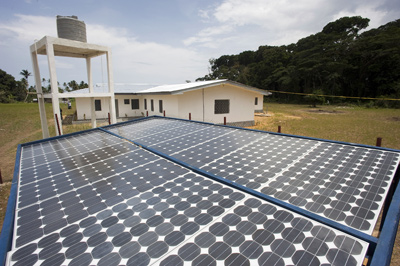
Examples of renewable energy projects are underway all over Africa. In the picture located on the top left of this post, solar panels in Liberia are generating energy for a newly renovated local administrative building. These panels were erected by the Government of Liberia with support from the United Nations Mission in Liberia and the United Nations Food and Agriculture Organization.

Ensuring access to reliable, efficient, affordable energy is a key element in creating decent jobs and increasing productive capacity.

© 2011, Richard Matthews. All rights reserved.

Related Posts
WWF is Conserving Nature and Combating Poverty in Namibia
Africa a Renewable Energy Superpower
East Africa Can Learn from Iceland's Geothermal Energy Industry
South Africa and the Rise of Renewable Energy on the Continent
Lesotho's Renewable Energy Projects One of the Largest in Africa
Arab Spring Fueling the World's Most Ambitious Solar Project in North Africa
Arab Spring and the Environment in North Africa
Norway a Model of Sustainability for the Arab World
House Made of Plastic Bottles in Nigeria
Sun Powered Entrepreneurship in Ghana

South Africa and the Rise of Renewable Energy on the Continent

Two of the largest renewable energy projects ever attempted are being built on the African continent. The World Bank’s Board of Executive Directors have approved $250 million in funding for the Eskom Renewables Energy Support Project (ERSP) to help implement major solar and wind power projects in South Africa. The new financing complements the US$260 million provided to Eskom to implement the Upington and Sere renewable energy projects included in the $3.75 billion Eskom Investment Support Project approved in April 2010.

South Africa's Power Sector Integrated Resource Plan began in 2010 and by 2030 the country aims to meet 42% of its national demand for power using renewable energy sources.

The Upington Project will be a one hundred megawatt, utility-scale, concentrating solar power plant to be located in Northern Cape province. Emission savings are estimated at about 9-million tons of CO2 equivalent over a 20-year life span.

The construction of the Upington project will create a significant number of jobs. As a whole the solar market has the potential to be a major employer in South Africa. The Spanish PV market created 28,000 jobs between 2001 and 2010 to account for slightly more than 3,000MW of PV. South Africa is planning to build 8,400MW of PV, with another 1,000MW of concentrated solar power (CSP) technology. Extrapolating from these numbers the whole solar energy industry in South Africa could provide in excess of 60,000 jobs. The infrastructure required for massive solar parks in the Northern Cape will require infrastructure that could create up to 100,000 jobs.

The Upington project is estimated to cost a total of R150 billion (US21.3 billion) and it is expected to start operating in 2012.

The Sere Project will be a one hundred megawatt wind power project located 300 kilometers (190 mi) north of Cape Town. The project will create at least 140 direct jobs during the construction phase and 10 permanent jobs once the plant is operational. It is targeted to reduce South Africa's CO2 emissions by 5 million tons during its first 20 years. Evaluating and reassessing existing studies in 2003, a South African renewable energy strategy formulation team from the Department of Minerals and Energy estimated the total wind generation potential for the entire nation to be 60 TWh per annum.

The Sere project is estimated to cost R2.689 billion ($375 million)and Eskom has stated that the plant will be commissioned by 2012 and expects the plant to be fully operational by summer 2013.

The Clean Technology Fund is providing the loan for these pioneering and innovative projects which will go to South Africa’s power utility, Eskom. The Clean Technology Fund promotes scaled-up financing for demonstration, deployment and transfer of low-carbon technologies with significant potential for long-term greenhouse gas emissions savings.

These two projects are important not only for South Africa but for the entire continent. They make an important point about the viability of renewable energy in the developing world.

“Africa is rich in sources of renewable energy, and broadening the existing mix to include renewables is essential for sustainable development of the energy sector,” said Jamal Saghir, World Bank Director for Sustainable Development for the Africa Region. “Once implemented, these pioneering energy projects will provide powerful demonstrator effects for the benefit of Africa’s largest economy and beyond.”

The fact that only 31 percent of Africa’s population has access to energy, is both a challenge and an opportunity. The challenge comes from meeting the continent's energy needs. The opportunity comes from renewable energy development that skips the industrial world's large scale reliance on energy derived from fossil fuels.

These projects underscore the World Bank’s development strategy for Africa which emphasizes competitiveness and employment by harnessing technology and innovation from the private sector.

“We are very pleased to assist South Africa launch these ambitious flagship renewable energy projects,” said Ruth Kagia, World Bank Country Director for South Africa. “They will help South Africa to fulfill its commitments on lowering emissions while demonstrating the viability of large-scale renewable energy projects undertaken in Africa.”

The South African economy is one of the most carbon-intensive in the world, however, investment in large scale renewable energy projects are helping to position the country as a leader in clean energy.

Renewable energy is not only benefiting South Africa, the development of renewable sources of energy has the potential to transform a continent burdened by poverty.

© 2011, Richard Matthews. All rights reserved.

Lesotho's Renewable Energy Projects One of the Largest in Africa

One of the largest energy projects in Africa is being built in the tiny mountain kingdom of Lesotho. This renewable energy project will make power from wind and water. The Lesotho highlands power project (LHPP) will cost $15bn (£9bn) and will generate 6,000 megawatts (MW) of wind power and 4,000MW of hydropower.

It will also create 25,000 jobs over 15 years including 1,500 technicians and engineers. This is a major boon for Lesotho, because as one of the world's poorest countries in the world, where nearly half the population struggles to live on less than $1.25 a day.

Lesotho, officially the Kingdom of Lesotho, is a landlocked country and enclave, surrounded by the Republic of South Africa. It is just over 30,000 km (11,583 sq mi) in size with a population of approximately 2,067,000. Its capital and largest city is Maseru.

Lesotho's energy efficiency policies and regulations are contained in the National Initiative for an Energy Efficiency Program in Lesotho's Water Sector: Barrier Analysis Report. Lesotho is focused on energy efficiency through its Energy Management Plan - Lesotho Water Sector.

Lesotho gets it electricity primarily from hydro power and since 2000 it has been able to supply its own power needs. Going forward, Lesotho's large scale renewable energy projects will make the nation a net exporter of energy to South Africa. This project will help to sate South Africa's growing energy appetite and reduce its reliance on coal.

Construction is expected to take between 10 and 15 years. The first phase is a 150-megawatt windfarm, set to start next year. South Africa's Harrison and White Investments and its Chinese technology partner, Ming Yang Wind Power, will build wind turbine components factories in South Africa and Lesotho.

The Lesotho energy projects demonstrate that renewable energy can help wean us off destructive fossil fuels and create employment in some of the most impoverished places on earth.

© 2011, Richard Matthews. All rights reserved.