Showing posts with label solar. Show all posts

Solar Powered Plane Traverses the Pacific Ocean Highlighting the Importance of Renewable Energy (Video)

The Solar Impulse, a plane powered by nothing other than the sun has succeeded in crossing the Pacific Ocean. This amazing accomplishment highlights the capabilities and the importance of renewable energy. This record setting voyage was flown by pilot Andre Borschberg. The 118-hours it took to make the journey breaks a record for the longest nonstop solo flight ever.


The trans-Pacific leg of the voyage was the most difficult and dangerous portion of its global trek. The 35,000 kilometer flight across the Pacific was the riskiest segment of the plane's global travels as there was nowhere for it to land in the event of an emergency. It took five days for the plane to fly from Nygoya Japan to an airport just outside of Honolulu in Hawaii.

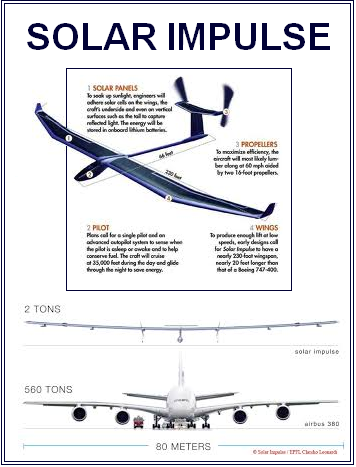
What makes 118 hour flight even more remarkable is the fact that the single-seater aircraft is powered entirely by 17,000 solar panels. The plane has a wingspan wider than a jumbo jet yet weighs only 5,000 pounds. It averages speeds of around 28 miles per hour, although it can travel at over 50 miles per hour when the sun is shining.

The plane took off from Japan on June 29th and landed in Hawaii on July 3. Here is a video of the Solar Impulse landing in Hawaii


Borschberg called the flight an extraordinary experience, saying it marked historical firsts for aviation and for renewable energy.

"Nobody now can say that renewable energies cannot do the impossible," he said. The most challenging part of the journey was when he and fellow Swiss co-pilot Bertrand Piccard had to decide when exactly to leave Japan.

"You don't know if it's feasible. You don't know if it's possible. You don't know if you are going to lose the airplane," he said.

The $100 million project highlights the importance of emissions free renewable energy. It also demonstrates the capabilities of technological innovation to meet the challenges we face.

Hawaii is an appropriate place for the plane as the state is leading the charge towards 100 percent renewable energy in the US.

Related
Solar Plane in the Process of Setting a Record by Circumnavigating the Globe
Solar Powered HB-SIA Plane Sets New Record
Video - The Solar Impulse Crosses the US Powered Only by the Sun

Solar Plane in the Process of Setting a Record by Circumnavigating the Globe

A solar powered plane is making its way around the world. The lightweight plane is called Solar Impulse 2, it has a wingspan wider than a 747. The carbon fiber and polymer impregnated paper plane incorporates high performance energy management software, advanced lithium-ion batteries powered by 17,000 high efficiency solar cells.

The two rotating pilots hope to fly the plane into the record books. The flight began in Abu Dhabi on March 9 and is expected to conclude its global voyage in July of this year. The first leg of the journey took the plane to Muscat, Oman and then on to India on March 10.

The plane's maximum altitude is 28,000 feet and it can travel about 11 hours without sunlight. This constitutes a major challenge for the two ocean crossings which will take as long as five days and nights.

The two pilots Bertrand Piccard and André Borschberg, are pioneers, risking their lives to make the point that aviation is possible without the use of fossil fuels.

Click here to track the plane's progress.

Related
Solar Powered HB-SIA Plane Sets New Record
Video - The Solar Impulse Crosses the US Powered Only by the Sun

Infographic - Solar's Potential in US Public Schools


Make sure to see the article titled, "Comprehensive Green School Information and Resources." It contains links to over 200 articles covering everything you need to know about sustainable academics, student's eco-initiatives, green school buildings, and college rankings as well as a wide range of related information and resources.

Event - Venture Summit West

This event will take place on February 12, 2014, at the Computer History Museum in Mountain View, California. The summit content will include discussions and educational tracks focused on cleantech. The Second annual Venture Summit West, presented by youngStartup Ventures, is the premier industry gathering connecting venture capitalists, corporate VCs, angel investors, technology transfer professionals, senior executives of early stage and emerging growth companies, university researchers, incubators and premier service providers.

Whether you are an investor seeking access to new early stage deals, or a CEO or Founder of a new venture looking for funding, visibility and growth, Venture Summit West is one event you won’t want to miss.

Venture Panels

Hear more than 40 top tier VCs, Corporate VCs and Angel Investors on the key issues facing Investors and Startup CEOs alike. Industry experts will provide updated analyses and share their experience with the audience. Company Presentations Discover more than 50 of the hottest early stage and emerging growth technology, life sciences and clean-tech innovators as they present live to leading investors. High-level Networking: Connect with investors, startups and potential partners.

Audience Profile

Venture Capitalists, angel investors, corporate VCs, CEOs, CFOs and other senior management of early stage and emerging growth ventures, technology transfer professionals and premium services firms.

To register click here.

© 2013, Richard Matthews. All rights reserved.

Related Articles
America Surpasses a Solar PV Milestone and Keeps Going
Ambitious Growth Predicted for Solar in 2013 and 2014
Solar Increasingly Sustainable Even Without Subsidies
How the West can Capitalize on the Growth of Chinese Cleantech in 2012
US Regains Lead from China as Clean Energy Leader
US Solar Energy Review and 2012 Forecasts
Renewable Energy Is Our Only Hope
India is the World Leader in Cleantech Investment Growth
The EU Debt Crisis did Not Curb the Growth of Renewables in 2011
Cleantech the Next Great Investment Opportunity

The Winner of the Solar Decathlon 2013

In October, eighteen collegiate teams from around the world went to Irvine, CA to participate in the U.S. Department of Energy Solar Decathlon 2013. Collegiate teams composed of architecture, engineering, business and communications students designed, built and operated solar-powered houses that are cost effective, energy efficient and attractive.

In addition to home design, almost half of the competition teams showcased an electric vehicle next to their house.

Introduced in 2011, the competition requires that all houses be constructed for $250,000 or less to earn maximum points.

In 2013, the winner was an entry from Vienna University of Technology (Team Austria). University of Nevada Las Vegas took second place, followed by Czech Republic, comprised of students from Czech Technical University, in third place.


The winning design is a net-positive home, known as “LISI – Living inspired by sustainable innovation.” This is a simple, smart house that is capable of adapting to a variety of lifestyles and climate zones. This was the first time an Austrian university has participated in the U.S. Solar Decathlon.

The LISI entry was designed as a pre-fabricated modular wooden frame construction that allows for quick and simple assembly and disassembly. The plus-energy home generates all required energy from a roof-mounted PV array. The supply of cold and hot water for space heating, cooling and for domestic hot water relies on two air-water heat pumps.

An ERV unit provided comfortable air conditioning, which acts as a heat and humidity exchanger between used exhausted air and fresh intake air. A functional floor system regulated the entire buildings climate using water, air, and active cubic capacity. It efficiently provided heating, cooling, and fresh air to create a consistently comfortable indoor climate. In addition, an innovative shower tray recovers thermal energy from drain water through a heat exchanger, significantly reducing the net energy consumption needed for daily hygiene.

The winning home's synergy of modular timber lightweight construction, the use of eco-friendly materials and renewable energies, plus sophisticated home automation creates a sustainable and affordable high-quality housing project adaptable for different needs of users and sites.

Click here for more information about LISI and other entries.

Click here to view video tours inside the houses

© 2013, Richard Matthews. All rights reserved.

Related Posts
The Hyperloop: Solar Powered Rapid Transportation 
Solar Powered Yacht Turanor Circumnavigates the Globe
Luminos and Stella 2 Cars in the World Solar Challenge
Schindler Solar Elevator on the Rise
Solar Powered HB-SIA Plane Sets New Record
Video - Solar Boat Tûranor as it Embarked on its Global Voyage
Video - The Solar Impulse Crosses the US Powered Only by the Sun
Video - The Stella Solar Powered Family Car

Event - Clean and Cool 2013

This event will take place from November 30 to December 7, 2013 in Colorado. Clean and Cool Mission Colorado is an entrepreneur mission to help the UK’s most promising early stage and innovative cleantech SMEs do business in the US faster.

A total of 16 of the UK’s most innovated clean technology companies have been selected for the 2013 Clean and Cool Mission in Colorado. Among the delegation are companies whose innovations address some of the most pressing climate challenges in the country and worldwide, including increasing transport pollution, improving energy efficiency in residential homes and easing reliance on peak grid supply. These companies will showcase their innovations and explore business opportunities associated with tackling climate change. The Mission will help these companies to develop quality contacts with investors and partners, gain unique insight, profit from fresh stimulus, and improve pitch and profile. There have been eight previous missions, supporting the most promising UK entrepreneurs and early stage businesses working in web innovation, future health and clean technology.

Colorado has been selected as the focus because it is rapidly establishing its US and global prominence as a cleantech innovation ecosystem. Colorado is the number one U.S market for renewable energy, the second best state for entrepreneurship and innovation, and with over 300 cleantech and 1600 support companies the state is currently 3rd for US cleantech vc financing.

In 2013, the Clean and Cool Mission will coincide with The Industry Growth Forum, the premier event for clean energy startups to maximize their exposure to receptive venture capital, corporate investors, and strategic partners.

Clean and Cool Mission is run by entrepreneurs for entrepreneurs in partnership with the Technology Strategy Board, UKTI and private sector sponsors. The Technology Strategy Board (TSB), a business-led UK government body which works to create economic growth by ensuring that the UK is a global leader in innovation. Sponsored by the Department for Business, Innovation and Skills (BIS), the Technology Strategy Board brings together business, research and the public sector, supporting and accelerating the development of innovative products and services to meet market needs, tackle major societal challenges and help build the future economy.

The following fields are part of the mission:

· Clean or green transportation fuels for aviation and motorcycles
· Electricity & other Energy conservation
· Smart meters and smart grids
· Thermal sciences
· Climate change
· Wind Solar Power
· Cutting emissions and pollution

UK Cleantech Startups Selected for the innovation Mission

· Agility Global has blended Formula 1 and aerospace design with advanced engineering and electric technology to manufacture the world’s first high-performance, clean tech motorcycle. Saietta, is a premium, electric urban sports motorcycle that more than lives up to its name. Strikingly designed, fast and powerful, it is also clean and green.

· Alquist has pioneered an award-winning Data Center temperature management system, targeted to become the new world standard for a $17bn industry segment growing at 28% per annum. Alquist’s monitoring system enables Data Center operators to manage risk and reduce energy spend, resulting in reduced carbon emissions.

· Arcola Energy is a developer, manufacturer and retailer of fuel cell-based low carbon energy solutions, converting chemical energy from a fuel, such as hydrogen, into electricity. Ultimately, this makes electricity more accessible and cost-effective for consumers and businesses. Arcola’s technology can be used in the home and within the construction, entertainment, education and automotive industries.

· To support the continued roll-out of smart grids throughout the U.S., Each For All Productions has developed the Merismus micro-grid which is plugged into a smart meter to automatically manage grid and microgeneration energy usage to lower energy bills through very little effort.

· Energy created through the roof which could eliminate heating, cooling and hot water bills is the aim of a new product from Flint Engineering which blends a photovoltaic and solar thermal collector in a roofing/cladding material to be used on both new and refitted domestic and commercial buildings.

· The energy output of the sun is about 386 billion megawatts, presenting a free and inexhaustible power source that can be captured and converted into electricity. Fullsun Photovoltaics is doing exactly that by using High Concentrated Photovoltaic (HCPV) technology in a lightweight solar module designed for utility and commercial/industrial rooftop markets.

· Current technology is incapable of realistically meeting future demand for sustainable aviation biofuels. The mission of Green Fuels Research, a new venture building on 10 years’ CleanTech heritage, is to develop enabling technologies at every step in the value chain from primary producer to airplane

· In the US, a massive $7.4 billion is spent on cooling datacentres annually. Iceotope supports these applications by providing massive processing power, memory and storage in an integrated computing system cooled with liquid, which saves energy and lowers costs.

· Magnifye superconducting permanent magnets can be used to improve the efficiency of any electrical machine. Ten times stronger than conventional magnets, they are small enough to fit into the palm of the hand and large enough to power a train or a cruise liner. With almost limitless applications, Magnifye could transform the way the world powers electrical machines.

· Moixa Technology plans to put millions of smart batteries into customer premises to reduce peak period demand on the grid and improve the energy efficiency of essential Direct Current (DC) devices such as lights and mobile phones. Use of Moixa’s technology helps to significantly reduce bills and improves energy security by enabling the storage of energy at off-peak times.

· PJH Partnership has developed an innovative and domestically applicable solar power storage unit. The system is targeted to address grid-scale storage and balancing needs resulting from the continual growth of electricity generation from domestic houses.

· Renovagen has developed a transportable solar power solution that is capable of generating ten times more power than existing technologies. Designed for temporary or semi-permanent use in remote off-grid locations where self-sufficient power generation is essential.

· Considerable energy savings in both domestic and commercial environments can be realised by using high power heat batteries. Sunamp has developed a Heat Battery that is super-compact but can store heat from conventional and non-conventional heat pumps and boilers, delivering it quickly and with maximum energy efficiency as needed.

· Through innovation and ingenuity Straw Fuels has created a range of eco-friendly fire logs. Made from straw, the logs are clean, easy to use and produce much lower levels of smoke than traditional wood.

· Public vehicles, particularly buses, have a reputation for polluting roads, but a new hybrid-electric system from Vantage Power has been designed to help the bus industry to meet the increasing demands for lower emissions, improve air quality, and cut fuel consumption simultaneously, without the need for investing in new hybrid buses.

· The U.S. has a target of 20% renewable energy by 2020, and this target has been behind the development of a new grid-scale energy storage battery from Wind Power Performance that promises to lower energy storage costs globally.

Agenda

The week-long agenda is designed to provide unparallelled insights, connections and opportunities.

Monday Dec 2
08.45 – 12.15 Pitch sessions and panel discussion
Venue: Hotel Boulderado, Columbine Room, 2115 Thirteenth Street, Boulder, CO 80302

Tuesday Dec 3
18.30 – 20.30 UKTI and British Consul hosted Reception and Networking
Venue: Galvanize, 1062 Delaware St, Denver, CO 80204

Thursday Dec 5
18.30 – 20.30 Rocky Mountain Innosphere hosted panel and networking event
Venue: All Staff Room, New Belgium Brewery, 500 Linden, Fort Collins, CO 80524

For more information click here

© 2013, Richard Matthews. All rights reserved.

Related Articles
America Surpasses a Solar PV Milestone and Keeps Going
Breakdown of Solar Demand in Q1 & Q2 2013
Deutsche Bank Revises its PV Forecasts for 2013
Ambitious Growth Predicted for Solar in 2013 and 2014
Solar Increasingly Sustainable Even Without Subsidies
Jinko Solar: Silicone Procurement at the Heart of its Success
Outlook for the Chinese Solar Industry in 2012
How the West can Capitalize on the Growth of Chinese Cleantech in 2012
US Regains Lead from China as Clean Energy Leader
US Solar Energy Review and 2012 Forecasts
Renewable Energy in 2012: The Global Economic and Environmental Climate
Will 2012 be the Best Year Ever For Clean-Tech Investment?
Renewable Energy Is Our Only Hope
India is the World Leader in Cleantech Investment Growth
The EU Debt Crisis did Not Curb the Growth of Renewables in 2011
Cleantech the Next Great Investment Opportunity

Video - Winner Crosses Finish Line at the 2013 Bridgestone World Solar Challenge


Watch the final moments of the grueling Bridgestone World Solar Challenge as the winning team for 2013 crosses the finish line in northern Adelaide, Australia. This 3000 kms event highlights some of the best solar powered car technology in the world.

Related Post
2013 Bridgestone World Solar Challenge in Australia

2013 Bridgestone World Solar Challenge in Australia

The biennial Bridgestone World Solar Challenge is a platform to showcase the world’s most efficient electric cars. In addition to presenting leading solar technology the event also inspires young people to address the imperatives of sustainable transport.

Solar car teams from 23 countries are competing in one of the world's most prestigious and grueling sun powered car races. By the end of the race cars will have traveled a total 3000 kms through the Australian Outback. However, the event is about far more than a long distance car race. The Bridgestone World Solar Challenge showcases innovation, adventure and achievement and brings cutting edge renewable energy technology to the forefront in an effort to find a sustainable future for the planet.

The largest World Solar Challenge ever is involving more teams from more countries and even more innovation than ever before. Static Scrutineering started on Tuesday October 1 and dynamic Scrutineering occurred on Saturday October 5. The official start time was at 8.15am on Saturday in Darwin and by October 8 teams had past the halfway point of the race. Teams are expected cross the finish line at Angle Vale north of Adelaide from Thursday 10 Oct to Sunday 13 October.

Nuon Solar Team's Nuna7 from the Netherlands are in the lead despite a ten minute penalty for exceeding the speed limit on day two. Japan's team Tokai are in second after overtaking Team Twente from the Netherlands.

Bridgestone is the proud partner for the 2013 World Solar Challenge. Other supporters include the Government of South Australia, Northern Territory Government, Clipsal & Schneider Electric, Michelin, Go Pro Go Puck, Adelaide City Council, Citizen, TIO, Coates Hire, Toshiba and Fila.

© 2013, Richard Matthews. All rights reserved.

Related Article
Video - Winner Crosses Finish Line at the 2013 Bridgestone World Solar Challenge

Event - Clean Energy Conference and Exhibition: ICCE 2013

Clean Energy Conference and Exhibition: ICCE 2013 will take place Monday September 9 - Wednesday September, 11, 2013 in Ottawa, Ontario. ICCE 2013 will take place on the banks of the majestic Ottawa, Rideau and Gatineau Rivers. Ottawa is one of the most beautiful G8 capitals in the world. Ottawa is also rich in culture and heritage with its many national institutions, parklands, waterways and historic architecture.
This conference is organized to share and discuss recent developments in clean energy sector. The aim of ICCE 2013 is to gather researchers, scientists, engineers, practitioners, policy makers, from all over the world to present advances in the clean energy technologies. We are in an era in which there is a continuous progress in green energy sources and technologies and ICCE 2013 will provide a forum to exchange information, present new technologies and developments, and discuss the future direction, strategies and priorities in the field of clean energy.

For more information or to register click here.

© 2013, Richard Matthews. All rights reserved.

Related Articles
America Surpasses a Solar PV Milestone and Keeps Going
Breakdown of Solar Demand in Q1 & Q2 2013
Deutsche Bank Revises its PV Forecasts for 2013
Ambitious Growth Predicted for Solar in 2013 and 2014
Solar Increasingly Sustainable Even Without Subsidies
Jinko Solar: Silicone Procurement at the Heart of its Success
Outlook for the Chinese Solar Industry in 2012
How the West can Capitalize on the Growth of Chinese Cleantech in 2012
US Regains Lead from China as Clean Energy Leader
US Solar Energy Review and 2012 Forecasts
Renewable Energy in 2012: The Global Economic and Environmental Climate
Will 2012 be the Best Year Ever For Clean-Tech Investment?
Renewable Energy Is Our Only Hope
India is the World Leader in Cleantech Investment Growth
The EU Debt Crisis did Not Curb the Growth of Renewables in 2011
Cleantech the Next Great Investment Opportunity

Working Paper - China’s Overseas Investments in the Wind and Solar Industries: Trends and Drivers

Shifting to a low-carbon economy will require current emitting countries and projected future emitters to rapidly scale up their investments in renewable energy. China is already the leading global investor in renewable energy infrastructure, and is increasing its overseas investments in renewable energy, particularly solar and wind. This working paper aims to help policymakers, investors, and researchers better understand the trends in China’s overseas investments in the wind and solar industries, as well as the factors behind those trends.

Executive Summary

Shifting to a low-carbon economy will require current emitting countries and projected future emitters to rapidly scale up their investments in renewable energy. In recent years, major emerging economies like China, India, and Brazil have been catching up with leading developed country investors in Europe and the United States. By some estimates, China is already the leading global investor in renewable energy infrastructure, and is increasing its overseas investments in renewable energy, particularly solar and wind. If China achieves its goal of sourcing 15 percent of its energy mix from renewables by 2020 and 30–45 percent by 2050, renewable energy will become closer to a mainstream energy resource within the country. Cost reduction incurred in this process would benefit not only China, but also the rest of the world.

This working paper aims to help policymakers, investors, and researchers better understand the trends in China’s overseas investments in the wind and solar industries, and the factors behind those trends. It examines the scale, nature, and types of China’s overseas investments in the wind and solar industries, and identifies the policy and market factors that drive these investments. China has made at least 124 investments in solar and wind industries in 33 countries over the past decade. Of the investments for which data were available, the cumulative value amounted to nearly US$40 billion in 54 investments, and the cumulative installed capacity added was nearly 6,000 MW in 53 investments. Of the 124 investments, 41 were in the wind industry, 81 in the solar industry, and 2 in both the wind and solar industries.

The majority of investments were in electricity generation. Twenty-seven of the wind investments were in wind farms predominantly carried out through joint ventures, as were most of the 41 solar investments. Several investments were made in manufacturing facilities and to establish sales and marketing offices. Most of the investments were concentrated in a few developed countries: the United States, Germany, Italy, and Australia. A handful of developing countries, including South Africa, Pakistan, and Ethiopia, also attracted investments.

China’s investments in the wind and solar industries are driven by a multitude of factors including macroeconomic conditions; industry conditions; policies (both general and specific to the wind and solar industries) that “push” Chinese companies to invest overseas; policy incentives in host countries that “pull” Chinese investors; and financial support from Chinese banks that “enables” these investments.

China is driven to seek solar and wind markets overseas largely because its manufacturing capacity exceeds domestic demand. The Chinese government’s policy support and financial support—mainly from state-owned banks that respond to government policy—encourage this overseas investment trend. Host countries’ policies have also attracted investments from China’s solar and wind industries, either advertently through tax breaks, feed-in tariffs, or bilateral cooperation agreements, or inadvertently as a “side-effect” of policies discouraging imports.

Although the analysis in this working paper points to interesting trends and provides useful insights that enhance our understanding of China’s role as an overseas investor in the wind and solar industries, it is limited by a paucity of information. Beyond the data collected for the 124 investments, the authors also reviewed literature and carried out interviews to deepen the analysis. The analysis is confined to a subset of the renewable energy sector rather than the full range of possible low-carbon investments. The inadequacy of the data does not allow an analysis of the emissions impact of these investments. These limitations suggest areas for further research that could help improve an understanding of China’s potential to reduce emissions beyond its borders, and would allow policy analysis on how China could increase this positive impact, particularly in developing countries.

To download the WRI working paper click here.

Related Posts
Smog Pollution Mutes Chinese New Year Celebrations
China is Leading in Renewable Energy
China's Most Recent Five Year Plan is Greener than Ever
China Leading the Green Economy (Video)
China Powers Ahead in Green Technologies
China's Green Laws for Business
Green Investment Opportunities in China
China's Green Investments and Growing Economic Preeminence
Green Asia: China
The Greening of China's Cities, Counties and Towns
China More Receptive to EVs than the US
China Poised to Challenge Global Green Auto Market
China-US Green Cooperation
China can School the US About Green Growth
China's Green Innovation and the Challenge for America
How the West can Capitalize on the Growth of Chinese Cleantech

Video - The Stella Solar Powered Family Car


The Solar Team Eindhoven (STE) of Eindhoven University of Technology (TU/e) presented the world's first solar-powered family car. "Stella" is the first "energy-positive car" with room for four people, a trunk, intuitive steering and a range of 600 kilometers (373 miles). This is the car being entered by the student team in the Cruiser class of the World Solar Challenge that starts in Australia in October 2013.

Related Articles
Solar Powered Yacht Turanor Circumnavigates the Globe
Luminos and Stella 2 Cars in the World Solar Challenge
Schindler Solar Elevator on the Rise
Solar Powered HB-SIA Plane Sets New Record
Video - Solar Boat Tûranor as it Embarked on its Global Voyage
Video - The Solar Impulse Crosses the US Powered Only by the Sun

Video - Solar Boat Tûranor as it Embarked on its Global Voyage


The Tûranor is an extraordinary boat which highlights the seemingly limitless capabilities of solar energy. The largest solar boat in the world set sail from Monaco at the start of a world tour aimed at promoting the use of sustainable energy. The Tûranor is now the first solar powered boat to successfully circumnavigate the globe.

Related Articles
Solar Powered Yacht Turanor Circumnavigates the Globe
Luminos and Stella 2 Cars in the World Solar Challenge
Schindler Solar Elevator on the Rise
Solar Powered HB-SIA Plane Sets New Record
Video - The Stella Solar Powered Family Car
Video - The Solar Impulse Crosses the US Powered Only by the Sun

Video - The Solar Impulse Crosses the US Powered Only by the Sun


Watch the Solar Impulse as it flies from California on its journey across America. In 2013, the Solar Impulse became the only solar powered plane to fly across the country. This plane proves the extraordinary capabilities of solar power.

Related Articles
Solar Powered Yacht Turanor Circumnavigates the Globe
Luminos and Stella 2 Cars in the World Solar Challenge
Schindler Solar Elevator on the Rise
Solar Powered HB-SIA Plane Sets New Record
Video - The Stella Solar Powered Family Car
Video - Solar Boat Tûranor as it Embarked on its Global Voyage

Solar Powered Yacht Turanor Circumnavigates the Globe

At the World Future Energy Summit in Abu Dhabi Planet Solar unveiled the Turanor, the world's largest solar powered boat. As reported in Triple Pundit, this is the first ocean going craft to sail around the world powered entirely by solar energy.

The massive 8.5 ton yacht comfortably carries a crew of a half dozen and can accommodate up to100 people at a time.

It cruises comfortably at 5 knots with a maximum speed of more than 10 knots. Thanks to its lithium-ion batteries the boat can also sail at night.

Swiss founder Raphaël Domjan conceived the project as a way of illustrating the possibilities of clean sun powered transportation.

© 2013, Richard Matthews. All rights reserved.

Related Articles
Luminos and Stella 2 Cars in the World Solar Challenge
Solar Powered HB-SIA Plane Sets New Record
Carrotmob in Support of Sailing Vessel Transportation
A Glimpse Into the Future of Traction Batteries
Schindler Solar Elevator on the Rise
Video - The Stella Solar Powered Family Car
Video - Solar Boat Tûranor as it Embarked on its Global Voyage
Video - The Solar Impulse Crosses the US Powered Only by the Sun

Luminos and Stella 2 Cars in the World Solar Challenge

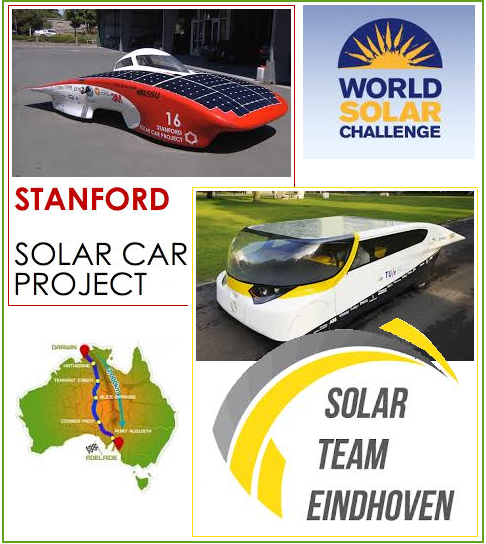
Here are two solar powered cars, Luminos and Stella that are both being entered into Australia's World Solar Challenge in October 2013. The goal of this competition is to travel 3000km across Australia from Darwin to Adelaide. The key qualifying feature is with the exception of 5kW hours of stored energy, all other energy must come from the sun or be recovered from the kinetic energy of the vehicle.

Luminos, is a Stanford Solar Car Project, which is the 11th such vehicle since their founding in 1989.

As reported in Cleantechnica, Luminos boasts several major innovations including their own highly efficient drive motors – one on each front wheel. Another innovation of the Luminos involves the use of monocrystalline silicon solar cells from Sunpower that have one of the highest production conversion efficiencies available in the world today, as well as a 3M-designed antireflective layer that also has excellent aerodynamic properties.

This robust vehicle boasts electrical and software design that make it the most efficient, durable, and reliable system the Stanford team has created to date.

Stella is the world’s first solar-powered family car, it has been constructed by Solar Team Eindhoven (STE) at the Eindhoven University of Technology (TU/e), Netherlands. As a family car Stella has enough room for four people, a trunk, and has a range of 600 kilometers (approx. 370 miles).

As reported in DailyFusion the Solar Team Eindhoven (STE) at the Eindhoven University of Technology (TU/e), Netherlands, presented the world’s first solar-powered family car. “Stella” is the first “energy-positive car” with enough room for four people, a trunk, intuitive steering and a range of 600 kilometers (approx. 370 miles).

The car's designation as “energy-positive” means that solar cells generate more electricity than the car uses and the surplus electricity can be returned to the power grid.

The vehicles combination of aerodynamic design and lightweight make it a highly energy efficient car. The car includes a steering wheel that can expand or contract as that the car moves too fast or too slow which makes the driving process intuitive.

This vehicle is a fully-functional and will be certified for road use.

© 2013, Richard Matthews. All rights reserved.

Related Articles
Solar Powered HB-SIA Plane Sets New Record
Solar Powered Yacht Turanor Circumnavigates the Globe
Carrotmob in Support of Sailing Vessel Transportation
A Glimpse Into the Future of Traction Batteries
Schindler Solar Elevator on the RiseVideo - The Stella Solar Powered Family Car
Video - Solar Boat Tûranor as it Embarked on its Global Voyage
Video - The Solar Impulse Crosses the US Powered Only by the Sun

Schindler Solar Elevator on the Rise

The Schindler Solar Elevator supplies up to 100 percent of elevator power needs in residential and low-rise commercial applications. This technology reduces energy costs while ensuring operations during power interruptions.

As reported in Energy Manager Today, some of Schindler's engineers contributed to the record breaking flight of the Solar Impulse.

According to the head of Schindler Elevators, the successful journey of the Solar Impulse has implications for solar elevators. What they learned can be put to work to make elevator and escalator operations more energy efficient. Their experience will also help them to develop power management systems, including batteries, and the lightweight construction.

Schindler already has one solar-powered elevator operating in Barcelona, Spain. The solar elevator is currently commercially available in Europe, India and it will be available in the US and other global markets in 2014.

Click here for more information.

© 2013, Richard Matthews. All rights reserved.

Related Articles
Luminos and Stella 2 Cars in the World Solar Challenge
Solar Powered HB-SIA Plane Sets New Record
Solar Powered Yacht Turanor Circumnavigates the Globe
Carrotmob in Support of Sailing Vessel Transportation
A Glimpse Into the Future of Traction BatteriesVideo - The Stella Solar Powered Family Car
Video - Solar Boat Tûranor as it Embarked on its Global Voyage
Video - The Solar Impulse Crosses the US Powered Only by the Sun

Solar Powered HB-SIA Plane Sets New Record

Earlier this summer, the plane known as the Solar Impulse landed at New York's JFK airport, completing the final leg of a journey across the US using nothing but the power of the sun.With the exception of a tear in the fabric of the left wing, the journey went off without a hitch.

Nearly 12,000 solar cells, drive its four propellers and charge the plane's 400kg of lithium-ion batteries for night-time flying.

The two seater HB-SIA craft carried out the first inter-continental flight in 2012 and holds the world record for the longest manned solar-powered flight at 26 hours.

A larger, two-seat plane, the HB-SIB, is going to attempt an around the world flight in the spring of 2015.

The pilots Piccard and Borschberg are behind what is known as the Clean Generation Initiative, an effort to encourage policy-makers and businesses to develop and adopt sustainable energy technologies.

© 2013, Richard Matthews. All rights reserved.

Related Articles
Luminos and Stella 2 Cars in the World Solar Challenge
Solar Powered Yacht Turanor Circumnavigates the Globe
Carrotmob in Support of Sailing Vessel Transportation
A Glimpse Into the Future of Traction Batteries
Schindler Solar Elevator on the RiseVideo - The Stella Solar Powered Family Car
Video - Solar Boat Tûranor as it Embarked on its Global Voyage
Video - The Solar Impulse Crosses the US Powered Only by the Sun

America Surpasses a Solar PV Milestone and Keeps Going

NPD Solarbuzz reports that due in part to state incentive programs, the US has installed more than 1.8 gigawatts (GWs) of solar photovoltaics (PV) in the first half of 2013, pushing the nation beyond 10 GWs. Solar PV is a semiconductor technology used for generating electricity by converting the the sun's rays into electricity. America joins Germany, Italy and China which have already produced more than 10 gigawatts of solar power.

The performance of US solar in the first half of 2013 exceeds the growth of solar in the first half of 2012 (1.8 GWs compared to 1.3 GWs). The Utility-scale market was responsible for at least 45 percent of solar PV installations.

The report forecasts ongoing growth in the solar sector, “Cumulative solar PV installations are forecast to increase an additional 80 percent over the next 18 months, surpassing 17 GW by the end of 2014.”

While we have seen strong solar performances from the Southwest and Southeast regions there are tremendous opportunities for growth in the Great Plains and Great Lakes regions.

According to the SEIA report. “Solar PV has been one of the fastest growing energy sources in the US over the past six years, with a compound annual growth rate of over 50 percent since 2007,” Most of Solar's U.S. growth (83 percent) has occurred since 2010.

The declining price of solar since 2011 is driving this growth. “Average installed system prices in the US have declined from around $6 per watt two years ago to approximately $4.25 per watt for residential installations and $3 per watt for large utility-scale PV projects today,” the report states.

The Department of Energy’s SunShot Initiative is aiming at the ambitious target of $1 per installed watt. NPD Solarbuzz states that almost 1,400 solar PV installations in excess of 500kW size have been completed across 39 different states so far. This has accounted for approximately 5.4GW of new capacity in the US. Nearly 40 percent of the new capacity has been installed in California.

© 2013, Richard Matthews. All rights reserved.

Related Articles
Breakdown of Solar Demand in Q1 & Q2 2013
Deutsche Bank Revises its PV Forecasts for 2013
Ambitious Growth Predicted for Solar in 2013 and 2014
Solar Increasingly Sustainable Even Without Subsidies
Jinko Solar: Silicone Procurement at the Heart of its Success
US Solar Energy Review and 2012 Forecasts
Outlook for the Chinese Solar Industry in 2012

Investment in Fossil Fuel & Renewables in South East Europe

The European Investment Bank (EIB), and the European Bank for Reconstruction and Development (EBRD),  invest more in fossil fuels than they do in renewable energy.

According to EIB officials, between 2007 and 2011 their bank invested €15 billion in fossil fuel projects compared to €14.8 billion in renewables.

According to the new South East Europe Change Network (SEECN) report, (which covers Albania, Bosnia and Herzegovina, Croatia, Kosovo, Macedonia, Montenegro and Serbia), between 2006 and 2012, 32 times more of the €1.68 billion invested by development banks in the Western Balkans’ energy infrastructure went to fossil fuels than to non-hydropower-based renewables.

The SEECN report found that fossil fuels accounted for 36 percent of all bank loans in the region and almost half of the lending from the biggest regional lender, the EBRD. Half of the EBRD’s annual €6.7 billion of energy lending goes to fossil fuels.

The report found that only 17 percent of bank lending to the Western Balkans currently goes to energy efficiency projects.

Related Articles
European Commissioner for Climate Action Urges Development Banks to Divest from Fossil Fuels
Climate Change Speech by European Commissioner Hedegaard
British PM Says Investment in the Green Economy is a Competitive Necessity
Deutsche Bank Revises its PV Forecasts for 2013
British Government to Lead the Green Economy
Market Forces and the UK's Green Deal
UK Government Investments in Efficiency and Renewable Energy
Corporate Sustainability is Driving Green Businesses in the UK
The EU Debt Crisis did Not Curb the Growth of Renewables in 2011

Breakdown of Solar Demand in Q1 & Q2 2013

According to NPD Solarbuzz analyst Michael Barker, Germany, China, Japan, and the US accounts for more than 60 percent of solar demand in the first half of 2013. China and Japan alone are responsible for 45 percent of global demand in the second half, up from just 10% three years ago.

According to the quarterly report from NPD Solarbuzz, nearly half of the demand in the first half came from large-scale utility and commercial ground-mount applications, with just 20 percent from residential rooftops. The rest of solar demand came from non-residential rooftop installations like businesses and off-grid applications.

“The solar PV industry continues to transition from a European-dominated environment to a global market, with a wide range of countries contributing to growth in the overall PV market,” said Michael Barker, Senior Analyst at NPD Solarbuzz. “Until this transition phase is completed, however, the PV industry remains highly dependent on a small group of countries currently at the multi-GW level.”

Click here for the complete NDP Solarbuzz Quarterly report.

© 2013, Richard Matthews. All rights reserved.

Related Articles
Deutsche Bank Revises its PV Forecasts for 2013
Ambitious Growth Predicted for Solar in 2013 and 2014
Solar Increasingly Sustainable Even Without Subsidies
Jinko Solar: Silicone Procurement at the Heart of its Success
Outlook for the Chinese Solar Industry in 2012
US Solar Energy Review and 2012 Forecasts
Renewable Energy Is Our Only Hope
Cleantech the Next Great Investment Opportunity