Showing posts with label definition. Show all posts

Sustainable Production Defined

The Lowell Center for Sustainable Production offers the following definition: "Sustainable Production is the creation of goods and services using processes and systems that are: non-polluting conserving of energy and natural resources; economically efficient safe and healthful for workers, communities, and consumers socially and creatively rewarding for all working people."
Products and services are:
  • safe and ecologically sound throughout their life cycle;
  • as appropriate, designed to be durable, repairable, readily recycled, compostable, or easily biodegradable;
  • produced and packaged using the minimal amount of material and energy possible. 
Processes are designed and operated such that:
  • wastes and ecologically incompatible byproducts are reduced, eliminated or recycled on-site;
  • chemical substances or physical agents and conditions that present hazards to human health or the environment are eliminated;
  • energy and materials are conserved, and the forms of energy and materials used are most appropriate for the desired ends;
  • work spaces are designed to minimize or eliminate chemical, ergonomic and physical hazard.
Workers are valued and:
  • their work is organized to conserve and enhance their efficiency and creativity;
  • their security and well-being is a priority;
  • they are encouraged and helped to continuously develop of their talents and capacities;
  • their input to and participation in the decision making process is openly accepted.
Communities related to any stage of the product lifecycle (from production of raw materials through manufacture, use and disposal of the final product) are respected and enhanced economically, socially, culturally and physically. Continued economic viability does not depend on ever-increasing (i.e., unsustainable) consumption of materials and energy.

For more information from the The Lowell Center for Sustainable Production click here

© 2012, Richard Matthews. All rights reserved.

Related Posts
Sustainability (Sustainable) Defined
Sustainable Business as Defined by Paul Hawken
Sustainable Development Defined

Sustainable Business as Defined by Paul Hawken

In business sustainability involves living within certain limits, understanding interconnections (economy, society, and environment) and an equitable distribution of resources and opportunities. Perhaps the best definition for sustainability as it applies to business comes from Paul Hawken. According to Hawken*, sustainable businesses is defined as follows:
  • Replace nationally and internationally produced items with products created locally and regionally.
  • Take responsibility for the effects they have on the natural world.
  • Do not require exotic sources of capital in order to develop and grow.
  • Engage in production processes that are human, worthy, dignified, and intrinsically satisfying.
  • Create objects of durability and long-term utility whose ultimate use or disposition will not be harmful to future generations.
  • Change consumers to customers through education.
*The Ecology of Commerce. (New York, New York: Harper Business, 1993), p 144.

Related Posts
Sustainability (Sustainable) Defined
Sustainable Development Defined
Sustainable Production Defined

Sustainable Development Defined

Sustainable development is concerned with the reasonable and equitably distributed level of economic well being that can be perpetuated continually for many human generations. It also implies using renewable natural resources in a manner that does not eliminate or degrade them, or otherwise diminish their usefulness for future generations.

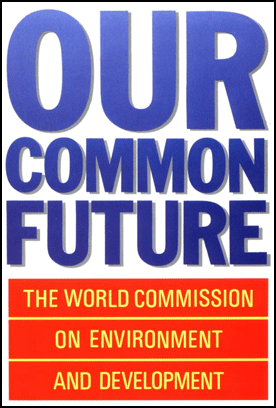
The 1987 Brundtland Report also know as Our Common Future, is a 400 page book published by United Nations World Commission on development and what to do about environmental sustainability. This report see sustainable development as development that meets the needs of the present without compromising the ability of future generations to meet their own needs. It contains within it two key concepts:
  • the concept of needs, in particular the essential needs of the world's poor, to which overriding priority should be given; and 
  • the idea of limitations imposed by the state of technology and social organization on the environment's ability to meet present and future needs.
Our Common Future serves notice that "the time has come for a marriage of economy and ecology, so that governments and their people can take responsibility not just for environmental damage, but for the policies that cause the damage. Some of the policies threaten the very survival of the human race. They can be changed. But we must act now."

All definitions of sustainable development require that we see the world as a an entire system rather than just individual parts.

© 2012, Richard Matthews. All rights reserved.  


Related Posts
Sustainability (Sustainable) Defined
Sustainable Business as Defined by Paul Hawken
Sustainable Production Defined
The Competitive Advantage of Sustainability: Short Costs Long Growth
Sustainability Nears a Tipping Point
Investors and Global Sustainability
MIT Survey Shows More Businesses are Embracing Sustainability and Turning a Profit
Sustainability Success Kit from Enviance
Sustainability (Sustainable) Defined
Top 10 Global Sustainability Leaders (Report)
Global Survey on Sustainability
10 Sustainability Initiatives for Small Businesses
The GRI Sustainability Reporting Framework
The New Sustainability Advantage
Corporate Sustainability Experts Want a Tax
Corporate Sustainability Experts Scoff
China's Twitter Users Focused on Sustainability
Spring of Sustainability (Video)
Corporate Sustainability Strategies in Asia Part1 (Video)
Sustainability Methodology (Video)
Sustainability in the Workplace Low-Hanging Fruit (Video)
The Benefits of Sustainability in Business (Video)
How sustainability can Save your Business (Video)
The New Sustainability Advantage (Book)Sustainability Nears a Tipping Point
Investors and Global Sustainability
MIT Survey Shows More Businesses are Embracing Sustainability and Turning a Profit
Sustainability Success Kit from Enviance
Sustainability (Sustainable) Defined
Top 10 Global Sustainability Leaders (Report)
Global Survey on Sustainability
10 Sustainability Initiatives for Small Businesses
The GRI Sustainability Reporting Framework
The New Sustainability Advantage
Corporate Sustainability Experts Want a Tax
Corporate Sustainability Experts Scoff
China's Twitter Users Focused on Sustainability
Spring of Sustainability (Video)
Corporate Sustainability Strategies in Asia Part1 (Video)
Sustainability Methodology (Video)
Sustainability in the Workplace Low-Hanging Fruit (Video)
The Benefits of Sustainability in Business (Video)
How sustainability can Save your Business (Video)
Sustainable Business Methods, Strategy, Management and Reporting
Sustainable Successes and Failures
Sustainability is an Unstoppable Megatrend
The Overwhelming Logic of Sustainable Business
Social Media and Sustainability
Social Action Driving Businesses to Adopt Sustainable Practices
A Sustainable World Order
Five Rules for Going Green (Video)
1. Sustainability Planning (Video): Business Practice Part 1/10

Sustainability (Sustainable) Defined

Although businesses have different ways of defining sustainability, in its simplest essence the word implies the ability to maintain a certain status or process in existing systems. The most frequent use of the term “sustainability” is connected to ecological systems. In this definition it refers to an ecosystems ability to function and maintain productivity for prolonged periods. Practically, sustainability refers to the coordination of economic, social and environmental, issues in support of the long term viability people and the planet.

Although sustainability is defined in different ways, by different groups, (ie: sustainable development sustainable community, sustainable society, sustainable agriculture, sustainable business and sustainable production) most of these definitions share a common reliance on living within certain limits.

Here are seven different but related definitions of sustainability: While this is hardly a complete summary it does encompass some of the differences as well as some of the similarities between definitions.

Merriam-Webster: Of, relating to, or being a method of harvesting or using a resource so that the resource is not depleted or permanently damaged.

Life Sciences: Capable of being maintained at a steady level without exhausting natural resources or causing severe ecological damage sustainable development.

Environmental Science: The quality of not being harmful to the environment or depleting natural resources, and thereby supporting long-term ecological balance: The committee is developing sustainability standards for products that use energy.

Ecologically: A means of configuring civilization and human activity so that society, its members and its economies are able to meet their needs and express their greatest potential in the present, while preserving biodiversity and natural ecosystems, planning and acting for the ability to maintain these ideals in the very long term.

EPA: Everything that we need for our survival and well-being depends, either directly or indirectly, on our natural environment. Sustainability creates and maintains the conditions under which humans and nature can exist in productive harmony, that permit fulfilling the social, economic and other requirements of present and future generations. Sustainability is important to making sure that we have and will continue to have, the water, materials, and resources to protect human health and our environment.

World Commission on Environment and Development: Forms of progress that meet the needs of the present without compromising the ability of future generations to meet their needsn

Business: A project that is of economic, social and environmental benefit.

These are but a few of the many variations in the way sustainability is defined. The one thing that they may unite these and other definitions is the fact that sustainability is one of humanities highest and most worthy aspirations.

© 2012, Richard Matthews. All rights reserved.  

Related Posts
Sustainable Business as Defined by Paul Hawken
Sustainable Development Defined
Sustainable Production Defined
The Competitive Advantage of Sustainability: Short Costs Long Growth
Sustainability Nears a Tipping Point
Investors and Global Sustainability
MIT Survey Shows More Businesses are Embracing Sustainability and Turning a Profit
Sustainability Success Kit from Enviance
Top 10 Global Sustainability Leaders (Report)
Global Survey on Sustainability
10 Sustainability Initiatives for Small Businesses
The GRI Sustainability Reporting Framework
The New Sustainability Advantage
Corporate Sustainability Experts Want a Tax
Corporate Sustainability Experts Scoff
China's Twitter Users Focused on Sustainability
Spring of Sustainability (Video)
Corporate Sustainability Strategies in Asia Part1 (Video)
Sustainability Methodology (Video)
Sustainability in the Workplace Low-Hanging Fruit (Video)
The Benefits of Sustainability in Business (Video)
How sustainability can Save your Business (Video)
The New Sustainability Advantage (Book)Sustainability Nears a Tipping Point
Investors and Global Sustainability
MIT Survey Shows More Businesses are Embracing Sustainability and Turning a Profit
Sustainability Success Kit from Enviance
Sustainability (Sustainable) Defined
Top 10 Global Sustainability Leaders (Report)
Global Survey on Sustainability
10 Sustainability Initiatives for Small Businesses
The GRI Sustainability Reporting Framework
The New Sustainability Advantage
Corporate Sustainability Experts Want a Tax
Corporate Sustainability Experts Scoff
China's Twitter Users Focused on Sustainability
Spring of Sustainability (Video)
Corporate Sustainability Strategies in Asia Part1 (Video)
Sustainability Methodology (Video)
Sustainability in the Workplace Low-Hanging Fruit (Video)
The Benefits of Sustainability in Business (Video)
How sustainability can Save your Business (Video)
Sustainable Business Methods, Strategy, Management and Reporting
Sustainable Successes and Failures
Sustainability is an Unstoppable Megatrend
The Overwhelming Logic of Sustainable Business
Social Media and Sustainability
Social Action Driving Businesses to Adopt Sustainable Practices
A Sustainable World Order
Five Rules for Going Green (Video)
1. Sustainability Planning (Video): Business Practice Part 1/10

Green School Census

Although green schools are proliferating, determining the exact number depends on how you define green. An orthodox interpretation would suggest that a truly green school involves both green building certification and a sustainable curriculum.

Green building is a strong and growing trend, according to green building industry leader Jerry Yudelson, green building has continued to grow worldwide, even through the recession. With corporate America greening its real estate portfolio, it is estimated that 10 percent of all commercial construction starts are now green. The estimated value of green building construction has grown to $60 billion in 2010.

The U.S. Green Building Council (USGBC), is a non-profit organization dedicated to sustainable building design and construction and LEED certification. LEED rating systems are developed through an open, consensus-based process led by LEED committees. Since 2000, USGBC membership has more than quadrupled to 19,957 member organizations and over 5 billion square feet of commercial building space.

While USGBC offers industry leading certification, it may not be the best way to assess the number of green schools. There are a number of schools that do not have LEED certification, but due to their sustainable curriculums, merit being counted as green.

Green curriculums are teaching the skills that will empower people to engage the environmental challenges we face. Sustainable programs are proliferating rapidly, according to a book by Bob Willard, The Next Sustainability Wave: Building Boardroom Buy-In, as of 2005 there were already numerous MBA programs that had integrated sustainability training. As of 2010 green MBAs can be found all across America.

An inclusive approach to assessing the number of green schools involves counting those schools that have made a public commitment to incorporating sustainability into their educational programs and operations. Around the world, there are more than 400 schools that have made a such a pledge.

In a 1990 document known as the Talloires Declaration, school administrators signed-on to a ten-point action plan for incorporating sustainability and environmental literacy in teaching, research, operations and outreach.

There are currently 419 signatories of the Talloires Declaration, 164 of these schools are located in the United States, with large concentrations in Canada, England, Brazil, and Australia.
____________________________________

Related Posts
Searchable Environmental Education Resources
USGBC's Green School Building Resources
2010 Green Schools Summit Workshop & Conference
Green Memes and Schools
Green Schools are Bridging the Knowledge Gap
Sustainable Education is Key to Accessing the Green Economy
Green School Rejuvenates Dying Town
Green Buildings Combat Climate Change
Leading the Green Job Market with a Sustainable MBA
The University of Oregon's MBA and Green Chemistry
Marylhurst's MBA in Sustainable Business
MODUL University's Sustainable MSc
UBC`s PhD in Resource Management and Environmental Studies
Prescott College`s Ph.D in Sustainability
PhD in Innovation and Governance for Sustainable Development
Columbia University's PhD in Sustainable Development
Walden University's PhD in Sustainability Online Degree
Commonground University's Online Environmental Classes
West Michigan's Green Academic Offerings
Da Vinci Arts Middle School in Portland
Ferrum College's Climate Research Opportunities
Arizona State University's Sustainable Business Curriculum
Arizona State University and Green Supply Chains
Penn State's Online B.A. in Energy and Sustainability Policy
IMD and WWF's Sustainable Business Program
WWF's One Planet Leaders Program
The Green Business League Sustainability Officer Training
CleanEdison Building and Design Courses
NYC Public School's Green Initiatives
America`s Greenest School Contest 2010
Sierra's Top 100 Cool Schools
The Princeton Review Green Colleges Honor Role 2010
California's Green Schools (Videos)
LAUSD Green School Initiatives
China’s Green School Project
The University of Hong Kong's Sustainable Development
China Europe International Business School's Green Campus
The Development of Sustainable Education at South China Normal University
China Turns to International Community to Learn about Green Buildings
Green School in India: Shoolini University
The Green School In Bali
Green School Buildings Health and Performance Benefits Part 1
Green School Buildings Health and Performance Benefits Part 2
Green School Buildings: The Many Benefits of Natural Lighting
Green School Buildings: The Many Benefits of Ventilation
The Future of Green School Buildings
Green Building Social Benefits
Green Building Environmental Benefits
Green Building Economic Benefits
The Implications of the Growth of Green Buildings
Top 10 Green Building Trends for 2010
CleanEdison Building and Design Courses
The Green Building Focus Conference and Expo
Environmental Revolution: Building and Operations
New York's Leed Certified Universities
The Growth of Green School Sustainability Officers
AASHE Survey of Sustainability Positions in Higher Education
How to Become a Sustainability Officer
Ecovillages Environmental Study Program

An Integrative Approach to Eco-Innovation


Eco-innovation offers businesses an increasingly important competitive advantage and an integrative approach to innovation often yields the best results.

The term eco-innovation is used to describe products and processes that contribute to sustainable development. Eco-innovation is the commercial application of knowledge to elicit direct or indirect ecological improvements. It is often used to describe a range of related ideas, from environmentally friendly technological advances to socially-acceptable innovative paths towards sustainability. One of the first appearances of the concept of eco-innovation in the literature is in the book by Claude Fussler and Peter James (1996).

Eco-innovation requires a workforce that can consider problems from multiple perspectives and that can effectively work in cross-functional teams. For example, experience in chemistry and physics is required to tackle things like photovoltaics, polymers and greener chemical production.

For an integrative approach, research and development need to encompass the entire life cycle, and this information needs to be continuously shared among the various work groups. Green innovation is about maintaining a sustainable focus and this requires continuous project evaluation from idea to commercialization. It is important to ensure that each phase creates a feedback loop that continually informs decision-making.

The common business basics of location, capital construction, and equipment considerations, need to be viewed from a sustainability perspective. For some, the hurdle for green innovation is related to physical infrastructure rather than human resources or knowledge.

Green innovation is a significant challenge, but an integrative approach increases the possibilities for significant rewards.
____________________________

Related Posts
10 Steps to Sustainability-Driven Innovation
Sustainability is a Catalyst for Innovation
Sustainable Brands 2010
Sustainable Brands Innovation Open Finalists
Sustainable Successes and Failures
Sustainable Business Methods, Strategy, Management and Reporting
Sustainability is an Unstoppable Megatrend
The Overwhelming Logic of Sustainable Business
Climate Counts: Businesses Combating Climate Change
Social Action Driving Businesses to Adopt Sustainable Practices
Consumers Continue to Embrace the Burgeoning Green Market
The 2010 World Energy Technologies Summit
America's Most Sustainable Businesses
Canada's Most Sustainable Businesses
Social Media and Sustainability
Environmental Revolution: Leadership and Morale

Sustainability is an Unstoppable Megatrend


Sustainability is not a passing fad or a marketing gimmick, it is a worldwide movement that is changing the way we do business. Sustainability entails continued development or growth, without significant deterioration of the environment and depletion of natural resources on which human well-being depends. This definition measures income as flow of goods and services that an economy can generate indefinitely without reducing its natural productive capacity.

Sustainability is more than a trend, a trend reflects a pattern of gradual change in a condition, output, or process, or an average or general tendency of a series of data points to move in a certain direction over time, represented by a line or curve on a graph. The term megatrend was popularized by John Naisbitt in his 1982 bestseller "Megatrends". Rather than being a function of a series of data points, the term megatrend reflects a general shift in thinking or approach affecting entire countries, industries, and organizations.

In the May 2010 issue of Harvard Business Review there is a feature article titled ‘The Sustainability Imperative’. The feature is written by David Lubin from the Sustainability Network and Daniel Esty from Yale University. Together they argue that sustainability is the next transformational business megatrend comparable to mass production, manufacturing quality movement, IT revolution, and globalization.

The authors suggest firms seeking to gain a competitive advantage must know what to do and how to do it. With many already onboard businesses must act now, as this unstoppable megatrend will make or break companies around the world.

Although we are still at a relatively early stage of the sustainability megatrend, it can be expected to continue to grow exponentially.
__________________________________________

Next: Sustainable Business Methods, Strategy, Management and Reporting / Sustainable Successes and Failures

Related Posts

The Overwhelming Logic of Sustainable Business
Climate Counts: Businesses Combating Climate Change
Social Media and Sustainability
Social Action Driving Businesses to Adopt Sustainable Practices
Consumers Continue to Embrace the Burgeoning Green Market
The 2010 World Energy Technologies Summit
America's Most Sustainable Businesses
Canada's Most Sustainable Businesses
A Sustainable World Order