Showing posts with label divestment. Show all posts

Harvard Faculty Wants the School to Divest from Fossil Fuels

Harvard University faculty members are calling the school to divest from fossil fuels. They stridently disagree with the University's decision to hold on to their fossil fuel investments.

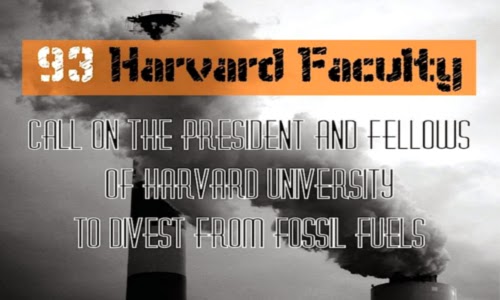
Shortly after Harvard announced that its new sustainable investing guidelines do not exclude investing in fossil fuels, 93 faculty members sent an open letter of protest to the president and fellows.

On April 7th, Harvard President Drew Faust said that divestment is not an option the university is willing to consider. Faust made the absurd statement that the school can do more to influence the future of fossil fuels by holding onto these assets.

As explained by faculty members, the fossil fuel industry is premised on misinformation. They said that in addition to being the primary cause of the climate change, the petrochemical industry compounds promotes misinformation and influences government to move in the wrong direction.

Among the impacts of fossil fuels, the Harvard faculty letter cites the following:
  • Extreme weather
  • Rising levels of ocean acidification acidified
  • Loss of biodiversity
As stated in the letter:

"We know that fossil fuel use must decrease. To achieve this goal, not only must research and education be pursued with vigor, pressure must also be exerted. If there is no pressure, then grievous harm due to climate change will accelerate and entrench itself for a span of time that will make the history of Harvard look short."

Related Articles
Harvard's New Responsible Investing Guidelines do not Include Divestment from Fossil Fuels
Harvard's New VP for Sustainable Investment Proves that Students can Change the World Video - Bill McKibben Makes the Case for Fossil Fuel Divestment at Middlebury College
Students Advocating Divestment from Fossil Fuels
Fossil Fuel Divestment Universities Will Not be Able to Resist

Harvard's New Responsible Investing Guidelines do not Include Divestment from Fossil Fuels

The exclusion of divestment from fossil fuels is an important contradictory caveat in Harvard University's newly adopted code of investment principles. Harvard's investment policies are far more than symbolic as the university oversees the world’s largest college endowment valued at $33 billion.

Shortly after hiring Jameela Pedicini as Harvard’s first vice president for sustainable investment in 2013, the university announced that it would not divest from fossil fuels despite a groundswell of protest both on and off campus.

Harvard is ignoring a trend that is sweeping across institutes of higher learning in much of the western world. A total of 500 university campuses and other institutions across America and Europe have divested from fossil fuels. While the new Harvard investment code will address a wide range of environmental and social issues, it does not oblige the school to sell off its existing fossil fuel investments.

With the exception of the university's refusal to divest from fossil fuels, there are a number of positive elements in the new initiatives. The investment guidelines are backed by the UN and Harvard is the first university to adopt such a code. As announced by Harvard president, Drew Gilpin Faust, the school will ask alumni and donors to help raise $20 million for climate research. The university will also join the Carbon Disclosure Project, requiring the school to report on its carbon footprint.

At first glance the fact that Harvard has adopted these initiatives is a great feat, however excluding divestment from fossil fuels is a deliberate and glaring omission.

Related
Harvard Faculty Wants the School to Divest from Fossil Fuels
Harvard's New VP for Sustainable Investment Proves that Students can Change the World
Video - Bill McKibben Makes the Case for Fossil Fuel Divestment at Middlebury College
Students Advocating Divestment from Fossil Fuels
Fossil Fuel Divestment Universities Will Not be Able to Resist

Video - Bill McKibben and NEI President Bob Massie: "Divestment And The New Economy"


"Divestment And The New Economy" Bill McKibben and NEI President Bob Massie discuss the relationship between fossil fuel divestment, the climate crisis, and the transition to a New Economy. In recent weeks, the movement to divest college and university endowments from the fossil fuel industry has spread to over 250 schools. Just last weekend, hundreds of students converged outside of Philadelphia to strategize and grow the movement. Today, those activists are back on campus meeting with their peers and planning ways to escalate their campaigns and fight for their futures.


These brave young people are asking difficult questions about the role of universities and the ethics of one of the world's most powerful industries. Now, students at Middlebury, the birthplace of 350, are using the opportunity to ask even harder questions about the basic nature of our economic system.

On Wednesday, March 6th they came together for a day-long summit supported by the New Economics Institute which seeks to create space for the Middlebury community to explore the kinds of economic alternatives that are springing up all over the world.

Related Articles
Video - Bill McKibben: Climate Change is an Environmental and Economic Problem
2013 Global Power Shift in Istanbul Turkey
Debate: McKibben vs. Epstein—Are Fossil Fuels a Risk to the Planet? (Video)
350.org's Connect the Dots End Fossil Fuel (2012)
350.org's Bill McKibben on Connect the Dots (2012)
Bill McKibben: Global Warming's Terrifying New Math
Rio+20: 350.org Campaign to End Fossil Fuels (2012)
350.org's Bill Mckibben Calls Hurricane Sandy a Wake-up Call (2012)
Bill McKibben on The Fight of Our Lives Video (2012)
Business and Climate Impacts Day from 350.org (2012)
Success of the End Fossil Fuels Campaign (2012)

Students Advocating Divestment from Fossil Fuels

American higher education endowments represent $400 billion worth of investments and there is a movement afoot to divest these funds from fossil fuels. The EPA, the IPCC, and many others have stated that fossil fuels are the primary driver of climate change. However, rather than moving away from fossil fuels, the US is intensifying its exploration efforts. Right now ExxonMobil spends $100 million a day trying to find more hydrocarbons. For companies like ExxonMobile who are stalwart supporters of dirty energy, divestment is a powerful instrument to induce change.

In finance and economics, a divestment is the reduction of an asset (the opposite of an investment). Historically, a good example of ethical divestment was the withdrawal of support from companies doing business with the apartheid regime in South Africa.

Throughout the 1980s, 155 colleges and universities divested themselves of the portions of their endowments that did business with the apartheid regime. This movement gained national attention and inspired others to do the same. Divestment helped to bring an end to apartheid, now students are advocating divestment from fossil fuels to combat climate change.

One of the schools the took the lead in divestment from the South Africa in the 80s was Hampshire College. Hampshire and other colleges are now leading the charge to divest from fossil fuels. Amhurst College, Lewis & Clark, Cornell, Tufts, Harvard, Boston University and Mt. Holyoke, are amongst the schools that are seeking to push administrators to divest from hydrocarbon investments.

These student campaigns have already proven successful. On October 15, 2012, Hampshire College made history by announcing that its endowment is now free of investments in fossil fuels.

Alli Welton, an undergraduate student at Harvard College and Ben Thompson, a graduate student at Boston University are amongst the students working to push their schools to divest from fossil fuels. They are members of Students for a Just and Stable Future, a student-led organization partnering with Better Future Project and 350.org on university divestment campaigns. They have written an article entitled "Its Getting Hot in Here."

Another similar article by Tufts students Nick Ryder, Jeremy Goldman and Dan Jubelirer is titled "The Case for Divestment." Bill Mckibben, the leader of 350.org works closely with students, he offered his take in an article titled "Divest from Fossil Fuels. Now." In this article he states "you can have a healthy fossil-fuel industry or a healthy planet, but you can't have both."

Campuses across the country are joining a national student divestment movement that is fighting against the environmental catastrophe being perpetrated by the fossil fuel industry. A national day of action for fossil fuel divestment is planned for October 24, 2012. To learn more about starting a divestment campaign at your school go to www.divestforourfuture.org or contact media@justandstable.org.

American students who are advocating divestment are at the forefront of a movement that may snowball into an international initiative. Divestment sends a powerful message to the financial community, perhaps most importantly it impacts amoral investors who in turn may withdraw their own investments due to concerns about stock devaluation.

Divestment is a powerful reminder that irresponsible industries face serious risks that they cannot control. Divestment is an effective way to use financial instruments to put pressure on the fossil fuel industry.

Just as students led a divestment movement that helped to topple Apartheid, a similar movement can combat the climate crisis by diminishing our reliance on fossil fuels.

© 2012, Richard Matthews. All rights reserved.

Related Articles
Burning Fossil Fuels and Staying Within the 2 Degree Limit
President Clinton on What People Need to Know about Renewable Energy
Fossil Fuels are the Most Hated Industry in the US
End Fossil Fuel Subsidies Totaling One Trillion Per Year
Success of the #EndFossilFuelSubsidies Campaign
Rio+20: 350.org Campaign to End Fossil Fuel Subsidies
Obama Striving to Put an End to Oil Subsidies
Environmental Politics: Obama Versus the GOP
GOP Fights Removal of Oil Subsidies
End Fossil Fuel Subsidies
Obama's Call for an End to Oil Subsidies
Tell the G20 to End Fossil Fuel Subsidies Now
The G20 and the Transition to a Greener Economy
Reigning in Irresponsible Oil Giants Chevron
Canadians Disappointed with Conservatives
Scientists Urge Government Action on Climate Including Removing Oil Subsidies
4 Principles for Climate and Energy Legislation
Air and Water in the OECD Report
Independence Day: Declaration of Freedom from Fossil Fuels