Showing posts with label Global. Show all posts

Climate Change was the Hot Topic at the World Economic Forum in Davos

Climate change was the dominant theme at and this year's World Economic Forum (WEF). Panel discussions covered a wide range of related topics and including global warming, ocean sustainability and biodiversity. Al Gore, David Attenborough and Jane Goodall were among the participants.

This year's Global Risk Assessment report released at the WEF in Davos revealed, yet again, that climate change and related phenomenon are among the greatest risks both in terms of impact and likelihood. The report surveys nearly 1,000 decision-makers (public sector, private sector, academia and civil society) who are asked to assess the risks facing the world.  Over a ten-year horizon, extreme weather and climate-change policy failures are seen as the gravest threats.

The WEF has issued many similar warnings in recent years. The 2016 Global Risks Report was the first that put environmental risks at the top the ranking. This report said the failure of climate change mitigation and adaptation is the risk with the greatest potential to impact society. It specifically warned about the impact of climate change on food security. As an interesting aside, the 2016 report included a prophetic warning about the risks associated with disempowered citizens.

The experts at Davos called for corporate and government action and there was widespread agreement that this requires economic change. As reported by CNN, these experts singled out fossil fuel subsidies in G7 countries. "There are still fossil fuel subsidies from G7 countries — that's ridiculous," said Rachel Kyte, special representative of the UN Secretary-General for Sustainable Energy. "Why we are subsidizing something we know is killing our children, poisoning them and affecting their ability to learn? That's beyond me," she added.

Attenborough, Gore and others have been sounding the alarm about climate change for years. However, the most powerful warning came from 16 year old Greta Thunberg who told attendees: "I don't want you to be hopeful, I want you to panic, I want you to feel the fear I feel every day," She also pulled no punches when she ascribed blame those assembled in Davos: "Some people say that the climate crisis is something that we will have created, but that is not true, because if everyone is guilty then no one is to blame. And someone is to blame," Thunberg said flatly. "Some people, some companies, some decision-makers in particular, have known exactly what priceless values they have been sacrificing to continue making unimaginable amounts of money. And I think many of you here today belong to that group of people."

After her speeches at COP24 and the WEF Greta has emerged as a leading voice for climate action. She is a realist in a world where many are either ebulliently optimistic about the prospects for climate action.

"Many people say that this is not an easy issue, we cannot just say that this is how it is, it's not black and white. But I say that this is black and white. Either we stop the emissions or we don't. There are no gray areas when it comes to survival,"Greta said.

In a chapter on the human causes and effects, the Global Risks Report 2019 calls for greater action around rising levels of psychological strain across the world.

"The world faced a growing number of complex and interconnected challenges in 2018. From climate change and slowing global growth to economic inequality, we will struggle if we do not work together in the face of these simultaneous challenges," the report's authors conclude.

Related
Climate Optimism and Sustainability Initiatives at the World Economic Forum in Davos
Climate Focus at The World Economic Forum in Davos
This Year's WEF Gives us Reason to Hope
Video - WEF 2015: A Climate for Action
WEF Summaries: Climate Change
Towards a Global Climate Agreement at COP21 (WEF Summaries)
Business Leadership on Climate Change (WEF Summaries)
Curbing Fossil Fuels - Carbon Pricing and an End to Subsidies (WEF Summaries)
The Value of Investing in Climate Mitigation (WEF Summaries)
Global Economies Feeling the Heat from Climate Change (WEF Summaries)
Collaboration and Cooperation are Imperitive (WEF Summaries)
What is The World Economic Forum (WEF)
Risks Associated with Environment, Climate, Water Crisis and Extreme Weather in the WEF Report


This Year's WEF Gives us Reason to Hope

Climate and energy conversations that took place at this year's World Economic Forum (WEF) in Davos gave us reason to hope. Many of those who constitute the core of the world's economic power acknowledged the urgency of climate action and the opportunities associated with forging a new green economy.

We are beginning to see the kind of leadership from CEO's and investors that is an essential if we are to succeed in tackling climate change. Companies and investors are coming together to advance meaningful solutions. Business leaders are now looking at climate change as both a risk and an opportunity. Investors are showing unprecedented interest in investments that support low carbon technologies.

There was even support for bold action that includes ambitious climate policies. Such government support was highlighted for its ability to drive innovation, advance clean energy and improve energy efficiency.

As we head towards a hoped for global climate agreement in Paris at the end of the year, there is reason for unprecedented optimism.

Related
Video - WEF 2015: A Climate for Action
WEF Summaries: Climate Change
Towards a Global Climate Agreement at COP21 (WEF Summaries)
Business Leadership on Climate Change (WEF Summaries)
Curbing Fossil Fuels - Carbon Pricing and an End to Subsidies (WEF Summaries)
The Value of Investing in Climate Mitigation (WEF Summaries)
Global Economies Feeling the Heat from Climate Change (WEF Summaries)
Collaboration and Cooperation are Imperitive (WEF Summaries)
What is The World Economic Forum (WEF)
Risks Associated with Environment, Climate, Water Crisis and Extreme Weather in the WEF Report

Collaboration and Cooperation are Imperitive (WEF Summaries)

Collaboration and cooperation are commonly mentioned as important aspects of sustainability and they emerged as salient themes at the World Economic Forum in Davos, Switzerland. Over the course of the last year we have seen historic collaboration on carbon emissions reduction between the US and China. We have also seen tremendous progress in some private sector areas.

While many are talking about global disunity, others are pointing to significant examples of global collaboration. John Kerry, US Secretary of State, said "I don’t see an unraveling [of international cooperation]. I see just the opposite. I see nations coming together … to reach an ambitious global agreement to address climate change, with the recent agreement by China and the United States that begins to set the targets to make the Paris negotiations this year a success."

Over the course of the last year businesses have come together and provide real leadership on issues like sustainably sourced palm oil. This was the subject of a talk by Dominic Waughray, Head of Public/Private Partnerships at the World Economic Forum. He addressed how the peer-to-peer conversations among business leaders led to significant commitments to sustainably sourced palm oil. As of right now over 90 percent of global palm oil demand is covered by voluntary agreements focused on sustainability.

However, the reality on the ground does not always live up to the talk, particularly in the private sector. As revealed by the BCG/Sloan Management Review annual sustainability survey which found that while 90 percent of respondents believe that collaboration is needed for sustainability, only 47 percent of companies are actually collaborating on sustainability.

We will need to see a lot of progress on the collaboration front if we are to sign a global agreement at COP21 in Paris.

"The key is coming up with a vision of how we are going to finance mitigation and adaptation to climate change," said World Bank President Jim Kim. "We have got to get away from the mutual accusations between rich and poor and move towards cohesive collaboration."

In both the public and the private sector we require more collaboration and cooperation to advance the sustainability agenda.

Related
WEF Summaries: Climate Change
Towards a Global Climate Agreement at COP21 (WEF Summaries)
Business Leadership on Climate Change (WEF Summaries)
Curbing Fossil Fuels - Carbon Pricing and an End to Subsidies (WEF Summaries)
The Value of Investing in Climate Mitigation (WEF Summaries)
Global Economies Feeling the Heat from Climate Change (WEF Summaries)
What is The World Economic Forum (WEF)
Risks Associated with Environment, Climate, Water Crisis and Extreme Weather in the WEF Report

Towards a Global Climate Agreement at COP21 (WEF)

Much of the climate momentum that occurred at the World Economic Forum (WEF) in Davos is in anticipation of COP21 where it is hoped that a global agreement can be signed.

François Hollande, the President of France and host to next year's COP21 climate talks in Paris, made a number of prescient comments in Davos.

"I call upon the whole of business to make an economic contribution to the most fragile of states, in the name of solidarity and security. I call on you also to counter another threat which is one that looms over the very future of this world: we need to fight global warming,"  Hollande said.

He continued saying, "The time is past when humankind thought it could selfishly draw on exhaustible resources. We know now the world is not a commodity, is not a source of revenue; it’s a common good, it’s our heritage. And the consequences of climate change are fully known now – we’re not talking about theories anymore, we’re talking about certainties."

Lord Stern has made it clear that the decisions taken at the intergovernmental conference in Paris in late 2015 will shape the next 20 years.

"Paris needs to result in a binding global agreement that will map out an effective fight against climate change – that is the major challenge of the twenty-first century," Hollande said.

UN Secretary-General Ban-Ki Moon added, "Ours is the first generation that can end poverty, and the last that can take steps to avoid the worst impacts of climate change."

The private sector has an important advocacy role to play. They must push governments to be more ambitious with their targets ahead of COP21.

"We have a single mission, to protect and hand on the planet to the next generation," Hollande said. "We are faced with a moral and political responsibility, because a botched solution to a crisis might result in exacerbating the consequences of climate change."

As he introduced the Live Earth: Road to Paris concert, Al Gore said: "The purpose is to have a billion voices with one message to demand climate change now...It is absolutely crucial that we build public will for an agreement."

Although the importance of securing a global climate deal is obvious it will not be easy. "There is a huge challenge ahead for the rest of this year," World Bank President Jim Kim told the Guardian.

"If this year goes badly, and I don't think it will, it would be a massive missed opportunity," said Nobel laureate Michael Spence Michael Spence.

Related
WEF Summaries: Climate Change
Business Leadership on Climate Change (WEF Summaries)
Curbing Fossil Fuels - Carbon Pricing and an End to Subsidies (WEF Summaries)
The Value of Investing in Climate Mitigation (WEF Summaries)
Global Economies Feeling the Heat from Climate Change (WEF Summaries)
Collaboration and Cooperation are Imperitive (WEF Summaries)
What is The World Economic Forum (WEF)
Risks Associated with Environment, Climate, Water Crisis and Extreme Weather in the WEF Report
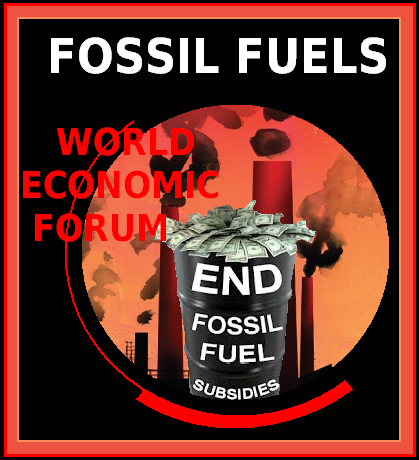
Curbing Fossil Fuels - Carbon Pricing and an End to Subsidies (WEF Summaries)

Carbon pricing and fossil fuel subsidies were popular topics at the World Economic Forum (WEF) in Davos, Switzerland. The comments made by economists, business leaders and climate experts signal a global readiness to price carbon and remove oil subsidies.

Investors and business leaders need and want regulatory certainty. Regulations on fossil fuels are coming the only question is when. Climate economist Lord Nicholas Stern was among those who argued that we need to see carbon taxes and eliminate oil subsidies.

If we are to get serious about tackling climate change we will need to curb fossil fuel use. One of the best ways to do so is through carbon pricing schemes. Rowan Douglas, CEO Capital, Science & Policy Practice and Chairman, Willis Research Network, said, "Carbon pricing is a very important tool in the armory. I think it is difficult to see the world achieving its targets without some sort of pricing mechanism for this critical pollutant."


Stern said, "Those of us who think that market economies work well, are also those who think when we see a major failure like this that the right thing to do to get the markets to work well is to correct it. And there’s a very simple correction: it’s carbon pricing. It can raise revenues for all the important things we have to do, like enhancing the life of poor people, [and] investing in innovation, health and education." He also said, "If you want to put a carbon tax on, now is absolutely the right moment."

Rachel Kyte, World Bank Group, Vice President and Special Envoy for Climate Change said, ‘We want carbon pricing. If you price carbon, we will be able to reduce emissions,’ then that will be a powerful message." World Bank President Jim Yong Kim urged governments around the world to agree on a pricing system for climate-changing CO2 emissions.

We are seeing momentum build for some form of carbon pricing scheme. Kim noted there had been progress over the last 12 months, including the UN general assembly’s commitment to set a carbon price. The head of Unilever, Paul Polman explained that businesses are also getting on-board, "50 of the top-200 companies now have an internal price for carbon. In New York, we had 1,000 businesses who signed a statement calling for a price on carbon."

In the US the Republican controlled congress stands in the way of carbon pricing. As Al Gore said in Davos, "We need to put a price on carbon and we need to put a price on denial in politics."

In addition to carbon pricing we also need to eradicate fossil fuel subsidies. Richard Branson, founder of the Virgin group said, "We have to make sure there are no more coal-fired power stations built anywhere in the world from today onwards. And we’ve got to get rid of all fossil fuel subsidies.”

Nobel Economics Prize laureate Michael Spence talked about progress being made removing oil subsidies in the developing world. "Fortunately, they [oil subsidies] are in the process of disappearing. Energy subsidies are a catastrophic policy. They produce a distorted development of the economy and all kinds of bad things."

Related
WEF Summaries: Climate Change
Towards a Global Climate Agreement at COP21 (WEF Summaries)
Business Leadership on Climate Change (WEF Summaries)
The Value of Investing in Climate Mitigation (WEF Summaries)
Global Economies Feeling the Heat from Climate Change (WEF Summaries)
Collaboration and Cooperation are Imperitive (WEF Summaries)
What is The World Economic Forum (WEF)
Risks Associated with Environment, Climate, Water Crisis and Extreme Weather in the WEF Report

The Value of Investing in Climate Mitigation (WEF Summaries)

One of the salient themes that emerged at the 2015 edition of the World Economic Forum (WEF) is that investors are very interested in climate action. There have been a number of important developments during the course of the WEF but few are more important than the emerging trend of integrating climate risks into financial assessments. The risks and the opportunities  posed by climate change are bottom line issues.

Low carbon energy investments are providing considerable returns. According to Bloomberg New Energy Finance, clean energy investment increased by 16 percent in 2014. The We Mean Business Coalition reports that companies are achieving 20+ percent internal rates of return on their own clean energy projects.

United Nations Secretary General Ban Ki-Moon noted that investing in climate protection could make a significant impact.

"Infrastructure and sustainability are treated as separate issues. We see this at the meetings of the G20, at other international gatherings, and even here at the World Economic Forum. We need to address this troubling disconnect," Ban said.

According to Paul Polman, Chief Executive of Anglo-Dutch food company Unilever, the size of global infrastructure investment will reach $90 trillion over the next 15 years.

"That needs to be done anyway. Do it in the right way, and you can solve your climate change issues and stimulate economic growth," he said.

Related
WEF Summaries: Climate Change
Towards a Global Climate Agreement at COP21 (WEF Summaries)
Business Leadership on Climate Change (WEF Summaries)
Curbing Fossil Fuels - Carbon Pricing and an End to Subsidies (WEF Summaries)
Global Economies Feeling the Heat from Climate Change (WEF Summaries)
Collaboration and Cooperation are Imperitive (WEF Summaries)
What is The World Economic Forum (WEF)
Risks Associated with Environment, Climate, Water Crisis and Extreme Weather in the WEF Report

Global Economies Feeling the Heat from Climate Change (WEF Summaries)

Economic assessments of climate risks and the potential returns from mitigation and adaptation emerged as salient themes at the World Economic Forum (WEF) in Davos, Switzerland.

A number of speakers made the point that it is important to calculate the massive risks associated with climate change. We are already seeing that climate change is systemically disrupting the global economy and the situation is destined to get far worse if we do not significantly reduce global carbon emissions.

As explained by several economists, we do not have to make the false choice between combating climate change and growth. We can both grow our economy and act on climate change.

The climate economist Lord Nicholas Stern, delivered a powerful presentation at Davos. His speech was rendered in a language that the business community and investors can understand. Stern makes the point that addressing climate change affords room for "better" growth. He explained the hidden cost of burning fossil fuels and extolled the virtues of renewable energy.

Although the price of oil is currently very low, we have seen tremendous volatility in the market valuation of fossil fuels. Against the backdrop of this volatility the cost of renewables has been steadily decreasing.

"Very serious economic analyses have shown that we have alternative energy sources and that at a relatively modest cost – about 1 or 2% of global GDP – we could take measures to decrease the risk [of climate change] very significantly," said Nobel Prize winning Professor Mario J. Molina at the WEF.

The economics of climate change mitigation is not only about decreasing the risks it is also about generating a very major for each dollar invested. As Jim Yong Kim pointed out, in the next decade, the potential return on aggressive investments inefficiency and clean transport alone could amount to US$ 1.8 - 2.6 trillion.

Related
WEF Summaries: Climate Change
Towards a Global Climate Agreement at COP21 (WEF Summaries)
Business Leadership on Climate Change (WEF Summaries)
Curbing Fossil Fuels - Carbon Pricing and an End to Subsidies (WEF Summaries)
The Value of Investing in Climate Mitigation (WEF Summaries)
Collaboration and Cooperation are Imperitive (WEF Summaries)
What is The World Economic Forum (WEF)
Risks Associated with Environment, Climate, Water Crisis and Extreme Weather in the WEF Report

Business Leadership on Climate Change (WEF Summaries)

The 2015 edition of the World Economic Forum (WEF) put unprecedented emphasis on the role of business to manage climate change. Both to mitigate costly risks and reap lucrative benefits, the business community is beginning to take climate concerns very seriously.

One of the key stories that emerged out of the WED last week is that an unprecedented number of business leaders are showing bold leadership on climate action. Business leaders are speaking more clearly and more cohesively than ever about the need to address climate change.

As Al Gore explained in a Davos presentation, "We have the solutions at hand. And this is why I’m so excited about all of the work being done, led by the business community," he said. "The private sector is leading the way," he added.

The private sector represents more than half (60%) of the global economy, so their importance in efforts to combat climate change cannot be overstated. Christiana Figueres, Executive Secretary of the UNFCCC made the point eloquently when she said, "There is no solution for climate without business, but equally there is no business continuity without a solution to climate."

Business has a critical role in helping to meet the climate challenge and they appear to be prepared to play their part. Business leaders continue to be concerned about risk not only in the future but as a present day reality. They see that climate change is already impacting their bottom lines.

Necessity is driving an unprecedented number of businesses to get on-board. Paul Polman, the CEO of Unilever, a leading sustainability focused company, summarized the current state of business saying, "It is not surprising that more businesses are stepping up to the plate. We now have 4,000 businesses reporting their greenhouse gas emissions; 80% of the world’s 500 largest companies are now setting target emissions standards."

The conversation on climate and energy in Davos shifted from one focused exclusively on financial risks to a discussion about economic benefits. With more companies than ever benefiting from low carbon investments, business leaders are beginning to see that climate change is not only a matter of reducing costs by managing risk it is also a lucrative opportunity. The Climate Has Changed Report demonstrates that in 2012 and 2013, companies invested in low-carbon programs are reaping an average rate of return of 27 percent.

Andrew Wales, SVP Sustainable Development, SABMiller put it this way. "I think progressive businesses have no option but to stand up more frequently and boldly to talk about the growth impact of not tackling climate change, of not understanding water scarcity. It's a growth question, therefore it's a business success question."

Businesses cannot afford to avoid acting on climate change nor should they ignore the opportunities. More than at any point in human history, the business community is acknowledging that addressing climate change makes good business sense.

Related
WEF Summaries: Climate Change
Towards a Global Climate Agreement at COP21 (WEF Summaries)
Curbing Fossil Fuels - Carbon Pricing and an End to Subsidies (WEF Summaries)
The Value of Investing in Climate Mitigation (WEF Summaries)
Global Economies Feeling the Heat from Climate Change (WEF Summaries)
Collaboration and Cooperation are Imperitive (WEF Summaries)
What is The World Economic Forum (WEF)
Risks Associated with Environment, Climate, Water Crisis and Extreme Weather in the WEF Report

WEF Summaries: Climate Change

Climate change was a central part of this year's World Economic Forum (WEF) which took place in Davos Switzerland from January 21 to 24. Unlike previous meetings there was an unprecedented sense of urgency in this year's discussions about climate change.

A WEF plenary titled "Tackling Climate, Development and Growth" included Paul Polman, A. Michael Spence, Jakaya M. Kikwete, Christine Lagarde, Ban Ki-moon and Jim Yong Kim. This distinguished panel shared the view that to combat climate change we must engage sustainable development. They also said that to succeed in efforts to reduce climate impacts we must see significant investments from both the public and private sector.

Barack Obama addressed climate change in his State of the Union speech saying, “And no challenge – no challenge – poses a greater threat to future generations than climate change.”

This point was borne out in the WEF's Global Risks Report which indicated that climate change and water issues are among the most serious concerns.

The headlines about the WEF meeting say it all, as explained by an article in The Guardian titled, Davos 2015: climate change makes a comeback,"The financial crisis pushed climate down the Davos agenda. This year, there are clear signs that it has made a comeback." The New York Times made a similar point in an article titled, “Leaders in Davos Urge Quick Action to Alter the Effects of Climate Change.”

At the WEF meeting Nobel laureate Michael Spence pointed to the "window of a very small number of years, after which we cannot win the battle." He also said that, "There is a tremendous sense of public sector awareness, commitment, demonstrations on the streets, a sense of momentum that has not been there before."

Related
Towards a Global Climate Agreement at COP21 (WEF Summaries)
Business Leadership on Climate Change (WEF Summaries)
Curbing Fossil Fuels - Carbon Pricing and an End to Subsidies (WEF Summaries)
The Value of Investing in Climate Mitigation (WEF Summaries)
Global Economies Feeling the Heat from Climate Change (WEF Summaries)
Collaboration and Cooperation are Imperitive (WEF Summaries)
What is The World Economic Forum (WEF)
Risks Associated with Environment, Climate, Water Crisis and Extreme Weather in the WEF Report

Video - WEF 2015: A Climate for Action

Video - WEF Pre-Annual Meeting Press Conference

What is The World Economic Forum (WEF)

The 2015 edition of the World Economic Forum convenes on Wednesday January 21, in Davos-Klosters, Switzerland. The World Economic Forum (WEF) is an international institution committed to improving the state of the world through public-private cooperation. The WEF’s Annual Meeting convenes global leaders from across business, government, international organizations, academia and civil society to map the changes taking place in our world.

The Forum has evolved from an opportunity for European corporate stakeholders to discuss business strategies into an organization that today is widely regarded as the world’s foremost multistakeholder platform for public-private partnership.

Together with other stakeholders, the WEF works to define challenges, solutions and actions, always in the spirit of global citizenship. It both serves and builds sustained communities through an integrated concept of high-level meetings, research networks, task forces and digital collaboration.

The WEF was established in 1971 as a not-for-profit Foundation and is headquartered in Geneva, Switzerland. It is independent, impartial and not tied to any special interests, although it works in close cooperation with all major international organizations. It strives in all its efforts to demonstrate entrepreneurship in the global public interest while upholding the highest standards of governance. Moral and intellectual integrity is at the heart of everything it does.

German-born Klaus Schwab, then Professor of Business Policy at the University of Geneva, chaired the initial gathering, which took place in Davos, Switzerland. Professor Schwab’s inspiration for creating the Foundation was his book –Moderne Unternehmensführung im Maschinenbau – in which the stakeholder principle was first defined. This concept states that the management of an enterprise is not only accountable to its shareholders but must also serve the interests of all stakeholders, including employees, customers, suppliers and, more broadly, government, civil society and any others who may be affected or concerned by its operations.

From the beginning, the Forum had considerable impact in improving political, economic and social awareness, acting as a catalyst for major bridge-building efforts. The Forum has provided a critical platform for furthering peace and reconciliation in many parts of the world, promoting understanding between East and West before and after the fall of the Berlin Wall, introducing emerging economies such as China and India to the international community, and bringing to the fore the latest trends and developments in many fields.

The Forum has also been the catalyst for a number of significant global initiatives, such as the Global Compact (developed jointly with the UN); the GAVI Alliance (initially the Global Alliance for Vaccines and Immunization); the Global Fund to Fight AIDS, Tuberculosis and Malaria; the expansion of the OECD; and the development of the G20 concept.

Over the last 20 years, the Forum has also evolved the stakeholder principle beyond the corporate level to a truly global sphere, stipulating that political, business and civil society leaders must work together to address the challenges of a globally interconnected world. This enhanced dimension has led to the notion of corporate global citizenship, as outlined by Professor Schwab in a Foreign Affairs article published in 2008.

Complexity, fragility and uncertainty are potentially ending an era of economic integration and international partnership that began in 1989. What is clear is that we are confronted by profound political, economic, social and, above all, technological transformations. They are altering long-standing assumptions about our prospects, resulting in an entirely “new global context” for decision-making.

Related
WEF Summaries: Climate Change
Towards a Global Climate Agreement at COP21 (WEF Summaries)
Business Leadership on Climate Change (WEF Summaries)
Curbing Fossil Fuels - Carbon Pricing and an End to Subsidies (WEF Summaries)
The Value of Investing in Climate Mitigation (WEF Summaries)
Global Economies Feeling the Heat from Climate Change (WEF Summaries)
Collaboration and Cooperation are Imperitive (WEF Summaries)
Risks Associated with Environment, Climate, Water Crisis and Extreme Weather in the WEF Report

Environmental Justice on the 50th Anniversary of the Passage of the Civil Rights Act

Today is the anniversary of the passage of the landmark Civil Rights Act which was signed into law 50 years ago. The half century celebration pays homage not only to race, but also to progress on gay rights and the equality of women. To that list of civil rights we should be adding environmental issues.

As reviewed in an August 2013 article in the Guardian, Phaedra Ellis-Lamkins, the chief executive officer of Green For All made the point the Hurricane Katrina highlighted issues of injustice and inequality.

As she explained, "Climate change isn’t just an environmental issue; it’s about keeping our communities safe. It’s a matter of justice. Because when it comes to disasters — from extreme temperatures to storms like Katrina — people of color are consistently hit first and worst."

In 2013 Green for All marched in Washington DC with tens of thousands of people from across America to observe the 50th anniversary of the 1963 March on the Nation's capitol. They marched against the recent attack on voting rights. They demanded justice in the face of Stand Your Ground laws and racial profiling. They marched to raise awareness on unemployment, poverty, gun violence, immigration, and gay rights. And they called for action on climate change.

As explained by Ellis-Lamkins, "African-Americans living in L.A. are more than twice as likely to die in a heat wave as other residents in the city." He also showed how people of color are more likely to suffer the ravages of pollution, citing the fact that 68 percent of African-Americans live within 30 miles of a toxic coal plant and one out of six black kids suffers from asthma, compared with one in 10 nationwide.

He said that efforts to combat climate change are part of Martin Luther King's famous 1963, "I have a dream" speech. "This is Dr. King’s dream reborn. And fighting climate change helps get us there" he said. "We need to respond to climate change today to ensure safe, healthy, prosperous lives for our kids tomorrow."

"The solutions to climate change won’t just make us safer and healthier — they are one of the best chances we’ve had in a long time to cultivate economic justice in our communities. Clean energy, green infrastructure, and sustainable industries are already creating jobs and opportunity," he said.

For people of color creating employment and improving the environment are fundamental issues of human rights.

"That’s why we have to add climate change to our retooled list of what the civil rights movement stands for," Ellis-Lamkins said.

© 2014, Richard Matthews. All rights reserved.

Related
Canadian Sheila Watt-Cloutier the World's Leading Voice on Arctic Climate Impacts and Human Rights
Former Irish President on Development Goals, Climate and Human Rights
A Policy Perspective on Climate Change and Human Rights
Human Rights Day (December 10): Climate Change
The UN Connects Human Rights and Climate Change
World Bank on Human Rights and Climate Change
Dr. Martin Luther King Civil Rights and Environmental Issues in America
What is Environmental Migration and Who are Climate Refugees
Climate Change Exacerbates Social Tensions and Causes Conflict
Sustainable Development Goals to Follow Millennium Development Goals

Figueres on the Need for a Binding Global Climate Treaty by 2015

Christiana Figueres, the Executive Secretary of the UN’s Framework Convention on Climate Change (UNFCCC) is a stalwart champion of efforts to reign-in climate change causing greenhouse gases (GHGs). She has repeatedly made bold statements about the need to act now. “We’re running out of time…we have to get to zero net emissions by the second half of this century, and in order to put us on a path to do that we have to reverse the trajectory of GHG emissions that we have now,” Figueres said.

She points out that we really have no alternative to a binding global climate treaty by 2015. “Not coming to an agreement is unacceptable – there’s just no way,” said Figueres. “We don’t have the option of not coming to an agreement, and frankly we don’t have an option of not coming to an agreement that is meaningful.”

Figures has made it clear that combating climate change is not just the responsibility of governments, businesses and large organizations, it is the responsibility of each and everyone of us as we all have a stake in a positive outcome.

“Every single one of us needs to be part of that team. None of us are exempted from responsibility, all of us can contribute,” Figures says. “This needs to be a movement forward that is constructed by everybody, not just by institutions, not just be government, not just by corporations. The team is a seven billion man and woman team.”

Related Articles
National Laws and a Global Climate Agreement 
Obama's End Run Around the Senate to Secure a Climate Deal
Denmark's Climate Change Bill
Finland's New Legislation will Reduce Emissions by 80%
Why France is a Global Climate Leader
Hope for Climate Finance and Why We Can't Give Up on UN Climate Talks
Role of Business in Managing Climate Change by UNFCC Executive Secretary Christiana Figueres
Showcasing Progress: Momentum for Change Lighthouse Activities
Video - Business Needs to do More to Reduce Emissions - Godot Paralysis
COP 19: The Good, the Bad and the Ugly
Video - COP 19 Strategies: Walkouts, Sanctions and Eco-Socialism
Video - COP 19: Wealthy Nations Refuse to Help the Developing World Manage Climate Change
Video - Walkouts Over Inaction on Climate Finance, Green Climate Fund and Loss and Damage
Walkouts and Hunger Strikes Draw Attention to Inaction at COP 19
COP 19: Nothing But Bad News at the End of Week One
Shameful Nations at COP 19: Poland, Japan, Australia and Canada
COP 19: Progress Needed on the Green Climate Fund
Business is Being Prominently Highlighted at COP 19
World Climate Summit - Warsaw Business Day at COP 19: WBCSD and World Climate Forum for Business
Ukraine and Belarus Derail 2013 UN Climate Talks in BonnAchievements of COP 18: The Doha Climate Gateway
COP 18: Bridging the Gulf Between Science and Reality
Yvo de Boer's Comments and Predictions Post COP 17
A Short History of the UNFCCC Conference of the Parties (COP) 

Video - Spiderman is the 2014 Earth Hour Ambassador

Video - Spider-Man 2 the Most Sustainable Blockbuster Ever

Video - Earth Hour Blue Crowdfunding Tutorial

Video - Earth Hour 2014 (60 seconds)

Video - Earth Hour 2014 (2 Minutes)