Showing posts with label game. Show all posts

Game to Make Super Bowl 50 a Net Positive Event

This year there is a campaign to make this the most healthy, sustainable, shared, and socially responsible Super Bowl ever. An initiative called "Play Your Part" is trying to make Super Bowl 50 a net positive event. Play Your Part arises organically from the fact that Super Bowl 50 is being played in San Francisco Bay, an area well known for its leadership in innovation, sustainability, and technology.

The event is the brainchild of the 50 Fund and the 50 Host Committee. It is designed to help people make more sustainable choices in their lives now and in the future and to leave Bay Area communities better than they were before.

As they explain on their website, "We’re not just hosting the Super Bowl. We’re redefining it." Being Net Positive is about using Super Bowl 50 as a platform to do good – socially, environmentally and economically – for the benefit of the entire Bay Area.

The event is premised on four main goals:

To deliver a low-emissions event (power/ transportation)
To responsibly use materials and resources (food/water/waste)
To leave a positive and lasting legacy for the region
And, last but not least, to inspire fans to join us in making all of this a reality

The Play Your Part’ campaign hopes to inspire Bay Area sports fans and residents to do the right thing and join in embracing sustainable practices. In support of this goal the organizers will showcase innovative solutions that lessen our collective impact and by inspiring people to share stories of the simple, everyday things we can do each day to make a difference. The game designed to raise awareness and minimize impacts.

Environment

Levi's Stadium - The first LEED gold-certified professional football stadium.
Moscone Center – The 700,000 square foot convention center, home of The NFL Experience, and a hallmark of San Francisco tourism, is also a LEED gold-certified building.
Carbon Offsets – While our first goal is to reduce and avoid emissions, Host Committee sustainability partners TerraPass are helping to offset the emissions that are unavoidable. TerraPass is also working with the NFL, Host Committee Partners and Fans to do the same.
NFL's Urban Forestry Grants – This program provides much needed support for the planting of trees in Bay Area communities through grants to local Bay Area organizations.

Transportation

Public Transportation – As part of Super Bowl 50’s overall transportation plan, the Host Committee is working with regional agencies to ensure there are increased service levels for all public transit during Super Bowl week (January 30 – February 8). This will include additional service for Golden Gate Ferry, BART, WETA, and Muni. The Host Committee is also working with VTA and Caltrain to create a joint fare that encourages public transit along the Peninsula on game day.

Public Awareness – The Host Committee will work with media partners to promote the use of public transit and to discourage the use of cars. For Super Bowl Sunday, the Host Committee has created a special ‘SB 50’ pass with VTA to ensure that public transit provides the best option to get and from Levi’s Stadium. In addition, over 35,000 branded Clipper cards will help promote the use of public transit through a partnership with the MTC. Volunteer Transportation – The Host Committee will distribute branded Clipper Cards to all 5,000 SB50 volunteers to encourage them to take public transportation to and from their shifts.

Bike Valet – The Host Committee has partnered with the San Francisco Bike Coalition to establish a Bike Valet station at Super Bowl City for all 9 days, thanks to funding from the BAAQMD.

Fan Express – The Host Committee will make available a ‘Fan Express’ charter bus system for transportation to Levi’s Stadium on Super Bowl Sunday, with pick-up points spread throughout the Bay Area. Media Shuttles – The Host Committee is working with BYD to incorporate a small fleet of fully-electric buses into the NFL's media shuttle operation around downtown San Francisco.

Energy

PG&E, our official Clean Energy Partner, have made it possible for the Host Committee to run Super Bowl City on clean renewable power.

All generators used in Super Bowl City will run on Neste NEXBTL renewable diesel which to reduce emissions and improve air quality. Generators meeting EPA’s Tier 4 standards will be used in Super Bowl City to reduce emissions and noise, while Hydrogen Fuel Cell generators will be used to supplement renewable diesel generators and showcase this new technology of the future.

And we’ll be relying on the human energy provided by our 5,000 Volunteers and 100 Net Positive Champions that will be engaging with fans and helping them to have a net positive experience at Super Bowl 50.

Community

25% of corporate sponsorship monies raised for Super Bowl 50 go towards creating a positive legacy by improving Bay Area communities.

The 50 Fund, with support from Host Committee Partners, the NFL, and Friends of 50 Fund, is leading the charge to make this the most giving Super Bowl ever by supporting Bay Area organizations that help young people overcome the opportunity gaps that many face. 50 Fund programs include the Game Changer and Playmaker Grants programs, as well as legacy initiatives The RE(A)D ZONE and Play 60, Play On. For details, go to 50fund.org. The NFL's Super Kids, Super Sharing initiative sees schools from across the Bay Area teaming up with the NFL, Oakland Raiders, San Francisco 49ers, Verizon, and the Host Committee to put books, sports equipment, and school supplies into the hands of our children, and children in need.

The YES Youth Conference, hosted by BAAQMD, will feature a Super Bowl 50 theme. The conference will be attended by over 300 youth leaders from Bay Area schools with the goal of inspiring them to embrace sustainable futures, and share these messages with their fellow learners.

The Super Bowl 50 Host Committee has collaborated with Bay.org to establish Go Places, an innovative booking system and funding platform for school field trips. Go Places’ “Ready, Set, GoPlaces” awareness initiative will provide 50 free field trip buses for underserved Bay Area classes. Through the generous support of our funders and in collaboration with our field trip and transportation partners, 1,500 students will be getting out of the classroom to experience the amazing nature and science the Bay Area has to offer including Super Bowl City.

Food

The Host Committee’s master food concessionaire Legends will be serving locally sourced and organic food options in Super Bowl City.

A strong, active food recovery program will ensure that various food banks around the Bay Area benefit from receiving food for the needy that would otherwise go to waste.

Water

As part of the #BringYourOwn campaign, fans are encouraged to bring their own reusable water bottles and will be able to rehydrate using free water stations located throughout Super Bowl City. All 5,000 volunteers and 5,000 media personnel will be using reusable BPA free stainless steel bottles provided by official sustainability partner Klean Kanteen.

Water used to irrigate the pitch at Levi's Stadium is 100% recycled.

Waste

There will be no single-use bottles at Super Bowl City. Together with official sustainability partner Klean Kanteen, we’ll be inspiring a new conversation with fans around the elimination of single-use waste in the environment through their #BringYourOwn campaign.

A robust waste management plan is being implemented to ensure the greatest diversion of waste from landfill. Attention is also being paid to what materials are brought onsite at Super Bowl City to reduce what enters the waste stream. One example is the compostable serviceware that concessionaire Legends will use to serve all food and beverages.

A materials recovery program is being conducted by the NFL and Host Committee with various local community partners. This will lead to event related materials being collected post-event and upcycled to multiple uses. The Super Bowl City Production Charter will guide those brands activating in Super Bowl City, and their production companies, to embrace sustainable design practices. The Production Awards, to be announced on Sunday, January 31st 2016, will recognize those companies that best embrace these guidelines.

Choose Your Cause and Create a Net-Positive Legacy for the Bay Area

The 50 Fund selected four deserving Bay Area environmental non-profits to receive grants from the $1 million Sustainable Environments Grant Program. Once you submit your pledge, you receive 50 GoodCoins to give to the cause that matters to you most. You will be able to select from one of the four featured causes below. Through our collective action we’ll direct $200,000 from the Sustainable Environments Game Changer Program to causes that make a real and lasting impact on young people in the Bay Area. Thanks to the 50 Fund for supporting innovative approaches that create lasting solutions for local challenges. Causes

Education Outside

By using green schoolyards as innovative outdoor learning laboratories and connecting students with nature and healthy food as a regular part of their school day, Education Outside is creating resilient students that have the critical thinking skills and inspiration needed to achieve high-quality careers in the sciences, life-long health, and an environmentally sustainable future.

Environmental Volunteers

To provide affordable, easy-to-schedule, efficient and safe transportation for low-income youth (K-12) in the San Francisco Bay Area that facilitates access to science and environmental education field trips. The Game Changer grant will expand the Transportation Fund’s reach with an additional 340 buses sending over 13,000 more students on field trips.

Children’s Discovery Museum Of San Jose

To address the lack of connection to the natural world in nearby densely urban neighborhoods by building an outdoor play space that is a bridge to nature, combining interactive experiences in a natural setting with conservation, demonstration and educational programs that respond to the learning needs of diverse families.

Hunters Point Family

Hunters Point Family’s Healthy Bayview program will be scaled to increase the capacity of Hunters Point Family’s extensive community gardens and food education programs and also support the development of a state-of-the art aquaponics social enterprise that will increase healthy food production (produce and protein) and distribution to over 1,000 Bayview Hunters Point families each year.

For more information click here.

Related Articles
Solar Energy and other NFL Sustainability Initiatives
LEDs Light Up Super Bowl XLIX
Sustainability a Winner at Super Bowl XLIX
First Super Bowl to be Played under LED lights
Super Bowl XLVlll the Greenest Ever
World Cup 2014: An Environmental Post Mortem
Olympic Sized Greenwashing at the Sochi Olympics

Solar Energy and other NFL Sustainability Initiatives

The NFL leads all professional sports in its adoption of solar energy. The two teams that competed in Super Bowl XLIX are no exception. Both the Seattle Seahawks and the New England Patriots employ solar power at their home stadiums. This has prompting some to call the 2015 match-up, the "Solar Super Bowl."

The Seahawks Century Link Field and the Patriots Gillette Stadium rank fifth and sixth respectively among all sports franchises in installed solar capacity. Together these two stadiums have a solar capacity of 1,800 kilowatts (kW).

"Since the construction of Gillette Stadium, we have focused on long-term sustainability and energy efficiency as we try to not only be good corporate citizens, but leave behind a healthy environment for our children and grandchildren," said Jim Nolan, New England Patriots senior vice president of operations, finance and administration. "We are proud of our renewable energy efforts and happy to see so many other sports franchises taking similar steps to collectively reduce our environmental impact."

Century Link Field gets almost one third of its electricity from solar. The increasing reliance on solar energy is not unique to the teams that competed in this year's Super Bowl. One third of all American football stadiums have solar panels. The leading NFL stadiums belong to the Washington Redskins which ranks second in the league with 2,000 (kW) of installed capacity. By far the leading team is the Philadelphia Eagles with a total of 3,000 (kW).

"Our commitment to sustainability began in 2003 with the opening of Lincoln Financial Field," said Eagles President Don Smolenski. "What started with a blue bin under each employee’s desk has grown into our company-wide Go Green initiative that encompasses energy efficiency, recycling, composting, green purchasing, reforestation and more. Through our partnership with NRG, we are now able to produce clean energy on site after installing more than 11,000 solar panels and 14 wind turbines. We are fortunate to have a platform that allows us to lead by example and reduce our environmental impact and we are supportive of all the other venues and organizations doing the same."

In addition to generating good PR, solar is also good business. Like other sports organizations, football teams are turning to solar because it is both cost effective and environmentally responsible.

"The San Francisco Giants recognize that innovation and sustainability go hand-in-hand from our solar initiatives to our recycling and water conservation programs. Sustainability is one of the ways that we can be innovative as a business," said Alfonso Felder, Giants Senior Vice President of Administration.

Related
Game to Make Super Bowl 50 a Net Positive Event
LEDs Light Up Super Bowl XLIX
Sustainability a Winner at Super Bowl XLIX
First Super Bowl to be Played under LED lights
Super Bowl XLVlll the Greenest Ever
World Cup 2014: An Environmental Post Mortem
Olympic Sized Greenwashing at the Sochi Olympics

LEDs Light Up Super Bowl XLIX

LEDs were in the spotlight at the 2015 Super Bowl. The first Super Bowl to be illuminated by LEDs yielded a lighting energy savings of 75 percent over traditional lighting. LEDs have overcome some of the early hurdles and they now offer excellent lighting quality while consuming only 25 percent of the energy of traditional lighting. The cooler-burning LEDs also cut air-conditioning costs by 30 percent.

The new lighting at the University of Phoenix stadium was provided by 44,928 Cree XLamp MK-R LEDs, and installed by Ephesus Lighting.

LEDs offer a number of benefits including efficiency and quality. LEDs are far more powerful than traditional stadium lighting. The new lighting at the University of Phoenix Stadium uses 480 fewer fixtures than the previous system (300 LED fixtures replaced 780 metal halide fixtures). Even more dramatically the new LED lighting system uses 930,000 less watts of power than the previous system (310,000 watts for LEDs vs 1.24 million watts for metal halide bulbs).

In addition to substantially lower power requirements, the lighting quality of LED lighting is also superior to metal halide. LEDs make everything look better by producing nearly double the illumination of the old metal halide bulbs. The LEDs are also more life-like and they provide more uniform lighting. This reduces shadows which helps to improve visibility for both players on the field and viewers.

The high profile of the Super Bowl is a great way to disseminate the value and quality of LEDs.  As explained by Michael Watson, Cree’s vice president of product strategy: “The Super Bowl and stadium lighting is sort of like the holy grail from an LED perspective.”  

Super Bowl XLIX may have been the first to be illuminated by LEDs but it is not the last. A value equation that combines quality and efficiency mean that LEDs are destined to dominate the future of lighting.

Related Articles
Game to Make Super Bowl 50 a Net Positive Event
Solar Energy and other NFL Sustainability Initiatives
Sustainability a Winner at Super Bowl XLIX
First Super Bowl to be Played under LED lights
Super Bowl XLVlll the Greenest Ever
World Cup 2014: An Environmental Post Mortem
Olympic Sized Greenwashing at the Sochi Olympics

Sustainability a Winner at Super Bowl XLIX

The 2015 Super Bowl provided a powerful platform that showcased sustainability. The game at the University of Phoenix stadium was lit by LEDs and powered by both wind and solar energy. Carbon emissions were offset by renewable energy credits and recycling efforts permeated the entire event. This included donating uneaten food and an e-waste recycling program. The NFL also donates tons of materials that would otherwise be discarded and they run an urban forestry tree planting program.

These efforts are meant to reduce the Super Bowl's hefty environmental impact. The 2012 Super Bowl in Indianapolis used around 15,000 megawatt-hours of electricity. That is enough energy to power about 1,400 US homes for a year. The 2013 Super Bowl in New Orleans generated about 3.8 million pounds of carbon dioxide emissions, which is equivalent to the annual tailpipe emissions of 400 cars.

There is a massive environmental burden associated with all major sporting events. While critics rightly say that the Super Bowl event is an "energy guzzling, carbon emitting, waste generating machine," they overlook the positive steps that are being taken to reduce the game's environmental impact. Even more importantly they ignore the public relations bonanza that the event affords.

"It's not so much about how much of the problem do you create; it's about how much of the problem are you willing to take responsibility for," said Jack Groh, director of the NFL Environmental Program.

Both the Seahawks the Patriots are engaging a range of sustainability initiatives to reduce their carbon load. However, it is important to understand that sustainability in football is not only something that is showcased at the Super Bowl. The stadiums of many teams are becoming more sustainable. What is happening in football is part of a clear trend towards lower carbon sporting events. This emanates from a powerful value proposition where reduced environmental impacts generate cost savings.

The 2014 Superbowl, which up to then was the greenest ever, has been eclipsed by this year's event. As the nation's largest sporting event it is fitting that the Super Bowl is striving to be a sustainability leader. With one million people coming to the host city for the event, 120 million American television viewers and an international audience that is growing by 7 percent every year, the Super Bowl is an unparallelled opportunity to communicate the value of sustainability.

It is not only the scope of the Super Bowl's reach but who it reaches that make this event so powerful. The Super Bowl succeeds in reaching a particular demographic that may be less receptive to science driven assessments.

The co-founder of the Green Sports Alliance, Allen Hershkowitz, who is also a senior scientist with the Natural Resources Defense Council explained it this way: "I always say, 13 percent of Americans follow science. Sixty-three percent of Americans follow sports."

Green Sports Alliance Executive Director Martin Tull added, the Super Bowl is "an amazing opportunity" to reach people you otherwise wouldn't.

"When you have teams you respect and admire, when sports teams start to talk about why sustainability is cool, it can inspire millions of people in a way that other organizations can't," Tull said.

The Super Bowl is an important venue to help the public to buy into a low carbon future. Popular support is essential if we are to succeed in making society wide changes to stave off some of the worst impacts of climate change.

Katy Perry's half time show may have generated considerable buzz but so have renewables, energy efficiency and recycling. Super Bowl XLIX was not only a win for the New England Patriots, it was a victory for sustainability.

Related
Game to Make Super Bowl 50 a Net Positive Event
Solar Energy and other NFL Sustainability Initiatives
LEDs Light Up Super Bowl XLIX
First Super Bowl to be Played under LED lights
Super Bowl XLVlll the Greenest Ever
World Cup 2014: An Environmental Post Mortem
Olympic Sized Greenwashing at the Sochi Olympics

Video - First Superbowl to be Played Under LED Lights


LED lights take center stage at Super Bowl XLIX. The world's most watched sporting event between the New England Patriots and the Seattle Sea Hawks will be illuminated by LED lighting. This is the first time ever that LEDs are to be used to light a Super Bowl event. Ephesus lighting installed Cree's LEDs in the light fixtures at the University of Phoenix stadium. The lights were installed at the home of the Arizona Cardinals, this past fall making it the first NFL stadium to be lit by LED lighting.

Related
Game to Make Super Bowl 50 a Net Positive Event
Solar Energy and other NFL Sustainability Initiatives
LEDs Light Up Super Bowl XLIX
Sustainability a Winner at Super Bowl XLIX
Super Bowl XLVlll the Greenest Ever
World Cup 2014: An Environmental Post Mortem
Olympic Sized Greenwashing at the Sochi Olympics
Super Bowl XLVlll the Greenest Ever

On Sunday, February 2, 2014, Super Bowl XLVIII will go down in history as the greenest such event ever. Everything from energy to food will be green at this year's Super Bowl and the stadium boasts extensive use of recycled materials. There was also an e-waste recycling initiative in the region to help green the event. There is even a green element to the advertising this year.

There are both practical and symbolic implications of this effort. Such initiatives help to raise awareness with people who otherwise may be nonplussed by sustainability. It will also significantly reduce the environmental footprint of the world's largest single sporting event.

Super Bowl XLIII marks the 16th consecutive year that the NFL has incorporated environmental projects into the management of a professional championship event.

The Environmental Program is about far more than building a green image. This event is about actually addressing environmental impacts cost effectively and leaving a permanent environmental legacy in the host community.Super Bowl events have engaged a wide variety of green initiatives included incorporating hybrid vehicles and offsetting travel emissions for both teams and NFL staff and officials. Super Bowl XLlll is no exception and it will rank as the greenest championship event ever.
Energy

A ring of solar panels encircle the event venue, Met Life Stadium (MLS). These solar panels provide electricity equivalent to 34 average homes’ annual energy consumption. Green power for the game will also be provided by Public Service Enterprise Group (PSEG) who is working in partnership with the NFL Environmental Program. PSEG will retire one renewable energy credit (REC) for every megawatt hour of electricity used. This includes the power used at MLS, team hotels and the Super Bowl Boulevard event.

A renewable energy credit (sometimes referred to as a renewable energy certificate or "greentag") is defined as "an environmental commodity that represents the added value, environmental benefits and cost of renewable energy above conventional methods of producing electricity, namely burning coal and natural gas. RECs help wind farms and other renewable energy facilities grow by making them more financially viable, thereby incentivizing development."

PSEG’s REC purchase will include New Jersey solar renewable energy credits and Community Energy, a certified Green-e Supplier, sourced from the Jersey – Atlantic City Wind Farm.

Food

The food for the XLVIII Super Bowl will be the “greenest in history." MLS and foodservice partner Delaware North Companies Sportservice are the first Certified Green Restaurant stadium as awarded by the Green Restaurant Association (GRA). They received a 2-star certification from the GRA. No other stadium in the world has achieved Certified Green Restaurant status and this is the largest food service operation ever to receive such certification. This is quite a feat given that there will be more than 200 on-site restaurants servicing up to 100,000 people in a day.

The GRA started in 1990 with the goal of reducing restaurants’ harmful effects on the environment. MetLife Stadium kiosks and food courts were evaluated using a certification system with seven categories: energy, chemical and pollution reduction, food, waste, water, disposables and furnishings and building materials.

A summary of their green food accomplishments include:

All waste kitchen oil is being converted to biodiesel fuel
Composting all kitchen scraps
Donating all leftover food
Recycling cardboard, plastic, glass, aluminum, and paper
Use of Energy Star equipment
Installation of waterless urinals, touchless sensor faucets, 1/2 gallon faucet aerators, and low-water landscaping
Eliminating all polystyrene foam containers


Recycled Materials

In addition to energy and food, the venue for this year's Super Bowl also incorporates recycled steel. A total of 40,000 tons of recycled steel went into the construction of the stadium, according to the building’s website. Recyclers took 84 percent of the stadium’s construction waste.

Recycling of e-Waste

A partnership between NY/NJ Super Bowl Host Committee, the NFL, Verizon and the Broadway Green Alliance has collected and recycled electronic waste in New York and New Jersey as part of a series of sustainability initiatives aimed at “greening” the Super Bowl and making a positive environmental impact in New York and New Jersey.

Advertising

Even Super Bowl advertising went green. Northern Minnesota egg farm, Locally Laid, was the runner up in a contest staged by Intuit which awarded the winner an expensive ($3 million) and highly coveted 30 second advertising spot. The winner was a toy company called GoldieBlox, whose mission is to encourage female engineers, and perhaps even help to support women who will one day in the future help us to manage the environmental crisis we face.

The GoldieBlox ad is scheduled to run in the third quarter of Sunday’s Super Bowl broadcast.

Related
Game to Make Super Bowl 50 a Net Positive Event
Solar Energy and other NFL Sustainability Initiatives
LEDs Light Up Super Bowl XLIX
Sustainability a Winner at Super Bowl XLIX
First Super Bowl to be Played under LED lights
World Cup 2014: An Environmental Post Mortem
Olympic Sized Greenwashing at the Sochi Olympics

World Water Week Raises Awareness through Gamification

A new game designed to promote sustainable water resources management has been released for World Water Week. The game is called Aqua Republica and was created through a partnership between UNEP and DHI along with the collaboration of a number of others.

The game not only raises water awareness it is designed to help build capacity in some of the most critical issues in water resources management.

In this game participants make decisions about water management and in the process they learn about the connectivity and importance of water resources, as well as the need for careful management.

While the world of Aqua Republica is fictitious, the challenges of sustainably managing a limited supply of water resources in a situation of growing demand between multiple users and uses are very much based on real life scenarios.

Click here to play the game.

Related Articles
40 Eco-Apps that Put Technology to Work for the Environment
Mobile Gaming Promoting Sustainability and Social Responsibility at Events (White Paper)
Game Change Rio: An Interactive Game based on System Dynamics

TerraCycle Facebook Game App: Upcycling & Recycling

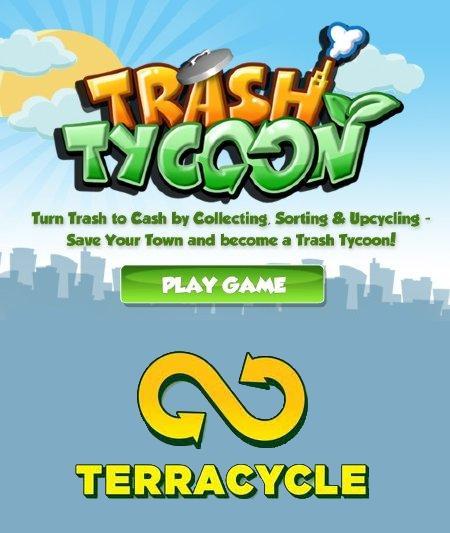
An initiative from TerraCycle incorporates recycling into a game. In 2011 TerraCycle, the company which turns trash into eco-products, launched Trash Tycoon, a Facebook game that teaches players to upcycle. Instead of planting crops or building cities as in FarmVille or CityVille, in Trash Tycoon the player cleans houses and town buildings such as a library, a school and a town hall. Players also build factories, which upcycle and recycle the collected trash and include a worm farm, glass smelter, plastic extruder, injection molder, paper recycler and greenhouse.

Players earn game money and points for the amount of waste that they upcycle into products. The products that the game produces are the same TerraCycle products on the shelves and on their website. In Canada, the upcycled Kool-Aid pencil case or the Kit Kat tote bag for instance are made from used drink pouches and Chocolate bar wrappers.

When players start making these products, they can get an idea of what it takes to make these things in real life, and how they can be made from trash that we produce every day. Today, almost 1,000,000 Canadians are collecting trash for TerraCycle diverting more than 2,000,000 waste units from landfill.

The online game helps both learn about the environment and raise money for CarbonFund.org, an environmental non-profit. 10% of all in-game currency will be donated to a CarbonFund project, and players will get to choose from three monthly projects to support with their efforts.

To play the game click here.

© 2012, Richard Matthews. All rights reserved.

Related Posts
40 Eco-Apps that Put Technology to Work for the Environment
Mobile Gaming Promoting Sustainability and Social Responsibility at Events (White Paper)
Game Change Rio: An Interactive Game Based on System Dynamics
What is TerraCycle (Video)
TerraCycle Making Products from Waste (Video)
TerraCycle and Upcycling (Video)
TerraCycle Reach a Major Milestone in Non-Recyclable Waste Diversion
Earth Day Marketing Mayhem ROI

40 Eco-Apps that Put Technology to Work for the Environment

Technology may not be a panacea to solve the climate crisis, but green applications (eco-apps) are helping to drive awareness and foster responsible action. There was a time when eco-apps did little more than provide lists of so-called “green” products and services. Now green-themed apps have turned mobile devices into portals for environmental education and sustainable action. The smartphone market share is now estimated to be more than 40 percent in the U.S. Around the world, smartphones are proliferating and green apps are growing along with them. Eco-apps can help people be more efficient and reduce their energy consumption.

There are a wide variety of energy apps including those that monitor efficiency and consumption. Apps help with things like recycling and other aspects of green living. Mobile and tablet based smart energy applications help consumers to optimize their energy and water consumption, monitor their appliances, water heater and other electronics. These apps can also monitor and operate HVAC, grey water (from rain), automated windows (shutters and blinds) and lighting systems. They can even provide information about renewable energy conversion and variable price grid management.

Here is a list of some of the best eco-apps compiled from a variety of sources including the Department of Energy, Environmental Protection Agency, Living Green Magazine, Clean Techies, Good & Green Guides, ecofriend, Solar Energy and the Globe and Mail. Most of the Apps listed below are free or cost less than one dollar.

At the end of May 2012, the Department of Energy announced the winners of its Apps for Energy competition. Apps for Energy challenged developers to build applications that help consumers get the most out of their energy usage data. These apps were created using Green Button, which is an open standard for sharing electricity data of utility customers. The goal was to help consumers to understand and reduce their energy use.

The Apps for Energy competition had a few key goals. The first was to encourage open innovation around Green Button. With Apps for Energy, they challenged developers to leverage the enormous potential of Green Button data by building web and mobile applications that help homeowners and business understand their energy usage and take action, so they can save money by saving energy. As the number of utilities around the country offering Green Button data increases, the importance of these applications will continue to grow. Equally important is the effort to create a thriving, energy-focused developer community that is committed to using technology to address real-world challenges, like reducing energy waste.

Developers submitted more than 50 web and mobile-based applications for the competition. This wide range of apps ran the gamut from a program that helps commercial builders reduce energy waste, to a fun, social game that lets you compare your energy-usage to that of your friends.

First Prize went to LEAFULLY for an app that helps utility customers visualize their Green Button data as a variety of units, such as the amount of trees needed to offset an individual’s energy usage. This app is the brainchild of Seattle-based team, Timothy Edgar and Nathan Jhaver. This app calculates a user’s energy use and then displays the impact in terms of an equivalent number of trees. Users have four main views: overview, trends, calculator and ways to save.

The Leafully app compiles historical data for energy use (electricity, natural gas and miles driven) and provides hourly breakdowns. Leafully even addresses sleeping energy, efficient appliances and peak time use. The app also lets a user see the energy they are using from their utility and the impact if they were to use only renewable energy. Users sign into the app with their Facebook account, which encourages energy reduction competition amongst friends.

Second prize went to MELON for an app that evaluates the energy performance of commercial buildings to help building owners to obtain the Energy Star benchmark. DC-based startup Melon describes itself as the first company to utilize Green Button data to simplify the process of obtaining an ENERGY STAR benchmark for commercial buildings. The app uses Green Button to evaluate the energy performance of commercial buildings.

Third prize went to VELObill, which is similar to Leafully except it focuses on the cost of energy as opposed to the environmental impact. VELObill was created by Zerofootprint and it provides consumers with an easy to understand comprehensive picture of their energy use including how much they spend on gas, water and electricity, whether their bill has gone up or down, and how they compare to peers. In addition, VELObill shows consumers how to save money, who can provide them with help, and offers tools to manage their plan of action.

The first student prize went to WOTZ for an app that was submitted by a team of students at the University of California, Irvine. This app lets users explore and play with Green Button data. The app provides several games based on the “shape” of your data, and provides creative comparisons to illustrate your usage.

The second student prize went to BUDGET IT YOURSELFfor an app that is a collaborative project from a team of students at Case Western Reserve University and the Cleveland Institute of Art. The app helps users track their energy usage and make energy-savings goals.

Some other popular apps using Green Button include Innovative Solar Demand Response, Grid Fortune and iEnergy. To see the full range of diverse, innovative and engaging energy apps developed for the competition click here.

In the fall of 2011, the Environmental Protection Agency (EPA) announced the winners of their Apps for the Environment competition. The winner of the EPA’s “Best Overall App” was Light Bulb Finder by Adam Borut and Andrea Nylund of Eco Hatchery. Light Bulb Finder helps users switch from standard incandescent to energy-efficient light bulbs. With simple inputs about bulb and fixture types, the app recommends energy-saving bulbs with the right light quality, fit and style. Light Bulb Finder calculates financial payback and environmental impact. Energy-saving bulbs can be purchased via the app or at local stores.

The EPA’s runner up for Best Overall App was Hootroot by Matthew Kling of Brighter Planet. The Best Student App was EarthFriend by Will Fry and Ali Hasan of Fry Development Company and Differential Apps. The Best Student App runner up was Environmental Justice Participatory Mapping by Robert Sabie, Jr. of Western Washington University. The Popular Choice Award went to CG Search by Rajasekaran Bala of Cognizant Technology Solutions.

Other eco-apps include Green Genie, which is a complete guide to the sustainable lifestyle. Developed in collaboration with a LEED Accredited Professional and a professional sustainability consultant, this app offers more than just green tips, it is a massive collection of green projects and resources. Green Genie shows users how to reduce their impact and save money doing it.

Whirleo is the first game developed in conjunction with global eco-charity 1% for the Planet, it lets players control colorful, spinning tops on planet Rotopolis. As they travel, each Whirleo cleans up pollutants released by the begrimed Guzzler. Players swipe and tilt their touch-based smartphones and tablets to make tops whirl across land, sky and water. They locate hidden power-ups, discover magical crystals, solve puzzles and unlock new characters while learning about environmental issues.

Yoink is an app that reduces waste by providing a fast and easy way to find or give things away that may otherwise by thrown in the garbage. It employs an interactive map for local sourcing. There is no cost for this app and all that is required is a private message through the app to organize the pickup.

iamgreen’s Battery Saver is an app that allows users to adjust their battery settings to cut out unnecessary energy draining settings such as bright screens and unneeded Wi-Fi. It also includes an energy quiz, offers tips on saving energy and plants a tree with each purchase.

A wide range of apps are available that help people to reduce energy usage in the home. Such apps can remotely turn off appliances that use energy when they are not in use but remain plugged in. Research has shown that homeowners who are able to check how much electricity they are using in real time save an average of more than 10 percent almost immediately by turning off unnecessary lights and appliances.

The UFO Power Center is a power saving device that helps users to manage the energy use of home appliances, eliminate stand-by power, and save electricity. It provides real–time feedback which enables users to follow the energy consumption of each individual electrical device.  It can automatically turn off appliances when not in use.

Meter Readings is an app for recording readings from electricity, gas and water meters. Based on manually entered data, it displays graphs and tables of weekly and monthly costs and year-to-year comparisons, predicts your next bill and helps check bill accuracy. The app can handle multiple meters.

Control4 is a home energy app that allows users to control everything from security, lighting, and temperature to music and video for homes with the Control4 system.

SunPowerSolar Management Systemapp is an innovative Solar Electric Home Energy Management System that lets you monitor energy produced from SunPower-branded solar systems in real time. SunPower® Monitoring provides on-the-go access to the information to help save on energy expenses. Homes with the SunPowersolar system connected to SunPower Monitoring can monitor the energy produced by this solar system in real-time, wherever you are.

The Wiser Home Control app allows anyone who owns a Wiser Home Control energy management system to control everything from lighting, security, climate and even camera monitoring can be controlled from their smartphone.
 
Kill-O-Watts is an app lets users calculate energy use and predict bills. Users must input power consumption data for individual devices (this information is usually supplied with new appliances, computers, etc.) or pick typical devices from a database that comes with the app. Then specify how many hours a day each is used and utility rates. Kill-O-Watts can then tell you every device’s monthly usage and cost.

Ecobee sells smart thermostats that have an app that allows users to adjust the thermostat remotely.

Watts Plus is an app that calculates approximately how much an appliance costs to run.

iGo Vampire Power Calculator helps you calculate how much electricity you may be wasting in each room of your home.

My Water Diary is an app that helps you track your weekly water consumption by tracking what you use for drinking, cooking, washing and more, so you can reduce your use and save money.

There is also an app to help people with their recycling. An app called My Recycle List is “a grocery list for recyclers” and aims to take “the pain out of recycling by making it straight forward to find recyclers with the least amount of trips.”

There is also an entire range of apps designed to encourage more efficient driving. Eco-apps even make it easier to make informed decisions about the purchase or lease of the most energy efficient vehicles. E-Cars Pocket Guide allows users can compare different cars on important elements such as electric driving range and battery capacity. These apps can even tell you how much it costs to drive an electric vehicle compared to a car with an internal combustion engine.

An app called greenMeter can be used the same way you would use a GPS. The app’s sensors record your speed and changes in acceleration tell you if you are driving efficiently. Following this app reduces speeding, rapid acceleration and braking, which can reduce gas mileage by one-third.

The GasHog app can facilitate your car’s overall fuel efficiency by offering a plethora of calculative features that can add up to your car’s overall fuel efficiency. The features include calculations (all in international standards) of the odometer reading, amount of fuel added, and total cost to generate the fuel economy of the tank. It also displays important tips on reducing the fuel consumption of the vehicle. 

The Carticipate app is for ride sharing. All users need to do is input the data of their destination. This saves energy and makes driving more efficient. 

The Good & Green Guides are sustainable travel guides that show inhabitants and tourists how to enjoy a city while taking care of the environment. The new sustainable travel guide has over 4200 rated sustainable points of interests. This first of its kind app responds to growing consumer demand for finding credible sustainable options. The criteria for what is included in a Good & Green Guide are strict, objective and transparent. Each point of interest is thoroughly researched and reviewed by local volunteers and students, then rated using the Good & Green Star System for three categories of sustainability – Good, Green and/or Great. The guides offer points of interest including fair trade shops, organic markets, yoga studios, aid organizations, vegetarian restaurants, eco-fashion shops, natural cosmetic shops, green hotels, and more. 23 different categories are organized into five easy to navigate chapters.

The What’s Fresh app integrates a dashboard, which shows locally available fruits and vegetables. You can search for seasonal natural delicacies and expand your search by radius distance. Moreover, the app also displays a calendar with yearly availability of fruits and vegetables with their growth relation to specified locations and their cultivation attributes.

The Locavoreapp is designed for both the gourmets and the gourmands.Locavore gives you a list of seasonal produce in a chronological week by week fashion. It also shows you locally available food commodities in farmer’s markets and restaurants, along with the foods-related government and NGO data (for each state). The informative scope is enhanced by Wikipedia articles and a myriad of recipes.

The GoodGuide app allows users to select the best of eco-friendly products.This app allows you to select the best of eco-friendly products with a detailed built-in rating system. GoodGuide is the world’s largest source of information about the health, social and environmental impacts of products and companies. A team of chemists, toxicologists, nutritionists, sociologists, and environmental lifecycle analysis experts rated over 150,000 consumer products. Barcode scanning reveals how a product scores on a scale of 0-10, and suggests better alternatives.

3rdWhale app is for green shoppers. It contains over 20,000 green businesses across 30 major cities in United States and Canada. Businesses included are vetted according to stringent selection criteria involving third party certifications and accreditations.

The Green Bootis an app that helps to provide funding for public lands and nature organizations. The user starts the app while running, hiking or walking in the wilderness or even on the treadmill. The app records the steps as a pedometer. Once finished, the user submits his or her steps and chooses the program that should benefit from the donation. As Green Boot tells it, “There are no actual funds given by the user. The funds are donated from the proceeds from the ad stream that is running while the user is signed in to the program. Therefore, the more users using the app, the more possible donations there are for organizations that really need it.”
The National Parks Conservation Association app provides a complete view of park wildlife, as well as a comprehensive ecosystem review of 50 national parks.

NASA’s chemical sniffing app has the ability to detect dangerous gaseous components. Developed by NASA, this app has a chemical sensor that can be connected to an iPhone to identify and reveal very small traces of chemicals like methane, ammonia, and chlorine gas.

This is only a tiny fraction of the plethora of eco-apps that are helping to turn handheld devices into mobile green machines. Some of these eco-apps have been around for years while others are new. The next generation of eco-apps will be even more effective at putting the power of technology to work for the environment.


Related Posts
Mobile Gaming Promoting Sustainability and Social Responsibility at Events (White Paper)
Game Change Rio: An Interactive Game Based on System Dynamics