Showing posts with label climate change science. Show all posts

International Day for the Preservation of the Ozone Layer

The 16th of September is the International Day for the Preservation of the Ozone Layer, this year the theme is: ‘HCFC phase-out a unique opportunity’. To commemorate the day, UNEP has announced the release of a new report entitled: Risk Assessment on Illegal Trade in HCFCs. This report provides a summary of recent cases of illegal trade in HCFCs and the policy measures in place to combat smuggling of ozone depleting chemicals.

The Ozone layer protects the earth's inhabitants from harmful UV radiation and is essential for life on Earth, as it screens out lethal UV-B radiation. Increased UV-B from ozone depletion can lead to skin cancer, cataracts, weakened immune systems, reduced plant yield, damage to ocean eco-systems and damage to things like wood and plastic. The Montreal Protocol focuses on the protection of the earth's ozone layer.

The International Day for the Preservation of the Ozone Layer or ("Ozone Day"), is an official UN day commemorating the date in 1987 on when the Montreal Protocol on Substances that Deplete the Ozone Layer was signed.

The international community adopted the Montreal Protocol on Substances that Deplete the Ozone Layer to protect the earth from harmful ultraviolet radiation. In more than 24 years of successful implementation, the Protocol has been gradually strengthened to cover the phase-out of nearly 100 ozone-depleting substances. The latest adjustments were adopted in 2007 to accelerate the phase-out of hydrochlorofluorocarbons, or HCFCs.

The Montreal Protocol has enabled both developed and developing countries to achieve a near total phase-out in the production and use of most ozone depleting substances. Because the majority of ozone depleting substances are also potent global warming gasses, the actions taken under the Montreal Protocol have contributed significantly to the global effort to address climate change.

"The Montreal Protocol is a great example of what can be accomplished if nations, industry, technologists and scientists all combine to work on a problem," said Paul Newman from NASA's Goddard Space Flight Center.

United Nations Secretary General Kofi Annan, termed the Montreal Protocol "perhaps the single most successful international environmental agreement to date".

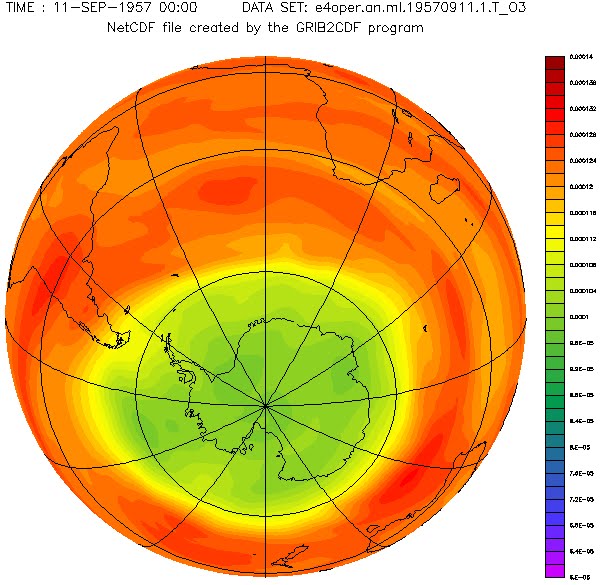
Despite these efforts, there is still a hole in the ozone over the Antarctic that will take decades to close. Global observations have verified that atmospheric levels of key ozone depleting substances are going down and it is believed that with implementation of the Protocol's provisions the ozone layer should return to pre-1980 levels by 2050 to 2075. However, in August the World Meteorological Organization (WMO) reported that signs of ozone depletion were again appearing over the Antarctic.

For these reasons, the OzonAction Programme of the United Nations Environment Programme (UNEP) has created a documentary called, The Antarctic Ozone Hole: From Discovery to Recovery. The documentary examines the current state of the ozone layer, the effects of ozone depletion on climate change and the potential impact on communities worldwide. The documentary had a worldwide screening on September 16, to mark the International Day for the Preservation of the Ozone Layer. The Antarctic Ozone Hole: From Discovery to Recovery offers solutions to reducing ozone depletion. The film reviews how the Montreal Protocol, can deliver immediate climate benefits. See the trailer here.

Screenings of the film include a launch in Nairobi where UNEP has its headquarters, and at the Biosphère Environment Museum in Montreal, the city where the Protocol was signed. The video is available in English and French here.

© 2011, Richard Matthews. All rights reserved.

Related Posts
The Montreal Protocol Celebrates
Video: Trailer for The Antartic Ozone

Video: The Reality of Climate Change

In this video the Socio Capitalist interviews Atmospheric Scientist Dr. Andrew Dessler, and climate scientist at Texas A&M University. Dessler addresses the well-established science behind climate change. Other areas discussed include:

  • The reality of climate change from the perspective of the scientific community
  • The distorted view that policymakers and the general public have on climate change
  • Media’s role in conveying information inaccurately
  • The science behind climate change
  • Water Vapor’s role in climate change


  • Click here to see the video interview with Climate Scientist Dr. Andrew Dessler from The Socio Capitalist on Vimeo.

    © 2011, Richard Matthews. All rights reserved.

    Related Posts
    Video: Debate on Climate Science and Policy Implications
    Debunking CO2 Myths and The Science of Climate Change
    Green Dissent (Part 1)
    Green Dissent (Part 2)
    Green Science
    The Effects of Global Warming
    Primer on CO2 and other GHGs
    How to get Through to Climate Change Deniers

    Population Growth and Climate Change will Add to the World Water Crisis

    Water shortages will be one of the world's most pressing problems in the next decade, and this will be compounded by a growing global population and climate change.

    Without some means of equitable water distribution, water may even be the cause of the next world war. Rivers lakes and aquifers are cross border issues. Already the allocation of water resources is causing disputes between Israel and Palestine, India and Pakistan, as well as the US and Mexico. Many believe that the crisis in Darfur was at least in part due to issues surrounding access to water.

    Population growth will place additional demands on dwindling water supplies. The world's population is expected to grow to almost 9 billion by 2050. In addition to the population explosion, growing wealth and urbanization is fueling demand for water. The United Nations climate panel says between 90 and 220 million people in Africa will face water shortages by 2020 due to climate change. This will have a direct impact on farms, which exacerbate the problem by further depleting groundwater.

    According to Britain's chief scientist John Beddington, "The availability of fresh water...[is] the first problem that has got to be addressed. Agriculture is intimately linked with that, but I would say water is probably going to be more concerning over the next 10 years."

    "Population growth, an increase in wealth, urbanization, and ... climate change, all of those are going to present really big problems to humanity," Beddington told the Reuters Global Climate and Alternative Energy Summit.

    Climate change will add additional burdens to the worsening water crisis. Climate change is forecast to disrupt rainfall patterns, leading to more severe droughts and floods, posing problems for the supply of fresh water.

    "Water security fears, rising demand for food and a drive to curb greenhouse gas emissions all posed commercial opportunities," Beddington said.

    To help combat growing water problems, countries need to focus on water efficiency. Countries can also reduce the burden of climate change by focusing on low-carbon technologies, including energy efficiency, renewable energy and carbon capture.

    © 2011, Richard Matthews. All rights reserved.

    Related Posts
    Environmental Impact of Overpopulation and Sustainable Development
    Celebrate World Water Day
    World Water Week 2011
    WWF Celebrates Canada Water Week
    First International Water Hour
    Blog Action Day 2010: Raising Awareness about Water

    Ferrum College's Climate Research Opportunities

    Ferrum College offers an excellent undergraduate program and great opportunities for environmental research. Ferrum College professors Bob Pohlad and Carolyn Thomas are part of a team that will receive $494,980 from the National Science Foundation (NSF) for environmental research related to climate change.

    The money will be used to establish a national ecological and education network that will begin with 12 primarily undergraduate institutions (PUIs) and expand to colleges and universities throughout the United States. The work has been shown to be significant both in terms of tracking environmental issues, and increased student learning and understanding.

    Collaborative projects engage students in scientific research while teaching them basic ecology, “It’s unusual for undergraduate students to be able to do this kind of research,” said Thomas.

    “It’s important to point out that students at Ferrum College and the 11 other PUIs, will be out in the woods and wading streams — taking measurements, studying wildlife, and learning how to use the data.” Thomas explained that the data is combined with research from other institutions, so scientists can measure changes over time.

    "What is most important," Thomas expained, is that “students will be learning, while the world gains a clearer picture of what’s happening around us.”
    ___________________________________________

    Related Posts
    Green School Census
    Leading the Green Job Market with a Sustainable MBA
    The University of Oregon's MBA and Green Chemistry
    Marylhurst's MBA in Sustainable Business
    MODUL University's Sustainable MSc
    West Michigan's Green Academic Offerings
    NYC Public School's Green Initiatives
    America`s Greenest School Contest 2010
    LAUSD Green School Initiatives
    California's Green Schools (Videos)
    Green School Rejuvenates Dying Town
    Da Vinci Arts Middle School in Portland
    Arizona State University's Sustainable Business Curriculum
    Arizona State University and Green Supply Chains
    Penn State's Online B.A. in Energy and Sustainability Policy
    CleanEdison Building and Design Courses
    Commonground University's Online Environmental Classes
    Walden University's PhD in Sustainability Online Degree
    UBC`s PhD in Resource Management and Environmental Studies
    Prescott College`s Ph.D in Sustainability
    PhD in Innovation and Governance for Sustainable Development
    Columbia University's PhD in Sustainable Development
    Sierra's Top 100 Cool Schools
    The Princeton Review Green Colleges Honor Role 2010

    Debunking CO2 Myths and The Science of Climate Change

    There are a number of myths about CO2 that continue to circulate despite scientific evidence to the contrary. These myths are often perpetuated by the uninformed or those with an agenda to protect non-sustainable corporate interests. With the aim of exposing some of the major fallacies here is quick summary of the science debunking eight CO2 myths.

    Myth # 1 : CO2 Levels are Not Rising

    Objective measurement of atmospheric increases in carbon dioxide was confirmed beginning in the 1930s, and these observations were corroborated in the late 1950s with the development of highly accurate measurement techniques.

    In 1959 Charles Keeling began collecting flasks of air from an observatory at the summit of Mauna Loa in Hawaii in 1959. His research, known as the Keeling Curve, confirmed suspicions that carbon dioxide released from the burning of fossil fuels and other industrial activities are accumulating in the atmosphere.

    Keeling's data set was confirmed by the Vostok ice core. The ice core findings reveal annual layers of air bubbles trapped in the ice, they can be dated and CO2 levels can be measured representing the atmosphere when the ice formed. Atmospheric CO2 concentrations calculated from trapped air bubbles indicate that "present carbon dioxide concentrations far exceed all values for the past 400,000 years."

    Another source of scientific evidence comes from Houghton and Hackler. Their research indicates that land-use changes from 1850-2000 and the combustion of fossil fuels have caused the atmospheric CO2 concentrations to rise from 288 ppmv in 1850 to 369.5 ppmv in 2000. The Mauna Lao Observatory reports that as of May 2009, CO2 levels are at 390 ppmv.

    Myth # 2 : CO2 is Not Related to Global Warming

    The Vostok ice core reveals ratios of oxygen isotopes and deuterium they in turn indicate air temperature at the station at the time ice was formed. The study shows that carbon dioxide and temperature are linked through feedback loops; when the concentration of CO2 is high so is the temperature.

    Myth # 3: CO2 is Not the Most Important GHG

    Although water vapor is the most significant GHG, CO2 levels are steadily increasing while others like Methane have stabalized. Human activity is producing levels of CO2 that are upsetting the natural greenhouse balance and imperiling our planet. This is largely because CO2 remains in the atmosphere for more than a century while water vapor lasts only a few days. CO2 is the greatest concern because it is responsible for two-thirds of the additional warming caused by all the anthropogenic GHG.

    Myth # 4: Anthropogenic CO2 is Harmlessly Absorbed

    The Keeling Curve indicates that carbon dioxide released from the burning of fossil fuels and other industrial activities are accumulating in the atmosphere rather than being fully absorbed by the oceans and vegetated areas on land.

    Houghton and Hackler's research has revealed that approximately 40% of the additional carbon has remained in the atmosphere, while the remaining 60% has been transferred to the oceans and terrestrial biosphere. This research reveals that 64% can be attributed to fossil-fuel combustion, representing about 14% of the carbon in the atmosphere in the form of CO2.

    According to research from Woods Hole Oceanographic Institution, "around 30 per cent of the CO2 put into the atmosphere by human activities is absorbed by the oceans where it dissolves, altering the chemistry of the surface sea levels making it more acidic." Increasing levels of ocean acidity could destroy fisheries and damage coral reefs that provide habitat and coastal protection from storms. In a statement from the science academies of 70 countries rising levels of CO2 may cause an "underwater catastrophy.

    Myth # 5: CO2 is Too Heavy to Reach the Troposphere

    According to the Carbon Dioxide Information Analysis Center (CDIAC), the chemical formula of CO2 is Carbon (12) + Oxygen (16) + Oxygen (16), giving it a molecular weight of 44. Although this gas is heavier than air (50% heavier or 1 and 1/2 time as heavy). CO2 will mix with the air as all gasses do because of Brownian Motion (molecules bumping into each other). And like all gases, when wind is blowing, CO2 is carried up into the atmosphere, where more winds are able to carry it up to the troposphere.

    "Free radicals, which are atomic or molecular species with unpaired electrons, and are highly reactive and this makes them able to form a chemical bond. The free radicals attach and form a new bond with CO2 creating a new gas depending on the species of the free radical. These gases work their way a bit further into the upper atmosphere and this is where they become GHGs."

    Myth # 6: Respiration is to Blame for CO2

    All living things including plants and animals exhale CO2. According to the Carbon Dioxide Information Analysis Center (CDIAC), "the average person exhales approximately 1 kg of CO2 per day. However the exhaled CO2 includes carbon that was originally taken out of the carbon dioxide in the air by plants through photosynthesis - whether you eat the plants directly or animals that eat the plants. Thus, there is a closed loop, with no net addition to the atmosphere. Of course, the agriculture, food processing, and marketing industries use energy (in many cases based on the combustion of fossil fuels), but their emissions of carbon dioxide are captured in our estimates as emissions from solid, liquid, or gaseous fuels."

    Myth # 7: Technologies Using CO2 are to Blame

    According to the CDIAC, technologies that use CO2 are not responsible for increased GHG emissions. Technologies like dry ice blasting, supercritical cleaning and painting etc., do not increase GHG emissions because "most of the CO2 used in these kinds of applications is recovered from processes like fermentation and it is either CO2 that it is being extracted from the atmosphere by plants or CO2 that would have been released from fossil fuel burning anyhow. In essence it passes through this kind of use rather than being emitted immediately and there is no extra CO2 produced".

    Myth # 8: Managing CO2 is Too Expensive


    There are viable ways we can facilitate the shift towards a low carbon economy. As we will review in the next post, cap-and-trade legislation is a viable way of creating incentives for lowing carbon and generating revenues that can help to finance the transition. Immediate action is required as we simply cannot afford to continue to ignore the cost of anthropogenic CO2 emissions.

    Next: Action on Climate Change

    Related Articles
    Green Dissent (Part 1)
    Green Dissent (Part 2)
    Green Science
    The Effects of Global Warming
    Primer on CO2 and other GHGs
    US Cap-and-Trade: Business
    US Cap-and-Trade: Solutions
    US Cap-and-Trade: What and Why
    COP 15 Implications for Business
    COP 15 Timetable
    China-US Cooperation
    Green Stimulus and Opposition
    US Green Legislation
    Green Stimulus Package Part 1
    Environmental Politics
    Market Based Social Change
    Green Policy Debate in Canada
    Cap-and-trade in Ontario and Quebec
    Green Capitalism
    Green Blueprint