Showing posts with label moving. Show all posts

Growing Climate Refugee Crisis in the US and Around the World

The refugees pouring out of Syria and Iraq have focused global attention on migrants however the unfolding human catastrophe will be dwarfed by the coming climate refugee crisis. The issue of climate refugees is an international problem that is already impacting the US. The refugees are streaming from Syria and Iraq was caused in part by climate impacts in the Levant. However, the refugees that streamed out of Syria and Iraq in 2015 is nothing compared to the number of climate refugees we can expect in the years to come.

Climate refugees are people who are forced to leave their homes and their communities due to global warming. The number of people who fall into this category is destined to get far worse in the coming years. Although climate change is not new, warming attributable to human activities is a recent phenomenon.

The so called age of the Anthropocene started with the dawn of the industrial revolution and specifically the burning of fossil fuels and cutting down forests which serve as carbon sinks. Together these forces have increased the amount of carbon dioxide and other greenhouse gases in the atmosphere. This in turn has caused global temperatures to rise, which exacerbates drought and causes the ice to melt and the seas to rise.

Flooding, droughts and other forms of extreme weather will force massive migrations in coming years. Climate refugees are a subset of environmental refugees. Environmental refugees include immigrants forced to flee because of natural disasters, the numbers of these types of refugees is on the increase. By some accounts there may be hundreds of millions of such refugees in the coming decades. Climate change is killing people and compromising health, livelihoods from tourism, fishing and agriculture are also in jeopardy.

People have been suffering and dying due to drought in parts of Africa, however parts of China and the state of California has also been suffering from massive droughts in recent years. Under drought conditions agriculture becomes much more difficult and in places without access to irrigation it is impossible. Morocco, Tunisia, and Libya each lose more than 1,000 square kilometers (386 square miles) of productive land every year to desertification. Residents near the Horn of Africa are especially vulnerable to drought and desertification. Most rural residents in Somalia, Ethiopia, and Eritrea. Drought is particularly severe and causing mass migrations in Ethiopia's Somali region.

Many coastal cities throughout the world are located in low-lying areas vulnerable to sea level rise. This includes: Manhattan, New York; London, England; Shanghai, China; Hamburg, Germany; Bangkok, Thailand; Jakarta, Indonesia; Mumbai, India; Manila, Philippines; and Buenos Aires, Argentina.

Flooding is already inundating some island nations like the Maldives. Large populations in countries like Bangladesh could also be directly impacted by flooding. Developed countries are also at risk including Italy and the US. Residents of Chesapeake Bay's Tangier Island are expected to become climate refugees in the few decades.

Scientists estimate that due to climate change, the village of Kivalina, in northwestern Alaska, will be under water by the year 2025. A total of more than 180 villages are already feeling the impacts from rising seas. The Yupik community of Newtok, is expected to be completely under water by 2017.

Rising seas from climate change are already causing the some people to relocate in the US. Climate migration is already underway in the bayous of Louisiana, about 80 miles southwest of New Orleans, the Isle de Jean Charles, is disappearing into under the rising waters in the Gulf of Mexico forcing many of its residents to flee.

The tiny island was inhabited by the Isle de Jean Charles Band of Biloxi-Chitimacha-Choctaw Native Americans. The climate related problem of rising seas and coastal erosion has swallowed 98 percent of the land and the situation has been compounded by the oil and gas industry which is the root cause of global warming. The island used to be 22,000-acres but only 320-acres are left.

Here is a UN map of areas around the world where we can expect to see climate refugees.


Related Articles
Climate Migrants Will Add to the Refugee Crisis
Climate Refugee Campaign: Postcards from the Frontlines
What is Environmental Migration and Who are Climate Refugees
Video - Beyond Environmental Refuge
Video - Climate Refugees the Documentary

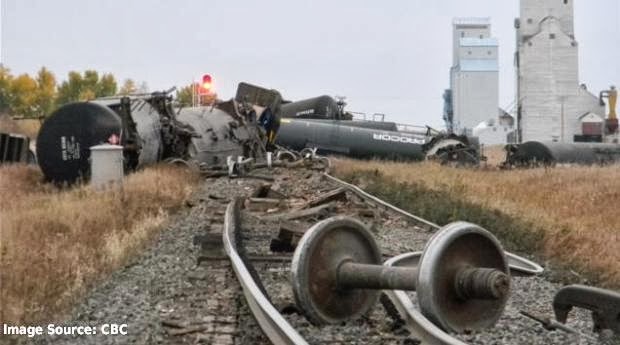
Breaking News: Train Derails Spilling Oil in Saskatchewan

On September 25, 2013, a Canadian National (CN) train derailed just east of the small town of Landis, Saskatchewan and at least one car is reportedly spilling its load of crude oil. Each tank car holds some 30,000 gallons (113,600 liters) of oil. The school in Landis has been closed for the day as a precaution. A grass fire caused by the wreck has been extinguished and there are no reports of injuries.

Vacuum trucks are being used to clean up the spill. A hazardous material crew is on the scene but the quantity of the spill is not known at this time nor whether the oil will reach any of the five nearby lakes.

According to a CN spokesman, 17 CN train cars of the 130 cars on the half-kilometre-long train derailed shortly after 4 a.m. local time near Landis, west of Saskatoon. The provincial government of Saskatchewan has indicated that the cars were loaded with ethanol, crude oil, car carriers and grain.

© 2013, Richard Matthews. All rights reserved.

Related Articles
<The Dangers of Transporting Fossil Fuels
Video - Truck Carrying Oil Crashes and Explodes Illustrating the Dangers of Transporting Fossil Fuels
Video - Train Carrying Oil Derails Illustrating the Dangers of Transporting Fossil Fuels
Massive Oil Spill: Help the Town of Lac-Mégantic
Massive Oil Spill: MMA's Bankruptcy Protection is Unconscionable
Three of the Most Destructive Tanker Oil Spills in History
Top 25 Oil Spills Over 1000 Tonnes in the Last Decade
Another Leaking Pipeline in Montana
Pipelines and Oil Spills in Alberta Canada
Oil Spills Add to Concerns about the Keystone XL Pipeline
Oil Spills off the Coast of New Zealand
South Dakota Wants Additional Protections Against Spills
Shell Oil Rig Runs Aground in Alaska Raising Safety Concerns
Lawsuit Protecting the Arctic from Oil Spills
Inadequate Safety Measures for the Keystone XL Pipeline
Two More Reasons to Move Beyond Fossil Fuels

Climate Refugee Campaign: Postcards from the Frontlines

On September 25, 2013, the Environmental Justice Foundation (EJF), in collaboration with ByPost and with the support of Dame Vivienne Westwood and Gillian Anderson, launched a campaign to recognize and protect climate change refugees worldwide. EJF has been working to secure recognition and protection for climate refugees since 2009. Despite their efforts there is presently no recognition of climate refugees by any international law.

Climate refugees are a large and growing problem. In 2012, 31.7 million people were forced from their homes due to weather related events. The campaign titled "Postcards from the Frontlines" is trying to draw attention to this problem. It encourages people to send pictures of their homes along with a short message about what their home means to them. Others who have suffered first hand exposure to extreme climate events are also urged to share their experiences. These "postcards" will be sent to the United Nations (UN) headquarters in New York.

Each postcard calls for the introduction of a UN Special Rapporteur on climate change and human rights. The goal of the campaign is to inspire more than 100,000 people worldwide to send a postcard by Human Rights Day on Dec. 10.

For more information click here.

© 2013, Richard Matthews. All rights reserved.

Related ArticlesWhat is Environmental Migration and Who are Climate Refugees
Video - Beyond Environmental Refuge
Video - Climate Refugees the Documentary