Showing posts with label canadian politics. Show all posts

No Reprieve for the Environment as Slacktivists Hand Majority to Canadian Conservatives

The 2011 Canadian federal election vindicates those who characterize young people as apathetic. Had Canada's youth voted in larger numbers they could have prevented a Conservative majority, instead they generated a lot of online buzz, but failed to pull the trigger when it counted. In many parts of the country it appears that the under 30s did not leave their computers and cell phones long enough to cast a vote.

Although we will not have hard data from Elections Canada for a few weeks, publications like Saanich News are reporting low youth vote turnout: "Despite expectations, early numbers suggest social media hype before Monday’s election did not translate into more young people making it to the polls."

The election of US President Barack Obama succeeded due in large part to the youth vote. Many were hoping that similar youth involvement in Canada would impede the Conservative's assault on the environment. With fewer than 14 million ballots cast in the last federal election, Canada's 5.5 million Canadians under the age of 30 could have been a game changer.

The reason why younger voters are so important is because they tend to favor parties other than the Conservatives. In the 2008 federal election less than 40 percent of young people voted and although advanced polling suggested that we would see a surge of young voters, Canada's youth did not materialize in sufficient numbers to deny a Conservative majority.

The fact that the Conservatives won 167 seats indicates that young people did not get out and vote en masse. Although Canada's youth did help propel the NDP to a second place finish with 31 percent of the popular vote. An “orange crush” of historic NDP support swept through Quebec, parts of Ontario and the Prairies to give the party 102 seats. “You, young Canadians, are an inspiration and a source of hope for our country’s future,” NDP leader Jack Layton told a large crowd in downtown Toronto.

Liberal leader Michael Ignatieff resigned after his party lost more than half their seats leaving them with 34.“We’ve seen tonight, I think, the emergence of a polarization in Canadian politics,” a defeated Ignatieff told supporters in Toronto. The people may be polarized, but the power is now in the hands of the Conservatives. Canadians failure to vote against the Conservatives have given a majority to a party that will aggressively support tar sands oil and largely ignore the environment and the green economy.

In British Columbia, Green Party leader Elizabeth May won the party’s first-ever elected seat in Saanich—Gulf Islands. The Green Party's first seat along with Liberal losses and NDP gains make this a historic election. This election is also historic as a missed opportunity to reverse Canada's anti-environment trajectory.

According to an early Elections Canada report, 61 percent of eligible Canadians voted in the 2011 federal election. The 2011 turnout was only slightly more than 2008's dismal electoral participation of 59 percent.

More than 70,000 youth had pledged to vote as part of the “I Will Vote” campaign, but efforts to boost the youth vote with social media and vote mobs were insufficient to prevent a Conservative majority. The outcome of the 2011 election indicates that while Canadian youth like online campaigns, they are not interested in doing much to manage climate change, even when it concerns an action as simple as voting.

Some attribute lower than expected youth voter turnout to a lack of engagement by Canada's political parties and the need for more face-to-face mobilization. The truth is the 2011 election results show that Canada's youth are indeed an apathetic group of slackers, (hence the expression slacktivists). Even though the under 30s claim to care about efforts to manage climate change, through their inaction they have effectively given the Conservatives carte blanche to continue to ravage the environment.

Young Canadians could have moved beyond raising awareness and started changing the world. Instead the under 30s stayed home in many parts of the country. Canada's youth missed a historic opportunity to use their democratic rights to lead the country into the future and enjoin the battle against climate change.

© 2011, Richard Matthews. All rights reserved.

Next: The Last Best Hope to Combat Climate Change

Related Posts
Youth Vote May Determine the Outcome of the Canadian Federal Election
Vote for Canada Vote for the Environment Vote for Change
Strategic Voting by Canada's Youth Threatens Conservatives
Social Media Mobilizing Youth in the Canadian Federal Election
Leadnow: Voting for Change in Canada
Leadnow's Declaration For Change
Video: Leadnow Interview on CPAC
Video: Vote Mobs Getting Youth Involved in Canada's Democracy
Video: Leadnow's My Canada
Environmental Issues in the 2011 Canadian Federal Election
Environmental Platforms of Canada's Federal Parties in 2008
Canadian Conservatives Repudiation of the Environment in 2008
Canada's Conservatives at Odds with the Public on Climate Change
Conservatives Ignore Canadians While Jeopardizing the Environment and the Economy
Canada's Conservative Government Opposes Kyoto and Hampers Progress at COP16
World Urges Canada to Fight Climate Change
The State of Canada's Environment
Canada is a World Leader in GHG Emissions
WWF's Canadian Living Planet Report
Green Market Opportunity Being Missed by Canada
Why Canadian Environment Minister Resigned
Conservatives Ignore Canadians While Jeopardizing the Environment
Copenhagen Accord: Canada to Reduce its GHG Emissions
The Impact of a Climate Change Deal on Canada
Conservative Budget: No Green for Canada
Canada Votes: Environmental Politics
Green Policy Debated in Canadian Parliament

Youth Vote May Determine the Outcome of the Canadian Federal Election

The youth vote could oust Harper's anti-environment Conservatives. Although polls in the days before the election indicate that the Conservatives are losing ground to the NDP, that shift may be even more pronounced than the results suggest. National polls of party preferences, draw upon the views of people with land lines. However, the majority of 18 to 24 year-olds use cell phones so they are not counted in polling results.

At the very least young people are likely to foil a Conservative majority. If the youth vote doubles from 2008, it is entirely possible that the NDP or Liberals may form a minority government. If the youth vote triples, we may even see an NDP or Liberal majority.

Canadian youth are strong supporters of the environment and many hold staunch anti-Conservative views. Vote mob websites, and opinion pieces in university newpapers single out Conservatives for criticism, not the Liberals, NDP or Greens. The environment is an important issue for many of those who organized vote mobs. A number of these people have been actively involved with the progressive environmental action groups like 350.org.

No one can be sure exactly what percentage of those participating in vote mobs will actually cast a vote, but by the end of election day we may find that the youth vote has been vastly underestimated by the pundits and the pollsters.

© 2011, Richard Matthews. All rights reserved.

Related Posts
Vote for Canada Vote for the Environment Vote for Change
Strategic Voting by Canada's Youth Threatens Conservatives
Social Media Mobilizing Youth in the Canadian Federal Election
Leadnow: Voting for Change in Canada
Leadnow's Declaration For Change
Video: Leadnow Interview on CPAC
Video: Vote Mobs Getting Youth Involved in Canada's Democracy
Video: Leadnow's My Canada
Environmental Issues in the 2011 Canadian Federal Election
Environmental Platforms of Canada's Federal Parties in 2008
Canadian Conservatives Repudiation of the Environment in 2008
Canada's Conservatives at Odds with the Public on Climate Change
Conservatives Ignore Canadians While Jeopardizing the Environment and the Economy
Canada's Conservative Government Opposes Kyoto and Hampers Progress at COP16
World Urges Canada to Fight Climate Change
The State of Canada's Environment
Canada is a World Leader in GHG Emissions
WWF's Canadian Living Planet Report
Green Market Opportunity Being Missed by Canada
Why Canadian Environment Minister Resigned
Conservatives Ignore Canadians While Jeopardizing the Environment
Copenhagen Accord: Canada to Reduce its GHG Emissions
The Impact of a Climate Change Deal on Canada
Conservative Budget: No Green for Canada
Canada Votes: Environmental Politics
Green Policy Debated in Canadian Parliament
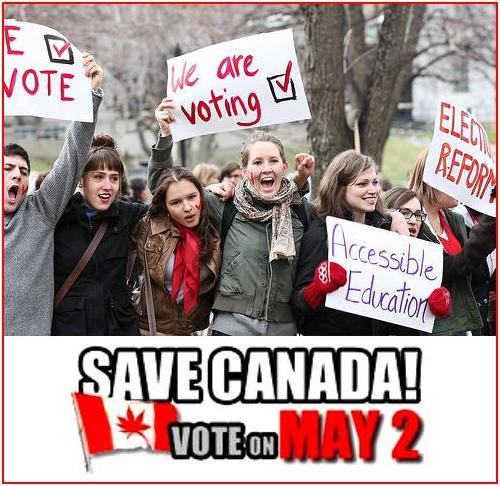
Vote for Canada Vote for the Environment Vote for Change

Under Harper's Conservatives Canada's environment is under threat. Canada's ecological problems include a wide range of issues that impact people, individual species and entire ecosystems.

The ruling Conservative government is at odds with Canadians on climate change. Harper's Conservatives have a history of contempt for the environment. Despite the fact that the world urged Canada to do more on the environmental front, Conservatives have amassed a deplorable track record on some of the most important environmental issues, including the way they have handled international climate change summits and greenhouse gas emissions reductions.

Due to the country's dependence on oil, Canada is a world leader in GHG emissions. Harper's Conservatives are working to ramp-up tar sands oil production which cause up to five times the climate change pollution of conventional crude oil. The proposed Canadian Enbridge Northern Gateway oil sands pipeline would cut through British Columbia’s pristine temperate rainforests and coastal ecosystems to export tar sand oil to Asia. For more information or to take action click here.

Canada's woodland caribou are an example of one species that is in urgent danger. In Alberta, some herds have less than 100 caribou left. Caribou are considered threatened species under Canada's Species at Risk Act, yet Alberta's tar sands development and forestry industry operations are driving vulnerable herds to the brink of survival. For more information or to take action click here.

Canada enacted the federal Species at Risk Act (SARA) in June 2003 to address the mounting threats to Canada’s endangered animals. But the Canadian government is failing to fulfill its duty of care toward our nation’s wildlife by refusing to properly implement the Act.

Many of Canada’s endangered animals live in the Arctic, which is suffering disproportionally from the consequences of global warming. Research shows that temperatures in the Arctic are rising at almost twice the rate of the rest of the world. As a result, Arctic sea ice is shrinking by up to 5% every ten years. This is crucial because sea ice not only provides hunting ground for polar bears, but shelter and transportation for seals, walrus, arctic foxes, and the Inuit people.

The underside of Arctic ice provides a surface for algae that support cod, char, beluga, and narwhal. The white sea ice also has a cooling effect on climate by reflecting light away from Earth's surface. As the Arctic continues to melt, global warming will advance even more quickly. For more information or to take action click here.

There are a total of 256 species that are listed by the Scientific Committee on the Status of Endangered Wildlife in Canada (COSEWIC) as being extinct, extirpated, endangered, threatened or vulnerable. In Canada environmental degradation is widespread. For more detailed information about the state of Canada's environment see the WWF's Canadian Living Planet Report

A comparison of the environmental platforms of the four national parties in Canada reveals that the Conservatives are the worst choice for the environment. In 2008 they laughed at Dion's Green Shift platform and we have had ample opportunity to see them put their environmental disregard into action.

Contrary to the traditional view, Conservatives are not the party for the economy either. Their lack of action on the environment undermines Canada's international competitiveness and this is a high priority economic issue.

By voting strategically, Canadians can make democracy work and perhaps even restore Canada to its rightful role as an environmental leader.

© 2011, Richard Matthews. All rights reserved.

Related Posts
Youth Vote May Determine the Outcome of the Canadian Election
Strategic Voting by Canada's Youth Threatens Conservatives
Social Media Mobilizing Youth in the Canadian Federal Election
Leadnow: Voting for Change in Canada
Leadnow's Declaration For Change
Video: Leadnow Interview on CPAC
Video: Vote Mobs Getting Youth Involved in Canada's Democracy
Video: Leadnow's My Canada
Environmental Issues in the 2011 Canadian Federal Election
Environmental Platforms of Canada's Federal Parties in 2008
Canadian Conservatives Repudiation of the Environment in 2008
Canada's Conservatives at Odds with the Public on Climate Change
Conservatives Ignore Canadians While Jeopardizing the Environment and the Economy
Canada's Conservative Government Opposes Kyoto and Hampers Progress at COP16
World Urges Canada to Fight Climate Change
The State of Canada's Environment
Canada is a World Leader in GHG Emissions
WWF's Canadian Living Planet Report
Green Market Opportunity Being Missed by Canada
Why Canadian Environment Minister Resigned
Conservatives Ignore Canadians While Jeopardizing the Environment
Copenhagen Accord: Canada to Reduce its GHG Emissions
The Impact of a Climate Change Deal on Canada
Conservative Budget: No Green for Canada
Canada Votes: Environmental Politics
Green Policy Debated in Canadian Parliament

Strategic Voting by Canada's Youth Threatens Conservatives

Canada's youth are mounting a serious challenge to Conservative Prime Minister Stephen Harper's government. With the Conservatives leading and Canadians heading to the polls in a few days, organizations like Avaaz have been working feverishly to oppose Harper's bid for reelection.

Compared to the opposition parties, the Conservatives do not have much of an environmental platform and opinion polls decisively show that a majority of Canadians oppose Harper on all the major issues. Harper's Conservatives are at odds with Canadians on a wide range of issues including Canada's role in the war against climate change. According to an Avaaz national poll, conducted by Environics Research, 82 percent of Canadians want a UN treaty on climate change. Rather than work towards signing a binding treaty, Conservatives blocked progress at international climate change summits, they also made no progress on greenhouse gas emissions reductions and they left Canadian oceans vulnerable to oil spills

In addition to their crimes against the environment, Harper and the Conservatives have amassed an impressive rap sheet, they shut down parliament for months, fired civil service whistleblowers, ignored lawful requests for financial information, created a handbook on how to disrupt parliamentary meetings and processes, and flooded the airwaves with vicious attack ads.

Although the Conservatives were first elected to office in 2006 on the promise of having an honest and transparent party, Conservatives from top officials to staffers are being charged or investigated. The conservatives are the first party in office to be brought down on contempt charges in the history of the Canadian commonwealth. Recently four of the Conservative's top officials have been charged with election overspending and two RCMP investigations have been launched against former political staffers.

This election is in large part about accountability, and now with the election looming, there is another massive misappropriation of taxpayer money. A report leaked earlier this month indicates that the Harper government illegally poured 50 million taxpayer dollars into a single Conservative riding and covered it up as G8 summit spending.

Even though the majority of Canadians oppose Harper, pundits predicted his reelection because Canada's democracy is fractured and the votes are split across 4 opposition partied. In some ridings this translates to Conservative wins with less than one third of the votes.

However, the momentum is shifting as Canada's youth are showing signs that they are serious about trying to defeat Harper on May 2nd. A new poll has the NDP gaining even more ground on the Conservatives, and experts say exceptional youth interest in the election could be responsible.

The latest Angus Reid Public Opinion survey, conducted on April 25 and 26, has the New Democrats sitting at 30-per-cent support, just behind the Conservative's 35 per cent. The Liberals have slipped to just 22-per-cent support. Among decided voters between the ages of 18 and 34, NDP support shoots up to 37 per cent, up seven per cent since the middle of the month. The Conservatives trail behind at 28 per cent, followed by the Liberals with 22 per cent.

Canada needs to reform their electoral system, but in the interim mobilizing the youth vote and voting strategically is the best way to ensure that Parliament will represent the majority of Canadians.

Avaaz and Project Democracy have created a strategic voting tool that could tip the balance in several close races. This online tool helps people to vote strategically by identifying the leading opposition challengers in ridings where Conservatives are most vulnerable. Avaaz used a similar tool in the 2008 election that swung 6 seats away from the Conservatives. With just 10 seats separating Harper from the unchecked power of a majority government, voting strategically can at the very least keep the Conservatives at bay. Click here to use the strategic voting tool.

If the youth vote the way they did in advanced polling, Harper may not only be deprived of a majority, he may even fail to get enough support to form the next government.

© 2011, Richard Matthews. All rights reserved.

Related Posts
Social Media Mobilizing Youth Vote in Canada's Federal Election
Video: Vote Mobs Getting Youth Involved in Canada's Democracy
Leadnow: Voting for Change in Canada
Leadnow's Declaration For Change
Video: Leadnow Interview on CPAC
Environmental Issues in the 2011 Canadian Federal Election
Environmental Platforms of Canada's Federal Parties in 2008
Canadian Conservatives Repudiation of the Environment in 2008
Canada's Conservative Government at Odds with the Public on Climate Change
Conservatives Ignore Canadians While Jeopardizing the Environment and the Economy
Canada's Conservative Government Opposes Kyoto and Hampers Progress at COP16
World Urges Canada to Fight Climate Change
The State of Canada's Environment
Canada is a World Leader in GHG Emissions
WWF's Canadian Living Planet Report
Green Market Opportunity Being Missed by Canada
Why Canadian Environment Minister Resigned
Conservatives Ignore Canadians While Jeopardizing the Environment
Copenhagen Accord: Canada to Reduce its GHG Emissions
The Impact of a Climate Change Deal on Canada
Obama's Visit to Canada
Conservative Budget: No Green for Canada
Canada Votes: Environmental Politics
Green Policy Debated in Canadian Parliament
Canada's Most Sustainable Businesses
Canadian Municipal Green Incentives
Government Energy Policy the Environment and the Economy
A Sustainable World Order

Leadnow's Declaration For Change

Leadnow.ca wants to help Canadians move beyond today's political division and short-term thinking, and get to work on the shared challenges of our time. Across geographies and generations, in local communities and online, thousands of Canadians are coming together to create a new kind of politics.

Based on more than 80 local gatherings across the country and an online engagement initiative, Leadnow has issued a “declaration for change," a call for politicians across the political spectrum to co-operate for progress on some of the major challenges facing Canada.

The declaration for change, calls for political cooperation to build a stronger democracy that protects te environment and creates economic opportunity. It also calls for equality, and guarantees that everyone receives the care they need.

Those who sign the declaration of change commit to support action and vote for the politicians who will:

-Establish climate legislation to meet international and science-based targets
-Invest in renewable energy, energy efficiency and home retrofits
-End subsidies to fossil fuel companies

-Establish a plan with clear targets to reduce poverty and provide affordable housing
-Improve access to high quality post-secondary education and reduce student debt
-Ensure access to affordable quality child care and early childhood education

-Create an open government plan to increase transparency and accountability
-Initiate a citizen-led process for a referendum on electoral reform
-Make it easier for people to participate directly in government decision-making

-Ensure universal access to high quality and publicly administered health care
-Invest in programs that prevent illness and promote wellness
-Create a national strategy to increase mental health support

Leadnow is providing Canadians with information, analysis and tools to ask politicians whether they support these priorities, what measures they would take to give them life, and how they would pay for them.

Click here to sign the Declaration for Change.

© 2011, Richard Matthews. All rights reserved.

Related Posts
Leadnow: Voting for Change in Canada
Video: Leadnow Interview on CPAC
Strategic Voting by Canada's Youth Can Unseat Harper's Conservatives
Environmental Issues in the 2011 Canadian Federal Election
Environmental Platforms of Canada's Federal Parties in 2008
Canadian Conservatives Repudiation of the Environment in 2008
Canadian Participation in Earth Hour Sets Records and Sends a Message to Politicians
Canada's Conservative Government at Odds with the Public on Climate Change
Conservatives Ignore Canadians While Jeopardizing the Environment and the Economy
Canada's Conservative Government Opposes Kyoto and Hampers Progress at COP16
World Urged Canada's Conservative Government to Do More to Manage Climate Change
The State of Canada's Environment
Canada is a World Leader in GHG Emissions
WWF's Canadian Living Planet Report
Green Market Opportunity Being Missed by Canada
Why Canadian Environment Minister Resigned
Canada is a World Leader in GHG Emissions
World Urges Canada to Do More on Climate Change
Conservatives Ignore Canadians While Jeopardizing the Environment
Copenhagen Accord: Canada to Reduce its GHG Emissions
The Impact of a Climate Change Deal on Canada
Why Canadian Conservatives Must Make Concessions on Climate Change
Canada Makes Dramatic Shift on Climate Change Management Policy
Program and Plans for G8 and G20 Summits in Canada
Obama's Visit to Canada
Conservative Budget: No Green for Canada
Canada Votes: Environmental Politics
Green Policy Debated in Canadian Parliament
The Montreal Protocol Celebrates 23rd Birthday
Montreal 2010 World Energy Congress
Canada and 350.org's 10/10/10 Event
Canada's Most Sustainable Businesses
Canadian Municipal Green Incentives
Government Energy Policy the Environment and the Economy
A Sustainable World Order

Video: Leadnow Interview on CPAC

Video: Leadnow Interview on CPAC


In this March 3rd 2011 interview, Leadnow co-founders Jamie Biggar and Adam Shedletzsky appear on CPAC's Prime Time Politics. As discussed in the interview, young people are increasingly apolitical, but Leadnow wants to put the power of social media to work to encourage young voters to exercise their democratic rights. Although Leadnow is a nonpartisan organization, their efforts could significantly change the political landscape. As Chantal Hébert, said in Le Devoir, on april 4, 2011, "In Canada, the current Conservative Party would have much less chance of coming back to power and almost no chance of winning a majority if the youngest portion of the electorate voted in large numbers on May 2."

© 2011, Richard Matthews. All rights reserved.

Related Post
Leadnow: Voting for Change in Canada
Leadnow's Declaration For Change
Strategic Voting by Canada's Youth Can Unseat Harper's Conservatives
Environmental Issues in the 2011 Canadian Federal Election
Environmental Platforms of Canada's Federal Parties in 2008
Canadian Conservatives Repudiation of the Environment in 2008
Canadian Participation in Earth Hour Sets Records and Sends a Message to Politicians
Canada's Conservative Government at Odds with the Public on Climate Change
Conservatives Ignore Canadians While Jeopardizing the Environment and the Economy
Canada's Conservative Government Opposes Kyoto and Hampers Progress at COP16
World Urged Canada's Conservative Government to Do More to Manage Climate Change
The State of Canada's Environment
Canada is a World Leader in GHG Emissions
WWF's Canadian Living Planet Report
Green Market Opportunity Being Missed by Canada
Why Canadian Environment Minister Resigned
Canada is a World Leader in GHG Emissions
World Urges Canada to Do More on Climate Change
Conservatives Ignore Canadians While Jeopardizing the Environment
Copenhagen Accord: Canada to Reduce its GHG Emissions
The Impact of a Climate Change Deal on Canada
Why Canadian Conservatives Must Make Concessions on Climate Change
Canada Makes Dramatic Shift on Climate Change Management Policy
Program and Plans for G8 and G20 Summits in Canada
Obama's Visit to Canada
Conservative Budget: No Green for Canada
Canada Votes: Environmental Politics
Green Policy Debated in Canadian Parliament
The Montreal Protocol Celebrates 23rd Birthday
Montreal 2010 World Energy Congress
Canada and 350.org's 10/10/10 Event
Canada's Most Sustainable Businesses
Canadian Municipal Green Incentives
Government Energy Policy the Environment and the Economy
A Sustainable World Order

Leadnow: Voting for Change in Canada

To help auger political change in Canada, Jamie Biggar and Adam Shedletzky are spearheading a new organization called Leadnow. The duo was inspired by Canadian national elections scheduled for May 2, 2011. They are seeking greater political involvment from Canadians. With the ruling Conservative government failing to heed the views of Canadians on issues like climate change, the need for change in Ottawa is urgent.

Leadnow is a grassroots movement that seeks to bring Canadians together to hold politicians accountable and take action for a cleaner future. Leadnow is Canada’s embryonic answer to Moveon.org, the US site that helped put Barack Obama in the White House in 2008.

In Leadnow's online surveys, thousands of Canadians are ranking the environment as the issue they most care about. According to these surveys the environmental issues that are most pressing to Canadians include:

-Establishing climate legislation to meet international and science-based targets
-Putting a price on global warming pollution
-Ending subsidies to fossil fuel companies
-Investing in renewable energy, energy efficiency and home retrofits
-Investing in creating sustainable economies in resource dependent communities
-Investing in public transportation and rail networks
-Protecting half of Canada's wild land and ocean areas

Using the revolutionary power of social media, the non-partisan site leadnow fights against voter apathy and generates debate about national values. At their site, users can rank policy issues, then pledge support to the party leader who conforms to the values of Canadians.

According to Leadnow, it's time to work together for change to combat toxic politics and divisions that are holding Canada back and hurting Canadians and the planet.

According to former Clerk of the Privy Council Alex Himelfarb, Leadnow.ca is exactly what Canada needs. “Leadnow addresses what has arguably been an infrastructure deficit: they provide the much needed opportunity to work with others from every region and sector of the country, to influence the political agenda by defining the Canada we want based on environmental stewardship, equality and justice," Himelfarb said.

“Our federal government is dividing us, damaging our democracy and failing to address the major challenges that face our country,” said Jamie Biggar, co-founder and Executive Director of Leadnow.ca. “Whether we’re talking about the lack of action for our environment, the unequal economic recovery, or the erosion of democratic values – this government is failing to take action on the issues that matter to Canadians. It’s time we work together for change.”

Canadians are coming together in support of political cooperation. Canadians are creating the Declaration for Change—a call for politicians to work together for progress on the major challenges facing our country.

A nationwide event took place from March 6-12, 2011, it was titled (Re)Generation: Voices for Canada. Canadians from across the country participated in face-to-face gatherings to discuss their hopes and ideas for their country and their future. Dozens of Canadian cities hosted events from coast to coast.

Through Leadnow, thousands of Canadians are sharing their values and ideas for Canada and politicians should take notice. The Declaration for Change has identified four major areas: reforming our democracy, protecting our environment, promoting equality and economic opportunity, and improving our systems of care. See the Declaration for Change online values survey.

Many of the people working with Leadnow.ca started organizing in the youth climate movement, and they have participated in many 350 events. They are excited because they know that if Canadians work together, they can change Canadian politics.

Leadnow is enriching Canada's democracy encouraging people to participate in a new kind of politics that asks people to lead. Click here to join the process online, share your views with politicians and see what Canadians want for Canada.

As explained by Jamie Biggar, "Our goal is to create a new way for Canadians to come together online to talk about their hopes and priorities for the country and create a really strong voice that's going to be heard in Ottawa. Today is the beginning of a new type of politics in Canada. We will no longer wait to be told who and what we should vote for. Leadnow.ca will enable people to take politics into their own hands - by coming together around shared values, and telling our politicians what they can do to earn our vote...We will be a united force in the next election, strengthening the voices of thousands of Canadians who want a different type of politics in Ottawa.”

See Leadnow on Facebook or follow them on Twitter. For more information, contact: Jamie Biggar, Co-Founder & Executive Director (jamie@leadnow.ca, 778-847-8205 - Vancouver) or Adam Shedletzky, Co-Founder (adam@leadnow.ca, 647-213-6591 - Toronto).

© 2011, Richard Matthews. All rights reserved.

Related Posts
Leadnow's Declaration For Change
Video: Leadnow Interview on CPAC
Strategic Voting by Canada's Youth Can Unseat Harper's Conservatives
Environmental Issues in the 2011 Canadian Federal Election
Environmental Platforms of Canada's Federal Parties in 2008
Canadian Conservatives Repudiation of the Environment in 2008
Canadian Participation in Earth Hour Sets Records and Sends a Message to Politicians
Canada's Conservative Government at Odds with the Public on Climate Change
Conservatives Ignore Canadians While Jeopardizing the Environment and the Economy
Canada's Conservative Government Opposes Kyoto and Hampers Progress at COP16
World Urged Canada's Conservative Government to Do More to Manage Climate Change
The State of Canada's Environment
Canada is a World Leader in GHG Emissions
WWF's Canadian Living Planet Report
Green Market Opportunity Being Missed by Canada
Why Canadian Environment Minister Resigned
Canada is a World Leader in GHG Emissions
World Urges Canada to Do More on Climate Change
Conservatives Ignore Canadians While Jeopardizing the Environment
Copenhagen Accord: Canada to Reduce its GHG Emissions
The Impact of a Climate Change Deal on Canada
Why Canadian Conservatives Must Make Concessions on Climate Change
Canada Makes Dramatic Shift on Climate Change Management Policy
Program and Plans for G8 and G20 Summits in Canada
Obama's Visit to Canada
Conservative Budget: No Green for Canada
Canada Votes: Environmental Politics
Green Policy Debated in Canadian Parliament
The Montreal Protocol Celebrates 23rd Birthday
Montreal 2010 World Energy Congress
Canada and 350.org's 10/10/10 Event
Canada's Most Sustainable Businesses
Canadian Municipal Green Incentives
Government Energy Policy the Environment and the Economy
A Sustainable World Order

Environmental Issues in the 2011 Canadian Federal Election

In 2008, the Conservatives belittled the opposition's green initiatives, and in 2011 the Conservatives continue to have very little for the environment. Conservatives are leading in the polls, but the platforms of the opposition are far greener.

Here is an overview of the environmental platforms of the major federal parties. (As a regional party the Bloc Quebecois has not been included in this review).

Conservative Party

Despite a deplorable track record on the environment, the Conservative Party is still trying to portray itself as green. The truth is they left Canadian oceans vulnerable to oil spills, made no progress on greenhouse gas emissions reductions, and blocked progress at international climate change summits.

The Conservative Party is nonetheless trying to take credit for establishing regulations on greenhouse gases and air pollution. They have preserved some land and marine areas, while banning toxic chemicals and creating new labeling guidelines.

Liberal Party

The Liberal Party has a comprehensive plan to create clean energy jobs. If elected, Liberals will make an historic investment in clean energy and energy efficiency, quadrupling Canada's production of renewable energy. They have also indicated they would create a cap and trade system with hard caps leading to absolute reductions in greenhouse gas emissions. The Liberal environmental platform includes a commitment to protect Canada'a air, oceans, waterways, forests and Arctic.

New Democratic Party

The New Democratic party rejects the claim of a fundamental contradiction between environmental health and economic growth. They advocate developing green energy industries as an opportunity for job creation as well as encouraging environmental technologies and practices, which in turn help to foster innovations in manufacturing.

New Democrats believe that reshaping energy policy for the 21st century means moving away from fossil-fuel dependence toward a green future by investing in energy derived from solar, wind, wave, and geothermal. They support working closely with Canada's provinces and territories to share clean energy and ensure energy conservation in transportation and building methods. A New Democrat government will strive to make Canada a global environmental leader. They would achieve this goal by incorporating strong environmental standards in trade agreements and ensuring that Canadian companies operating abroad will be held to standards and practices that reduce their footprint and leave local ecosystems in good health.

Green Party

The Green Party's Elizabeth May has said "I hold a vision of this blue green planet, safe and in balance. At the end of the Fossil Fuel Era, we are emerging to a new reality. We are ready to make the next leap - as momentous as abolishing slavery or giving women the vote. We are ready to make the fundamental shifts that allow us to live in balance with our life support systems, respecting each other, achieving social and economic justice, peace and democracy."

The Green Party believes in sound fiscal management and strengthening the Canadian economy while ensuring that it is sustainable. They believe that government must provide needed social services while protecting our environment and human rights.

Conclusion

Elections in Canada are usually decided on economic issues, but what many fail to realize is that environmental concerns are also vital economic issues. A government that addresses the environment is positioning canada for a vibrant economic future. A government which avoids these issues is putting Canada at an economic disadvantge that will prevent the nation from being internationally competitive. Before deciding who they vote for on May 2nd, all Canadians should consider the environmental platforms of each party.

The budget that brought down the government offers insights into Conservative priorities. While the budget contained over one billion in oil and gas subsidies, it provides only $400 million for the ecoEnergy retrofit program.

As evidenced by their last five years in office and the budget, the Conservatives and environmental stewardship are like oil and water, they do not mix well.

© 2011, Richard Matthews. All rights reserved.

Related Posts
Strategic Voting by Canada's Youth Can Unseat Harper's Conservatives
Leadnow: Voting for Change in Canada
Video: Leadnow Interview on CPAC
Leadnow's Declaration For Change
Canada's Conservative Government at Odds with the Public on Climate Change
Environmental Platforms of Canada's Federal Parties in 2008
Canadian Conservatives Repudiation of the Environment in 2008 Canadian Participation in Earth Hour Sets Records and Sends a Message to Politicians
Conservatives Ignore Canadians While Jeopardizing the Environment and the Economy
Canada's Conservative Government Opposes Kyoto and Hampers Progress at COP16
World Urges Canada's Conservative Government to Do More to Manage Climate Change
The State of Canada's Environment
Canada is a World Leader in GHG Emissions
WWF's Canadian Living Planet Report
Conservative Budget: No Green for Canada
Obama's Visit to Canada
Why Canadian Environment Minister Resigned
Green Policy Debated in Canadian Parliament
Why Canadian Conservatives Must Make Concessions on Climate Change Policy
Canada Makes Dramatic Shift on Climate Change
The Impact of a Climate Change Deal on Canada
Canada Votes: Environmental Politics
A Made in Canada Sustainable World Order
Canadian Municipal Green Incentives