Showing posts with label Partnerships. Show all posts

Collaboration and Best Practices in Sustainability

Research suggests that collaborative approaches are often the best way to succeed in the development and implementation of a sustainable best practice campaign. Collaboration is key because although best practice is an increasingly popular buzzword, real-world development and implementation is no easy feat.

Canadian research by the Network for Business Sustainability reveals that collaborating on green issues is the key issue facing companies with a strong record of sustainability. The complex and diverse nature of developing and implementing best practice means that companies need to share best practices and solve these difficult problems.

Collaborating to develop and share best practices is not only a concern for profit driven corporations and SMEs. Diverse groups of people are coming together to explore ways of collaborating to build a sustainable future. Social enterprises, social venture capital firms, educational institutions, governments, non-profits, social innovators, and many others are also seeing the value of collaboration.

While these efforts have been thwarted by a culture of individualism, increasingly this mentality is being replaced by the pragmatic realization that together we can achieve more than we can achieve on our own.

Collaboration is key not only as a means of pushing forward the planet saving goals of sustainability but as a means of advancing other interests as well. Part of effectively collaborating involves redefining success and coming to terms with the collective impact of shared value.

To succeed in such a collaborative endeavor involves networking with sustainability professionals from a variety of sectors and industries.

Collective action through collaboration accelerates movement toward sustainability and advances the interests of diverse groups and individuals.

© 2013, Richard Matthews. All rights reserved.

Related Articles
Best Practices in Sustainability: Employee Engagement and Reporting
Whitepaper - Best Practices in Sustainable Procurement of Paperboard
Sustainable Practices are a Strategic Priority for Business
Best Practices for Sustainable Businesses
Best Practices for Communicating Sustainability
Best Practices for Engaging Employees in Sustainability
Sustainable Business Methods, Strategy, Management and Reporting
The Benefits of Sustainability in Business (Video)
How sustainability can Save your Business (Video)
Sustainability Methodology (Video)

The EPA Seeks Historic Proposal to Protect Clean Air

In the last couple of months, more than 2 million Americans have submitted comments in support of the EPA's efforts to reduce carbon pollution. The proposal has received more comments than any agency has ever received. Carbon pollution is linked to significant health hazards like asthma-inducing smog. Carbon pollution is a pandemic in the US with half of Americans (158 million) living in counties with unacceptable air pollution levels.

Big Coal has done everything in its power to stop the EPA from curbing carbon pollution. There is currently no federal limit on how much life-threatening carbon pollution can be spewed by coal plants. Infamous corporate polluters like the Koch Brothers want to keep it that way. This climate denying duo are amongst that group of billionaires who put their profits ahead of human health and use their fortunes to undermine efforts to address pollution.

Click here to join the Sierra Club and let the EPA know Americans stand behind cleaner air and spread the word through social media portals like Facebook and Twitter with their handy share buttons.

© 2012, Richard Matthews. All rights reserved.

Related Posts
EPA's Carbon Pollution Standard has Strong Support
EPA Limits GHGs from Power Plants
EPA Proposes Standards for the Airline Industry
The EPA's Top Green Powered Organizations Q1 2012
EPA's Top 20 On-Site Power Generation List
EPA's Clean Air Rules
Supreme Court Recognizes EPA Role
Koch Industries War with the EPA
Zotos Earns a Place on the EPA's Top 20
Video: EPA Administrator Lisa Jackson
Cardinal Health and the EPA's SmartWay
EPA's Proposed Rule to Regulate Emissions
The EPA Proposes Cleaner Air
Too Dirty to Fail: The GOP's Ongoing War with EPA Standards
Republican's Fail in their Bid to Defund the EPA
The Ignorant Anti-Environmental Views
Defend Clean Air and Oppose the TRAIN Act
Stop the Republicans Anti-Environment TRAIN
EPA Working Cooperatively to Improve Fuel Efficiency
Republican Cuts Target Green Jobs

US Secretary of State at the Green Partnership for Growth Launch

Here is the address of US Secretary of State Hillary Rodham Clinton to the Danish Parliament in Copenhagen, Denmark on May 31, at the 2012 meeting of the Green Partnership for Growth
___________________________________

We have tried to make green growth a center of our diplomacy here because we think we have a lot to learn from Denmark. It is certainly not a surprise that Denmark leads the world when it comes to clean energy and energy efficiency. Because, as the prime minister said, for the past few decades, Denmark has grown economically. As you have also made it clear, that can be done without significantly increasing your electricity use. Your national plan to be completely independent of fossil fuels by 2050 is a global first. And in true Danish fashion, the plan is comprehensive and rigorous. (Laughter.)

But I believe if any country can do this, it’s yours. So we are here to learn and listen and support. But the ambitious plan that you have set for 2050 is just the latest in your efforts on climate change – your commitment to reducing greenhouse gas emissions by 40 percent in 2020. And it is for me, personally, inspirational to see government and business working so closely together, because I do think this is a win-win. The green economy has so many opportunities not only for national purposes, but for exports and other ways of building the green market globally.

In fact, I know in 2009, when I was last here at the UN Climate Conference with President Obama, we brought a number of American companies with us, and many of them came home and told us we had no idea how many opportunities there are in Denmark for business partnerships in green tech, and some of those businesses are represented here today. So the word spread, and our team at the Embassy began bringing Danish and American businesses together. In 2010, we had a delegation of American companies come, and in 2011, a delegation of Danish companies traveled to the United States.

Now with the Green Partnership for Growth, we are carrying these exchanges forward by joining with the Danish Government to promote more public-private partnerships between our countries. Now the United States has three goals with this initiative. First, we want to help create more opportunities for U.S. companies to export their products and services to Denmark. Second, we want to open the door to more investments by Danish companies in America, which would have mutually beneficial, positive effects, including creating jobs in both. And third, we want to find opportunities for Denmark and the United States to work together to export green tech products and services throughout the world.

Now we know that energy efficiency and the development of clean energy are going to continue to rise in importance as the world grapples with meeting the energy needs of a growing population. So we have every confidence that this industry will thrive well into the future, and we certainly cannot afford to overlook its potential, not if we’re serious about creating jobs and achieving sustainable economic growth.

So we’ve got the growth part of it figured out – if we can get the green part of it actually figured out as well. (Laughter.) We know that we have to decrease our greenhouse gas emissions. If we’re going to fulfill our responsibilities as fellow inhabitants on this planet, we have to work to try to help solve the climate crisis. And the only way to do that that is known to us is to change the way we use energy. We need to be, we should be, more efficient and develop cleaner energy sources. And this partnership should help us.

Now, it’s not that Denmark has the only examples. California, years ago, way back in the 1970s, made decisions about more efficient use of electricity. California’s population has grown in the last 30-plus years. Their output, their gross domestic product, if you will, has certainly grown. They’ve continued to innovate. They’ve seen new industries develop, like those in Silicon Valley, that consume huge amounts of electricity. But their use of electricity statewide has stayed flat, because they’ve had a good framework that was put into place that rewarded energy efficiency and innovation.

Now, at the national level, the United States has implemented a range of actions to reduce greenhouse gas emissions. It’s often not well-known, because our legislative approach in the Obama Administration was not able to pass completely through the Congress, but the Administration has gone forward in taking actions. And our new fuel efficiency standards are slated to be among the most aggressive standards in the world. In March, our Environmental Protection Agency put forth the first ever national standards for CO2 emissions from new power plants, the largest stationary source of carbon pollution in the United States, accounting for 40 percent of our emissions.

As the prime minister said, we’ve invested more than $90 billion in clean energy and energy efficiency. We’re more than doubled our installed capacity of wind and solar since 2008. And this year we launched the Climate and Clean Air Coalition, which brings together governments, the private sector and key organizations around the world to work toward reducing short-lived climate pollutants, which cause more than 30 percent of near-term warming. Reducing short­-lived pollutants is an important complement to the work we must do to reduce carbon emissions. And I’m delighted, Prime Minister, that Denmark has agreed to join the Climate and Clean Air Coalition.

So this Green Partnership for Growth exemplifies what we call a win-win. As part of our commitment, our countries are going to look for opportunities to make our governments greener. The Danish minister for defense recently returned from a trip to the United States, after having met with officials at the U.S. Department of Defense to discuss ways to make our militaries more energy efficient. We think this is a quite promising area of collaboration.

So we’re looking forward to continuing these conversations, to keep identifying new ways of working together to share our knowledge, increasing bilateral trade and investment. And I want to thank Denmark for agreeing to host the next meeting of this partnership this fall in Copenhagen. And I really admire Denmark’s leadership in creating the Global Green Growth Forum, which is an innovative platform to encourage leaders to do exactly what we’re doing here today to work across sometimes the gaps that divide us between government and the private sector, academia, the not-for-profit civil society, to work toward the same goal.

Thanks to everyone here for being part of what is among the most consequential work we can do together. We have to do this work; there is no doubt about it. As I am sure you are aware, we still have something of a political debate going on in my country, and it is quite remarkable that we still have a hard core of people who refuse to accept either the science or the responsibility that goes along with the science. But I can assure you that despite that, we have continued to move forward, and not only at the governmental level but equally, if not more importantly, at the private sector, business-driven level as well.

We have quite the argument going on back home between natural gas and coal, and many of the utilities that a few years ago used coal, which made up 50 percent of our energy, are now moving toward natural gas. And the United States is becoming a net energy exporter because of natural gas. And we are continuing to make progress. It often is not in the headlines, but it is part of the trend lines that I think in many ways are more important and actually stand the test of time.

Every day when I look at the news, of course I look at the headlines. But I try to find those stories that are sometimes buried that are going to really affect our lives today, tomorrow, far into the future, even going on to generations. And this commitment that Denmark has made and exemplified to clean energy and energy efficiency is certainly one of those, and we are very proud to be your partner.

Related Posts
G8 Agrees to Cut Short-Lived Climate Pollutants
Clinton Working to Cut Short-Lived Climate Pollutants
New Partners of the Climate and Clean Air Coalition
Six Initiatives from the Climate and Clean Air Coalition
The Climate and Clean Air Coalition to Reduce Short Lived Pollutants
EPA's Carbon Pollution Standard
Primer on CO2 and Other GHGs
Global Warming Exposes Resources

EPA's Top Green Powered Organizations (Q1 2012)

In April 2012, the Environmental Protection Agency (EPA) published its list of the Top 50 Green-Powered Organizations. This quarterly list is part of the Green Power Partnership which works with a wide variety of leading organizations in the US. This includes Fortune 500® companies, local, state and federal governments, and a growing number of colleges and universities.

Combined, the green power use of Partners on the National Top 50 list amounts to nearly 16 billion kilowatt-hours annually, which represents nearly 70 percent of the green power commitments made by all EPA Green Power Partners.

Using green power helps reduce the environmental impacts of electricity use and supports the development of new renewable generation capacity nationwide. Organizations can meet EPA Partnership requirements using any combination of three different product options: (1) Renewable Energy Certificates, (2) On-site generation, and (3) Utility green power products.

The EPA's list of top green-powered organizations included number of companies who have made sizable investment in renewable energy. This shows an increasing demand for renewable energy as well as a rising commitment to corporate social responsibility (CSR).

As reported in Earth Techling, Intel offsets 85% of its annual energy bill with RECs and 2.5 billion kilowatt-hours. While Microsoft is a new addition to the EPA's top 50. With over 265 ENERGY STAR certified stores, 63 LEED certified stores, and solar power installations on 100 stores in 6 statesKohl's has been a green power leader since 2007.

The following companies and organizations ranked in the top 10 on the EPA's list in Q1 2012:
  1. Intel
  2. Kohl's
  3. Microsoft
  4. Wal-Mart
  5. Whole Foods
  6. Staples
  7. City of Houston, TX
  8. Starbucks
  9. City of Austin, TX
  10. Hilton Worldwide
Find out how your organization can partner with EPA.

© 2012, Richard Matthews. All rights reserved.

Related Posts
EPA's Carbon Pollution Standard has Strong Support
EPA Limits GHGs from Power Plants
EPA Proposes Standards for the Airline Industry
EPA's Top 20 On-Site Power Generation List
EPA's Clean Air Rules
Supreme Court Recognizes EPA Role
Koch Industries War with the EPA
Zotos Earns a Place on the EPA's Top 20
Video: EPA Administrator Lisa Jackson
Cardinal Health and the EPA's SmartWay
EPA's Proposed Rule to Regulate Emissions
The EPA Proposes Cleaner Air
Too Dirty to Fail: The GOP's Ongoing War with EPA Standards
Republican's Fail in their Bid to Defund the EPA
The Ignorant Anti-Environmental Views
Defend Clean Air and Oppose the TRAIN Act
Stop the Republicans Anti-Environment TRAIN
EPA Working Cooperatively to Improve Fuel Efficiency
Republican Cuts Target Green Jobs

GHG Protocol and Scope 3 Accounting and Reporting Standard

The Greenhouse Gas Protocol (GHG Protocol) is the most widely used international accounting tool for government and business leaders to understand, quantify, and manage greenhouse gas emissions. A decade-long partnership between the World Resources Institute (WRI) and the World Business Council for Sustainable Development (WBCSD), the GHG Protocol is working with businesses, governments, and environmental groups around the world to build a new generation of credible and effective programs for tackling climate change. It serves as the foundation for nearly every GHG standard and program in the world - from the International Standards Organization to The Climate Registry - as well as hundreds of GHG inventories prepared by individual companies.

The GHG Protocol also offers developing countries an internationally accepted management tool to help their businesses to compete in the global marketplace and their governments to make informed decisions about climate change.

The Corporate Value Chain (Scope 3) Standard allows companies to assess their entire value chain emissions impact and identify the most effective ways to reduce emissions. Often, the majority of total corporate emissions come from scope 3 sources, which means many companies have been missing out on significant opportunities for improvement.
“The new Corporate Value Chain Standard provides a much needed harmonized global methodology for businesses to measure value chain greenhouse gas emissions. Our road test of the new Scope 3 standard provides us with key data to drive our strategic business decisions regarding greenhouse gas reductions. We encourage other businesses to similarly employ this effective method to measure, and subsequently address, greenhouse gas emissions from the entire value chain."

- Kelly Semrau, Senior Vice President of Global Corporate Affairs, Communication and Sustainability, S.C. Johnson
“Our work with the GHG Protocol was instrumental in guiding our first efforts towards environmental footprinting. In 2010 Kraft Foods participated in the GHG Protocol Corporate Value Chain (Scope 3) Standard ‘road test’. Our Scope 3 inventory results are the backbone that informed our future footprint work. For GHG Protocol, the feedback from Kraft Foods informed the final Scope 3 standard WRI will be launching around the world this October.”

- Dan Pettit, Associate Director of Sustainability for Research Development & Quality at Kraft Foods
Users of the new standard can now account for emissions from 15 categories of scope 3 activities, both upstream and downstream of their operations. The scope 3 framework also supports strategies to partner with suppliers and customers to address climate impacts throughout the value chain.

The Corporate Value Chain Standard has been created through a broad, inclusive, multi-stakeholder process. Over a three year period 2,300 participants were involved from 55 countries; 96 members participated in technical working groups to draft the standard, and 34 companies from various industries road tested the standard in 2010.

The new standards provide a methodology that can be used to account for and report emissions from companies of all sectors, globally. They are accompanied by user-friendly guidance and tools developed by the GHG Protocol.
“We believe that by adopting the same standards, we can move ahead faster with confidence to tackle product emissions. CGF represents more than 400 members in the Consumer Goods Sector with annual sales of more than $3 trillion.”

- Jeff Rice, Director Sustainability Walmart, Co-leading the Consumer Goods Forum work
Click here to download GHG Protocol (Print Version (PDF), 149 pages, 7.3 Mb)

Click here to download (E-Reader Version (PDF), 154 pages, 7.0 Mb)

© 2012, Richard Matthews. All rights reserved.

Related Post
PUMA's Comprehensive Sustainable Strategy Now Includes Environmental Accounting

Collaboration in Sustainable Supply Chains

One of the key requirements of successful sustainable supply chains is collaboration. Supply chain collaboration includes practices like sharing distribution to reduce waste. Research demonstrates that a collaborative sustainable supplier “network” outperforms a buyer-centric “mission control” supply chain, resulting in a steady supply over the long term, financial benefits to suppliers and quality assurance. Collaborative approaches to managing supply chain issues can increase efficiency and thereby save costs and increase profits.

Transportation is a significant component of the costs incurred by most supply chains. The role of transportation is even more significant in global supply chains. The success of sustainable supply chains is closely linked to the appropriate use of transportation. One of the ways collaboration can improve efficiency in supply chains is by ensuring that vehicles are not dispatched half-empty. By sharing transportation services, vehicles can increase the likelihood that they are always at or near capacity. Collaboration can help make company supply chains more efficient by ensuring that vehicle capacity is maximized according to regional shipping routes.

Information is at the center of virtually every aspect of business especially in today's dynamic uncertain and highly cooperative environment. Advances in information systems are driving more transparent organizational structures, more strategic alliances, increased emphasis on performance measurement and greater reliance on time-based strategies.

One of the components of the implementation of sustainable supply chain management is information sharing through two-way communication between partners within a supply chain.

The advancement of technology is changing the way companies do business. Companies must harness the power of technology to collaborate with their business partners as never before. A proper IT strategy integrated with a sustainable supply chain strategy can provide a powerful competitive advantage.

Many companies resist collaborative supply chain because they fear a loss of commercial control by working with others. However, in many cases, this fear is largely unwarranted.

By sharing risks across supply chain partners, companies may be able to improve their own performance in increasingly volatile and competitive global markets.

Collaboration throughout supply networks enhance efficiencies and optimize value.

© 2011, Richard Matthews. All rights reserved.

Related Posts
The Rise of Sustainable Supply Chains
Environmental Regulations Shaping Today's Sustainable Supply Chains
Sustainable Supply Chains and New Environmental Laws
Sustainable Supply Chain Integration
Introduction to (Sustainable) Supply Chain Management
The Three Tiers of Sustainability and Supply Chains
Sustainable Supply Chains are Profitable
Case Study Illustrates the Profitability of Sustainable Supply Chains
Sustainable Procurement Guidelines and Procedures
Sustainable Supply Chains
Puma's Sustainable Supply Chain
PUMA's Comprehensive Sustainable Strategy Now Includes Environmental Accounting
The Sustainable Supply Chain Efforts of Interface Inc
Nike and H&M Bow to Greenpeace and Green their Supply Chains
Walmart and HP's Sustainable Supply Chains
Arizona State University and Green Supply Chains
IT Sector Should Leverage Their Supply Chains
Video: Future Supply Chain 2016
Video: Ten Steps To A Greener Supply Chain
Video: Green Supply Chain

Working Cooperatively to Improve Fuel Efficiency in the US

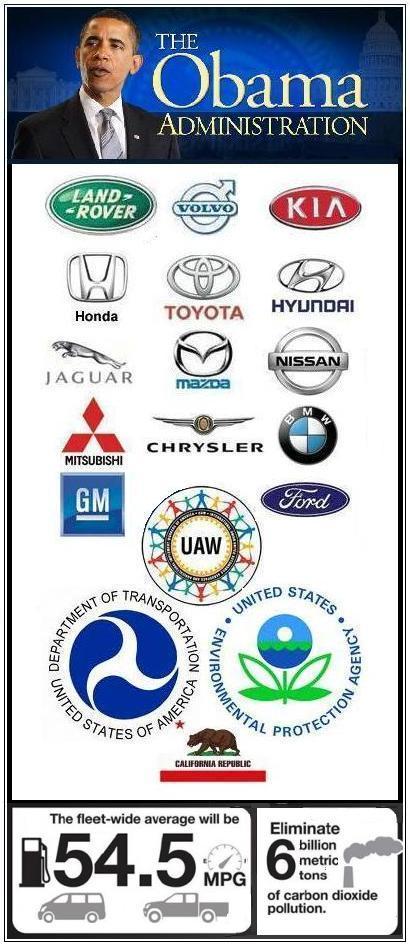
Many have trouble reconciling the seemingly disparate interests of government, automakers and environmentalists, but as the new rules on US cars and light trucks, as well as long-haul trucks and buses reveals, diverse groups can work together to produce the best results for all stakeholders.

"These standards will help spur economic growth, protect the environment, and strengthen our national security by reducing America’s dependence on foreign oil,” said U.S. Transportation Secretary Ray LaHood. “Working together, we are setting the stage for a new generation of clean vehicles.”

President Obama reached the agreement with thirteen major automakers (Ford, GM, Chrysler, BMW, Honda, Hyundai, Jaguar/Land Rover, Kia, Mazda, Mitsubishi, Nissan, Toyota and Volvo). The United Auto Workers (UAW), and the State of California, were also an integral part of developing this agreement. The Environmental Protection Agency (EPA) and the Department of Transportation (DOT) oversaw the viability of the agreement.

“This is another important step toward saving money for drivers, breaking our dependence on imported oil and cleaning up the air we breathe,” said EPA Administrator Lisa P. Jackson. “American consumers are calling for cleaner cars that won’t pollute their air or break their budgets at the gas pump, and our innovative American automakers are responding with plans for some of the most fuel efficient vehicles in our history.”

The EPA and NHTSA are developing a joint proposed rulemaking, which will include full details on the proposed program and supporting analyses, including the costs and benefits of the proposal and its effects on the economy, auto manufacturers, and consumers. The agencies plan to issue a Notice of Proposed Rulemaking by the end of September 2011. California plans on adopting its proposed rule in the same time frame as the federal proposal.

The EPA and NHTSA are committed to maintaining a single national framework for vehicle GHG and fuel economy regulation. The agencies will conduct the mid-term evaluation in close coordination with California.

© 2011, Richard Matthews. All rights reserved.

Related Posts
New Rules for US Cars and Light Trucks
New Rules for US Trucks and Buses
US Government Incentives for EVs

Toyota and Tesla Making Electric Sedan

Toyota, the world's largest automotive company is teaming up with Tesla Motors to manufacture a fully electric Sedan. The Tesla Model S sedan in scheduled to launch in 2012.

The Model S is a high performance electric sedan that will compete with cars like the BMW 5-series. The 4 door, 7 seat sedan is powered by an electric 70 kW battery, it accelerates from 0-60 in 5.6 seconds, has a top speed of 120 mph, and a range of 300 miles. Batteries can be quick-charged in 45 minutes. Two additional rear-facing seats in the cargo area give the car its seven seat capacity.

The Model S has a high-tech cockpit with two LCD screens, including a touchscreen panel in the center console. Prototypes of the Model S have sophisticated on-board computer systems with peripheral hardware. Their 17” touch-screen control panel includes HD radio integration, quick GPS navigation, streaming audio and other Internet and cloud-based data and information.

Tesla Motors reported a net loss of $38.5 million in the second quarter of 2010, compared with a loss of $10.8 million in the second quarter of 2009. The company said revenue climbed 5 percent from a year ago, to $28.4 million. Losses were attributed to higher research and development costs associated with the engineering of the Model S.

Tesla went public to raise funds with its IPO in late June. Tesla's IPO raised more than $200 million. The company has said it does not expect to be profitable before mid 2012, when its Model S sedan is slated to reach production. Tesla expects to build about 20,000 units a year when full production is reached after 2012.

The collaboration between Toyota and Tesla is the type of partnership that is driving the greener vehicle market and benefiting all parties. Toyota will benefit from the buzz around Tesla, and this will help the Japanese carmaker to recapture some of the credibility that it lost during its recent wave of recalls. Tesla will benefit from Toyota's $50 million investment and from Toyota's engineering and production systems. The public will benefit from a high performance sedan that has zero emissions.
__________________________________

Related Posts
Toyota's Greener Vehicles
GM Breakthrough Reduces Emissions
Electric Vehicles Need New Business Models
Private Public Cooperation Behind SA Joule
Governments and the Growth of EVs
Government Investment Fuels Greener Vehicles
Germany and the Global Competition for EV Supremacy
Competition in the Green Vehicle Market
Electric Vehicle Bill Passes Energy Committee
American Electric Vehicle Strategy
Jaguar XJ: A Greener Luxury Car
The FIAT 500 is Coming to America
E-Range: World's First Fully Electric 4x4
Korean (Hyundai & Kia) Greener Cars
Honda's CR-Z and Second Generation Hybrids
Honda's Greener Vehicles
Honda's Solar-Hydrogen Powered Future
Volkswagen's Greener Vehicles
Volkswagen Wins Green Car of the Year for 2010
Porsche and Audi`s Greener Vehicles
Volkswagen's Dirty Automotive Brands
European Greener Cars
GM's Greener Vehicles
Ford's Greener Vehicles
Nissan's Greener Vehicles
Greener Commercial Transport Vehicles
Greening Vehicle Fleets