Showing posts with label Natural Gas. Show all posts

Jurisdictions Across the US are Saying "No" to Fracking

States and other smaller jurisdictions are saying no to fracking. More than 150 towns, cities, and counties across the U.S. have already adopted such policies. A number of US jurisdictions have passed laws forbidding fracking. Some have even mandated that up to one-third of their power must come from renewable sources by 2020.

After a thorough investigation the state of New York State banned fracking at the start of 2015. Maryland has put a moratorium on the practice and Maryland county became the first in the state to ban fracking outright.

Counties and towns in California, Ohio, and Texas banned fracking. Texas may be the home of oil but the town of Denton voted to ban fracking.

Residents voted to ban fracking in counties and towns in California including Mendocino and San Benito. Santa Barbara failed get enough votes due largely to Chevron Corporation and Occidental Petroleum who spent $7.7 million to prevent the anti-fracking plebiscites in California from succeeding.

Fifty-seven percent of voters in San Benito voted against fracking in a referendum. In places like Mendocino the vote was not even close with 75 percent of voters opting to ban fracking and protect their water. Seventy-eight percent citizens of Athens, Ohio, voted to ban fracking.

Similar efforts are underway across the US. In March, a small town in Western Pennsylvania legalized civil disobedience to combat fracking.

Related
The Myth that Fracked Gas is a Bridge Fuel
Fracking Contaminates Drinking Water
Natural Gas Versus Renewable Energy
Fracking and Earthquakes go Together like Sodom and Gomorrah
Obama Begins to Reign-in Methane Emissions from Fracking
Leaking Methane Associated with Fracking
The Porter Ranch Methane Leak Could be a Catalyst for Change
Natural Gas Will Not Slow Climate Change and it Will Impede the Growth of Renewables
Natural Gas (Methane) is Not Clean Energy
Video - Methane is a Potent Greenhouse Gas
Whats the Fracking Problem
Natural Gas Explosions Highlight Safety Concerns

Obama Begins to Reign-in Methane Emissions from Fracking

Through the Environmental Protection Agency the Obama administration is cracking down on methane associated with the extraction of fossil fuels. Fugitive emissions are unintended or irregular gas leaks, however most of the emissions associated with fracking are intentional. Releases of gas are part of the standard operating procedure of the extraction process.

Methane is main ingredient in natural gas and one of the world's most potent greenhouse gases. The Obama administration’s new rules to curb methane come in the wake of two reports that illustrate the dangers of fracking. These reports show that methane is seeping into that atmosphere throughout the fracking process from extraction to the end users.

The Environmental Protection Agency (EPA) recently released the final version of their new federal rules to limit methane emissions at oil and gas facilities. While this is a good first step, the regulations only apply to new facilities.

Although carbon gets most of the attention, methane is a powerful greenhouse gas. Although burning natural gas releases half as much carbon dioxide as coal, fracking for gas also releases unburned methane. CH4 (methane) is the main component of natural gas, it is a potent GHG and as such, a major contributor to global warming. Although methane has a shorter active life, it is as much as 105 times better at trapping heat over a 20-year timeframe than carbon.

In addition to contributing to climate change, fracking has been shown to contaminate drinking water, cause seismic activity (earthquakes), contribute to air pollution, and destroy land. Further, US fracking operations may make it difficult for the US to achieve its 26 to 28 percent GHG reduction targets.

A recent Environment America Fracking Report concluded that fracking poses a risk to local communities and wildlife. The report comes to the clear and unavoidable conclusion that fracking must be stopped.

The report says that there are 137,000 fracking wells drilled or permitted across more than 20 states. In 2014, new fracking wells released 5.3 billion pounds (2.4 million metric tons) of methane into the atmosphere which is equivalent to the emissions from 22 new coal-fired plants. Fracking is fraught with a host of problems, starting from the point of extraction. Methane is released during fracking, in the processing, transporting and distribution.

The report concludes that there is “tremendous environmental harm and puts the health and safety of communities across the country at risk.” It further states that the companies behind this destruction should be made to pay for the damage they have caused.

The Environmental Protection Agency’s (EPA) methane calculations appear to have drastically underestimated the scale of the problem. A recent Harvard study used satellite data from across the country over a span of more than ten years and found that US methane emissions have increased by almost a third since 2002. What makes this data so shocking is the fact that the EPA had been insisting that US methane levels were falling. The Harvard satellite data concluded that the surge of methane from the US is responsible for between 30 and 60 percent of the global growth in methane emissions this past decade.

The Harvard research corroborates previous findings including a 2014 Stanford study that reviewed over 200 earlier studies to find “U.S. emissions of methane are considerably higher than official estimates.” A 2014 PNAS study of fracking sites in southwestern Pennsylvania found that methane was being released into the atmosphere at a rate 100 to 1,000 times greater than estimated by the EPA.

Together, these studies demonstrate that fracking obliterates any climate benefits associated with natural gas.

A study, entitled, “Greenhouse Gases from a Growing Petrochemical Industry” shows that in addition to methane emissions, fracked gas is encouraging the development of energy-intensive infrastructure and industries that produce huge quantities of carbon dioxide. The study concludes that cheap shale gas is encouraging the development of other energy-intensive infrastructure and industries, which in turn produce approximately 86 million tons a year of CO2 each year. This is the equivalent of 19 coal-fired power plants.

The EPA recently released the final version of new federal rules intended to curb methane emissions. It aims to reduce gas-sector methane emissions 40 to 45 percent below 2012 levels by 2025. The EPA expects the regulations will cost $530 million by 2025, while generating $690 million in environmental benefits.

Even before the EPA’s latest move, the fracking industry had fallen on hard times. It seems market forces, specifically the low price of oil, are forcing the shutdown of fracking operations.

Up to a third of all fracking companies may declare bankruptcy by the end of 2016, Fortune predicted at the end of 2015.

James West, an energy industry analyst at ISI Evercore, says months of low activity have left many of the companies in the hydraulic-fracturing business either insolvent or close to it. He says as many as a third of the fracking companies could go bust.

As reported by Desmogblog, some of the biggest players in the fracking industry are in trouble. Among them are Chesapeake Energy, Continental Resources, Whiting Petroleum and Halliburton. The latter has announced that it was axing 5,000 drilling jobs globally or eight percent of its workforce. Continental Resources has stopped its fracking operations and they reported their first annual loss since they began operating in 2007.

States dependent on fracking are being hit hard. North Dakota and Oklahoma are projecting a $1 billion budget shortfall and in Alaska, the budgetary shortfall is $3.5 billion.

We need to expose the myth that fracking is a source of clean energy. The research indicates that fracked gas is not a bridge fuel. Ramping up the use of fossil fuels is incompatible with the goal of the Paris Climate Agreement, which aims to keep temperatures from rising no more than 2 degrees Celsius. This is the conclusion of numerous studies including the Intergovernmental Panel on Climate Change. The Environment America Fracking report makes it abundantly clear that this also includes fracked gas.

Source: Global Warming is Real

Related
Leaking Methane Associated with Fracking
The Porter Ranch Methane Leak Could be a Catalyst for Change
Natural Gas (Methane) is Not Clean Energy
US Proposals to Cut Methane and Other Pollutants
EPA Announces Plans to Regulate Methane
Video - Methane is a Potent Greenhouse Gas
Radiative Forcing: Carbon Dioxide and Methane
Whats the Fracking Problem
The US Environmental Protection Agency and Fracking
The Implications of the US being a Global Leader in Fossil Fuel Production

Fracking Contaminates Drinking Water

Despite the secrecy of the fracking industry and the protections afforded by some states there is mounting evidence that hydraulic fracturing or "fracking" contaminates drinking water. Fracking is a fossil fuel extraction process that consists of injecting chemicals deep underground to break up shale formations.Conservative estimates indicate that there have been at least 260 documented examples of wells contamination due to fracking in Pennsylvania alone. As reported in Scientific American, a 2013 study published in the Proceedings of the National Academy of Sciences USA found widespread examples of methane laced drinking water In Pennsylvania. The researchers showed that the closer you are to a fracking site the more likely that your well will be contaminated.

According to an Environment America Fracking report water contamination is one of the most environmentally destructive corollaries of this process. "People living or working nearby can be exposed to these chemicals if they enter drinking water after a spill or if they become airborne." 

"For the past decade, fracking has been a nightmare for our drinking water, our open spaces, and our climate," Rachel Richardson, a co-author of the paper from Environment America, told ThinkProgress.

There have been a number of high profile frack-water related problems. Here are a few examples

"Two families in Pennsylvania were awarded more than $4 million in March — ending a seven-year legal battle against a fracking company they said contaminated local water sources. Last summer, a Texas man was severely burned after methane, allegedly from nearby fracking, caused an explosion in his well shed. Last summer, scientists in Texas found elevated levels of cancer-causing chemicals in the drinking water in one of the state’s major fracking regions."

Fracking also wastes vast quantities of water. According to Environment America, at least 239 billion gallons of water have been used in fracking since 2005. These fracking operations are reducing the availability of water and driving up the price. This is particularly pronounced in drought stricken areas of the country. In Colorado the price of water went up 100 times the usual rate. The competition for scarce water resources is a serious issue for agriculture.

One of the major problems associated with studying fracking is the fact that many of states do release data. This includes some of the states that do the most fracking (eg Texas and North Dakota). Of the states that do release information it was found that 14 billion gallons of wastewater was produced by fracking in 2014.

In February Triple Pundit covered the fracking water contamination connection. A 2015 a U.S. Environmental Protection Agency (EPA) draft report linked fracking to water contamination concluded that the absence of data and other “limiting factors” made research difficult. A similar conclusion was reached in a recent Stanford fracking report that was presented at the 2016 meeting of the American Association for the Advancement of Science. This study sought to explore how natural gas from the drilling sites contaminate local water supplies. However, it should be noted that the report’s lead author, Stanford professor Rob Jackson, has ties to the natural gas industry.

Nonetheless Jackson cites a case in Parker County, Texas, where the drillers did not include a cement liner all the way down the well and the result was that gases contaminated the drinking-water supply. Jackson singled out the dangers of contamination of drinking water from more than 2,600 shallow wells (ie wells that are less than 3,000 feet).

"We found a surprising number of places where companies are fracking directly into shallow freshwater aquifers," he says. "In no other industry would you be allowed to inject chemicals into a source of drinking-quality water."

After an exhaustive study New York state banned fracking in 2015. Last June, TriplePundit referenced studies which showed that fracking operations impact on water quality in Texas, and another associating lower birth-weight with mothers living near gas wells in Pennsylvania. Rolling Stone magazine followed up on an earlier Newsweek report on anecdotal evidence of infant mortality linked to fracking in Utah. Another fracking report linked a significant increase in hospitalizations to the "meteoric" rise in natural gas wells in Pennsylvania.

Determining the exact composition of the chemical cocktail used in fracking has been very elusive. However we are getting a better idea of what can be found in this toxic soup. There are over 700 chemicals used in fracking fluids which includes endocrine-disrupting chemicals, carcinogens and neurotoxins. This includes chemicals like formaldehyde, benzene and hydrochloric acid.

A 2014 study by scientists at Lawrence Berkeley National Laboratory found that around ten percent of chemicals used in fracking brine are toxic to humans or aquatic life. In addition to these poisonous substances, fracking can also bring naturally occurring radioactive materials to the surface.

As reported by the LA Times, a 2013 study of water collected from fracking sites in Colorado finds substances that have been linked to infertility, birth defects and cancer. They found endocrine-disrupting chemicals (EDCs), which can affect human sex hormones. Of than 700 chemicals that could be used in the fracking process and estimated that about 100 are known or suspected EDCs.

Exposure to EDCs has serious health implications for fetuses, babies and young children. The World Health Organization issued a report which indicates that endocrine-related illnesses were on the rise worldwide.

The study, published in the journal Endocrinology, also found elevated levels of the hormone-disrupting chemicals in the Colorado River.

"With fracking on the rise, populations may face greater health risks from increased endocrine-disrupting chemical exposure," said senior author Susan Nagel, who investigates the health effects of estrogen at the University of Missouri School of Medicine.

Out of 39 water samples collected at five drilling sites, 89 percent showed estrogenic properties, 41perent were anti-estrogenic, 12 percent were androgenic and 46 percent were anti-androgenic..

"The human endocrine system and that of wildlife is guided by very small fluctuations of hormones," said Dr. Meg Schwarzman, associate director of the Berkeley Center for Green Chemistry at UC Berkeley. "Even low levels of anti-estrogenic or anti-androgenic activity could potentially alter development in ways that are meaningful."

Secrecy in the fracking industry may be coming to an end. A March 2014 ruling by the Wyoming Supreme Court ordered companies engaged in fracking to reveal the concoction of chemicals they use. However, the fracking industry has Republican allies in legislatures across the country. At the end of May 2016 the GOP in North Carolina pushed a bill that would jail anyone for disclosing the chemicals found in fracking fluid.

Related
Fracking: A Tragic Waste of Water Resources
Infographic - How Much Water Does Fracking Consume
Fracking Operations Shut Down to Protect Drinking Water in California
Jurisdictions Across the US are Saying "No" to Fracking
The Myth that Fracked Gas is a Bridge Fuel
Natural Gas Versus Renewable Energy
Fracking and Earthquakes go Together like Sodom and Gomorrah
Obama Begins to Reign-in Methane Emissions from Fracking
Leaking Methane Associated with Fracking
The Porter Ranch Methane Leak Could be a Catalyst for Change

Natural Gas versus Renewable Energy

Natural gas, particularly gas from fracking cannot hold a candle to renewable energy. Nonetheless, the positive spin associated with fracking for natural gas persists. Natural gas is anything but clean but it continues to be sold as such.

This American made technology has been shipped all around the world. So has US natural gas. As the first load of American gas was being shipped by Cheniere Energy, the company’s vice president of marketing, Meg Gentle, told industry and government officials that natural gas should be rebranded as renewable energy.

"I’d challenge everyone here to reframe the debate and make sure natural gas is part of the category of clean energy, not a fossil-fuel category, which is viewed as dirty and not part of the solution," she said.

Contrary to Gentle's assertions, the emissions associated with natural gas are much higher than initially thought. In fact, gas may be worse than coal. We also know that fracking causes earthquakes and a host of other problems.

As explained in an Environment America report, air pollution from fracking also contributes to smog which can cause both disease and death. Fracking releases air pollutants that have been linked to cancer and other serious health effects.

Together the evidence is clear, natural gas is not clean energy. fracked gas does not warrant being called a bridge fuel. It is as bad or worse than some of the dirtiest forms of fossil fuels. 

Natural gas will not slow climate change but it has undermined the growth of renewables. Starting in 2012 we began seeing evidence that the prodigious growth of fracking was slowing the market for renewables. Natural gas production started eating into renewable energy development more than four years ago. The result was that investments in wind and solar waned somewhat in 2012.

Despite these headwinds, renewable energy keeps growing in the US. As reported by Cleantechnica, a 2013 Credit Swiss report predicted US renewable energy would keep growing. The title to the first section of the report says it all, “Renewables Are Economic and Disruptive to Conventional Markets.” The falling costs of renewables has made them competitive with natural gas. Once so called externalities are incorporated into the equation, renewables definitively crush natural gas.

Despite the plethora of fracked gas that has flooded the market, renewables continue to grow in 2016. According to the "Energy Infrastructure Update," in the first three months of 2016, the US added 18 megawatts of new natural gas generating capacity compared to 1,291 megawatts (MW) of new renewables.

Related
The Myth that Fracked Gas is a Bridge Fuel
Fracking Contaminates Drinking Water
Fracking and Earthquakes go Together like Sodom and Gomorrah
Obama Begins to Reign-in Methane Emissions from Fracking
Jurisdictions Across the US are Saying "No" to Fracking 
Leaking Methane Associated with Fracking
The Porter Ranch Methane Leak Could be a Catalyst for Change
Natural Gas Will Not Slow Climate Change and it Will Impede the Growth of Renewables
Natural Gas (Methane) is Not Clean Energy
Video - Methane is a Potent Greenhouse Gas
Whats the Fracking Problem
Natural Gas Explosions Highlight Safety Concerns

Fracking and Earthquakes go Together like Sodom and Gomorrah

Earthquakes caused by fracking are a common occurrence in the US. We have seen a 4000 percent increase in earthquakes in the US in the last 8 years. Earthquakes caused by natural causes can be both destructive and deadly but they are unavoidable, whereas earthquakes caused by fracking for climate change causing natural gas are both lamentable and avoidable. Fracking related earthquakes are caused when the heavily polluted water used for fracking is disposed of by injecting it deep underground below aquifers near fault lines.

A new report mapping earthquake hazards, including those induced by fracking, the U.S. Geological Survey (USGG) says that

Eight years ago the US was averaging 24 earthquakes of 3.0 magnitude or larger each year. In 2015, there were 1,010 earthquakes of 3.0 or greater. This year we may exceed that number. As of mid-march there have already been 226 earthquakes in the central United States alone.

According to the USGG, fracking has put parts of Oklahoma and Kansas on a par with California in terms of their earthquake risk. Last year, Oklahoma officially earned the dubious distinction of being the most earthquake prone place on earth. Scientists have linked this seismic activity to the fracking boom in the state. In 2009 Oklahoma experienced 20 magnitude 3 or higher earthquakes in 2015 there were more than 700.

Even if we were to stop injecting wastewater deep underground, the earthquakes would likely continue as it sometimes takes a while for the water pressure to trigger a quake.

To see the USGG's earthquake map click here.

Related
Leaking Methane Associated with Fracking
The Myth that Fracked Natural Gas is a Bridge Fuel
The Porter Ranch Methane Leak Could be a Catalyst for Change
Natural Gas Will Not Slow Climate Change and it Will Impede the Growth of Renewables
Natural Gas (Methane) is Not Clean Energy
US Proposals to Cut Methane and Other Pollutants
EPA Announces Plans to Regulate Methane
Radiative Forcing: Carbon Dioxide and Methane
Newfoundland Pauses Fracking
Whats the Fracking Problem
Record Breaking Drought in California at Odds with Fracking
The US Environmental Protection Agency and Fracking
The Implications of the US being a Global Leader in Fossil Fuel Production

Leaking Methane Associated with Fracking

A close examination of the facts exposes unconventional gas as anything but a cleaner bridge fuel. The gas obtained from hydraulic fracturing (fracking) leaks at every step in the process from extraction to the transportation and distribution. New research suggests these leaks cancel out the emissions reduction efforts of the Obama administration.

While it was known that fracking operations leak, the extent of those leaks is far worse than anyone, including the EPA had expected. Leakage of as little as 4 percent makes fracking a dirtier source of energy than coal. As Colm Sweeney, the head of the aircraft program at NOAA’s Earth System Research Laboratory, told the journal Nature, leakage makes the climate value of natural gas highly questionable.

A number of studies suggest that leakage rates in fracking are way above 4 percent. These studies show that leakage rates are between 7 and 17 percent. However the actual rates may be much higher.

"People who go out and actually measure methane pretty consistently find more emissions than we expect," said the lead author of a 2014 analysis, Adam Brandt, an assistant professor of energy resources engineering at Stanford University. "Atmospheric tests covering the entire country indicate emissions around 50 percent more than EPA estimates," said Brandt. "And that’s a moderate estimate."

As reported by the Climate Desk, the World Resources Institute (WRI) indicates that the leakage of natural gas amounts to approximately $1.5 billion a year in lost revenues

"Those leaks are everywhere," said WRI analyst James Bradbury said in 2013. Leaks are ubiquitous in the nation’s 300,000 miles of natural gas pipeline. Bradbury says that if President Obama wants to tackle climate change he must address the issue. "You want to get these rules in place at the front end; we’re already playing catch-up."

Although the EPA has released new methane emission rules they only apply to new fracking operations. The regulations seek to reduce gas-sector methane emissions 40 to 45 percent below 2012 levels by 2025.

The Environmental Defense Fund and Google were behind a series of studies that showed that methane leaks are a serious problem particularly older cities. As the Porter Ranch disaster illustrated there are also massive methane leaks from extraction and storage sites.

In February, Harvard researchers used satellite data to conclude that between 2002 and 2014, US methane emissions increased by more than 30 percent. This methane is responsible for 30 to 60 percent of the global increases in atmospheric methane.

In addition to the EPA's new climate rules, the US and Canada reached an agreement in March designed to reign in the leaks from all that new gas infrastructure.

However the amount of methane that continues to leak is massive and the multiple points at which this leakage occurs means that it will not be easily remedied.

Related
The Myth that Fracked Gas is a Bridge Fuel
Jurisdictions Across the US are Saying "No" to Fracking
Fracking Contaminates Drinking Water
Natural Gas Versus Renewable Energy
Fracking and Earthquakes go Together like Sodom and Gomorrah
Obama Begins to Reign-in Methane Emissions from Fracking
The Porter Ranch Methane Leak Could be a Catalyst for Change
Natural Gas Will Not Slow Climate Change and it Will Impede the Growth of Renewables
Natural Gas (Methane) is Not Clean Energy
Video - Methane is a Potent Greenhouse Gas
Whats the Fracking Problem
Natural Gas Explosions Highlight Safety Concerns

The Myth that Fracked Natural Gas is a Bridge Fuel

Now that the EPA is beginning to reign in methane emissions, we need to expose the myth that natural gas is a bridge fuel that will help us to transition to renewable sources of energy. The logic supporting fracking is based on the fact that there are lower carbon emissions associated with the burning of gas compared to coal.

However, a number of studies clearly demonstrates that when you factor the leaks, fracking for gas, is not clean and it may even have a more destructive climate impact than coal.

In an Independent article, Geffrey Lean, concludes: “The new study strikes another blow at the strategy of both the US and British governments to rely on shale gas as a relatively clean ‘bridge’ from dirty fossil fuels to non-polluting renewable sources”.

It is important to note that this is not a new finding. The realization that fracked gas is not a bridge fuel was contained in the conclusion of the IEA's World Energy Outlook published in 2011 titled the "Golden Age of Gas."

A 2011 study by Tom Wigley, a senior research associate at the National Center for Atmospheric Research (NCAR), also showed that switching from coal to natural gas will not reduce global warming.

Think Progress has referred to natural gas as a "bridge to nowhere" and they describe fracking as a "gangplank."

When fracked gas in included in the equation, all of President Obama's climate efforts are negated. Sadly the myth that natural gas is a bridge fuel persists despite years of study. In August 2015, Hillary Clinton delivered a keynote address at the National Clean Energy Summit in which she said we need to "build a safe bridge to a clean energy economy." Natural; gas is not a safe bridge to the clean energy economy.

As reviewed by Bill McKibben, two researchers by the name of Howarth and Ingraffea produced a number of papers which show that even if only 3 percent of fracked gas leaks, this would do more climate damage than coal. They estimate that methane leak rates from shale operations are between 3.6 and 7.9 percent. As Howarth says, "We closed coal plants and opened methane leaks, and the result is that things have gotten worse."

We now know that leakage rates are far worse than expected.  Even if we are able to radically reduce the leaks Howarth says that methane emissions will keep rising as long as we keep fracking.

Related
Leaking Methane Associated with Fracking
Natural Gas Will Not Slow Climate Change and it Will Impede the Growth of Renewables
Natural Gas (Methane) is Not Clean Energy
Video - Methane is a Potent Greenhouse Gas
The Porter Ranch Methane Leak Could be a Catalyst for Change
Jurisdictions Across the US are Saying "No" to Fracking
Fracking Contaminates Drinking Water
Natural Gas Versus Renewable Energy
Fracking and Earthquakes go Together like Sodom and Gomorrah
Obama Begins to Reign-in Methane Emissions from Fracking
Whats the Fracking Problem
Natural Gas Explosions Highlight Safety Concerns

The Porter Ranch Methane Leak Could be a Catalyst for Change
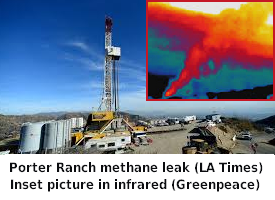
 The invisible methane leak in California is a great opportunity to open a discussion about the future of natural gas in America. The Porter Ranch disaster is one of the biggest environmental disasters in US history and it is happening right now in southern California. The methane leak at the SoCalGas Aliso Canyon Storage Facility, located in the Porter Ranch neighborhood of northwest Los Angeles, is already the largest such leak in U.S. history and it is far from over. The leak started in October and SoCalGas has indicated that it does not expect to be able to cap the leak until March.

Except for a mildly unpleasant aroma (due to an additive called mercaptan) a methane leak, which is the largest constituent of natural gas, is far more harmful to our climate than an oil spill. Unlike the pyrotechnics or black gooey mess that are often associated with an oil spill, a methane leak is invisible. The leak may not be discernible to the naked eye, but it is nonetheless highly destructive to both the earth’s climate and human health. The fact that it cannot be seen does not make it innocuous. The Porter Ranch leak is more serious than any of the 34 major oil spills that took place in North America last year.

Although it has not garnered the same attention, the leak is highly reminiscent of the BP oil spill in the Gulf of Mexico in 2010. So far, 2,300 homes have been evacuated and 1,500 other families are being relocated. The crisis prompted California governor Gerry Brown to issue a state-of-emergency declaration.

Carbon is the best known greenhouse gas, it gets the most press because it represents the largest share of climate pollution. However carbon is a relative lightweight compared to methane when it comes to trapping heat. Over a 100-year period, methane causes 28 times as much warming as carbon dioxide and over a 20 year time span, methane is 84 times as potent as CO2. Methane is responsible for ten percent of US greenhouse gas emissions.

While methane leaks are common at drilling sites, this one is a monster. It is spewing methane at a rate of 40 to 64 tons per hour. The EDF has compared the daily emissions coming out of the Porter Ranch leak to six coal fired power plants or 4.7 million cars. So far around 90,000 metric tons of methane have seeped from the SoCalGas facility and this is expected to continue for many more weeks.

According to Robert Howarth, a professor of ecology and environmental biology at Cornell University and an expert in the impacts of greenhouse gas emissions, the Porter Ranch leak will likely add 5 percent to the total amount of methane released by the entire US oil and gas industry.

Methane is not only destructive to the climate, it is a serious health risk for people. In addition to being highly flammable, methane fumes are dangerous to inhale. Other compounds such as hydrogen sulfide and benzene, have also been detected in the air and they are also injurious to human health. An attorney working on behalf of one thousand local residents says that there are short term effects from the leak including bleeding eyes and gums to long term effects like cancer and death. A class action filing alleges that SoCalGas and its parent company “negligently failed to construct, operate, and maintain” the storage facility.

California Governor Jerry Brown has ordered SoCalGas to pay to mitigate the leak, however, the issue is far deeper than this one event or the costs that it will incur. This leak may help to divest methane of its false persona as a green alternative to coal and oil.

Although the EPA is working on reigning in methane emissions, the Porter Ranch incident points to the wider issue of natural gas extraction. Amy Townsend-Small, a University of Cincinnati professor who’s studied methane emissions from the natural gas industry, said the size of the leak is staggering. “It’s a perfect example of how we can work on decreasing emissions from individual wells, but there’s going to be catastrophic events…and that can change everything,” she said.

This is certainly not the only time that we have seen methane leaks at such facilities. There are about 400 other storage wells like the Aliso Canyon. The Porter Ranch disaster shows just how destructive natural gas extraction can be.
“This event is a watershed moment both because it drives home for the general public the fact that these kinds of problems can and do exist, and hopefully it drives home for the industry that a business-as-usual approach is no longer tenable,” Mark Brownstein, vice president of the climate and energy program at the Environmental Defense Fund (EDF) said.
There is a lot of talk about the importance of using natural gas to help wean America off of oil, but the Porter Ranch disaster proves that fracking, touted by some as a more environmentally sound alternative, is anything but safe.

“I think this opens the door to a larger conversation: the fact that this gas is used to meet the peaking electricity demands,” said Timothy O’Connor, a director with EDF. Regulators need to look at “the role of natural gas for meeting peak electricity demand and how we reduce that role.”

Rather than hail natural gas as an important source of cleaner energy we need to acknowledge that it is just another fossil fuel that must be kept in the ground.

Source: Global Warming is Real

Related
Jurisdictions Across the US are Saying "No" to Fracking
The Myth that Fracked Gas is a Bridge Fuel
Fracking Contaminates Drinking Water
Natural Gas Versus Renewable Energy
Fracking and Earthquakes go Together like Sodom and Gomorrah
Obama Begins to Reign-in Methane Emissions from Fracking
Leaking Methane Associated with Fracking
Natural Gas Will Not Slow Climate Change and it Will Impede the Growth of Renewables
Natural Gas (Methane) is Not Clean Energy
Video - Methane is a Potent Greenhouse Gas
Whats the Fracking Problem
Natural Gas Explosions Highlight Safety Concerns