Showing posts with label Global. Show all posts

Climate Change was the Hot Topic at the World Economic Forum in Davos

Climate change was the dominant theme at and this year's World Economic Forum (WEF). Panel discussions covered a wide range of related topics and including global warming, ocean sustainability and biodiversity. Al Gore, David Attenborough and Jane Goodall were among the participants.

This year's Global Risk Assessment report released at the WEF in Davos revealed, yet again, that climate change and related phenomenon are among the greatest risks both in terms of impact and likelihood. The report surveys nearly 1,000 decision-makers (public sector, private sector, academia and civil society) who are asked to assess the risks facing the world.  Over a ten-year horizon, extreme weather and climate-change policy failures are seen as the gravest threats.

The WEF has issued many similar warnings in recent years. The 2016 Global Risks Report was the first that put environmental risks at the top the ranking. This report said the failure of climate change mitigation and adaptation is the risk with the greatest potential to impact society. It specifically warned about the impact of climate change on food security. As an interesting aside, the 2016 report included a prophetic warning about the risks associated with disempowered citizens.

The experts at Davos called for corporate and government action and there was widespread agreement that this requires economic change. As reported by CNN, these experts singled out fossil fuel subsidies in G7 countries. "There are still fossil fuel subsidies from G7 countries — that's ridiculous," said Rachel Kyte, special representative of the UN Secretary-General for Sustainable Energy. "Why we are subsidizing something we know is killing our children, poisoning them and affecting their ability to learn? That's beyond me," she added.

Attenborough, Gore and others have been sounding the alarm about climate change for years. However, the most powerful warning came from 16 year old Greta Thunberg who told attendees: "I don't want you to be hopeful, I want you to panic, I want you to feel the fear I feel every day," She also pulled no punches when she ascribed blame those assembled in Davos: "Some people say that the climate crisis is something that we will have created, but that is not true, because if everyone is guilty then no one is to blame. And someone is to blame," Thunberg said flatly. "Some people, some companies, some decision-makers in particular, have known exactly what priceless values they have been sacrificing to continue making unimaginable amounts of money. And I think many of you here today belong to that group of people."

After her speeches at COP24 and the WEF Greta has emerged as a leading voice for climate action. She is a realist in a world where many are either ebulliently optimistic about the prospects for climate action.

"Many people say that this is not an easy issue, we cannot just say that this is how it is, it's not black and white. But I say that this is black and white. Either we stop the emissions or we don't. There are no gray areas when it comes to survival,"Greta said.

In a chapter on the human causes and effects, the Global Risks Report 2019 calls for greater action around rising levels of psychological strain across the world.

"The world faced a growing number of complex and interconnected challenges in 2018. From climate change and slowing global growth to economic inequality, we will struggle if we do not work together in the face of these simultaneous challenges," the report's authors conclude.

Related
Climate Optimism and Sustainability Initiatives at the World Economic Forum in Davos
Climate Focus at The World Economic Forum in Davos
This Year's WEF Gives us Reason to Hope
Video - WEF 2015: A Climate for Action
WEF Summaries: Climate Change
Towards a Global Climate Agreement at COP21 (WEF Summaries)
Business Leadership on Climate Change (WEF Summaries)
Curbing Fossil Fuels - Carbon Pricing and an End to Subsidies (WEF Summaries)
The Value of Investing in Climate Mitigation (WEF Summaries)
Global Economies Feeling the Heat from Climate Change (WEF Summaries)
Collaboration and Cooperation are Imperitive (WEF Summaries)
What is The World Economic Forum (WEF)
Risks Associated with Environment, Climate, Water Crisis and Extreme Weather in the WEF Report


This Year's WEF Gives us Reason to Hope

Climate and energy conversations that took place at this year's World Economic Forum (WEF) in Davos gave us reason to hope. Many of those who constitute the core of the world's economic power acknowledged the urgency of climate action and the opportunities associated with forging a new green economy.

We are beginning to see the kind of leadership from CEO's and investors that is an essential if we are to succeed in tackling climate change. Companies and investors are coming together to advance meaningful solutions. Business leaders are now looking at climate change as both a risk and an opportunity. Investors are showing unprecedented interest in investments that support low carbon technologies.

There was even support for bold action that includes ambitious climate policies. Such government support was highlighted for its ability to drive innovation, advance clean energy and improve energy efficiency.

As we head towards a hoped for global climate agreement in Paris at the end of the year, there is reason for unprecedented optimism.

Related
Video - WEF 2015: A Climate for Action
WEF Summaries: Climate Change
Towards a Global Climate Agreement at COP21 (WEF Summaries)
Business Leadership on Climate Change (WEF Summaries)
Curbing Fossil Fuels - Carbon Pricing and an End to Subsidies (WEF Summaries)
The Value of Investing in Climate Mitigation (WEF Summaries)
Global Economies Feeling the Heat from Climate Change (WEF Summaries)
Collaboration and Cooperation are Imperitive (WEF Summaries)
What is The World Economic Forum (WEF)
Risks Associated with Environment, Climate, Water Crisis and Extreme Weather in the WEF Report

Collaboration and Cooperation are Imperitive (WEF Summaries)

Collaboration and cooperation are commonly mentioned as important aspects of sustainability and they emerged as salient themes at the World Economic Forum in Davos, Switzerland. Over the course of the last year we have seen historic collaboration on carbon emissions reduction between the US and China. We have also seen tremendous progress in some private sector areas.

While many are talking about global disunity, others are pointing to significant examples of global collaboration. John Kerry, US Secretary of State, said "I don’t see an unraveling [of international cooperation]. I see just the opposite. I see nations coming together … to reach an ambitious global agreement to address climate change, with the recent agreement by China and the United States that begins to set the targets to make the Paris negotiations this year a success."

Over the course of the last year businesses have come together and provide real leadership on issues like sustainably sourced palm oil. This was the subject of a talk by Dominic Waughray, Head of Public/Private Partnerships at the World Economic Forum. He addressed how the peer-to-peer conversations among business leaders led to significant commitments to sustainably sourced palm oil. As of right now over 90 percent of global palm oil demand is covered by voluntary agreements focused on sustainability.

However, the reality on the ground does not always live up to the talk, particularly in the private sector. As revealed by the BCG/Sloan Management Review annual sustainability survey which found that while 90 percent of respondents believe that collaboration is needed for sustainability, only 47 percent of companies are actually collaborating on sustainability.

We will need to see a lot of progress on the collaboration front if we are to sign a global agreement at COP21 in Paris.

"The key is coming up with a vision of how we are going to finance mitigation and adaptation to climate change," said World Bank President Jim Kim. "We have got to get away from the mutual accusations between rich and poor and move towards cohesive collaboration."

In both the public and the private sector we require more collaboration and cooperation to advance the sustainability agenda.

Related
WEF Summaries: Climate Change
Towards a Global Climate Agreement at COP21 (WEF Summaries)
Business Leadership on Climate Change (WEF Summaries)
Curbing Fossil Fuels - Carbon Pricing and an End to Subsidies (WEF Summaries)
The Value of Investing in Climate Mitigation (WEF Summaries)
Global Economies Feeling the Heat from Climate Change (WEF Summaries)
What is The World Economic Forum (WEF)
Risks Associated with Environment, Climate, Water Crisis and Extreme Weather in the WEF Report

Towards a Global Climate Agreement at COP21 (WEF)

Much of the climate momentum that occurred at the World Economic Forum (WEF) in Davos is in anticipation of COP21 where it is hoped that a global agreement can be signed.

François Hollande, the President of France and host to next year's COP21 climate talks in Paris, made a number of prescient comments in Davos.

"I call upon the whole of business to make an economic contribution to the most fragile of states, in the name of solidarity and security. I call on you also to counter another threat which is one that looms over the very future of this world: we need to fight global warming,"  Hollande said.

He continued saying, "The time is past when humankind thought it could selfishly draw on exhaustible resources. We know now the world is not a commodity, is not a source of revenue; it’s a common good, it’s our heritage. And the consequences of climate change are fully known now – we’re not talking about theories anymore, we’re talking about certainties."

Lord Stern has made it clear that the decisions taken at the intergovernmental conference in Paris in late 2015 will shape the next 20 years.

"Paris needs to result in a binding global agreement that will map out an effective fight against climate change – that is the major challenge of the twenty-first century," Hollande said.

UN Secretary-General Ban-Ki Moon added, "Ours is the first generation that can end poverty, and the last that can take steps to avoid the worst impacts of climate change."

The private sector has an important advocacy role to play. They must push governments to be more ambitious with their targets ahead of COP21.

"We have a single mission, to protect and hand on the planet to the next generation," Hollande said. "We are faced with a moral and political responsibility, because a botched solution to a crisis might result in exacerbating the consequences of climate change."

As he introduced the Live Earth: Road to Paris concert, Al Gore said: "The purpose is to have a billion voices with one message to demand climate change now...It is absolutely crucial that we build public will for an agreement."

Although the importance of securing a global climate deal is obvious it will not be easy. "There is a huge challenge ahead for the rest of this year," World Bank President Jim Kim told the Guardian.

"If this year goes badly, and I don't think it will, it would be a massive missed opportunity," said Nobel laureate Michael Spence Michael Spence.

Related
WEF Summaries: Climate Change
Business Leadership on Climate Change (WEF Summaries)
Curbing Fossil Fuels - Carbon Pricing and an End to Subsidies (WEF Summaries)
The Value of Investing in Climate Mitigation (WEF Summaries)
Global Economies Feeling the Heat from Climate Change (WEF Summaries)
Collaboration and Cooperation are Imperitive (WEF Summaries)
What is The World Economic Forum (WEF)
Risks Associated with Environment, Climate, Water Crisis and Extreme Weather in the WEF Report
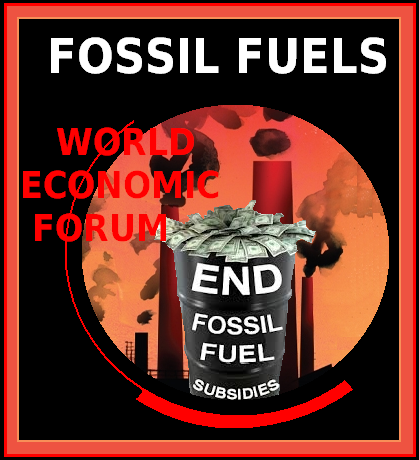
Curbing Fossil Fuels - Carbon Pricing and an End to Subsidies (WEF Summaries)

Carbon pricing and fossil fuel subsidies were popular topics at the World Economic Forum (WEF) in Davos, Switzerland. The comments made by economists, business leaders and climate experts signal a global readiness to price carbon and remove oil subsidies.

Investors and business leaders need and want regulatory certainty. Regulations on fossil fuels are coming the only question is when. Climate economist Lord Nicholas Stern was among those who argued that we need to see carbon taxes and eliminate oil subsidies.

If we are to get serious about tackling climate change we will need to curb fossil fuel use. One of the best ways to do so is through carbon pricing schemes. Rowan Douglas, CEO Capital, Science & Policy Practice and Chairman, Willis Research Network, said, "Carbon pricing is a very important tool in the armory. I think it is difficult to see the world achieving its targets without some sort of pricing mechanism for this critical pollutant."


Stern said, "Those of us who think that market economies work well, are also those who think when we see a major failure like this that the right thing to do to get the markets to work well is to correct it. And there’s a very simple correction: it’s carbon pricing. It can raise revenues for all the important things we have to do, like enhancing the life of poor people, [and] investing in innovation, health and education." He also said, "If you want to put a carbon tax on, now is absolutely the right moment."

Rachel Kyte, World Bank Group, Vice President and Special Envoy for Climate Change said, ‘We want carbon pricing. If you price carbon, we will be able to reduce emissions,’ then that will be a powerful message." World Bank President Jim Yong Kim urged governments around the world to agree on a pricing system for climate-changing CO2 emissions.

We are seeing momentum build for some form of carbon pricing scheme. Kim noted there had been progress over the last 12 months, including the UN general assembly’s commitment to set a carbon price. The head of Unilever, Paul Polman explained that businesses are also getting on-board, "50 of the top-200 companies now have an internal price for carbon. In New York, we had 1,000 businesses who signed a statement calling for a price on carbon."

In the US the Republican controlled congress stands in the way of carbon pricing. As Al Gore said in Davos, "We need to put a price on carbon and we need to put a price on denial in politics."

In addition to carbon pricing we also need to eradicate fossil fuel subsidies. Richard Branson, founder of the Virgin group said, "We have to make sure there are no more coal-fired power stations built anywhere in the world from today onwards. And we’ve got to get rid of all fossil fuel subsidies.”

Nobel Economics Prize laureate Michael Spence talked about progress being made removing oil subsidies in the developing world. "Fortunately, they [oil subsidies] are in the process of disappearing. Energy subsidies are a catastrophic policy. They produce a distorted development of the economy and all kinds of bad things."

Related
WEF Summaries: Climate Change
Towards a Global Climate Agreement at COP21 (WEF Summaries)
Business Leadership on Climate Change (WEF Summaries)
The Value of Investing in Climate Mitigation (WEF Summaries)
Global Economies Feeling the Heat from Climate Change (WEF Summaries)
Collaboration and Cooperation are Imperitive (WEF Summaries)
What is The World Economic Forum (WEF)
Risks Associated with Environment, Climate, Water Crisis and Extreme Weather in the WEF Report

The Value of Investing in Climate Mitigation (WEF Summaries)

One of the salient themes that emerged at the 2015 edition of the World Economic Forum (WEF) is that investors are very interested in climate action. There have been a number of important developments during the course of the WEF but few are more important than the emerging trend of integrating climate risks into financial assessments. The risks and the opportunities  posed by climate change are bottom line issues.

Low carbon energy investments are providing considerable returns. According to Bloomberg New Energy Finance, clean energy investment increased by 16 percent in 2014. The We Mean Business Coalition reports that companies are achieving 20+ percent internal rates of return on their own clean energy projects.

United Nations Secretary General Ban Ki-Moon noted that investing in climate protection could make a significant impact.

"Infrastructure and sustainability are treated as separate issues. We see this at the meetings of the G20, at other international gatherings, and even here at the World Economic Forum. We need to address this troubling disconnect," Ban said.

According to Paul Polman, Chief Executive of Anglo-Dutch food company Unilever, the size of global infrastructure investment will reach $90 trillion over the next 15 years.

"That needs to be done anyway. Do it in the right way, and you can solve your climate change issues and stimulate economic growth," he said.

Related
WEF Summaries: Climate Change
Towards a Global Climate Agreement at COP21 (WEF Summaries)
Business Leadership on Climate Change (WEF Summaries)
Curbing Fossil Fuels - Carbon Pricing and an End to Subsidies (WEF Summaries)
Global Economies Feeling the Heat from Climate Change (WEF Summaries)
Collaboration and Cooperation are Imperitive (WEF Summaries)
What is The World Economic Forum (WEF)
Risks Associated with Environment, Climate, Water Crisis and Extreme Weather in the WEF Report

Global Economies Feeling the Heat from Climate Change (WEF Summaries)

Economic assessments of climate risks and the potential returns from mitigation and adaptation emerged as salient themes at the World Economic Forum (WEF) in Davos, Switzerland.

A number of speakers made the point that it is important to calculate the massive risks associated with climate change. We are already seeing that climate change is systemically disrupting the global economy and the situation is destined to get far worse if we do not significantly reduce global carbon emissions.

As explained by several economists, we do not have to make the false choice between combating climate change and growth. We can both grow our economy and act on climate change.

The climate economist Lord Nicholas Stern, delivered a powerful presentation at Davos. His speech was rendered in a language that the business community and investors can understand. Stern makes the point that addressing climate change affords room for "better" growth. He explained the hidden cost of burning fossil fuels and extolled the virtues of renewable energy.

Although the price of oil is currently very low, we have seen tremendous volatility in the market valuation of fossil fuels. Against the backdrop of this volatility the cost of renewables has been steadily decreasing.

"Very serious economic analyses have shown that we have alternative energy sources and that at a relatively modest cost – about 1 or 2% of global GDP – we could take measures to decrease the risk [of climate change] very significantly," said Nobel Prize winning Professor Mario J. Molina at the WEF.

The economics of climate change mitigation is not only about decreasing the risks it is also about generating a very major for each dollar invested. As Jim Yong Kim pointed out, in the next decade, the potential return on aggressive investments inefficiency and clean transport alone could amount to US$ 1.8 - 2.6 trillion.

Related
WEF Summaries: Climate Change
Towards a Global Climate Agreement at COP21 (WEF Summaries)
Business Leadership on Climate Change (WEF Summaries)
Curbing Fossil Fuels - Carbon Pricing and an End to Subsidies (WEF Summaries)
The Value of Investing in Climate Mitigation (WEF Summaries)
Collaboration and Cooperation are Imperitive (WEF Summaries)
What is The World Economic Forum (WEF)
Risks Associated with Environment, Climate, Water Crisis and Extreme Weather in the WEF Report